On the evening of March 22, 1945, General Dwight D. Eisenhower was finishing a late dinner at Supreme Headquarters in Reims, France, when a clerk placed a single sheet of paper beside his coffee. Eisenhower read it, set down his fork, and looked at his Chief of Staff, Walter Bedell Smith. He spoke four words: “Patton crossed last night.
” The room fell silent. Every officer at that table understood the meaning instantly. The most carefully planned river assault in modern military history, Field Marshal Bernard Montgomery’s Operation Plunder, with its 3,000 artillery guns, 30,000 engineers, and a full airborne drop, had just been beaten to the Rhine by a single American general who had not asked permission and who had used wooden assault boats. The Rhine was the last great natural barrier protecting the heart of Germany.
For nearly two thousand years, invading armies had broken against it, and Hitler had promised the German people that no enemy soldier would ever cross it. By March 1945, the Allies agreed that breaking it would require the largest river crossing operation since the Roman Empire. That operation had a name: Operation Plunder. It belonged to Montgomery.
For weeks he had been building up forces near Wesel in the north, assembling thirty British, Canadian, and American divisions, vast stockpiles of bridging equipment, amphibious vehicles, and an entire airborne corps ready to drop behind enemy lines. Montgomery had set the crossing date himself, March 23, and his plan was slow, deliberate, and overwhelming. Down south, Patton’s Third Army had spent two weeks doing something that puzzled headquarters. They were collecting boats.
Small wooden assault craft, outboard motors, and pontoon sections were being stockpiled along a quiet stretch of the Rhine near the small German town of Oppenheim. Bradley knew what was happening. Eisenhower suspected. Montgomery had no idea.
To Patton, the war was not a parade but a race, and he was determined to win it. On the afternoon of March 22, Patton drove to the riverbank himself. The Rhine at Oppenheim was about a thousand feet across, cold, fast, and dark. According to the diary of one of his aides, he stood there with his pearl-handled revolvers and said quietly, “We’re going tonight.
” There would be no artillery preparation, no airborne drop, no bombing run. Just men, boats, and surprise. At 10:00 that night, the lead companies of the 11th Infantry Regiment, part of the famous 5th Infantry Division known as the Red Diamond, slid into the water. Most of the men paddled across by hand, though some boats had small outboard motors.
The Germans on the far bank were asleep. No searchlights. No flares. Nothing.
By midnight, six battalions were across. By dawn, the entire 5th Division was on the eastern shore, with elements of two more divisions following. Engineers were already laying a pontoon bridge. By the end of the next day, five divisions of Patton’s Third Army stood on German soil east of the Rhine, a full twenty-four hours before Montgomery had even fired the opening shot of Operation Plunder.
The cost of crossing the river that had stopped invasions for two millennia was twenty-eight casualties. The next morning, Patton called General Omar Bradley, his immediate superior at the 12th Army Group. According to Bradley’s memoir, the conversation went like this. “Brad,” Patton said, “don’t tell anyone, but I am across.
” Bradley wasn’t sure he had heard correctly. Across what? The Rhine, Patton said. He had a division over and elements of another, enough to hold against anything the Germans could throw.
Bradley sat down slowly. “Well, I’ll be damned, George. Are you serious? ” Patton told him he was, that he had sneaked a division over the night before, and that there were so few Germans in the area they didn’t know yet.
He asked Bradley to keep it secret for a while. Bradley later wrote that he was stunned. Not angry. Stunned.
The entire Allied plan called for Montgomery to make the first crossing, in the north, with the world’s press watching. Instead, an American general had quietly slipped across with five divisions and a couple of wooden boats. By the afternoon of March 23, Patton called Bradley again, this time with a different tone. According to multiple staff officers present, Patton was almost shouting through the line.
“Brad, for God’s sake, tell the world we’re across. I want the world to know Third Army made it before Monty starts. ” Those last words gave it away. While Patton was already pushing inland toward Frankfurt, Montgomery, far to the north, had not yet begun.
Operation Plunder, the largest river assault in the history of warfare, was still hours away from its opening barrage. The man who had spent months preparing the greatest river crossing of the war was about to learn that an American with a handful of fishing boats had beaten him to it. Then Patton did one more thing, something so theatrical that it would be talked about in officers’ clubs for the next fifty years. He walked out onto the pontoon bridge his engineers had just finished across the Rhine.
He stopped in the middle. He looked down at the dark water. According to the official Third Army diary and confirmed by multiple eyewitnesses, including his aide Colonel Charles Codman, Patton unbuttoned his trousers and relieved himself directly into the river. He turned to the men around him and said, “I have been looking forward to this for a long time.
” Then he picked up a handful of German soil from the eastern bank, the same gesture William the Conqueror was said to have made on the beaches of England in 1066, and held it up for the photographers. In London, the news landed inside the British War Cabinet rooms like a thunderclap. Neither Montgomery nor Prime Minister Winston Churchill had been informed in advance. The first they heard of it was when American newspapers ran headlines reading, “Patton across the Rhine,” followed by photographs of the pontoon bridge, grinning American soldiers on the east bank, and the triumphant general on the riverbank.
According to the diary of Lord Alan Brooke, Chief of the Imperial General Staff, Montgomery was furious. He saw what Patton had done as reckless gambling with soldiers’ lives, not brilliance. He sent a sharply worded protest up the chain, demanding that Patton be reprimanded. Some accounts say he wanted Patton relieved entirely.
He wanted the official Allied narrative to remain centered on Operation Plunder, the careful, planned, British-led crossing in the north, not on a cowboy American general urinating into the Rhine. The protest reached Churchill himself. The Prime Minister read it carefully, set it down, lit a cigar, and said, “My dear Field Marshal, the Americans have crossed the Rhine on the run. On the run with boats meant for fishing villages.
I should think we are far past the point of discussing whether General Patton has been a good boy. ” He paused, then added the line that would echo for the rest of the war: “In war, you do not punish the man who wins. You learn from him. ”
Montgomery received no support from London.
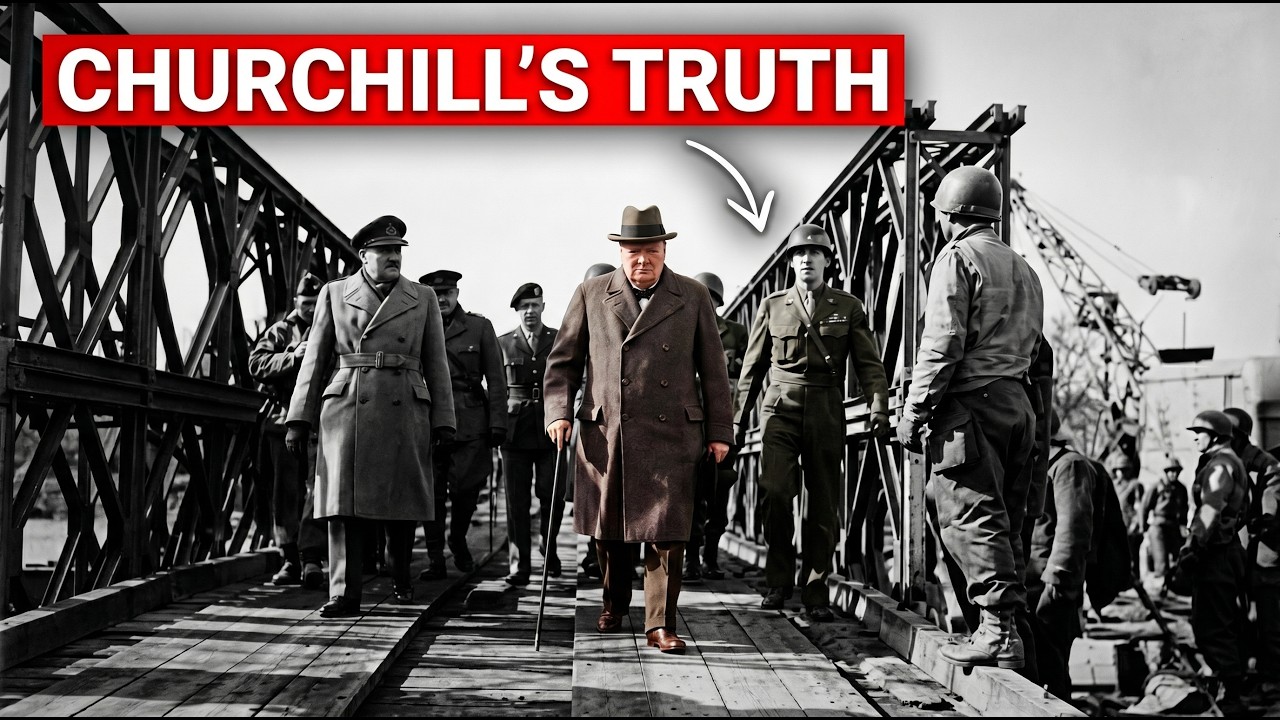
Patton received no reprimand. Within seventy-two hours, Operation Plunder finally began in the north, but the headlines of the world had already been written. The Rhine had been crossed, and it had been crossed by Patton. Two days later, Churchill flew to the Rhine to see Montgomery’s crossing in person.
Standing on the eastern bank, he reportedly said, “My dear general, the German war is finished. ” Before that, on his transport plane, Churchill had already called Patton, according to the notes of his private secretary John Colville, “a most remarkable example of dash and initiative. ” Coming from Churchill, who rarely praised American generals over British ones, this meant almost everything. By the end of March 1945, Patton’s Third Army had pushed more than a hundred miles east of the Rhine.
By April, they were sweeping across central Germany at a pace no army in modern history had sustained. Five divisions had crossed in that first night and the following day. Twenty-eight Americans died making the crossing. Operation Plunder, the great planned crossing in the north, suffered thousands of casualties for less ground gained in the same period.
The Rhine, the barrier that had stopped Caesar and Napoleon, was crossed with assault boats meant for moving fishermen between riverside villages. No airdrop. No artillery barrage. No press.
Just men, water, and an idea. Asked later in his unpublished diaries what he had been thinking that night, Patton wrote one short line: “I wanted to be first. We were. ”
Three weeks after the crossing, on April 12, 1945, President Franklin Roosevelt died in Warm Springs, Georgia.
Less than a month later, on May 7, Germany surrendered. The war Patton had been racing to win was over. He had won his race, but he would not live long enough to enjoy it. On December 9, 1945, General George S.
Patton was injured in a road accident in occupied Germany. He died twelve days later. He was sixty years old. Churchill, looking back on the war in his memoirs, wrote that the Allied victory had been built on three pillars: British endurance, American industry, and, in his exact words, “the audacity of a few commanders who refused to wait.
” He never named Patton in that sentence. He did not have to. Four words spoken in Reims that quiet evening, “Patton crossed last night,” became the unofficial epitaph for the most controversial commander in American military history.