The Battle of the Little Bighorn, fought on June 25 and 26, 1876, ended with the destruction of Lieutenant Colonel George Armstrong Custer’s battalion and the death of Custer himself. Yet the exact circumstances of that death—where he fell, when, and by whose hand—remain one of the most contested questions in American military history. The battle unfolded in chaos, with dust, gun smoke, and the desperate movement of hundreds of men obscuring nearly everything. In the decades that followed, warriors, scouts, officers, and relatives offered conflicting accounts, each shaped by memory, loyalty, and the fog of combat.
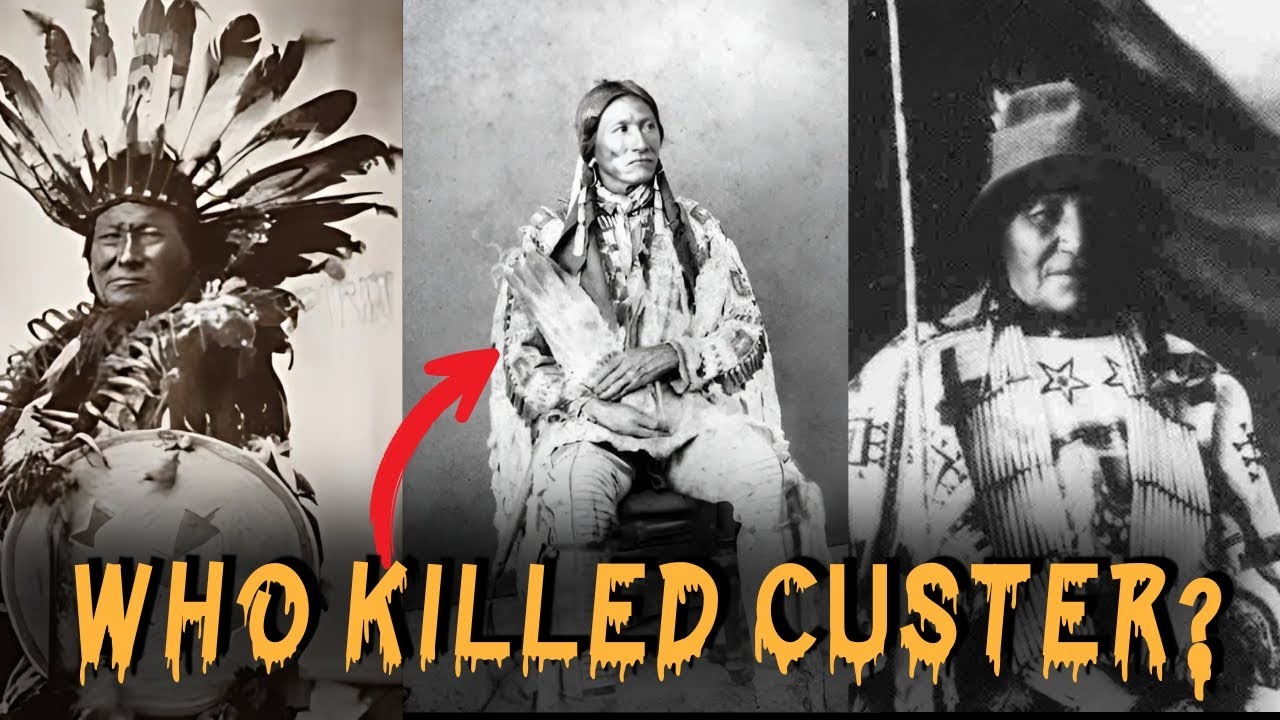
No single version has ever fully satisfied the record, and the mystery has only deepened with time. One leading theory holds that Custer was wounded or killed early in the engagement, a development that would have reshaped the entire trajectory of his regiment’s doomed attack. According to this account, Custer led several companies down Medicine Tail Coulee in a bold attempt to cross the Little Bighorn River and strike the Native American village directly. As the story goes, Custer, dressed in his distinctive buckskin outfit, was hit by a bullet while crossing the river, possibly in the torso.
His men reportedly fell back, supporting their faltering commander on his horse as they retreated. A Cheyenne warrior named White Cow Bull later claimed he fired the shot that brought down a buckskin-clad soldier, leading some to speculate that Custer was his target. But no other warrior at the crossing confirmed the claim, and doubt has lingered over its accuracy. The only supporting testimony came from two of Custer’s Crow scouts, White Man Runs Him and Goes Ahead, neither of whom was present at the crossing.
They passed along secondhand accounts of the event. Goes Ahead’s wife, Pretty Shield, later recalled her husband’s assertion that Custer was shot in the river and was intoxicated at the time. Historians have rejected the intoxication claim as highly improbable, given Custer’s well-documented abstinence from alcohol and the lack of primary evidence to support it. Scholars have also challenged the notion that an early wound at Medicine Tail Coulee triggered the retreat.
They argue instead that Custer abandoned the crossing after realizing his strategic mistake. The ford sat at the center of the vast Native American encampment, not at its northern edge as he had believed. The village stretched for more than three miles and sheltered thousands of Lakota, Cheyenne, and Arapaho people, along with a formidable force of warriors estimated at between 1,500 and 2,500. Charging into that concentration of strength would have been suicidal.
Crow scout Curley, who survived the battle, reported seeing Custer in good health after the supposed shooting, riding north in search of another ford. That testimony suggests Custer remained active and unharmed well into the fight, seriously weakening the early-death hypothesis. Other theories have proposed a range of possible killers, including the unsettling possibility that Custer took his own life. When his body was found on Last Stand Hill, it bore two wounds: a bullet to the left chest, almost certainly fatal, and another to the left temple.
That temple wound fueled speculation about suicide. Custer was right-handed, and shooting himself in the left temple would have been awkward and difficult. Some have suggested an assisted suicide, in which a devoted subordinate delivered the final shot to spare Custer the agony of capture and torture, a fate he reportedly feared. While conceivable in the desperate final moments of the battle, the theory rests on no concrete evidence and remains pure conjecture.
Native American oral traditions offer a rich and varied set of claims, each adding another layer to the mystery. Red Horse, a Miniconjou Lakota warrior, declared that he killed Custer. Flat Hip, a Hunkpapa Lakota, made the same claim. Walks Under the Ground, a Santee warrior, later came to possess Custer’s horse, which implied he had slain its rider.
Little Knife, another Hunkpapa, said a warrior named Brown Back killed Custer to avenge his brother’s death. Two sons of the Santee chief Scarlet Top asserted that they jointly brought Custer down. Perhaps the most compelling account comes from Cheyenne oral tradition, preserved continuously since 1876. It attributes a direct role in Custer’s death to Buffalo Calf Road Woman, a renowned female warrior.
Some versions depict her knocking Custer from his horse with a club and taking his saber, while others suggest she struck a fatal blow. Her presence at the battle is documented, and she became famous for saving her brother during the fighting. That established record gives her claimed involvement a degree of plausibility, though definitive evidence remains absent. In 1905, a Hunkpapa warrior named Rain in the Face offered a deathbed confession, claiming he killed Custer himself.
He said he fired from such close range that the gunpowder scorched Custer’s face. The account was vivid and dramatic, but it was weakened by Rain in the Face’s earlier denials and by the absence of corroboration from other warriors who had fought alongside him. Sitting Bull, the respected Hunkpapa leader, offered a far more grounded perspective. He said no one knew who killed Custer, and that Custer’s presence was not even noticed until days after the battle.
In the frantic chaos, with warriors and soldiers nearly indistinguishable amid the swirling dust and gunfire, precise identification was impossible. The battle itself made the answer unknowable. The enigma of Custer’s death is amplified by the broader context of the engagement. Custer commanded roughly 600 men and badly underestimated the strength and resolve of the Native American coalition arrayed against him.
He chose to split his forces and attack without adequate scouting, a decision that proved catastrophic. His battalion was surrounded on Last Stand Hill and annihilated to the last man. Archaeological work at the site has recovered bullet casings and bone fragments that confirm the ferocity of the combat, but the physical evidence offers no insight into Custer’s final moments. In the end, the question of who killed Custer may never be resolved.
The conflicting narratives, shaped by memory, cultural perspective, and the fog of war, mirror the complexity of the battle itself and the enduring fascination with its central figure. Custer, a flamboyant and polarizing commander, became a symbol of both valiant resistance and reckless ambition. His death, like the battle that claimed him, remains a tapestry of truths, half-truths, and legends, forever woven into the mythic fabric of the American frontier.