In the summer of 1777, the British Empire launched what it believed would be the decisive blow against the American rebellion. Three separate armies would march on New York, meet at Albany, and split the colonies in half, isolating New England from the rest and collapsing the entire uprising. That was the theory, at least. The plan came from General John Burgoyne himself, a professional officer and member of Parliament who had spent the winter of 1776 in London convincing the Secretary of State for the Colonies, Lord George Germain, to give him command of a major offensive.
Burgoyne called his proposal “Thoughts for Conducting the War from Canada,” calling for a coordinated attack on New York from three directions. Burgoyne would lead the main force of about 7,500 men south from Canada through Lake Champlain and the Hudson Valley. General William Howe would advance north from New York City up the Hudson River. The third column, under Lieutenant Colonel Barry St.
Leger, would move east from Lake Ontario through the Mohawk Valley with a mix of British regulars and Native allies, eliminating any resistance along the way. All three would converge on Albany. The rebellion would end by autumn. Germain approved the plan, but he also, disastrously, approved a separate plan from Howe to attack Philadelphia.
Historians still argue over whether Germain truly believed the two campaigns could happen simultaneously or whether he simply failed to notice the contradiction. In either case, no one told Burgoyne that Howe might not come. That was in June 1777. By October, Burgoyne had surrendered his entire army.
One of the biggest reasons for that was a dilapidated wooden fort in the middle of the New York wilderness that the British never expected to be a problem: Fort Stanwix. In 1758, during the French and Indian War, the British built a fort here under the direction of General John Stanwix. The location mattered because it sat atop the Oneida Carrying Place, a waterway connecting the Mohawk River to Wood Creek, which flows into Oneida Lake and then Lake Ontario. If you wanted to move troops or supplies between the Atlantic coast and the Great Lakes, you had to pass through here.
The British built Fort Stanwix to control that route. It was a true star fort, built of earth and timber, designed to hold a garrison and project influence across the frontier. The problem was that the French were already losing the war by the time the fort was completed. By 1761, the garrison was down to about 50 men.
By 1765, the British army withdrew entirely. And by 1768, after the fort hosted its final treaty conference with the Iroquois, it was abandoned and left to rot. For nearly a decade, no one cared about Fort Stanwix. The wooden walls became waterlogged.
The earthen works eroded. The palisade stakes rotted and collapsed. Animals wandered through the barracks. The roofs caved in.
By the time the American Revolution broke out in 1775, the fort was a ruin, just piles of decayed timber and accumulated earth in the middle of the forest. Here the story turns, because the Oneida, whose traditional lands surrounded the fort, began urging the Americans to reoccupy it. The Oneida understood something the Continental Congress was slow to grasp. Whoever controlled that water crossing controlled access to the entire Mohawk Valley.
And whoever controlled the Mohawk Valley had a direct road to Albany. In July 1776, the 3rd New Jersey Regiment under Colonel Elias Dayton became the first American force to guard the old fort. They renamed it Fort Schuyler after General Philip Schuyler, who oversaw American forces in the northern theater, and they began trying to rebuild it. “Trying” is the accurate word.
The defenses had deteriorated sharply. Decades of neglect had left the fort in a condition that would have made most officers abandon it entirely. The troops had to replace rotten timber, rebuild old structures, and construct new ones using freshly cut logs. They replaced almost all the vertical palisade stakes around most of the fort, pulling up the twisted, decayed pickets and driving new ones into the ground.
They filled in the areas where rain had washed away the earthen walls and added thick layers of sod to the slopes so the walls could absorb artillery fire instead of crumbling under it. They built wooden bunks in the barracks and brick chimneys in every room, with pipes running through the earthen roofs. Even the engineering oversight was poor. There was no professional military engineer on site during the entire project, and the soldiers doing the building were mostly farmers and craftsmen who had never constructed fortifications in their lives.
They learned on the job. Raiding parties from nearby hostile tribes added another layer of danger. The work crews had to post guards along the perimeter while they worked, meaning fewer hands for actual construction. Every tree they cut for timber was felled while watching the forest for movement.
By the spring of 1777, the 3rd New York Regiment under Colonel Peter Gansevoort arrived to take over and continue the repairs. Gansevoort was 28 years old and came from one of the most prominent Dutch families in Albany. His ancestors had been in the region since 1660, when it was still a Dutch colony called Fort Orange. He was young, but he had already proven himself during the disastrous American invasion of Canada in 1775 and 1776.
Schuyler sent him to Fort Stanwix because the task required someone with energy, confidence, and a willingness to take a post most officers considered a dead end. Gansevoort and his men arrived in May and got to work. Warnings from Oneida scouts that the British were planning a campaign into the Mohawk Valley arrived by mid-July, and the pace of repairs quickened. Gansevoort reported to Schuyler that supplies and ammunition had reached dangerously low levels.
Schuyler ordered more supplies sent on July 8. Reinforcements from Massachusetts were dispatched to support the garrison. By the time the British appeared, Gansevoort had about 750 Continentals inside those rebuilt walls. Here, British planning met American reality.
The confrontation was not what London had expected. St. Leger’s expedition had left Montreal on June 23 with a mixed force of about 750 British regulars, Hessians from the Hanau regiment, Loyalist militia, and Canadian rangers. They traveled west along the St.
Lawrence River, crossed Lake Ontario, and reached Oswego on the lake’s southern shore in mid-July. There, the Mohawk war leader Joseph Brant joined St. Leger with about 800 Native warriors from several tribes, primarily Mohawk and Seneca, along with smaller groups from other nations. St.
Leger’s total force numbered roughly 1,700 to 2,000 men. His intelligence told him the fort was in bad condition and the garrison small. Local Loyalists reported the place was barely holding together and could be taken without serious fighting. St.
Leger’s entire role in Burgoyne’s plan was to act as a fast-moving diversion, sweeping through the Mohawk Valley, gathering Loyalist support along the way, and arriving at Albany in time to unite with the main army. He expected to storm the place, demand surrender, and continue eastward almost without stopping. He sent part of his force ahead toward the fort, but to slow them down, the Americans felled large trees across the road and blocked the waterways with debris. Gansevoort’s men spent days cutting trees and throwing them across every path and stream between the fort and the western approaches.
The advance that should have taken days turned into weeks. St. Leger reached Fort Stanwix on August 2, 1777, and the first thing he saw was not the crumbling ruins his intelligence had promised. The walls had been rebuilt, the earthen works reinforced, and the garrison armed and waiting.
You might think someone would have briefed him on the update. No one did. St. Leger demanded surrender anyway.
The terms were straightforward. Surrender the fort and the garrison would march out with full military honors. If you refuse, St. Leger warned, he would not be responsible for what his Native allies would do when the fort inevitably fell.
Gansevoort’s reply was blunt and brief. He told St. Leger the fort would be defended to the last man. There would be no surrender.
And so the siege began. British artillery started bombarding the fort, but the guns St. Leger brought were far too light to do real damage to the earthen fortifications. He had mortars and small cannons, not the heavy siege guns needed to penetrate reinforced earth and timber from a distance.
Night after night, shells flew over the walls and exploded inside the compound. The bombardment was relentless, but the sod-covered slopes Gansevoort’s men had spent months building absorbed most of the impact. The shelling kept the garrison on edge, kept them from sleeping, forced them to take cover, but it never breached the walls. St.
Leger also tried to cut off the fort’s water supply by diverting the stream the garrison depended on. He was betting on exhaustion, on thirst, on the grinding arithmetic of siege warfare. The garrison held. Inside the fort, something remarkable happened on August 3.
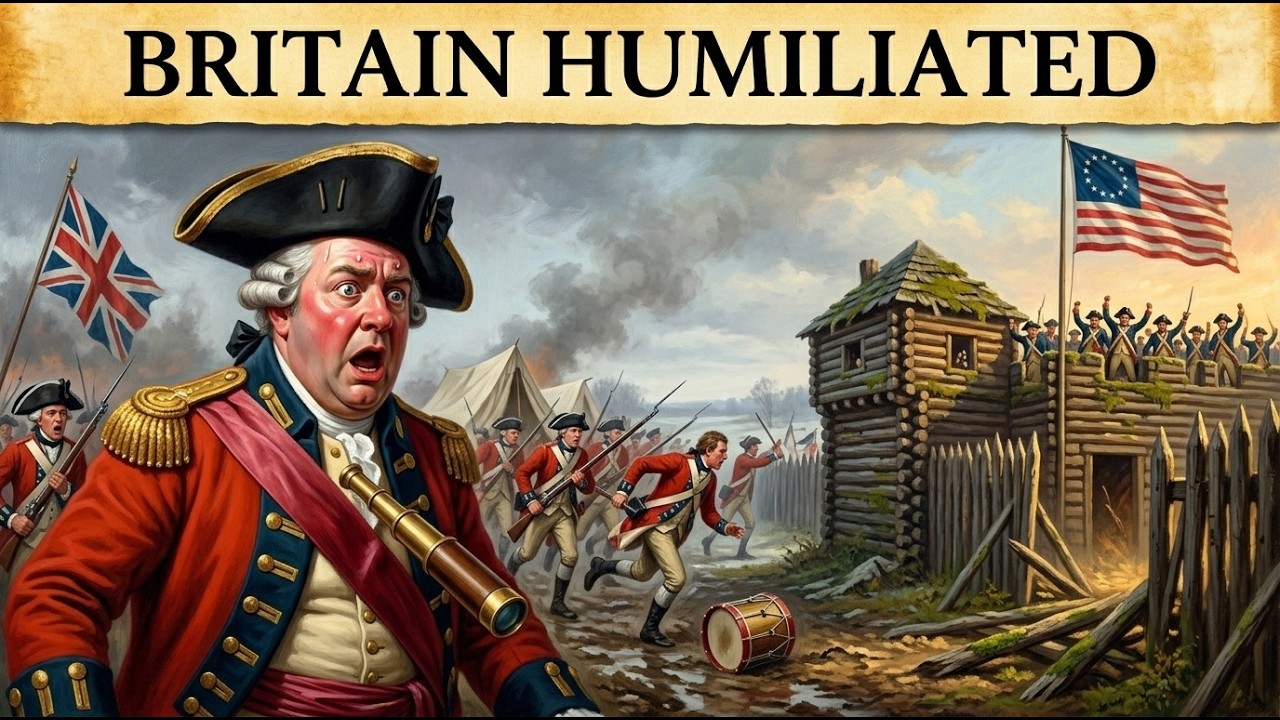
The Massachusetts reinforcements, which had arrived earlier, brought news that the Continental Congress had officially adopted a new national flag in June. Thirteen stripes, alternating red and white. Thirteen white stars on a blue field. The garrison did not have one, so they made one themselves.
Soldiers cut up their white shirts for the stripes. Red flannel was taken from the petticoats of officers’ wives. Blue fabric was cut from Captain Abraham Swartwout’s coat. According to local tradition, this handmade flag was raised over the fort and flew under enemy fire, making it one of the first times the Stars and Stripes was raised in battle.
Whether the flag actually had stars or was simply a striped banner remains debated among historians. Either way, it flew, and the garrison fought beneath it. While the British bombarded the fort, word spread through the Mohawk Valley that the post was under siege. About 80 miles downstream, militia Brigadier General Nicholas Herkimer gathered roughly 800 men and boys from the valley’s farms and settlements.
They were not professional soldiers. They were farmers, craftsmen, fathers, and sons. Many were German immigrants who had settled in the region. Herkimer organized them into the Tryon County militia and marched west to lift the siege.
St. Leger’s scouts spotted Herkimer’s approach. Instead of waiting for the relief column to reach the fort, St. Leger sent a force under Sir John Johnson and Joseph Brant to intercept them.
They set an ambush about six miles east of the fort in a heavily wooded ravine near the village of Oriskany, where the road crossed a swampy creek. On the morning of August 6, Herkimer’s column marched straight into the trap. The ambush was set in a swampy ravine where the path crossed a small stream surrounded by thick brush on both sides. Johnson’s Loyalists cut off the front, while Brant’s warriors waited on the flanks.
The first volley tore through the front ranks. Colonel Ebenezer Cox, commander of the first regiment, was killed almost immediately. The rear of the column, caught in the open, scattered and fled. Herkimer himself was hit by a musket ball in the leg in the opening moments, shattering the bone.
His men carried him to a beech tree, propped him against its trunk, and suggested he retreat to the rear. Herkimer refused. He lit his pipe, sat calmly with his shattered leg beneath him, and continued directing his men for the next five hours. What followed was among the most brutal battles of the entire Revolution.
By some estimates, American casualties reached half of the entire relief force. This was not a battle between disciplined armies trading volleys in an open field. It was close-quarters fighting in dense forest, in a ravine with nowhere for the smoke to go, where screams echoed between the trees. Neighbor against neighbor.
Loyalists against Patriots who had shared fence lines and church pews just a year earlier. Mohawk warriors against the Oneida, who were allied with the Americans. The Iroquois Confederacy itself was tearing apart in that ravine. The fighting devolved into musket butts, knives, tomahawks, and bare hands.
A thunderstorm swept through around 11 a. m. and halted the fighting for about an hour while both sides struggled to keep their powder dry. At one point, the militiamen heard what they thought was artillery fire from the fort, a signal that a relief party was approaching.
It was just thunder. When the rain stopped, the fighting resumed with the same ferocity. During the lull, Herkimer’s messengers finally reached Fort Stanwix. Here is the detail that completely unraveled the siege, though it did not seem so at the time.
Lieutenant Colonel Marinus Willett organized a sortie of 250 men from the fort. While the British and their Native allies were busy at the ambush site six miles away, Willett’s men rushed out the gates and raided the nearly empty British and Native camps. They looted tents, wagons, personal property, weapons, and supplies, everything they could carry. When word reached the warriors at Oriskany that their camps had been plundered and their possessions stolen, many of them stopped fighting immediately and headed back.
The timing of that raid was devastating to St. Leger’s alliance. The warriors had been promised an easy victory and abundant plunder. Instead, they fought a five-hour bloodbath against men who refused to flee.
And when they struggled back to camp, they discovered their possessions had been carried inside the American walls. Morale collapsed. Over the following days, hundreds of Native warriors simply left. The Battle of Oriskany ended in a tactical draw.
Herkimer’s exhausted militia retreated to Fort Dayton. Herkimer himself was carried on a stretcher. His leg was amputated 10 days later, and the surgery failed. He bled to death on August 16 while reading his Bible.
He never knew what his sacrifice had set in motion. Back at the fort, the siege continued, but St. Leger’s position weakened day by day. His artillery could not breach the walls.
His Native allies were deserting. His supply lines were stretched to the breaking point. Then he made things worse by attempting deception. He sent a message to Gansevoort claiming that Herkimer’s relief force had been completely destroyed and that no help was coming.
Surrender now or face the consequences. Gansevoort did not believe him. He refused again. Meanwhile, Willett and another officer, Lieutenant Stockwell, slipped out of the fort under cover of darkness and made an extraordinary 50-mile journey through enemy-controlled wilderness to reach Fort Dayton and then Albany.
They carried a request for reinforcements directly to General Schuyler. Schuyler held a council of war on August 12. Most of his officers opposed sending more troops west. Burgoyne’s main army was advancing from the north, and pulling any soldiers from that fight weakened the defense of the Hudson Valley.
Schuyler insisted Fort Stanwix had to be relieved. If St. Leger broke through, Burgoyne would get the reinforcements he needed and the entire northern campaign would collapse. Benedict Arnold stepped forward and volunteered to lead the relief mission.
Yes, that Benedict Arnold. In August 1777, Arnold was one of the most capable and respected officers in the Continental Army. He had fought brilliantly at Quebec and Lake Champlain and had a reputation for boldness bordering on recklessness. Schuyler gave him about 700 men and sent him west.
Arnold reached Fort Dayton by August 20. He tried to recruit more local militia, but the valley was still in shock after Oriskany. Only about 100 men joined him. He waited for reinforcements that never came and for Oneida and Tuscarora warriors to join the effort.
Then reports arrived that the siege had reached a critical stage. St. Leger had finally realized his artillery was useless in the long run and had begun digging approach trenches toward the fort’s bastions. Gansevoort reported that the enemy trenches had come within close range of one of the fort’s main defenses.
Arnold had to move, but he had fewer than 1,000 men against St. Leger’s remaining forces. A direct assault was a gamble he could not afford to lose. So he turned to deception.
Among the Loyalists captured at Fort Dayton was a man named Hon Yost Schuyler. He was a nephew of General Herkimer and a man well known among the Mohawk and other Native peoples of the region, partly because many of them considered him blessed by the spirits, a person whose words carried strange authority. Arnold offered Hon Yost a deal. Go to the Native camps around Fort Stanwix and spread the story that a massive American army was marching toward them.
Convince them, and you will live. Fail, and Arnold would order you hanged. To ensure Hon Yost did not simply vanish into the forest, Arnold held his brother hostage. Hon Yost agreed.
Arnold had his men puncture Hon Yost’s coat with several bullet holes to make it look like he had just miraculously survived a battle, then sent him ahead of the army’s vanguard with several Oneida messengers who would arrive separately to confirm the story from different directions. Hon Yost rushed into the British camp and the Native encampments around Fort Stanwix, breathless and terrified, telling his story. A huge American army was coming. Thousands upon thousands of soldiers, far more than St.
Leger could handle. The warriors asked him how many. Hon Yost pointed to the leaves. That many.
He had grown up among the Mohawk, and many of them regarded him as having a kind of spiritual insight. His words carried weight that strangers could not match. Then the Oneida messengers Arnold had sent arrived at the camp from different directions, each telling the same story. The Americans were coming, 3,000 soldiers strong.
The effect was immediate and total. The remaining Native warriors panicked, already worn down by the bloodbath at Oriskany, the loss of important leaders, and the humiliation of having their camps looted. They had no desire to be caught between a fortified garrison and a force four times their size. They packed up and left.
Some reports say they plundered the British camp on their way out, taking whatever they could carry from their former allies. St. Leger was finished. Without his Native allies, he had lost the bulk of his fighting strength.
He no longer had enough men to continue the siege, let alone storm the walls. On August 22, twenty days after arriving expecting an easy surrender, he ordered a full retreat. The withdrawal was so hasty and disorganized that his men left tents, supplies, artillery stores, and equipment along the way. Discipline broke down as the force scrambled back west through the same forests they had marched through so confidently three weeks earlier.
Parts of his column were harassed and robbed by the very warriors who had been his allies days before. St. Leger retreated back to Lake Ontario and finally reached Fort Ticonderoga by late September. He was far too late to help Burgoyne, who was already surrounded by then.
That was the crux of it. St. Leger’s failure at Fort Stanwix did not just mean a small fort in western New York remained in American hands. It meant the entire western wing of Burgoyne’s grand strategy simply ceased to exist.
There was no army marching from the Mohawk Valley to meet Burgoyne. There was no relief force clearing the frontier. There was only Burgoyne advancing south through increasingly hostile territory, his supply lines growing weaker with every mile, wondering where his reinforcements were. He would not get them from Howe either.
In one of the most consequential misunderstandings of the war, General Howe decided to sail south and attack Philadelphia instead of marching up the Hudson to meet Burgoyne. Germain, the British Secretary of State for the Colonies, had approved both plans without apparently noticing they contradicted each other. So Burgoyne was alone. No St.
Leger from the west, no Howe from the south, only the Continental Army growing stronger and more confident by the day, closing in around him near a place called Saratoga. In September, Burgoyne’s army clashed with American forces under General Horatio Gates at Freeman’s Farm near Saratoga. The Americans held their positions. Burgoyne tried again on October 7 at Bemis Heights, and this time the Americans launched a counterattack, led in part by the same Benedict Arnold who had deceived St.
Leger and forced him to retreat. Arnold fought like a man possessed that day and was severely wounded in the leg. But the American lines held, then advanced. Burgoyne was pushed back to his camp as his army dwindled and supplies ran out.
On October 17, 1777, General John Burgoyne surrendered his entire army of about 5,800 men to American General Horatio Gates. It was the first time in the war that a complete British army was forced to lay down its arms. The news crossed the Atlantic and stunned the courts of Europe. Within months, France formally recognized American independence and entered the war as a full military ally, committing its navy, army, and treasury to the American cause.
Spain soon followed. Suddenly, Britain was not fighting a colonial rebellion anymore. It was fighting a world war. The threat that unraveled all of this traces back to a ramshackle fort in the forests of upstate New York.
A fort the British had built, then abandoned, and considered worthless. A fort rebuilt by a 28-year-old Dutch-American colonel with the help of farmers and frontiersmen using hand tools and bricks they made themselves. A fort where soldiers sewed a flag from their shirts because they had no real one, and raised it while under bombardment. Fort Stanwix never fell.
It never surrendered. It is the only American fort from the Revolution that can make that claim. Every other major fort the Americans controlled during the war fell to the British at some point. Fort Ticonderoga fell.
Fort Washington fell. Charleston fell. But Fort Stanwix held. The great British strategy of 1777 was designed in London by men who looked at maps and drew arrows.
An arrow through Lake Champlain. An arrow through the Mohawk Valley. An arrow up the Hudson River. Three arrows converging on Albany to split the rebellion in half.
It looked perfect on paper. But on the ground, it collided with a rebuilt ruin, defended by men who had no intention of retreating. A militia ambush that became the bloodiest close-quarters battle of the war. A raiding party that destroyed an alliance by stealing blankets.
And a deceiver in a coat full of bullet holes telling stories about leaves. The fort that was supposed to be a minor obstacle on the road to Albany became the place where the British invasion strategy collapsed. Because it collapsed there, Burgoyne was left unsupported at Saratoga. Because Burgoyne surrendered at Saratoga, France entered the war.
Because France entered the war, the American Revolution ceased to be a long shot and became a fight Britain could actually lose. All because a ramshackle fort refused to die.