In the spring of 1879, Silas Vellacott died the way he had always said he wanted to go—working, out in the timber stand, when a tree came down at the wrong angle. He was fifty-three years old, and he had spent twenty-eight years on a farm cut into a narrow Appalachian hollow where the mountains pressed in so close that the sun disappeared by mid-afternoon. He left behind the farm, two hired men, and a locked iron box that his widow, Martha, found under a warped floorboard in his study three weeks after the funeral. The box contained cash, a land deed, and a notebook.
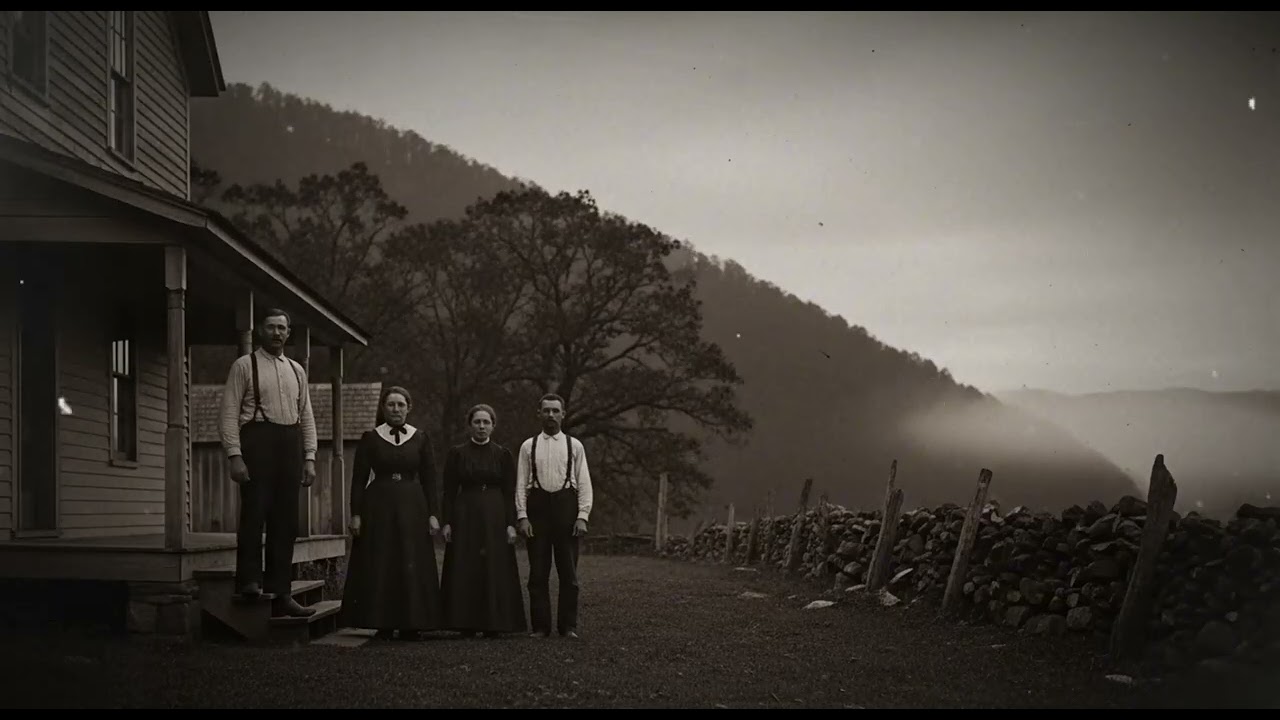
The cash and the deed she expected. The notebook she did not. It was small, meant for quick notes in the field, and the handwriting inside was cramped and hurried, as though written in short bursts. The entries were dated, the earliest from 1863, twelve years after they had arrived.
The most recent was from October 1878, six months before he died. Martha sat on the floor and read it twice. Then she put it back in the box, locked it, and said nothing to anyone for four years. What Silas had recorded was a slow accumulation of observations about the upper property, the stretch of land climbing toward the ridge where he had built a stone wall in the first year of settlement, before the house, before the barn.
He had told Martha only that the ground up there felt like it needed a line. The early notebook entries were ordinary—timber assessments, soil notes, weather. But around the mid-1860s, the character changed. Objects began appearing on the flat upper stones of the wall: stones arranged in configurations that weren’t natural, lengths of coiled material, marks carved into the mortar that he couldn’t find references for in any book he owned.
He removed each one, but only after documenting it with a precision that surprised Martha, who had never considered her husband a recording man. Later entries described sounds from the upper ridge at night, low and rhythmic, occurring on no regular schedule. He noted specifically that the pattern was not regular but not random either, and that he could not yet find it. By the late 1870s, the entries were shorter, more compressed.
One from the summer of 1877 read, “The wall is a record of what comes and tries to cross. I keep removing what it leaves. I do not know if removing is helping. ” The final entry, from October 1878, was three words: “It knows me now.
”
Arvid Brecht came to manage the farm after Silas’s death. He was thirty-four, a man of considerable practical intelligence who had spent his working life as hired help on other men’s land. He and Martha ran the place together—he the farm, she the house and finances—and they ate supper together most evenings. He was there four years before he told her that something was moving along the north wall at night.
Not an animal, he insisted. He knew animal movement. This was deliberate, slow, and it stopped at the same section of wall every time, the section nearest the old oak cluster. He had gone to look twice, found nothing.
The third time, he stood at the barn door and listened, and the silence that followed was different from the silence before, fuller somehow. That evening, Martha brought out the iron box. Arvid read the notebook twice, the same way she had. He asked how long she had known.
She told him. He asked what they were going to do about it. She said that right now they were sitting there talking about it, which was more than Silas had done. Arvid began keeping his own notebook in the winter of 1883, and he was more systematic than Silas had been.
He organized his entries around specific questions: what, when, under what conditions, what he had done in response, what changed afterward. He noted the objects on the wall, the sounds from the ridge, the patches where nothing grew despite good soil, the section of wall where the stones seemed to resettle themselves overnight, the spring-fed pool near the oak cluster that had gone still and stayed still through a season when every other water source on the property was moving. The problem was that the more carefully he recorded, the more apparent it became that what he was recording did not follow rules he had language for. He wrote in March 1884, “Every system I have worked with in my life has had a logic I could find if I looked carefully enough.
I have been looking carefully at this for four months. The logic here is not absent. It is present, but it is oriented toward something I cannot identify. And the more I try to understand the orientation, the more it seems to turn toward me.
” Below it, he added: “Yes, Silas wrote, ‘It knows me now. ‘ I understand what he meant. I did not understand it before. ”
In the spring of 1885, a surveyor named Rutherford Crane came looking for work.
He was in his late forties, recently relocated from the eastern counties after what he called a professional disagreement. He was competent with instruments and accustomed to working alone in difficult terrain. For three weeks, he said nothing about the upper property. He watched, he worked, he ate supper.
Then one evening he asked Arvid how long that section of the wall had been standing without mortar repairs, the northeast corner near the oaks. The three of them talked until the lamp oil ran low. Martha produced the iron box. Rutherford read the notebook slowly, then told them what he knew.
He had surveyed four parcels of land in the eastern counties with similar characteristics. Not identical, but the core was the same: a section of land where something had been present for a very long time. Something with orientation. Something that did things.
In three of the four cases, the families had left. In the fourth, they had stayed and found a way to manage the boundary—not eliminated, not moved, managed. That meant regular attention, physical maintenance, and the discipline not to cross the line between managing and engaging. He identified the flaw in Silas’s method.
Silas had been removing things from the wall without replacing them. When you take something off and leave nothing, there is a gap, and a gap reads as invitation. Arvid asked what it invited. Rutherford said he didn’t know what it was, but he knew what it did, and what it did when it found a gap was come further in.
They started working the wall that spring. Rutherford led the effort, resetting stones, assessing where settling had occurred and whether it was natural or something else, placing objects at intervals along the northeast section and doing specific work at the oak cluster on three mornings in early April. He explained the general purpose and not the details; Arvid wrote it down anyway, as precisely as he could. Over the following weeks, Martha noticed that the quality of the upper property began to change.
An easing. The specific reluctance she had felt for years about walking up toward the wall lifted enough to walk up toward it. The pool stayed still, but the stillness was less charged, less like something waiting beneath the surface. In the small notebook she kept for household accounts, there is a single sentence from May 1885 that has nothing to do with household accounts: “Arvid has done something and it has helped, and I think Silas would have recognized it immediately, and I wonder if he just didn’t know he needed someone to show him.
”
Rutherford stayed two seasons and left in the autumn of 1886 for legitimate work in a county to the west. He left Arvid a set of written notes—enough to maintain what had been established, enough to know what to watch for and what to do when it changed. He was careful about how much of what he knew he transferred. Arvid read those notes many times in the years that followed.
He and Marta continued the work between them. It became part of the rhythm of the farm, not discussed, just done. The wall was walked. The northeast section was checked.
The objects on the wall came less frequently. The sounds from the ridge faded until Arvid stopped noting them in the winter entries. The pool felt like rest, not like waiting. In the spring of 1891, a man named Lemuel Pace came to the valley asking questions about land use history.
He was in his early fifties, worked for no institution anyone could verify, and wrote his answers in a small leather notebook. He came to the Vellacott farm on a Tuesday afternoon and asked two questions: how long the current management of the property had been in place, and whether the north wall was original or had been rebuilt since settlement. Asked who had sent him, he said no one. He was working through a private ledger compiled in the 1860s by a surveyor in the eastern counties who had kept records of properties that shared specific characteristics.
Arvid asked if he meant Rutherford Crane. Pace looked at him steadily and asked if he had known him. Pace stayed four days. He told them there were forty-three properties on the list, and the farm was his thirty-first.
Of the thirty he had completed, eighteen had been brought to some form of management, eight were abandoned, and four had experienced what he described, with deliberate care, as uncontrolled escalation—each marked by unexplained gaps in the county records. The Vellacott property, he said, was one of the better managed cases on the list. He asked to walk the north wall. It was a clear April morning, the light low and sharp.
He walked the entire wall slowly, from west to east, and stopped at the oak cluster for a long time. He did not touch anything. Then he turned and said, “You’ve held the line remarkably well. ” Arvid said they had good instructions.
Pace said instructions only carry you so far; the rest is judgment. Back at the house, he opened his leather notebook and showed them what Rutherford had documented on a property three ranges over: the properties on the list were not independent. They were connected—not geographically, but through a common origin or quality that Pace could describe but not explain. Each property had a specific point of contact, a section where the condition was most active.
On the Vellacott farm, that was the northeast wall near the oak cluster. On others, a spring, a rock outcropping, a clearing. The management work held the boundary at the level of the individual site. But Rutherford had written in the final pages of his ledger, “I have been working on the assumption that each site is its own problem.
I’m no longer sure that assumption is correct. I think the sites know about each other, and I think some of what they know is about us. ”
Pace said he didn’t have a full picture of what this meant practically. His suspicion was that the work being done on properties like theirs mattered beyond the individual property, in a way that no one person could fully see.
Marta said, “Are you saying we’re part of something larger? ” Pace said he thought they might be. She looked at the iron box and said that Silas had built the wall before he had any reason to, in the first year, saying the ground up there felt like it needed a line. Pace said he thought some people just understood what a place needed before anyone told them.
Pace left on the fifth morning, leaving a copy of the relevant sections of Rutherford’s ledger and his own notes from the other sites. He asked Arvid to continue the documentation. The years between 1891 and 1898 were quiet. Arvid maintained the wall work on the schedule Rutherford had established, with modifications developed through his own observation.
Marta ran the house and kept brief notes in the margins of the account book. Pace returned twice, in 1893 and 1895. By the second visit, the list had grown to sixty-one properties, with seventeen additional sites that hadn’t been in the original ledger. He also mentioned three properties from the original list he could no longer account for—the families gone, the land transferred through several owners, whatever management had been in place ended, and the records of what happened afterward simply absent.
Martha Vellacott died in the autumn of 1898, at seventy-one, in the same bedroom where she had woken every morning for forty-seven years. On the last night she was fully lucid, she asked Arvid to bring the iron box. She took out Silas’s notebook and held it without opening it. She said he had known something was there before he broke the first tree, and that he had built the wall first, before the house, before the barn.
Arvid said it was the most important thing. She told him not to stop, and to make sure whoever came after him understood what they were inheriting. The farm passed to Arvid formally. He was fifty-one, in good health, and had no intention of going anywhere.
He hired a man named Cass Holloway in the spring of 1899, a quiet, practical man in his mid-thirties. Arvid did not tell him about the wall immediately. He waited a season and watched. The thing that decided it happened in late summer, when Arvid found Cass standing at the stone wall looking out at the ridge with his head slightly tilted, the way a person listens for something at the edge of hearing.
Cass said, “There’s something up there. ” Arvid said yes. Cass asked what they did about it. Arvid told him to come to the barn that night, and he would show him what he knew.
Teaching Cass took most of the winter. Not because he was slow—he absorbed practical knowledge through demonstration, watched something done once and did it correctly the second time—but because the knowledge resisted being taught quickly. By March 1900, Cass understood the wall, the northeast section, the oak cluster, the pool, the documentation practice, and the underlying reality of what they were managing. He said he used to think he was strange for noticing things other people didn’t.
Arvid said that wasn’t strange; it was necessary. Lemuel Pace returned in the autumn of 1902, older, carrying the weight of the work in the way of a man who had made peace with it. He walked the wall with Arvid and Cass and said the property was in the best condition of any on the list—not a compliment, a measurement. The list had grown to eighty-four properties.
He had brought in two other people to help with the documentation. Cass asked whether holding the line here helped hold it somewhere else. Pace was quiet for a moment. He said he believed so.
He couldn’t prove it mechanically, but over time and across the whole map, the cumulative effect of consistent management mattered. Pace appears to have stopped returning to the valley after 1902, though whether that was circumstantial or deliberate is unclear. Arvid’s notebooks continue through 1908, when they stop abruptly. The last entry, written in the late autumn, reads: “The work is not finished.
The work is never finished. I used to think that was discouraging. It isn’t. It means the work is real.
Real things don’t end because you decide they should. They continue, and they require people to continue with them. Walk the wall. Document what you find.
Don’t stop. ”
The Vellacott farm was sold in 1927. The iron box went with the household effects, passed through an estate sale in the 1940s, and one set of its contents turned up in a historical society archive in the 1980s, cataloged incorrectly as agricultural records. A researcher found it in the late 1990s and spent four years verifying what she could verify, which wasn’t everything, and making clear what she couldn’t, which was most of it.
As best she could determine, the line had held for as long as the consistent management had been maintained, from the mid-1880s through at least the first decade of the 1900s. The specific deterioration that marked the failing cases elsewhere was absent from this property’s history. The family that worked it left through ordinary means—death, inheritance, eventual sale—not through the abrupt departures that characterized the abandoned sites. Whether the line was still holding after 1927, after the sale, after the management simply stopped, she could not say.
She noted that she had driven past the property once, stopped at the roadside, and looked at the north end of the land where the old wall was still partially visible through the overgrowth, the oak cluster still standing. She noted that she had not gotten out of the vehicle. She wrote at the end of her account that there are people who build walls before they know why, who walk the line in the early morning without being asked, who keep the record and pass it on and trust that whoever receives it will understand its weight. Those people, she wrote, are the reason some lines hold as long as they do.
She did not know if anyone was walking this one. She hoped someone was.