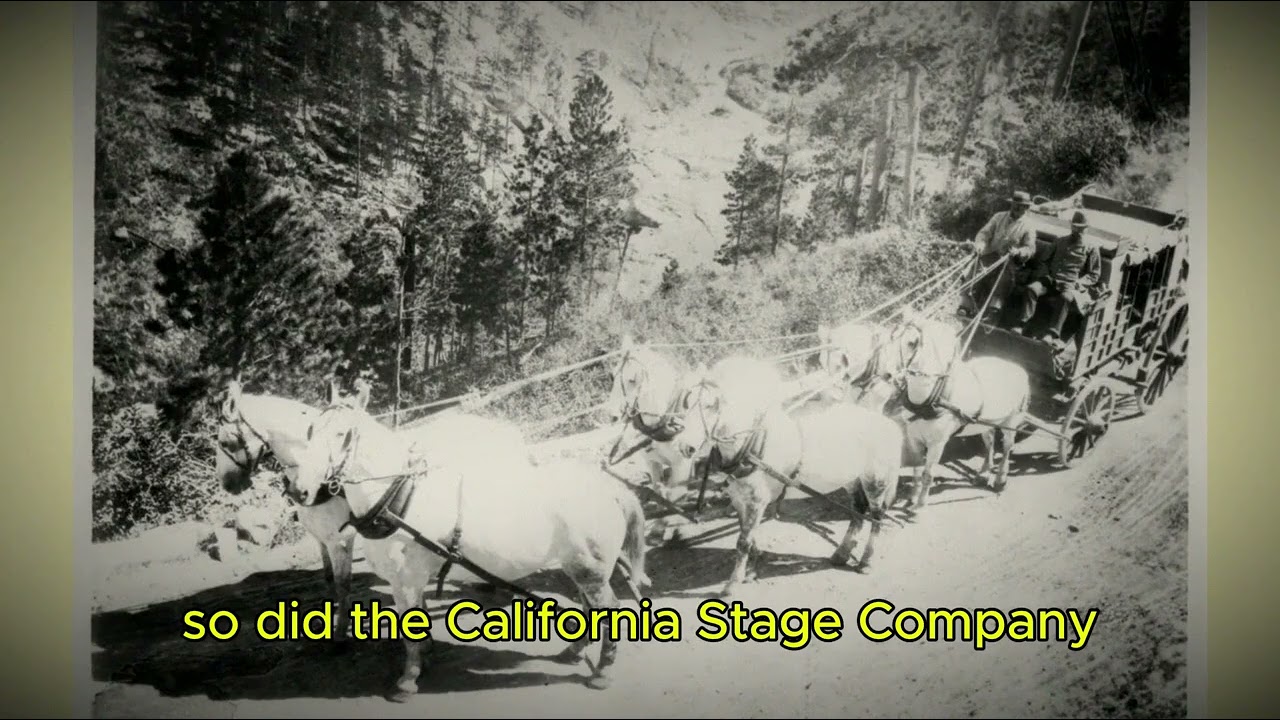
In the late autumn of 1858, on a dark mountain road outside Placerville, California, a stagecoach drawn by six horses climbed through the pines. The driver sat hunched on the box, reins wrapped around gloved hands, a black patch covering the left eye, a cigar stub clamped between teeth. Two men emerged from the shadows ahead. One raised a rifle and shouted the words every driver in the state feared: throw down the box.
The driver did not throw down the box. He did something few highwaymen had ever witnessed. He set down the whip, reached behind the seat, and drew a Colt revolver. A single shot cracked through the cold.
By the time the horses surged forward, one outlaw was bleeding on the road and the other had vanished into the trees. The coach reached the next station with every passenger alive and every dollar of gold still locked in the strongbox. When the station agent asked if there had been trouble, the driver spat and said only: a little. The wounded man crawled to a cabin in the hills and bled to death.
Before dying, he told the cabin owner he had never seen a driver with such a steady hand on a pistol. The highwayman was known as Shugerfoot, so named because he wrapped his boots in sugar sack burlap to leave no traceable tracks. He had robbed the wrong coach. The driver who killed him was known along the Pacific coast as One-Eyed Charlie.
Some called him Cross-Eyed Charlie, others Six-Horse Charlie. Everyone who rode behind him agreed that few men in California could handle a six-horse team through a mountain pass in rain and darkness with a mailbag full and a treasure box heavy on the floor. He had been driving for thirty years. He voted in the presidential election of 1868.
He was buried beneath a headstone bearing the name every friend, passenger, station agent, and Wells Fargo customer knew. But when the neighbors washed the body for burial, they discovered something no living person on the entire Pacific coast had ever suspected. The person who had worn that coat and that patch and carried that name for thirty years was not who they thought. The story begins in Lebanon, New Hampshire, in the winter of 1812.
A child was born and christened Charlotte Parkhurst, sometimes recorded as Barkhurst depending on the clerk. The parents did not want the child, and the infant was handed to an institution. As soon as Charlotte could escape without being dragged back, she did. She left in borrowed or stolen clothing: a boy’s shirt, trousers, boots too large, and a name that would remain on coaching records for sixty years: Charlie.
What Charlie thought that morning cannot be known. The world of the 1820s had no vocabulary for such a decision. What Charlie had was a set of clothes, a road, and one clear idea. With those clothes and that name, Charlie could work, eat, sleep in a hay loft without questions, and disappear into the mass of hired laborers.
The first steady work came in a livery stable in Worcester, Massachusetts, owned by a man named Ebenezer Balk. The work was hard and dirty, but Charlie proved skilled with horses, reading their ears, their weight shifts, the small snorts that meant trust or warning. Balk noticed and let Charlie drive: first short runs with a pair of horses, then longer routes with four, then six. The stable hand became one of the most trusted drivers in New England.
In the 1840s, two young men working alongside Charlie, James Birch and Frank Stevens, read the newspapers and saw one word growing larger: California. After gold was found at Sutter’s Mill in 1848, they sailed around Cape Horn, reached San Francisco, and began consolidating stage lines. By 1854, they had merged nearly every major line in California into the California Stage Company. They wrote to their old friend back east and said, come to us.
Charlie came, arriving around 1851 or 1852, likely by ship across the Isthmus of Panama, then by Pacific steamer. San Francisco in 1852 was barely a city: wooden wharves over mud, canvas tents beside brick buildings, abandoned ships in the harbor because crews had fled for the gold fields. The gold country needed men who could move goods and people without losing them. There was almost no railroad in the state.
Everything moved on wheels behind horses. The mail, the money, the gold dust, the miners’ payrolls, the passengers: all of them climbed onto the driver’s seat and trusted the man holding the reins. Charlie drove those roads for fifteen years without pause. Routes ran from San Jose to Santa Cruz, from Sacramento up the American River to Placerville, from Stockton east to Mariposa, later over the Sierra to the Nevada mines, and some accounts place Charlie as far north as the Oregon border on the Siskiyou road.
The Pioneer Stage Line employed him, and so did California Stage. When Wells Fargo bought the Pioneer line in 1866, Charlie stayed on the payroll because a driver like that was worth keeping. The work was brutal. A driver sat on a wooden seat ten feet above the ground, holding four leather straps in the left hand and a whip in the right.
The coach weighed several thousand pounds empty, doubled when loaded, and rode on leather thoroughbraces instead of springs because springs would shatter on such roads. The road was often just a ledge cut into a mountainside, sometimes a dry creek bed. Six horses ahead formed no single animal. Each had its own temperament.
If the lead pair spooked and jumped, the four behind might follow, and on a mountain edge the coach would go over. The driver’s job, from before sunrise to after dark, was to prevent that with voice, hands, and the crack of the whip. If you were good, you finished the run, collected your pay, slept six hours, and took another coach. If you were not, you died at some turn and they buried you in a shallow grave.
Charlie was among the best in the state. The San Francisco Morning Call called him the most skillful and famous driver in California. Other drivers said it, passengers said it. A story circulated, possibly true, that Charlie could use the whip to slice the end off an envelope from fifteen feet or snatch a lit cigar from a man’s mouth without touching his lip.
What is certain is that a driver who could do that could place a whip crack exactly where it needed to go. Around 1856, in a barn somewhere in the gold country, a horse kicked Charlie in the face. The left eye was lost. There was no emergency room in California then; a doctor cleaned the wound and gave whiskey.
Charlie emerged with a black leather patch and a new nickname. The patch became part of the man. It also became a mask. The scarred face drew attention away from the small frame, the smooth jaw, and the hands that journalists later noted were far slenderer than a driver’s hands should be.
For thirty years, sleeping in stage stations, sharing rooms with other drivers, washing at a pump in the yard, eating at common tables, laughing at jokes, holding steady at poker tables, never once did Charlie let anyone see the person beneath the coat. The gold rush created a specific kind of criminal. The bank was on wheels: the Wells Fargo strongbox bolted to the floor of a coach moving at eight miles an hour through the pines. Around that box grew a trade of highwaymen called road agents.
The method was simple. Wait behind a rock at the top of a pass. Let the coach slow to a walk. Step out with a gun and a scarf over the face.
Say the words: throw down the box. Nine times out of ten, the driver threw it down because the passengers had lives to return to and the box was Wells Fargo’s problem. According to every account that survives, Charlie was the tenth time. The highwayman called Shugerfoot was a man named John Allen.
He earned his nickname by wrapping his boots in burlap from old sugar sacks so trackers could not follow his prints. In their first encounter, Charlie was driving the run from Stockton to Mariposa. Shugerfoot and his men stepped out, and Charlie, alone against three armed men, followed Wells Fargo policy and handed over the box. The coach continued on safely.
Shugerfoot did not leave. He waited and watched the schedule, knowing Charlie would return in three days. In the same place, with the same rifle, Shugerfoot set a second ambush. What Shugerfoot did not know was that Charlie had spent those three days thinking.
Accounts differ on whether Charlie was calm or furious. All versions agree on the facts. When Shugerfoot stepped into the road, Charlie did not slow. He cracked the whip beside the lead horse’s ear like a gunshot, and the six-horse team surged full speed toward the men.
They jumped aside. As the coach rushed past, Charlie turned on the seat, drew a revolver, and fired. The bullet struck Shugerfoot in the stomach. He staggered into the brush and reached a prospector’s cabin, where he told the whole story, from the first ambush to the second.
Then he died on the cabin floor. The story passed from the cabin man to the sheriff, to the Wells Fargo agent, and to the newspapers. Wells Fargo summoned Charlie and presented a pure gold watch with a gold chain. The company had a policy: a driver who resisted a robbery got a watch.
The news spread among highwaymen. Some drivers on certain lines would shoot back. After Shugerfoot’s death, road agents on the northern gold roads avoided Charlie’s coach and chose easier targets on other lines. Another famous incident defined the driver’s character.
Charlie was coming down the western side of Carson Pass, a high Sierra crossing near Lake Tahoe, descending thousands of feet over a few miles. The lead pair of horses stumbled off the edge of the trail. The coach lurched, and Charlie was thrown from the seat. When a driver is thrown from a moving coach on a mountain pass, the sensible action is to let go of the reins, because if you hold on while the horses run, you will be dragged over rocks and ravines until you are dead.
Charlie did not let go. He held the reins with both hands while being dragged through the dirt, turning the horses back to the road with his voice and grip until the coach stopped. The passengers climbed down, pale, and realized they were alive because Charlie refused to release the reins. According to one account, they took up a collection and gave him everything they had.
Charlie took it, dusted off, climbed back onto the box, and finished the descent. In the late 1860s, Charlie left the coach seat for good. He was in his mid-fifties. His bones were worn from years on the wooden seat, his fingers stiffened in the cold, his remaining eye tired.
And everyone could hear the railroad coming. In May 1869, the transcontinental railroad joined east and west with a golden spike in Utah. Branch lines soon reached every mining town that could pay for tracks. Each mile of new track meant a mile less of stage line.
Around 1867, Charlie bought land in Santa Cruz County, on the central California coast behind the town of Watsonville, ran a farm and a stage stop, raised cattle, cut timber in the redwoods, and kept chickens outside the small coastal town of Aptos. It was the closest thing to peace that the records show. But before the final journey ended, the most surprising event in the entire story occurred. In the fall of 1868, the first presidential election after the Civil War pitted Republican Ulysses S.
Grant against Democrat Horatio Seymour. The nation was in turmoil. Reconstruction was unraveling. The Fourteenth Amendment had just been ratified.
The question of who exactly could vote varied from state to state, county to county, clerk to clerk. On October 17, 1868, a person named Charlie Parkhurst entered the voter registration office in the small town of Soquel, north of Watsonville, and signed the voter registry. The clerk saw a man of about the right age, a California pioneer with a hoarse voice, a black eye patch, a driver’s hat, and a tough reputation. The clerk recorded the name.
Charlie Parkhurst became a registered voter of the United States. On November 3, Grant won California, and Charlie walked or rode to the polling place and cast a ballot, fifty-two years before the Nineteenth Amendment gave American women the legal right to vote in federal elections. A person born Charlotte Parkhurst in 1812 voted in a presidential election in broad daylight on the Pacific coast, then returned home, lit the stove, and as far as anyone knows, never told a soul what that day truly meant. The fact is documented in historical records and appears on a plaque in the village of Soquel to this day.
Charlie lived eleven more years. The records grow quieter. There is a farm, a stage station, a reputation as an eccentric old man who preferred isolation. There is a cabin toward the Seven Mile House on the road between Watsonville and Santa Cruz.
Then came illness: a cough, a pain in the mouth, a growth on the tongue that would not heal. Doctors on the central California coast in 1879 had no cure for cancer of the tongue. In his final months, according to neighbors, Charlie could barely speak and used a driver’s horn to signal from a distance, the same kind used to warn traffic on mountain turns, a way of saying I am still here without saying anything else. A neighbor came each morning to check the fire and bring what food the sick man could take.
On December 28, 1879, a Sunday, Charlie Parkhurst died in that cabin at age sixty-seven. The neighbors came to prepare the body for burial: three of them in most accounts, including a woman, with warm water and clean cloths. They removed the coat and the shirt. In that quiet room in that small cabin in the winter afternoon, three neighbors stood staring at one another, unable to speak.
The person beneath the coat and the shirt and the name on the headstone was not the person they had known for years, not the person the town had known, not the person California had known for a full generation. The Sacramento Daily Bee wrote it plainly: it was discovered that Charlie Parkhurst was beyond doubt a fully developed woman. The San Francisco Morning Call sent a reporter to the coast. The New York Times reprinted the story on January 9, 1880, under the headline: thirty years in disguise, a famous California stage driver discovered after death to be a woman.
What emerges from the page is not scandal but astonishment. An entire state suddenly realized they had all missed something they thought they were watching. The language of 1880 could not contain it, and perhaps the language of today cannot entirely either. What can be said is this: Charlie Parkhurst was faithful to a private idea of who he was, from a morning in a New England institution in the 1820s until a winter afternoon in a cabin on the California coast in 1879.
Nothing in the world could turn him from that idea. Not the road agents, not the horses’ hooves, not the mountain passes, not the coming of the railroad, not the polling places, not the doctors, not even the grave. In a box inside the cabin, according to some newspaper accounts, the neighbors found a red silk dress, folded and preserved, a pair of small shoes, the gold watch and chain from Wells Fargo, and a bundle of papers. The dress and the shoes, if they existed, were folded and kept, not thrown away, not worn, but saved in a box out of sight for reasons known only to Charlie.
Charlie was buried in the Pioneer Cemetery in Watsonville. The original headstone was simple. Over the decades the grave was lost. In 1954, a local historical group called the Pajaro Valley Historical Society searched for it, found it, and in 1955 placed a new marker.
On that marker, words remain to this day: Charlie Darkey Parkhurst, 1812 to 1879, famous stage driver of the gold rush days, drove stage over Mount Madonna in the early days of the valley, and his last routes were from San Juan to Santa Cruz. His death at a cabin near Seven Mile House revealed that One-Eyed Charlie was a woman, the first woman to vote in the United States on November 3, 1868. The stage drivers came old men from all over the coast. Some wept.
Some refused to believe it. Some stared at the coffin and said later they had suspected. No one had suspected. No one had known.
The whole performance had been carried out with complete perfection. Charlie Parkhurst died on December 28, 1879. The gold watch from Wells Fargo and the red silk dress were buried with the belongings or scattered by relatives who came to take what could be sold. The records are thin.
The headstone still stands in the Pioneer Cemetery. Every year, a small handful of people, mostly locals, stop to read the inscription, stand for a minute, then drive home over paved roads that were once stage trails. The road climbing out of Placerville still climbs the same slope. If you drive late in the afternoon through heavy rain, and the light fades among the pines, you can, if you try, hear the crack of a whip above the sound of the wipers.
You can imagine a coach coming down out of the American River canyon, six horses stretched in their harnesses, a driver with a black patch over one eye, gloves on the reins, a cigar between the teeth, three days out of Sacramento, an iron box under the seat, and a private secret that would ride with him to the end of the road. That is the story of Charlie Parkhurst, the most trusted stage driver on the roads of northern California. He killed a highwayman named Shugerfoot during a gold shipment in 1858. He saved a coach full of passengers over Carson Pass by refusing to drop the reins.
He registered to vote in Soquel on October 17, 1868, and cast a ballot in a presidential election fifty-two years before the country allowed women to do so. He drove stages for thirty years, kept his secret for sixty, and died in a cabin among the redwoods with the door closed and the stove cold, and he did not let the world learn the truth until the world no longer had any choice.