On the evening of December 1, 1955, a 42-year-old seamstress named Rosa Parks paid her bus fare, took her seat, and refused to give it up. She was tired, but not in the way most people later understood. She was a trained civil rights organizer who had spent months preparing for precisely this moment. Her refusal that night triggered 381 days of walking, sacrifice, and organized resistance that broke the back of legal segregation in American public transit and introduced the modern civil rights movement to the world.
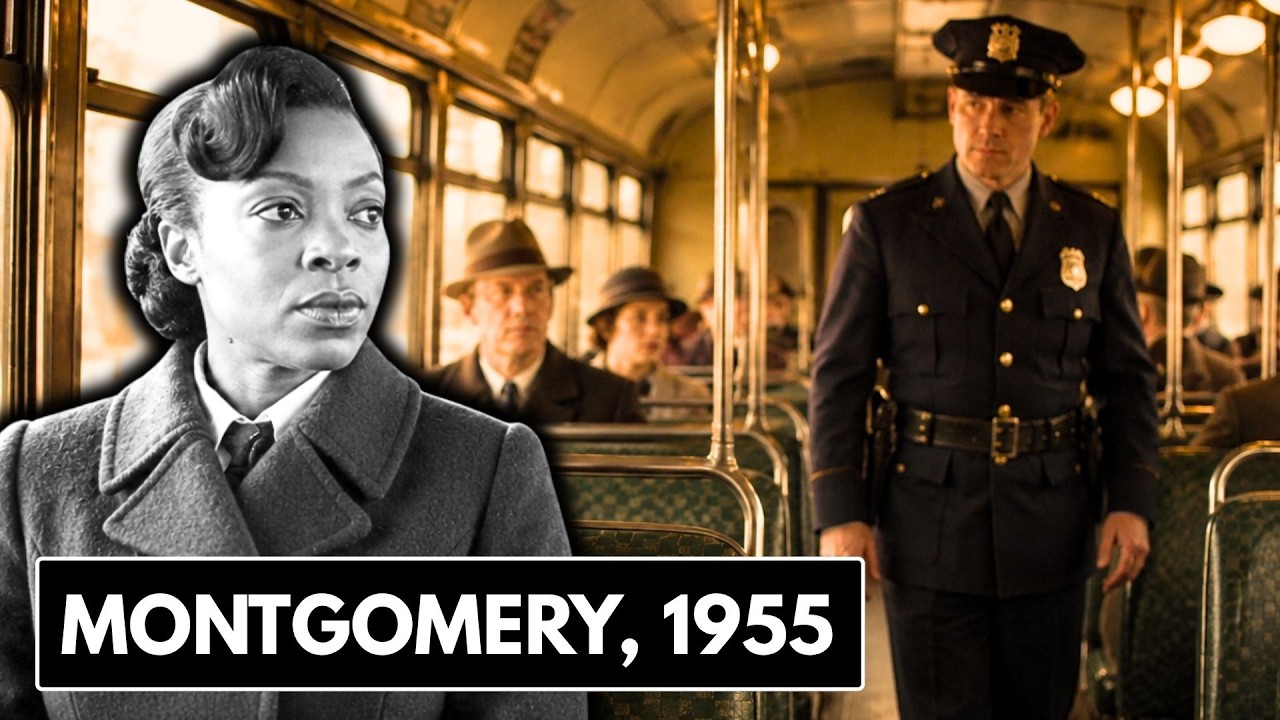
But the full story of what happened in Montgomery is far richer and far more collective than the single image most people carry of a woman too exhausted to move. To understand why Rosa Parks’s arrest became the spark for something much larger, it helps to know what daily life was like for Black riders on Montgomery’s buses in 1955. Under the city’s segregation ordinance, Black passengers were required to sit in the back of every bus, while the front was reserved exclusively for white riders. If the white section filled up, Black passengers sitting in the middle rows were ordered to give up their seats entirely, not merely move and stand for the rest of the trip, even if every seat in the so-called colored section behind them was already taken.
Black riders were also frequently required to pay their fare at the front of the bus, then step off and re-board through the rear door. Some drivers used this procedure to leave riders stranded, pulling away from the curb before they could climb back on after paying. This was the everyday reality facing nearly 75 of every 100 riders on Montgomery’s city lines, Black passengers who made up the vast majority of the bus system’s ridership and, crucially, the vast majority of its revenue. Rosa Parks was not the first Black rider in Montgomery to defy the system.
Nine months earlier, in March 1955, a 15-year-old girl named Claudette Colvin refused to give up her seat on a Montgomery bus and was arrested for it. Local civil rights leaders initially considered building a legal case around her act of defiance, but ultimately decided against using Colvin’s case as a public test, partly because she was a teenager whose family circumstances made her an easy target for the kind of smear campaigns that segregationist defenders were eager to wage against anyone who challenged the system. Rosa Parks, by contrast, had been a member of the NAACP since the early 1940s, served as secretary of the Montgomery chapter, and was highly respected within the city’s Black community. That background made her, in the eyes of local organizers, a figure whose reputation would be difficult for segregationists to attack successfully.
When Parks was arrested on December 1, Black leaders in the city recognized almost immediately that this was the case they had been waiting for. News of her arrest spread through Montgomery’s Black community with astonishing speed, driven largely by a woman whose contributions to the story have long been overshadowed by the names that came after hers. Jo Ann Robinson, a professor at Alabama State College and president of the Women’s Political Council, had been quietly preparing for just such a moment for months, tracking incidents of bus mistreatment and laying the organizational groundwork for a coordinated response. On the night of Parks’s arrest, Robinson and a small group of colleagues worked through the night at the college printing thousands of leaflets calling for a one-day bus boycott the following Monday, December 5.
Those leaflets were distributed by hand throughout Black neighborhoods across the city before dawn. On Sunday, December 4, Black churches across Montgomery announced the boycott from their pulpits, urging every member of their congregations to refrain from riding the buses the next morning in a unified show of protest. Monday, December 5 arrived, and what happened stunned even the organizers who had spent the weekend preparing. Observers across the city reported buses running their usual routes completely empty of Black passengers.
The level of unified participation on day one suggested this protest would not fade quickly. That evening, several thousand people gathered at Holt Street Baptist Church for a mass meeting to decide the next step. At this meeting, a 26-year-old minister new to the city, Martin Luther King Jr. , was chosen to lead a newly formed organization called the Montgomery Improvement Association.
He was tasked with coordinating what had begun as a one-day protest but quickly turned into something more sustained and more significant than anyone had initially planned. Maintaining the boycott required logistics of staggering scale. Of roughly 50,000 Black residents in Montgomery, between 30,000 and 40,000 actively participated day after day, refusing to ride a city bus for over a year. For people who depended heavily on public transit to reach jobs as domestic servants, laborers, and clerks across the city, sustaining a boycott this long required building an entirely new transportation infrastructure from scratch and quickly.
The Montgomery Improvement Association organized a sophisticated carpool system with 40 pickup stations spread across the city, where boycotters could gather each morning and evening to catch rides with volunteer drivers heading toward their destinations. Black-owned taxi companies initially agreed to carry boycotters for the regular bus fare instead of the usual taxi rate, until the city moved to shut that option down by threatening to revoke taxi licenses for undermining the fixed fare. The organizers were not deterred. They simply expanded the volunteer car network, coordinating hundreds of vehicles and private drivers with a level of precision that impressed outside observers who arrived in Montgomery expecting to find the protest collapsing under its own logistical weight.
For those who could not reach the carpool on any given day, walking became the alternative. And that, in its own way, became one of the most powerful public symbols of the boycott. Elderly Black residents of Montgomery, people who had worked as domestic servants their entire lives, walked miles to and from work rather than ride a segregated bus, day after day, through the brutal Alabama summer heat and the occasional winter cold alike. One elderly woman, when asked by a reporter if her feet were tired from walking, gave an answer that became one of the most quoted lines of the boycott.
Her feet were tired, she said, but her soul was rested. A simple sentence that summed up, better than any speech by the movement’s most famous leaders, exactly what kept 30,000 to 40,000 ordinary people going through more than a year of daily sacrifice. This was not a protest sustained by a handful of dramatic gestures. It was sustained minute by minute and mile by mile, by the accumulated will of an entire community that had simply decided, together, that they were finished accepting daily humiliation as the price of going to work.
The city and its white power structures did not respond to this sustained challenge with patience. Montgomery police began systematically harassing the carpool network, issuing citations to volunteer drivers for minor and often fabricated traffic offenses, stopping drivers repeatedly on the same routes, and in some documented cases using outright intimidation and threats of violence against boycotters waiting at designated pickup points. City officials resurrected an old, rarely enforced Alabama law originally designed to prohibit business boycotts and attempted to use it to charge Martin Luther King Jr. and nearly 90 other boycott leaders and participants with organizing an illegal conspiracy against the bus company.
The case made national headlines and, instead of intimidating the movement into submission, brought increased sympathy and attention to Montgomery from across the country. Meanwhile, the economic pressure on the bus company escalated with every day the boycott continued. Since Black riders had represented roughly three out of every four passengers before December 5, losing that revenue month after month pushed Montgomery City Lines toward genuine financial crisis. This was a pressure point boycott organizers had identified from the start as their strongest lever against a system that had never before been forced to recognize the real economic value of the Black riders it had spent decades humiliating.
Violence directed at boycott leaders escalated steadily as the protest stretched from weeks into months. In late January 1956, King’s own home was bombed while his wife, Coretta Scott King, and their infant daughter were inside. Neither was injured in the attack. The home of E.
D. Nixon, president of the local NAACP chapter, who had posted Rosa Parks’s bail on the night of her arrest and who had pushed harder than anyone to make her case a public test of the segregation laws, was also targeted. Rather than intimidating Montgomery’s Black community into abandoning the protest, each act of violence seemed only to strengthen the community’s resolve. That same night, King addressed the crowds gathered outside his bombed home, calling for calm and continued nonviolent resistance rather than revenge.
A moment that would later become a cornerstone of the broader philosophy of nonviolent direct action that guided much of the civil rights movement in the years that followed. While the boycott continued in Montgomery’s streets and through its shared cars, the legal battle that would decide its ultimate outcome was unfolding simultaneously in federal court. The criminal conviction of Rosa Parks for violating the city segregation ordinance made its way through Alabama’s court system on appeal, but it was a separate federal lawsuit, Browder v. Gayle, filed on behalf of four other Montgomery women who had also been mistreated on city buses, that actually achieved the legal victory.
A three-judge federal panel ruled in June 1956 that Montgomery’s bus segregation laws violated the equal protection guarantee of the Fourteenth Amendment. The city appealed directly to the United States Supreme Court. On November 13, 1956, the Supreme Court affirmed the lower court’s decision, ruling that seat segregation on public buses was unconstitutional. But the court’s written order did not reach Montgomery for several more weeks.
With extreme caution and strategic patience, the Montgomery Improvement Association kept the boycott fully in effect until that order arrived and became legally enforceable. That moment finally came on December 20, 1956, when the written order reached the city and segregation was officially abolished on Montgomery’s buses the following morning, December 21. In one of the quietest and most powerful moments of the boycott, Martin Luther King Jr. and a number of other movement leaders deliberately chose to ride in the front section of a city bus together that first morning of integration.
What many considered a striking coincidence, the driver assigned to that particular route was the same man who had been driving the bus on the night of December 1 of the previous year when Rosa Parks was first ordered to give up her seat. The boycott ended after 381 days of walking, carpooling, legal maneuvering, bombings, arrests, and an almost unbelievable level of sustained daily sacrifice from tens of thousands of ordinary Montgomery residents. Montgomery’s public buses became, for the first time in the city’s history, legally open to passengers of any race in any seat. But integration on paper did not translate immediately into safety on the ground.
The months following the official end of the boycott brought a new wave of violent resistance from segregationists determined to reverse what the courts had ordered. Snipers began firing on city buses carrying the newly integrated passengers. In one particularly brutal incident, a gunman’s bullet shattered the legs of a pregnant Black woman simply on her way home. In January 1957, only weeks after integration formally began, four Black churches across Montgomery were bombed in a single coordinated wave of attacks, along with the homes of several prominent movement leaders, including another attempt to target King’s own home, though the bomb planted there was discovered and defused before it could explode.
Only after Montgomery police finally arrested seven men connected to these bombings, all documented members of the Ku Klux Klan, on January 30 of that year, did the wave of violence targeting the newly integrated bus system largely subside. A sober reminder that legal victory, however historic, did not automatically translate into immediate safety or genuine acceptance among segregationists determined to resist it. It is worth pausing here to correct a part of the story that popular memory has blurred almost beyond recognition. For decades, Rosa Parks was remembered as a quiet, modest woman who happened to be so physically exhausted she could not move on that December evening.
Parks herself explicitly rejected this portrayal in her later years. She was not, by her own account, tired from work in any way that explained her decision that night. She was tired, in her words, of giving in. That distinction reframes her refusal from a spontaneous moment of fatigue into its actual truth: a deliberate act of political resistance by a seasoned organizer who had spent over a decade working within the NAACP specifically to challenge Jim Crow segregation laws, and who had, just months earlier, attended a training workshop at the Highlander Folk School in Tennessee focused precisely on strategies of nonviolent resistance and civil rights organizing.
Parks knew exactly what she was doing when she refused to move, and she knew exactly what consequences that refusal was likely to bring. That same corrective honesty should extend to the broader group of people who actually built and sustained the Montgomery boycott. The version of the story that focuses almost entirely on King and Parks alone omits a tremendous amount of the actual organizing work, much of it carried out by women whose names rarely appear in abbreviated accounts of this history. Jo Ann Robinson and the Women’s Political Council had been laying the organizational groundwork for such a boycott for months and possibly years before Parks’s arrest gave them the specific trigger they needed to act.
E. D. Nixon, as president of the local NAACP chapter, provided crucial early leadership, making the strategic decision to push Parks’s case forward as a public test rather than the earlier arrest of Claudette Colvin. And the tens of thousands of ordinary Montgomery residents who walked miles to work every day for over a year, who organized and ran the carpool network, who opened their churches for mass meetings and their homes for strategy sessions, were not simply following King’s leadership from a distance.
They were the boycott in the most literal sense, the collective force whose sustained daily sacrifice was what ultimately broke the bus company’s finances and forced the legal challenge that reached the Supreme Court. The significance of the Montgomery bus boycott extends far beyond the specific outcome of integrating seats on one city’s public transit system. It served as the first large-scale, sustained demonstration of what organized, nonviolent collective action could achieve against entrenched segregation in the South. The model was studied, adapted, and replicated throughout the South in the years that followed, from lunch counter sit-ins, to the Freedom Rides, to the massive marches of the early 1960s.
It propelled Martin Luther King Jr. , then a 26-year-old minister new to Montgomery with no prior national fame, into the role of the movement’s most prominent spokesperson. From that position he went on to help found the Southern Christian Leadership Conference and lead the broader civil rights movement over the next twelve years until his assassination in 1968. And it demonstrated in the clearest economic terms possible how much power a community holds once it realizes its collective economic influence, a lesson applied again and again in the boycotts, sit-ins, and organized economic pressure campaigns that defined the civil rights movement’s most effective tactics throughout the next decade.
To understand why Montgomery’s Black community was ready to respond so decisively to Rosa Parks’s arrest, it helps to look at what had been happening in the city in the months and years before December 1955, because this movement did not emerge from nowhere. The Montgomery police department had, for years before the boycott began, a well-established reputation within the Black community for brutality and sexual violence directed specifically at Black women. That pattern had bred deep and long-suppressed anger long before Parks boarded that particular bus. One case in particular, involving a young Black woman named Gertrude Perkins who was assaulted by two Montgomery police officers in 1949, who publicly reported the assault and pursued charges against her attackers, something remarkable for that era, had already galvanized local Black organizers around the very kind of coordinated, sustained civil response that later characterized the bus boycott.
When the editor of the Montgomery Advertiser was asked decades later, in a 1997 interview, whom he considered the most important figure in the bus boycott, his answer was notably not the name most people would expect. A reminder that the movement built by Montgomery’s Black community in 1955 and 1956 rested on years of accumulated organizing experience, community trust, and hard-won institutional knowledge about how to sustain collective pressure against a hostile local government. This broader view matters because it reframes the boycott not as a spontaneous uprising ignited by one tired woman’s feet, but as the culmination of years of patient and largely uncelebrated organizing work carried out primarily by Black women across Montgomery’s churches, schools, and civic organizations. The Women’s Political Council under Jo Ann Robinson had been documenting bus driver mistreatment, tracking specific routes and particular drivers known for especially harsh treatment of Black riders, and building relationships across Montgomery’s Black professional and working-class communities for years before 1955.
This foundation explains something that often puzzles people encountering this history for the first time: how a protest of this size and this level of sustained organizational sophistication, building an entirely new city-wide transportation network almost overnight, could come together so quickly and so precisely in the days following a single arrest. In truth, it did not come together overnight at all. It had been formed over years of careful preparation that simply found its spark on the evening of December 1. The economic dimension of the boycott deserves closer examination.
Montgomery City Lines had depended on Black riders for roughly three of every four tickets it sold. Near-total participation, sustained day after day for more than a year, drove the bus system toward genuine financial disaster. Contemporary reports indicated the company’s revenues collapsed by more than half during the boycott, forcing them to cancel routes, raise wages for the few white riders who remained, and face increasing pressure from downtown Montgomery merchants who depended on customers of all races reaching their stores easily. This merchant pressure became an unexpected but significant secondary front in the boycott’s overall impact, as downtown business owners watched their foot traffic decline alongside the bus company’s fortunes and quietly pressured city officials to find a solution to a confrontation costing the entire local economy dearly, not just the bus company.
The role of Montgomery’s Black churches throughout this period cannot be overstated. The churches functioned simultaneously as organizing headquarters, meeting halls for strategy sessions and mass rallies, collection centers for donations from around the country to help cover legal costs and maintenance for the carpool fleet, and spiritual pillars supporting a community asked to endure more than a year of daily hardship, harassment, and eventually targeted violence. Holt Street Baptist Church, where King was first chosen to lead the Montgomery Improvement Association on the first night of the boycott, became an unofficial headquarters for the movement, hosting mass meetings that regularly drew thousands attending to hear the latest developments in negotiations, legal proceedings, and the newest tactics the city was attempting to use against them. These meetings combined practical logistics with sermons and communal singing in a format that became a hallmark of civil rights organizing throughout the next decade, linking spiritual endurance with strategic planning in a way that reflected how deeply rooted the movement was in the religious institutions of Black Montgomery.
Rosa Parks herself paid a steep personal price for the role she agreed to play in this history, a price often omitted from popular accounts in favor of a neater, more triumphant narrative. She lost her job as a seamstress at a Montgomery department store within weeks of her arrest, her employer uncomfortable with the publicity surrounding her case. Her husband, Raymond Parks, lost his job at nearly the same time, and the couple found it increasingly difficult to find steady work anywhere in Montgomery as their names became inextricably linked to a boycott that deeply angered much of the city’s white business community. The family began receiving threatening phone calls and letters so regularly that by 1957, nearly a year after the boycott officially ended, Rosa and Raymond Parks made the difficult decision to leave Montgomery entirely, moving first to Virginia and then settling permanently in Detroit, Michigan, where Rosa Parks worked for decades as an aide in the office of Congressman John Conyers, quietly continuing her civil rights work for the rest of her life, far from the city where her individual act of refusal changed the course of American history.
It is a stark and uncomfortable fact that the woman whose name became synonymous with the triumph of the Montgomery bus boycott found little economic security or personal safety in the city where the victory was actually achieved. A reminder that symbolic victory and personal cost often went hand in hand throughout the civil rights era, and that the individuals who took the greatest personal risks rarely received protection or reward commensurate with that risk. Claudette Colvin’s story deserves accurate recognition as well. Colvin, only 15 years old at the time of her arrest in March 1955, was handcuffed and forcibly removed from a Montgomery bus and later became one of the four plaintiffs in the Browder v.
Gayle lawsuit that ultimately achieved the decisive legal victory for the boycott in federal court. This means, in the precise legal sense, that Colvin’s case, along with the cases of three other women, not Rosa Parks’s criminal appeal, is what actually struck down Montgomery’s segregation ordinance. Colvin herself spoke in later interviews about the complex emotions of watching an older, more publicly acceptable woman become the face of a movement her own arrest had helped spark months earlier. A complex emotional legacy that illustrates just how carefully, and sometimes painfully, Black organizers in Montgomery had to calculate which stories and which individuals the broader American public, and the deeply hostile Southern legal system of that era, would accept as sympathetic and credible figures.
The effects of the boycott spread across the country almost immediately, inspiring similar protests in other Southern cities that same year, including a boycott in Tallahassee, Florida, which drew directly on Montgomery’s organizational model. The Southern Christian Leadership Conference, founded in 1957 in the immediate aftermath of Montgomery’s victory, brought together King and other ministers who had led similar local struggles across the South, creating a formal regional organization designed specifically to coordinate and export the nonviolent direct action strategies Montgomery had proven could work against entrenched Jim Crow segregation. In less than a decade, the tactics first tested and refined in Montgomery’s streets and through its shared cars, sustained economic boycotts, mass meetings in Black churches, careful legal strategy pursued in parallel with grassroots direct action, and a public commitment to nonviolence even in the face of bombings and gunfire, were applied again and again across the South: from the lunch counter sit-ins that began in Greensboro in 1960, to the Freedom Rides of 1961, and to the massive voting rights campaigns culminating in the Selma to Montgomery marches of 1965. A decade of escalating civil rights activity whose organizational roots trace directly back to what tens of thousands of ordinary Montgomery residents proved possible during those 381 days of walking.
Montgomery succeeded where isolated protests elsewhere had failed because an entire community, not just its most prominent leaders, collectively realized that their economic power, their spiritual endurance, and their willingness to keep walking day after day for more than a year constituted a kind of pressure the Jim Crow system had never before been forced to confront. The legacy of those 381 days extends into the present, far beyond the specific legal victory of integrating bus seats. That victory, significant in itself, established a model of collective nonviolent resistance that shaped the next decade of American history and, in many respects, influenced civil rights and human rights movements around the world in the decades that followed. It elevated a 26-year-old minister unknown to most Americans outside Montgomery into the central moral voice of a movement that would ultimately transform American law and society.
And it remains, nearly seventy years later, one of the clearest demonstrations of what an entire community can achieve when it works together with discipline, patience, and an unwavering sense of collective purpose against a system that had stood for generations, a system very few people before December 1955 expected to be ended by something as simple and as powerful as the decision of tens of thousands of ordinary people to walk instead of ride.