The church bell rang slowly, steadily, though no service had ended and no one had died. The dogs beneath the chapel windows did not bark. They listened. Inside, the preacher spoke of obedience and order while the Louisiana heat pressed down on the congregation, sweat gathering beneath stiff collars, polished boots against pine floors scrubbed clean that morning by hands still trembling from the fields.
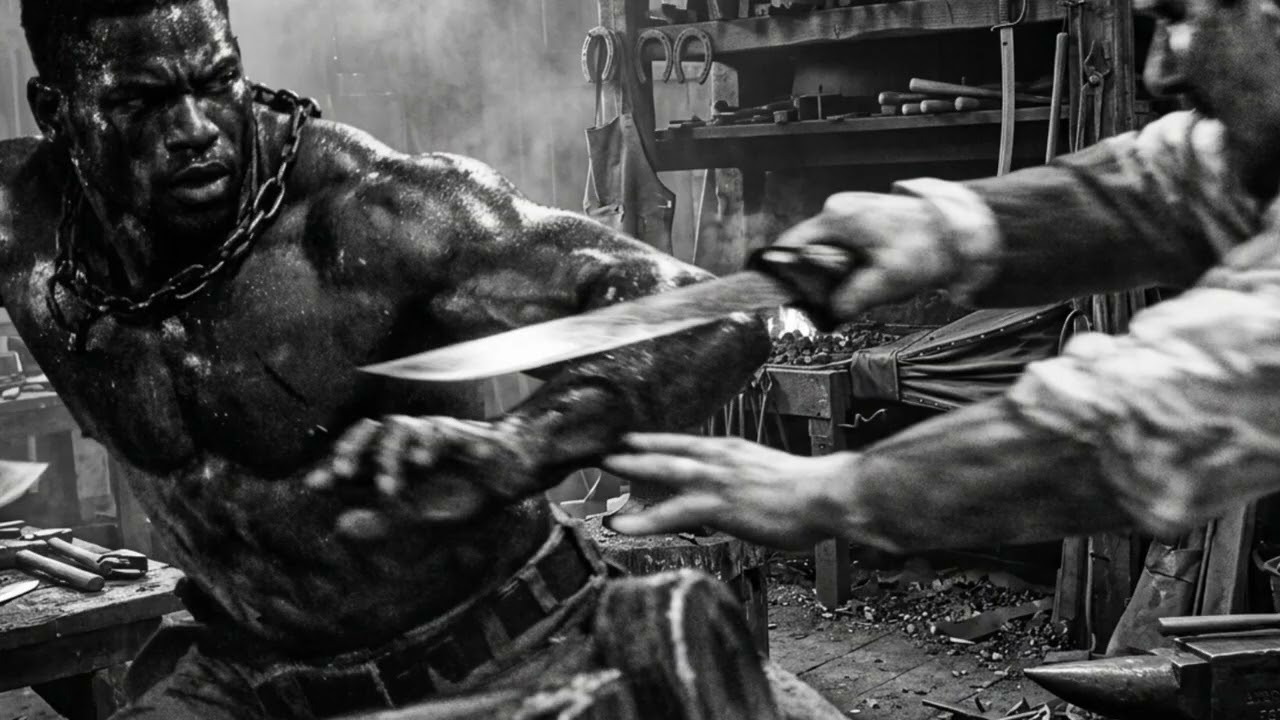
In the third pew from the back sat Elijah Turner, a 29-year-old cane cutter with a crescent scar splitting his left eyebrow. Hidden beneath his coarse linen shirt hung a small iron ring, once part of a shackle he had broken years ago. He wore it not as a trophy but as a reminder that something inside him had not broken, it had hardened. Three questions moved through his mind as the sermon droned on.
Why had the overseer sent for the dogs before sunrise? Why were the plantation gates chained shut during Sunday service? And why had Master Beauregard locked the church doors from the outside? Six nights earlier, Elijah’s wife, Ruth, had been taken without warning.
Lantern light had caught the outline of her face as she was pushed toward a wagon. She had not screamed. She had looked back once, not pleading, just memorizing him. Something inside Elijah had shifted that night.
That morning before sunrise, he had watched two wagons roll toward the quarters. He had counted four armed men. He had seen chains coiled in the back. By noon, five children would be gone.
That was the whisper passing through cane rows and kitchen shadows. That was why the gates were sealed. That was why the dogs were quiet. That was why the bell rang when no one had died.
Elijah had been counting for months. Steps from the back pew to the side door, steps to the pulpit, steps to Master Beauregard’s position when he stood to shake hands after service. He had watched guard rotations, studied which dog favored which handler, noted the preacher’s habit of closing his eyes during closing prayer. He had waited through heat that split lips and cold that cracked skin.
He had endured because survival required patience, but survival was no longer enough. As the preacher softened his voice for the closing prayer, heads bowed and eyes closed. Even some guards shifted into reverent stillness. Elijah felt the iron ring against his chest.
He thought of Ruth’s last glance. He thought of the children who would be chained before sunset. And in that silence between the final amen and the first lifted head, he stopped surviving and started deciding. The final amen hung in the air.
Heads began to lift. Elijah rose before the handshake ritual could begin, just enough to interrupt the rhythm. A small disruption in a room built on compliance. Master Beauregard noticed him standing.
Their eyes met across the aisle. It was not defiance Elijah showed. It was clarity. “Sit,” the overseer muttered without looking at him.
Elijah did not sit. He stepped into the aisle, one measured, deliberate step. The overseer’s hand dropped toward his pistol. The congregation stiffened.
“Service is concluded,” Master Beauregard said calmly, though tension tightened his jaw. “Return to your seats. ”
Elijah kept walking. “Brother Elijah,” the preacher began, voice thin, “there is a time for order.
”
“There is,” Elijah said quietly. His voice was steady, not loud, but it carried. It echoed with finality. The overseer stepped forward, pistol clearing leather with a small metallic whisper.
Elijah’s gaze did not leave Master Beauregard. “You locked the doors,” he said, not accusing, stating. “For safety,” the master replied. “Safety.
” The word hovered in the chapel like a lie too large to swallow. The overseer lifted the pistol slightly. “Last warning. ”
Elijah moved, not toward the door, but toward the pulpit.
The motion startled the guards who had prepared for flight, not confrontation. The overseer lunged to block him, the pistol swinging upward. Elijah’s hand shot out, precisely. Months of cutting cane had hardened his grip.
He seized the overseer’s wrist and twisted. The pistol discharged with a deafening crack that shattered stained glass above the altar. Shards of colored light fell in a fragile rain as the congregation screamed. Elijah forced the wrist downward.
The overseer stumbled, the pistol clattering across the floorboards. A blade flashed, small and quick, a thin cane knife hidden inside Elijah’s sleeve, dulled by labor but still sharp enough for intention. The sound was soft, fabric tearing, breath leaving. The overseer collapsed against the pew, blood darkening his shirt, spreading like spilled ink.
For a heartbeat, no one moved. The preacher froze. Master Beauregard’s composure cracked in the widening of his eyes. Outside, the dogs began to bark.
For the first time, fear changed direction. Master Beauregard stepped forward slowly, boots echoing across the boards. His voice remained calm, almost gentle. “You have made a mistake.
”
Elijah looked at him without blinking. “No,” he answered quietly. “I have finished waiting. ”
The guards hesitated.
Their training prepared them for flight, not for a man who moved toward power instead of away from it. One guard lifted his musket, then faltered when a woman grabbed his sleeve and screamed. A wild shot splintered wood near the ceiling. Elijah moved with the inevitability of a tide, reaching the pulpit and kicking the fallen pistol farther beneath it.
Master Beauregard lunged then, abandoning dignity for urgency. The two men collided, bodies striking hard against oak. The master’s ring cut Elijah’s cheek as they grappled. The blade flashed once more, not theatrical, precise.
The master staggered back, breath leaving him in a sharp, stunned exhale. His hand pressed against his side as crimson darkened the linen beneath his coat. He fell against the pulpit and slid slowly to the floor. Chaos erupted.
Some ran toward the doors only to find them bolted. Elijah raised his voice for the first time. “The children,” he said. Two words, clear, commanding.
A woman near the back rushed toward a side window. Another man overturned a pew and rammed it against the locked door. Elijah grabbed the fallen musket and struck the door’s hinge exactly where he had memorized its weakness. On the third strike, the hinge tore free.
Light flooded the threshold as the door sagged outward. Outside, a storm that had been gathering all morning cracked open. Rain slammed down in a sudden, violent downpour. Mud formed instantly.
Gunshots fired from the yard, but the rain swallowed some of their sound. Elijah turned to the congregation. “Now,” he said. They moved, not orderly, not coordinated, but moving, toward the tree line, toward the river, toward any direction not defined by chains.
In the yard, Elijah found two children crouched beneath a wagon, a third trapped behind feed barrels. He pushed them toward the cane fields, then found the last two in a locked toolshed, wrists loosely bound with rope meant for transport. He cut the rope quickly. As they stepped into the rain, a young white guard appeared at the end of the row, rifle trembling in his hands.
He looked no older than nineteen. Rain streamed down his face, mingling with something like doubt. He had a clear shot. The children clung to Elijah’s legs.
The guard’s hands shook. He lowered the rifle. Just slightly. Not heroic, just enough.
Elijah grabbed the children and ran, disappearing into the cane before the guard could change his mind. Behind them, men shouted for hounds, but the storm had flooded the low fields. Water rose through the ditches, swallowing scent and sound. The wagons meant for children stood abandoned in the yard, chains rattling in the wind.
By sunset, every armed man within miles would be searching. By sunrise, dogs would track through mud and water. And somewhere in the chaos, the children were no longer bound.
The illusion of order had fractured, and nothing in that chapel would ever return to the way it had been.