The ring sat where Alexander had left it, a plain seal of power that had once made any order law from the Danube to the Indus. When the dying king pressed it into the hand of his general Perdiccas, the men crowded around the couch read the gesture as a will and a naming. It made Perdiccas overnight the most powerful man on earth. It also got him killed.
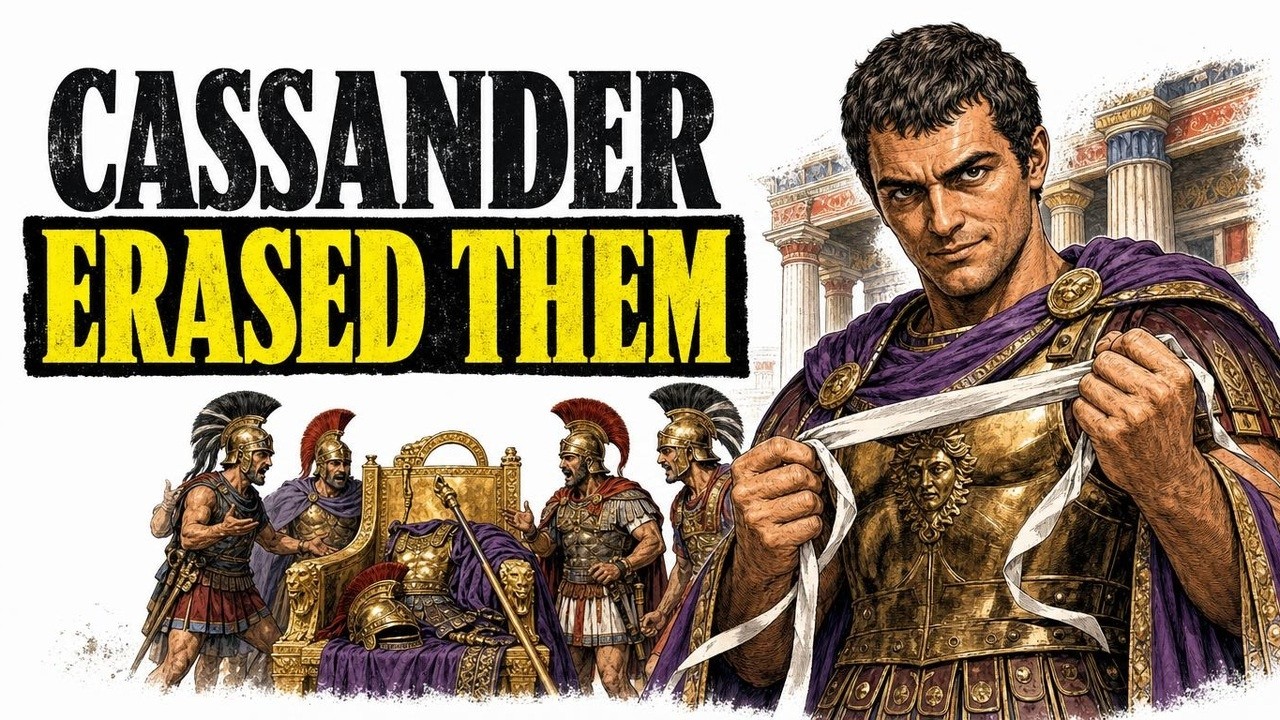
He led an army into Egypt, tried to force the Nile in flood, and lost two thousand men in a single night when the crossing failed, some dragged under and taken by crocodiles. His own officers walked into his tent afterward and put him to death in 321 BC. His death taught the survivors a lesson that governed everything that followed: none of them could wear that ring alone. The power it carried was indivisible, and indivisible power in a divided world was a death sentence for whoever held it.
Alexander the Great had died on the tenth of June, 323 BC, in the old palace at Babylon, after eleven days of fever. He was thirty-two years old. In his last coherent day, when the generals asked to whom he left the kingdom, he answered that it should go to the strongest. He left no named successor, no grown son, and a widow, Roxanna, six months pregnant.
His half-brother Arrhidaeus, the son of Philip II by a Thessalian dancer, was the only adult male of the blood, but every source agrees he was mentally incapable, a condition some writers attributed to poison given in childhood at the order of Alexander’s own mother, Olympias. The army split at once. The infantry wanted Arrhidaeus, a king of the true blood, however feeble. The cavalry commanders wanted to wait for Roxanna’s child.
The dispute grew loud enough that the phalanx nearly stormed the cavalry’s quarters, and the largest empire yet seen was minutes from tearing itself apart over a body not yet burned. Then a solution was found. They would have two kings. Arrhidaeus would be crowned as Philip III, and Roxanna’s child, if a boy, would reign beside him.
Perdiccas, holding the ring, would govern as regent in the east. Antipater would hold Macedon and Greece in the west. The provinces were parceled out, and the crisis, it seemed, was over. It was not a solution.
It was the forging of a weapon. They had placed on the throne a man who could not command and an infant not yet born, two kings with the sacred blood of the Argead house in their veins and no will of their own to spend. A king who cannot rule cannot resist. They could be carried from camp to camp, propped up at ceremonies, made to seal any order with the ring that once belonged to Alexander.
Before a single royal died, the generals had built the machine that would make killing the dynasty not merely possible but lawful. The first hand to break the oldest taboo of the kingdom, the rule against spilling royal blood, did not belong to a general. It belonged to Alexander’s own mother. Olympias had been kept at arm’s length in her homeland for years, watching from the mountains as other men decided the fate of her grandson, the boy king Alexander IV.
She had buried a husband and a son who wore crowns. She would not sit still. In 317 BC, with Epirote soldiers at her back, she marched through the passes into Macedon. Her targets were the co-king Philip III and his wife Eurydice, a granddaughter of Philip II who had raised troops to make her husband more than a figurehead.
The two armies met near the border. Philip’s Macedonian soldiers looked across the ground, saw the mother of Alexander standing against them in mourning black, and would not fight. They laid down their spears rather than raise them against the woman who had carried their god-king in her body. Philip and Eurydice were taken.
According to Diodorus Siculus, who wrote the fullest surviving account of these years, Olympias shut the royal couple in a cramped cell and had food passed through a narrow gap in the wall, keeping them alive just long enough for the news to spread. When murmurs began that the Macedonians pitied Philip, she moved. Eurydice, the account says, washed her husband’s body, arranged her own dress with care, and hanged herself with her girdle. Philip III, half-brother of Alexander and king of Macedon for six years, was killed by hired men from Thrace.
Olympias did not stop at the killing. She had the graves of her enemies opened and their bones left in the open air. She executed around a hundred of the leading men who backed her rival Cassander. She defiled the tomb of his dead brother.
In her desperation to save the throne for her grandson, she had proven to every ambitious man from the Adriatic to the Indus that Argead blood could be spilled and the world would keep turning. She handed her worst enemy the one thing he lacked: a precedent. Cassander, the son of Antipater, was patient in a way that frightened people. Plutarch tells a story that outlived him: years later, grown a king, Cassander saw a statue of Alexander at Delphi and was seized by such trembling that he could barely stand, so deep was the fear the dead man had planted in him as a young courtier.
When word of Olympias’s purge reached him, campaigning in the Peloponnese, he did not rage. He moved. He marched north at a pace his rivals could not match, slipped past the armies in his way, and closed his hands around the fortified port of Pydna on the Thermaic Gulf, where Olympias had gathered with Roxanna and the boy king inside the walls. Then Cassander did the cruelest thing a besieger can do: nothing.
He sat down behind a wall of his own and waited, his fleet sealing the harbor so nothing came in by sea. The winter of 317 into 316 BC is one of the bleakest passages the ancient record ever set down. Inside Pydna, the food ran out. The defenders ate their pack animals, then their war horses.
They stripped the leather from their shields and the straps from their gear, boiled the hides, and drank the broth. Diodorus tells us that hunger drove some of the trapped men to worse things still. The elephants Olympias had brought were kept alive on sawdust until there was none. Outside the walls, Cassander’s lines did not stir.
He understood that starvation would open the gates for him. By spring, the garrison was deserting in the dark. Olympias came out on a single condition, that her life be spared. Cassander gave his word through his envoys.
He never meant to keep it. He summoned the assembly of the army, the body that in Macedon held final authority over life and death, and put Alexander’s mother on trial without her present to speak. The charge was the killing of Philip III and the others she had struck down. The outcome was decided before a word was spoken.
The assembly condemned her to death. Even then he was careful. He first sent soldiers to kill her out of sight. They came into her chamber, found her standing, dressed as a queen, and their nerve failed them.
They backed out of the room without drawing a blade. Cassander understood that her royalty was a spell ordinary men could not break, so he handed the work to people who could. He armed the families of the dead and put stones in their hands. Diodorus records that she died beneath them without a cry and without begging for her life, arranging her clothing to fall decently as she went down.
For the next four years, Cassander played a slower game. He kept Roxanna and the boy Alexander IV alive. Alive, they were worth far more, because their existence made him something other than a usurper. He was the guardian of the rightful king.
He tightened his grip by marrying Thessalonike, Alexander’s half-sister, and he threaded his own line into the royal cloth. All the while the boy grew inside the fortress of Amphipolis, on the high ground above the Strymon River, a place dressed like a court and used like a prison, tutored as a monarch and watched as a hostage. Whenever the other successors carved their endless wars into treaties, they would insert a clause demanding the boy’s freedom. The peace of 311 BC did exactly that, stating in writing that Cassander held command only until Alexander IV came of age.
Cassander agreed to every word. Then he did nothing. Then the boy turned twelve, then thirteen, climbing toward the age when a Macedonian became a man and could by right rule in his own name. In that instant everything inverted.
The child who had been Cassander’s shield became his sharpest danger. In the camps and market towns, people began to talk: the boy is nearly grown, it is time he was taken from his guardian and given his father’s throne. The prosecution alleges that in 310 BC, Cassander gave the order, and this time there was no assembly and no trial. Diodorus tells it with a flatness that is worse than any detail.
A man named Glaucias held charge of the boy’s household inside Amphipolis. He was instructed to end the king and his mother and to hide what remained so that no one would gather at a grave. The chronicler says it was done with poison served at a meal. The last lawful heir of Alexander the Great died beside the woman who bore him, behind the walls above the Strymon, unannounced.
One thread was still loose. Alexander had a second son, Heracles, born to Barsine, a Persian noblewoman, and never counted as a legitimate heir. With the true heir dead, this half-forgotten youth suddenly became the shape that Cassander’s enemies rallied to. Polyperchon, an old rival who had once held the regency and lost it, brought the seventeen-year-old across from Pergamon into Europe, proclaimed him the rightful king, and gathered a force said to number twenty thousand foot and a thousand horse.
Cassander did not march out to fight him. He knew Polyperchon’s men would not eagerly die against a son of Alexander. So he sent an offer instead: power in the Peloponnese restored, command restored, honor restored. The price was a single life.
Polyperchon took the deal. The old general invited the boy to a feast, filled his ears with promises of the throne, and at an agreed signal his men laid hands on the last son of Alexander and strangled him among the couches. His body was hidden like his brothers: no tomb, no rites, no name carved anywhere. Cleopatra, Alexander’s full sister, had spent years as the most valuable unmarried woman alive, kept in comfortable confinement at Sardis under the eye of Antigonus the One-Eyed.
In 308 BC, she accepted a proposal from Ptolemy, who held Egypt and its grain and its endless silver. That union threatened a living claim on Macedon itself. Antigonus could not permit it, and he could not be seen to lift a hand against her. One morning her women found her dead in her chamber, and the killing was pinned on thieves who had never been there.
Antigonus executed the serving women he had used to seal their mouths, then buried her with royal honors, walking behind the bier with a composed face. The final name on the list belongs to Thessalonike, who bore Cassander three sons and outlived him. Cassander died of a wasting sickness in 297 BC. His eldest son followed him to the grave within months, and Thessalonike’s two surviving sons turned on each other over the throne.
When she pressed for the kingdom to be split between them, the elder took her favor as betrayal. In 295 BC, inside the kingdom her family’s blood had paid to secure, Thessalonike was killed by the hand of her own son. She is said to have bared the breast that had nursed him and begged for her life by it. He struck anyway.
The great extinction of the house of Alexander ended not on a battlefield or a scaffold, but in a domestic murder. Six deaths across three decades, and not one of them left an heir standing behind it. Not one of the generals dared take the title of king while a living Argead still held a claim. They ruled as regents, as governors, as protectors of a house they were quietly emptying for years.
Only after the boy in Amphipolis was cold in his unmarked grave did they place diadems on their own heads. Antigonus and Demetrius took the crown first in 306 BC after a naval victory off Cyprus. The rest hurried to follow within the year: Ptolemy, Seleucus, Lysimachus, and Cassander, each afraid to be the last man still pretending to serve a family that no longer existed. The killing of the Argeads was the last stroke needed to make the division of the empire permanent.
Splitting the map was not enough. They had to destroy the source of its legitimacy, and the source of its legitimacy was a bloodline. The generals who did it are remembered as founders of dynasties, builders of cities, patrons of the finest minds of their day. History wrote them down as kings, not as killers.
In the end, that is the coldest fact in the whole record. The winners do not stand in the dock. They name the cities, and the cities keep their names.