Of the four children born to Louis XVI of France and his wife Marie Antoinette, only one survived into adulthood. That child was their eldest daughter, Marie Thérèse Charlotte, born at the Palace of Versailles on 19 December 1778. Her three siblings all died young: Louis Joseph succumbed to tuberculosis in 1789 at age seven, Sophie Hélène died in 1787 before her first birthday, and Louis Charles, born in 1785, would meet a tragic end during the revolution. Marie Thérèse’s childhood unfolded amid the rigid formality of the royal court, where she was raised by governesses, including her mother’s closest confidante, the Duchess de Polignac.
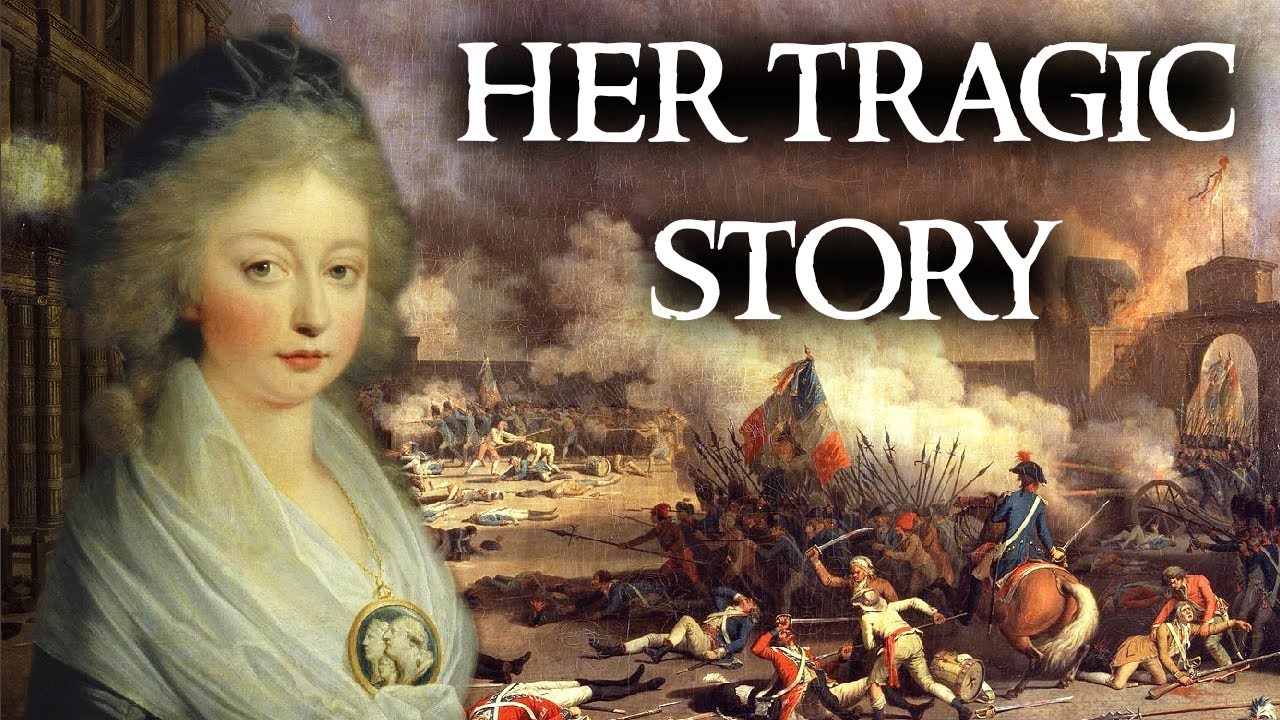
Contrary to popular perception, Marie Antoinette took an active interest in her daughter’s moral education, encouraging charity and compassion. Trouble, however, was brewing across France. A series of harvest failures and economic crises through the 1780s had destabilized the kingdom. In 1789, desperate to avert financial collapse, Louis XVI reluctantly convened the Estates-General, a parliamentary body that had not met in over 150 years.
The king believed he could grant minor concessions, disband the assembly, and return to ruling as an absolute monarch. He was profoundly mistaken. Within weeks, the assembly seized political power, moved the seat of government to Paris, and the revolution was underway. On 14 July 1789, a Parisian mob stormed the Bastille prison, marking a climactic moment in the revolution and exposing how marginalized the king had become in governing his own country.
In early October, a large band of Parisian citizens marched to Versailles and forced the royal family to relocate to the Tuileries Palace in Paris. They remained there for a year and a half, living under the watchful eye of the revolutionary government. In June 1791, a poorly planned attempt to flee France ended in capture at Varennes, poisoning relations between the monarchy and the revolution. In August 1792, Louis XVI was deposed, tried, and executed by guillotine on 21 January 1793.
Marie Antoinette met the same fate in October 1793. By the end of that year, Marie Thérèse, still a teenager, was an orphan imprisoned by a hostile revolutionary government, separated from her younger brother Louis Charles, who was held in solitary confinement. Louis Charles, who royalists regarded as the rightful King Louis XVII, died on 8 June 1795, at the age of ten. The cause was almost certainly tuberculosis, the same disease that had killed his older brother and sister, but an autopsy revealed signs of physical abuse, and the boy had evidently been mistreated in captivity.
His death came just as the most violent phase of the revolution was ending, and with it, the revolutionary government’s willingness to hold Marie Thérèse prisoner weakened. In December 1795, weeks before her seventeenth birthday, she was released and permitted to leave France. She arrived in Vienna in early 1796, the only member of the Bourbon royal family to survive prolonged imprisonment by the revolutionaries. Soon after, she was relocated to Courland, in present-day Latvia, where her uncle, Louis Stanislas, brother of the executed king, had installed himself as the self-proclaimed King Louis XVIII.
The exiled king wanted Marie Thérèse to marry Louis Antoine, son of his other brother, Charles Philippe. Despite the close family relation, she agreed, and the couple married on 10 June 1799, at the Jelgava Palace in Latvia. They subsequently settled in Britain, where they might have lived out comfortable lives in exile had events in France not intervened. In the late 1790s, the French Republic had mutated into a military dictatorship under General Napoleon Bonaparte.
In 1803, Napoleon crowned himself Emperor of the French, and years of war followed. He conquered much of Europe before overreaching and suffering defeat in Russia. Forced to abdicate in 1814, Napoleon’s fall opened the way for the Bourbon restoration. Louis XVIII assumed the French throne, and despite a brief return by Napoleon in 1815, the Bourbon monarchy held.
Louis XVIII ruled until his death on 16 September 1824, when he was succeeded by his brother, Charles Philippe, who became King Charles X. Thirty years after her parents’ executions, Marie Thérèse now found herself married to the heir apparent to the French throne. Her husband, Louis Antoine, was the new king’s eldest son. Charles X, however, was deeply unpopular.
A staunch royalist, he alienated broad sections of French society by attempting to strengthen the aristocracy and support the Catholic Church in ways that reminded people of the absolutist rule that had preceded the revolution. He launched a colonial war in Algeria to shore up domestic support, but his absolutist tendencies ultimately led to his downfall. In July 1830, he issued a series of ordinances that dissolved parliament, restricted voting rights, and censored the press. Days of rioting followed across France in what became known as the July Revolution.
Realizing his situation was hopeless, Charles X abdicated on 2 August 1830 in favor of his son, Louis Antoine. But Louis Antoine’s prospects of quelling the unrest were no better than his father’s. Though it is believed Marie Thérèse urged him to assume the throne, he hesitated. Twenty minutes after Charles X’s abdication, Louis Antoine renounced his own rights to the crown in favor of his nine-year-old nephew, Henry, hoping the boy could serve as a consensus candidate.
For those twenty minutes, however, Louis Antoine was technically King Louis XIX of France, and Marie Thérèse, the daughter of Louis XVI and Marie Antoinette, was briefly Queen of France. The succession crisis was resolved a week later. On 9 August 1830, the French Chamber of Deputies rejected the young Henry as an unacceptable candidate and instead offered the throne to Louis Philippe, a member of the House of Bourbon whose father had supported the French Revolution. He accepted the throne that same day and ruled as King Louis Philippe I for eighteen years in what became known as the July Monarchy.
Following her brief reign, Marie Thérèse and her family, including her husband and the deposed Charles X, went into exile, fearing violence if they remained in France. On 16 August 1830, they departed from the port of Cherbourg for Britain, where they were received coldly in England, a country with a long history of conflict with the French monarchy. They soon resettled in Edinburgh, Scotland, where they remained for just over two years. In late 1832, Emperor Francis I of Austria invited the exiled Bourbons to reside in the Austrian Empire, the land from which Marie Antoinette had originally come.
They took up residence at Prague Castle in Bohemia, then relocated again in 1835 to Gorizia, in present-day Slovenia, then part of Austria. Shortly after arriving there, Charles X contracted cholera and died on 6 November 1836. Marie Thérèse’s final years passed in relative obscurity compared with the turmoil of her earlier life. Her husband died in 1844, after which she moved once more, to the outskirts of Vienna.
Marie Thérèse lived long enough to see another revolution sweep through France in 1848, which deposed Louis Philippe and briefly established the Second French Republic. That republic proved short-lived; in 1852, Louis Napoleon Bonaparte, nephew of the great general, proclaimed himself Emperor Napoleon III. Marie Thérèse died several weeks before that event, on 19 October 1851, of pneumonia, at the age of seventy-two. A lifelong exile from France, she was buried in Gorizia beside her husband and uncle.
Her gravestone bears the inscription “Queen Dowager of France,” a final remembrance of the fact that the eldest child of Louis XVI and Marie Antoinette reigned as queen for just twenty minutes in 1830.