In the spring of 1887, a surveyor named Jedediah Strath was sent from Charleston into the mountains of western Virginia to assess a ridge line parcel for coal and iron ore. The land company he worked for had been quietly buying mineral rights across the region, and Strath, thirty-four years old and confident from a career spent in cities, expected a straightforward two-week job. He came up the narrow valley road in late April, hired a driver named Orville to take him as far as the bottom of the hollow, and was left there when Orville refused to go further. Strath walked the last mile and a half into the small town of Crain’s Hollow on foot.
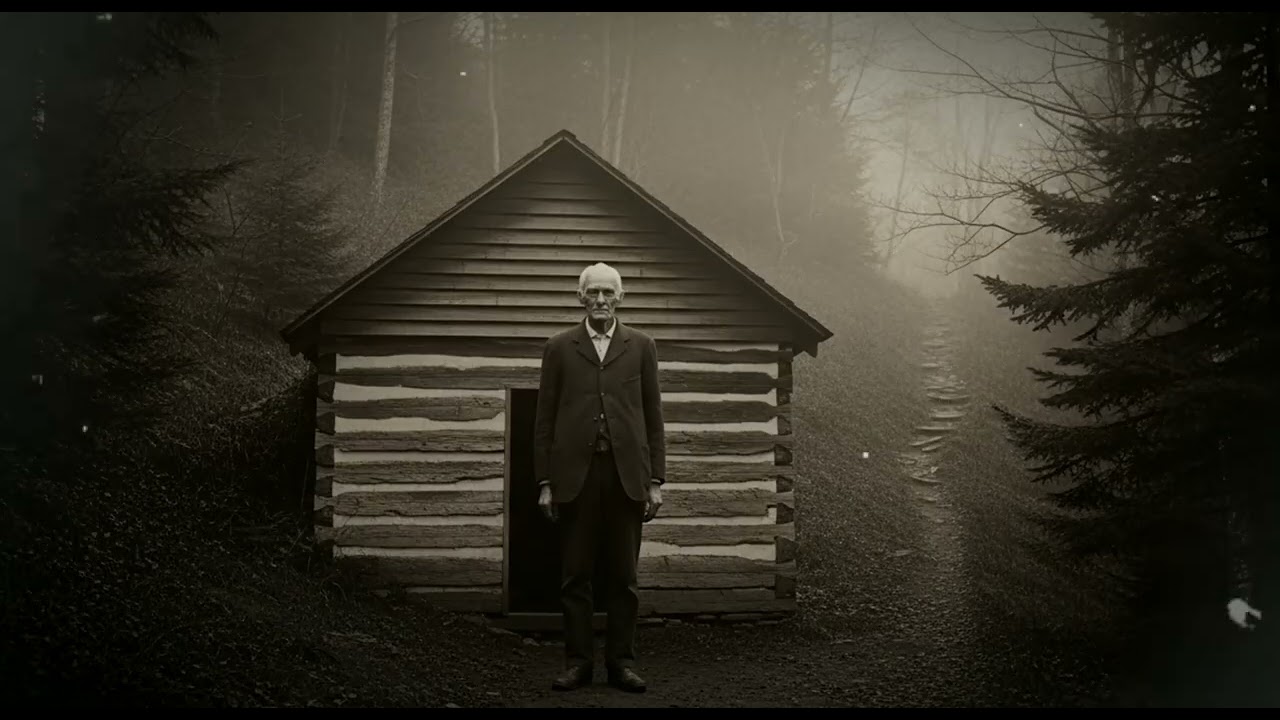
The town held roughly two hundred and thirty people. It had a general store, a post office, a church, and a mill fed by snowmelt. The valley was so deep that the sun disappeared behind the ridges by two in the afternoon, leaving the town in cold gray shadow until morning. Locals called it getting shadowed out and thought nothing of it.
Strath took a room at the boarding house run by a widow named Harriet Doll, and from his window he could see a low, long house built of gray stone on the ridge above town, mossy at the base, looking as though it had grown out of the mountain. He asked Harriet about it. She told him it belonged to a man named Corvus Aldenmore, and she said nothing more. Strath began his survey and found the work straightforward.
On his sixth day, working near the tree line, he heard footsteps moving parallel to him through the undergrowth, matching his pace. He called out. No answer. The footsteps stopped after ten minutes.
That night, he noticed a lamp burning in a window of the stone house that had not been lit before. The next morning, Harriet sat down across from him and warned him plainly: Aldenmore was not a man to go looking for, and curiosity was an invitation. Strath did not take the warning as seriously as he should have. On the ninth day of his survey, near the creek bed at the northern edge of the parcel, he found a dressed stone, shaped by hand with squared edges and a smooth face.
Cut into the face was a pattern of concentric lines interrupted at irregular intervals by short perpendicular cuts. He found eleven such markers that day, evenly spaced, all facing northeast, each paired with the same pattern cut into the bark of a nearby tree. He showed his sketches to Aldous Fenwick, the quiet mill worker who boarded at the same house. Aldous studied them, pushed them back, and said the stones were old, older than the town, and that Strath should leave them where they were.
Strath had been in Crain’s Hollow for two weeks when Aldenmore came down to the market on a Thursday. He was an old man, tall and still straight, with long white hair and clothes decades out of fashion. He moved through the crowd without speaking to anyone, and the people around him shifted away in small, practiced movements of avoidance. He bought nothing.
He was gone within twenty minutes. That night, Strath asked Harriet how often this happened. She said twice a year, sometimes three. Then she told him that Aldenmore now knew Strath was there.
Strath should have filed his notes and returned to Charleston. Instead, he wired his company that the initial survey had revealed complications requiring extended fieldwork. The company replied that they expected his full report within the month. He read the reply, folded it, put it in his pack, and went back up the hill.
He kept working through June, but his private journal tells a different story from his official survey records. He had begun mapping the marked stones on his own time. By the end of June, he had plotted forty-seven of them, arranged in a pattern he could see but not read. He wrote in frustration about having the data without the grammar.
In late May, Aldenmore appeared behind him at the tree line and spoke. He said Strath had been counting his markers. Strath asked what they marked. Aldenmore said they marked the boundary of what was his.
Then he said there was no coal on the ridge, and that the geological surveys were measuring the wrong thing. He turned and walked back up the slope and disappeared into the trees. Strath found more markers as the summer deepened, including a cluster of smaller, cruder stones in a depression on the western slope. Aldenmore appeared there too, and said those stones were older than the count Strath used.
He told Strath he was the first outsider to find that place, and that it meant he had a particular kind of attention, which could be useful. Then he invited Strath to his house on Saturday morning. Strath spent two days deciding whether to go. He wrote arguments both ways in his journal and concluded that visiting the man the whole town avoided was not a sensible decision.
On Saturday morning, he woke before dawn, put on his boots, and went up the ridge road anyway. The path was clear. At a certain point the character of the forest changed, the trees older and more deliberately spaced, the undergrowth thin as though the ground itself had been tended. Aldenmore was sitting outside on a flat stone, watching him come up.
He said he had thought Strath would not come. Strath said he almost had not. Aldenmore said good. Inside, the house was not what Strath expected.
It was one large room with a hearth, a curtained sleeping area, and shelves covering three walls, hundreds of them, holding ceramic jars, wooden boxes, leather cases, and books, bound volumes and sewn bundles, many older than anything Strath had seen outside a museum. He said, without thinking, that it was a library. Aldenmore corrected him. It was a record, organized for sequence, not retrieval.
The sequence was what happened, in the order it happened, over a long period. They met three more times that summer. Aldenmore spoke of the ridge, of the people who had come through, of things taken from the land without understanding what they were, and of what happened when taken things were not returned. Things come back to collect them, he said, without drama.
He spoke of an event in the winter of 1844 that he called the clearing. A minister had come believing strange things existed only to be corrected, spent three days on the ridge, and made changes he had no authority to make. By winter, everyone who had come with him was gone, not dead, just gone. The ledger had collected what was owed.
Strath could not tell whether Aldenmore was speaking literally or metaphorically, and he suspected Aldenmore would consider the distinction irrelevant. In September, the company sent a second surveyor, a man named Percival Court, twenty-seven years old, ambitious, and certain that Strath’s assessment had been influenced by isolation. Court covered in four days what had taken Strath two weeks. He found the markers on his third day out and was curious about them in the way of someone who had never paid a price for curiosity.
Strath tried to warn him. Court listened politely and did what he had planned to do. In mid-September, he went up to the upper parcel and did not come back. He was found the next morning sitting at the base of one of the marked trees, physically unharmed.
His instruments had been laid out in a row on the ground. He was conscious but did not speak for days. When he finally did, he said only two things. He said he had not known, and that it was too old.
He was taken back to Charleston, recovered, and refused any further assignments in the mountains. Strath stayed through October and met with Aldenmore twice more. On the second meeting, he asked what Aldenmore was. Aldenmore said he was the account, the ledger.
Every transaction required someone to hold it, someone who could not leave. He had not chosen it. The place had chosen him, and after enough time, the man and the place had become the same thing. Strath asked about the clearing.
Aldenmore repeated that the ledger had collected what was owed. On his last evening in the hollow, Strath went to the marker cluster on the western slope and sat among the older stones. He left the next morning. Harriet clasped his hand and told him not to come back.
Aldous said he had seen more than most. He did not say goodbye to Aldenmore. Strath’s company abandoned the parcel. The official reason was geological unsuitability.
An internal memorandum dated November 1887 described the situation as requiring indefinite deferment and recommended that no company personnel be sent to the region without board authorization. None was ever issued. Four years later, a surveyor from a different company working several miles east filed a report that included a notation about the ridge above Crain’s Hollow. He noted the presence of a low stone structure near the ridgeline that appeared to be uninhabited, and added a footnote in different ink.
It said the structure had been unoccupied since at least the winter of 1889. Aldenmore was gone. No grave, no body, no record of departure. Strath, when he heard about the footnote through a colleague, wrote a letter trying to make sense of it.
If the account was gone, if the ledger had no keeper, then where did the count go? He concluded that it did not go anywhere. It waited. It waited for the next one.
Strath lived to sixty-seven. He returned to Charleston, became a senior partner at his company, and retired. He never published anything about Crain’s Hollow, but he kept his journal, his sketches, and a small dressed stone he had picked up from the marker cluster on his last visit. He wrote near the end of his life that he had kept it for thirty years and still could not say whether he had taken it or whether it had been given.
Some nights he woke at three in the morning, took it out, and looked at it. He did not know what he was waiting for. He had not put it back. After his death, the stone passed to his estate, was inventoried as one fieldstone, small, and was likely disposed of.
The archival fragment from the region, a single damaged page estimated to date to the mid-1700s, described the elder on the ridge as someone who had been there since before any man could account for, who did not change, and who was best left undisturbed. The minister at Crain’s church had made his peace with him, which his predecessor could not do, and which cost that man considerably. The fragment advised against asking what the elder asked in return for his peace, because it was better not to know the price of a thing until after you had declined to pay it. The town of Crain’s Hollow is smaller now than it was.
The mill closed and the road was paved and then largely forgotten. The foundation of the stone house is still on the ridge, and the markers are still in the forest below it, still oriented northeast, undisturbed. The people who know what they are still know enough not to touch them, and the people who do not know what they are find after a while that they feel a need to leave them alone too. Some things teach their own rules.
The count, if it is still running, is simply waiting for the next person to come up that ridge with a particular kind of attention, the kind that a strange old man once said could be useful. Old places have long memories, longer than the roads built to reach them, longer than the names given to them by people who thought they were the first to arrive. And some of what is old in those mountains does not measure time the way other things do. Waiting is not waiting at all.
It is just being, just holding the count, just marking the ledger and keeping the balance.