On a Saturday night in the early 2000s, a 75-year-old man walked onto the stage of the Grand Ole Opry, his body ravaged by radiation treatments that had seared his throat. The audience saw the lead singer they had always known, but the people backstage saw a man who could barely stand. His brother stood beside him, his tenor wrapping around the faltering melody, filling in the cracks, holding up the song with his own voice. For fifty-five years, Jim and Jesse McReynolds had produced a harmony so perfect it sounded like a single voice.
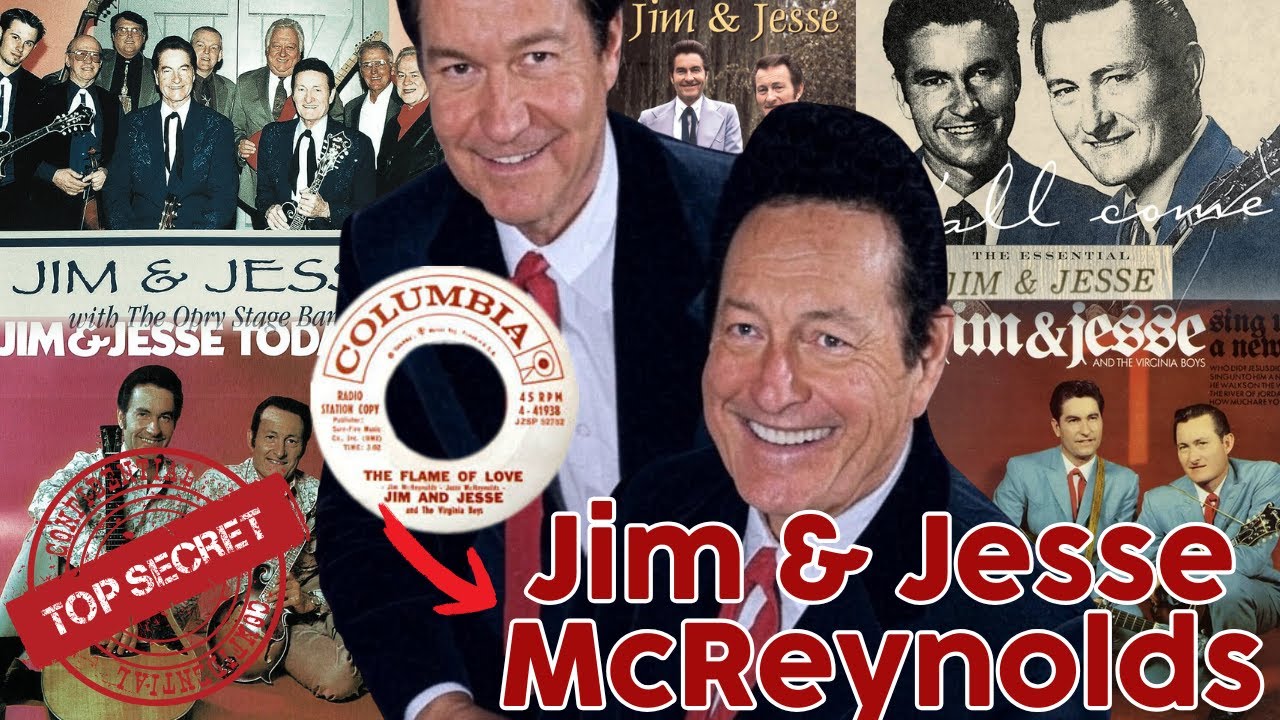
Now that harmony had become something else entirely: a brother using his instrument of voice to carry his dying brother through one more performance. They were the last brother duo, and one of them was singing his final notes. The story of Jim and Jesse McReynolds did not begin in Nashville. It began in a small unpainted farmhouse in Carterville, Virginia, where tobacco farming fed the family but music was their inheritance.
Their grandfather, Charles McReynolds, had been a master fiddler who took his band to New York in 1915 to record for Victor. Their father played fiddle and their mother played organ. There was no electricity in the house, but there was always music, and on a battery-powered radio, the boys absorbed the golden age of brother duets: the sweetness of the Blue Sky Boys, the drive of the Delmore Brothers, the raw danger of the Monroe Brothers. When they sang together as teenagers, something remarkable happened.
Jim’s warm baritone lead and Jesse’s pure tenor fused into a third voice that was uniquely theirs. In the mid-1940s, Bill Monroe hired Earl Scruggs, and bluegrass was born. Jim and Jesse, barely out of their teens, had the old-time music in their blood, the brother harmony in their throats, and the new sound in their ears. In 1947, they landed their first professional radio job in Norton, Virginia, and soon moved up to the legendary WWVA Wheeling Jamboree.
Their style was smoother, more polished than the raw Kentucky sound, and they were climbing fast. Then in 1951, the world intervened. Jim was drafted into the United States Army and sent to fight in Korea. For the first time since they had learned to sing, the third voice was silenced.
Jesse refused to quit. He became a hired sideman, playing mandolin for another duo and then briefly for Carter Stanley, one of the most foundational figures in bluegrass history. It was an education in surviving without his brother. Meanwhile Jim served on the front lines, saw combat, endured the brutal cold, and returned in 1952 a decorated veteran.
The moment the two brothers stepped back on stage together, the third voice returned, but it was stronger now, deeper, richer with experience. They packed their bags and moved to Orlando, Florida, where they landed a spot on live television. In the no-second-takes world of the 1950s, they were forged into genuine professionals. It was during this period that Jesse quietly started a revolution.
Obsessed with Earl Scruggs’ banjo rolls, he asked himself why the mandolin could not do the same thing. The mandolin was played with a single flat pick, and replicating the continuous, syncopated ripple of the banjo seemed physically impossible. Jesse spent thousands of hours developing a blindingly fast technique that struck three different strings in a continuous rolling motion. He called it simply Jesse’s style.
The world would call it cross-picking, and it was one of the most difficult techniques in all of string band music, a revolutionary new voice for an instrument that had never spoken that way before. They signed with Capitol Records in 1952 and recorded what are now considered bluegrass classics, but their timing was catastrophic. Elvis Presley had just entered Sun Studios, and rock and roll was about to redraw the entire musical landscape. Nashville producers created the Nashville Sound, drowning out the fiddles and steel guitars with string sections and smooth vocals.
Bluegrass was trapped in a commercial no-man’s-land, and Jim and Jesse were caught between the country mainstream that considered them too rustic and the bluegrass purists who found their polished sound too smooth. They bounced between record labels and worked the B circuit, playing high school auditoriums and regional fairs. They could have plugged in and added drums like the Osborne Brothers later would. Instead, they made a different wager: they would not compromise their acoustic purity.
They would outwork and outlast everyone. The lifeline came from two unexpected directions. The folk revival of the early 1960s created a massive new audience for acoustic music, and Jim and Jesse became staples on the folk festival circuit, their polished professionalism a perfect fit for educated northern audiences. The second lifeline was a bag of flour.
Martha White Flour, the legendary sponsor of bluegrass, gave Jim and Jesse their own syndicated television show, beaming them into living rooms all over the South five days a week. They became household names on a platform that bypassed the radio stations that had ignored them. The secret of their endurance was the bond itself. For fifty-five years as a professional duo, Jim and Jesse McReynolds never had a written contract between them.
Their entire decades-long business ran on a single verbal fifty-fifty agreement. In an industry notorious for lawsuits and betrayals, they were immune to the ego and rivalry that destroyed the Everly Brothers, the Louvin Brothers, and the Monroe Brothers. Jim was the front man and the anchor, handling bookings and money. Jesse was the musical engine, quietly tinkering and inventing.
They trusted each other completely. Their bus was clean, there was no drinking, no drama, no arguments. They arrived on time, wore matching suits, and performed flawless shows, then signed autographs for everyone in line and drove to the next town. On March 2, 1964, after more than fifteen years of professional grinding, they finally got the call.
Jim and Jesse were invited to become official lifetime members of the Grand Ole Opry. It was the coronation of two boys from Carterville who had spent their childhoods huddled around a battery-powered radio dreaming of that very moment. In 1967, their producer Billy Sherrill let them record a novelty song by an unknown songwriter named Jimmy Grizzard. Diesel on My Tail, a fast, witty story about a truck driver running from a smokey, was recorded as pure acoustic bluegrass.
Jesse kicked it off with a blistering cross-picking solo that sounded like a revving engine. The song shot up the Billboard country charts, peaking at number twelve, and became the flagship of the entire truck-driving music subgenre. They had achieved a massive mainstream hit without compromising their sound. The new stability gave Jesse freedom.
He had been listening to the Beatles, Merle Haggard, and most curiously, Chuck Berry. He translated Berry’s electric guitar licks to the mandolin, and in 1970 they released the album Berry Pickin’ in the Country, recorded one hundred percent acoustically. The purists were confounded. They had used the purest bluegrass instrumentation to play the most impure rock and roll, and the album was too technically brilliant to dismiss.
It sparked a quiet philosophical debate about whether their polished perfection had sanded off the grit of bluegrass, a debate that raged in the pages of Bluegrass Unlimited magazine for decades. Jim and Jesse ignored it and kept working, becoming improbable superstars in Japan, where Jesse’s cross-picking made him a sensei to disciples who studied his hands. In 1993, the International Bluegrass Music Association inducted Jim and Jesse into the Bluegrass Hall of Fame, the ultimate vindication. They were in their sixties, healthy, happy, and still singing in perfect harmony.
They had built a perfect, unshakable life, and none of them could have known that this very perfection was about to make the end so profoundly tragic. In the late 1990s, Jim began to feel unwell. A persistent fatigue, a rasp in his throat. Doctors ran tests and called him back.
It was thyroid cancer, a disease that attacks the very mechanism of the voice. Jim, the anchor, the man who had built an empire on stability, was facing the betrayal of his own body. He told Jesse, and they made a decision: they would fight and they would keep working. For several years, Jim underwent brutal radiation treatments during the week that seared his throat and left him so weak he could barely stand.
And then on Saturday night, he put on his suit, combed his hair, and drove to the Grand Ole Opry. Jesse carried his guitar. When they sang, Jim’s voice was thinner, fragile, and Jesse’s tenor would wrap around it, covering the cracks, filling in the waivers, literally holding up the melody. It was the sound of one brother using his own voice to carry the other.
By November 2002, the fight was almost over. The cancer had spread, the guitar was too heavy to hold, the voice was almost gone. Jim played his last show at the Opry with no announcement, no farewell performance. Just another Saturday night.
The applause came just as it always had. Then they turned and walked back into the darkness of the wings. On New Year’s Eve, December 31, 2002, Jim McReynolds passed away at the age of seventy-five. The fifty-five-year harmony was broken, and the third voice was gone from the earth.
The country music industry expected Jesse to retire. He was seventy-three. He had a lifetime of accolades. Instead, he made a decision of profound, almost stubborn loyalty.
He would not retire. The show would not become the Jesse McReynolds Show. It would remain, for the rest of his life, Jim and Jesse. For the next ten years, audiences at the Grand Ole Opry witnessed something remarkable.
Jesse McReynolds would walk to the center microphone, and beside him there would be a space, sometimes an empty space, sometimes a guitar on a stand under its own spotlight in Jim’s traditional spot. He would sing the lead vocal, the part Jim had sung for fifty-five years. Then the chorus would come, and Jesse would sing his high harmony, and his tenor would float out into the auditorium, a beautiful, perfect note of harmony reaching for a melody that wasn’t there. It was loyalty made audible, the sound of a void.
When journalists asked how he could bear it, Jesse would say quietly, Oh, I can still hear him. When I’m up there singing, I can hear Jim singing his part. Just as plain as day. He’s still right there with me.
Jesse McReynolds continued to perform a beloved patriarch well into his eighties, carrying the name Jim and Jesse until his own body began to fail. He passed away peacefully on June 23, 2023, at the age of ninety-three. The tragedy of Jim and Jesse was not a bond that shattered. It was a bond that held with perfect gentle strength for fifty-five years until it was severed by the one unavoidable force that no handshake deal can defy.
Their career was a testament to the sublime beauty of perfect harmony, and Jesse’s final lonely decade was a testament to the courage and profound loyalty of being the last brother left on stage, still singing for two.