When an enemy sultan sent Queen Tamar of Georgia a letter demanding her surrender, he made a fatal error. He opened the missive by declaring that every woman is feeble of mind. He continued by demanding that Tamar and her armies lay down their arms. Then he saved his worst insult for last: after her surrender, Tamar could become his wife if she converted to Islam, or his concubine if she refused.
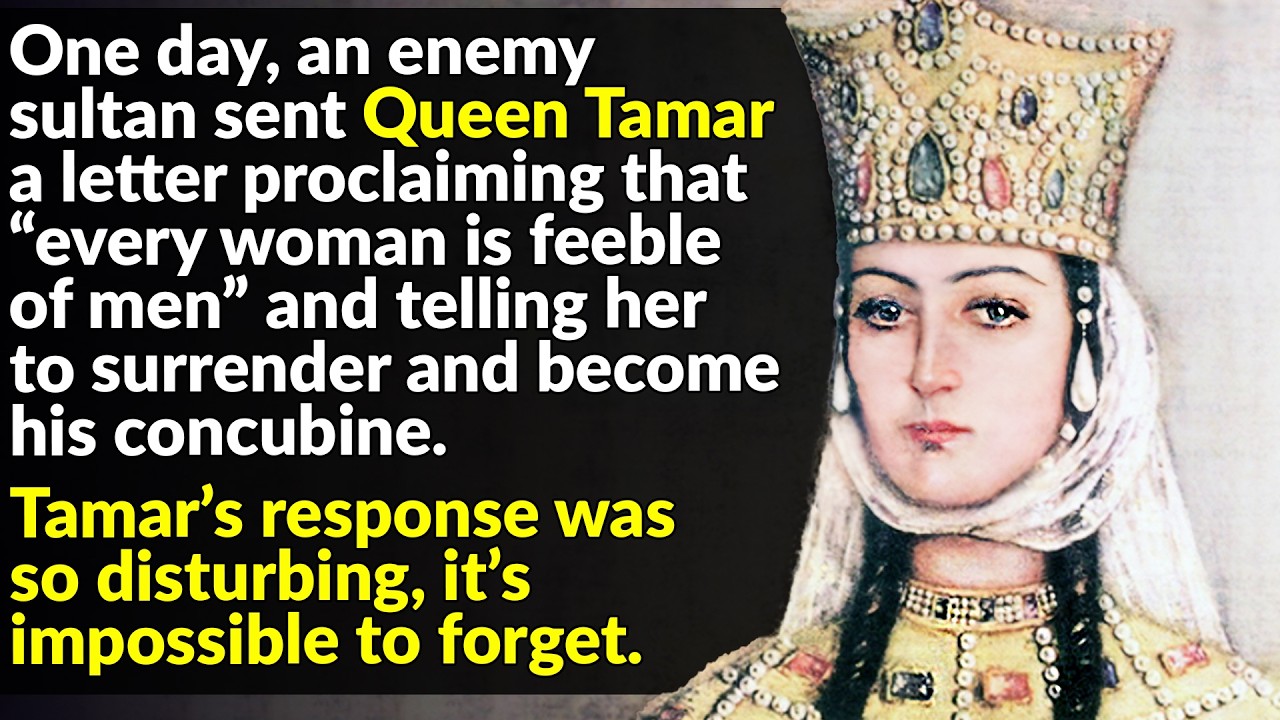
One of Tamar’s generals read the letter and was so enraged that he slapped the messenger unconscious. When the messenger regained his senses and returned to the sultan, he carried back a simple answer: Tamar would not be surrendering. She did not bother with a written reply. Instead, she rallied her army with one of her legendary speeches, sent her husband David to lead the charge, and destroyed the sultan’s forces entirely, seizing his territory in the process.
Historians have long found Tamar a puzzle. They struggle to reconcile her genuine piety and kindness with the brutal wars she waged. But for Tamar, the two were never in conflict. Her devout Christianity and her ruthless ambition worked together, making her one of the most successful monarchs of the medieval world.
Born around 1160, Tamar carried an extraordinary pedigree. The Georgian royal dynasty claimed direct descent from King David of Israel, a lineage that for Christians was nearly as prestigious as being descended from Christ himself. That heritage did not make her humble. In 1178, when she was about eighteen, her father named her co-ruler, making her Georgia’s first queen.
That title was not enough for her. She wanted no confusion about her intentions, so she began calling herself King of Kings, the first of many power moves that defined her reign. Power attracts the power-hungry, and Tamar faced challenges from the very beginning. A man named Kutlu tried to establish a council that would make the laws instead of the queen.
The attempt did not go well for him. Tamar had him detained and thrown into prison. She showed mercy to the rest of his faction, telling them to abandon their leader, give up, and go home. They did.
But they soon had an unwise change of heart, marched back to the queen, and demanded Kutlu’s release. Tamar was unafraid. She sent two noble women to negotiate with the rebels. The details of that conversation are lost, but the result is not.
Within moments, the men who had been planning to attack were on their knees, swearing loyalty and obedience to the queen. When Kutlu was finally released, he and his allies tried again to push their plan for a power-sharing arrangement. Tamar strung them along, letting them believe she was open to negotiation, then shut them down at every turn. The chroniclers of the era were not kind to him.
One referred to him as a boy and a mule. Tamar, by contrast, was remembered as a woman endowed with the intelligence and courage of a man, high praise in the medieval period. Queen Tamar was about to meet her match, though not in the form of a rival politician. Like most medieval queens, she did not choose her own husband.
Her aunt selected him for her. On paper, the choice was solid. The man, Yuri, was a prince, politically important, a good soldier, and, according to one source, perfect of body. Unfortunately, looks were not everything.
Yuri was inebriated nearly all the time. As the marriage wore on, he developed a taste for power that he liked too much. There were also rumors that he had his own reasons for unhappiness in the marriage, including whispers that he preferred men. None of this made for a blessed union.
After two years of a doomed marriage, Tamar took drastic action. Divorce was looked upon poorly in the Orthodox Christian kingdom of Georgia in the twelfth century, but she did not let that stop her. In 1187, she persuaded the Georgian church leaders to grant her the divorce. They agreed without hesitation, perhaps because they should have known better.
After the divorce, Tamar arranged to have Yuri sent far away, eight hundred miles to Constantinople, a completely different country where they spoke a different language. Tamar enjoyed three years free of her ex-husband. Then Yuri returned and staged a coup against her. He failed.
He was such little threat that Tamar did not even bother imprisoning him, a decision she may have regretted. Even after she pardoned him, Yuri tried a second rebellion. He failed again. One good thing came from these coups.
Tamar had a devoted ally in Prince David Soslan, a handsome and exceptionally skilled fighter who had been one of her aunt’s students. Whether Tamar was following her heart or her strategic instincts, she married David in 1189. He proved his loyalty in the most dramatic way possible: defeating her ex-husband Yuri and his band of rebels in battle. The new power couple was just getting started.
Tamar was a hands-on ruler who rode with her men and relished delivering rousing speeches before battle. She also gave away enormous sums of money to those in need. When she learned that a group of monks had lost their quarters to fire, she sent funds to improve their living situation dramatically, enough to install an irrigation system, build a mill, and plant a large garden. But even her generosity carried a warning.
When she sent money to monks in Constantinople and the Byzantine emperor Alexios III Angelos confiscated it for himself, Tamar retaliated. She set her sights on his territory in Trebizond, in modern-day Turkey, and sent in her army. She did not forget the monks while she was fighting. She sent them even more money than originally intended.
After defeating the Byzantine emperor and seizing part of his territory, Tamar gave its rule to one of her younger cousins, creating a staunch ally and extending her network. She spread her wealth around the kingdom, forgiving debts and giving ten percent of the country’s wealth to the lower classes. The people were not receiving pennies. One observer remarked that peasants were like nobles, nobles like princes, and princes like kings.
Her reign is still called Georgia’s Golden Age. Even while she led battles, pillaged, and plundered, she abolished the worst torture punishments, which only increased her popularity. It was during this heyday of conquest that the neighboring sultan made his fatal mistake. Seeing Tamar and David’s successes, he grew worried and sent his insulting letter.
Her response, crushing his army and taking his land, was her final answer. Tamar was so revered that she was named a saint while still alive, an extraordinary honor in a tradition that usually waited until after death. But sainthood did not make her immortal. In 1213, at the age of fifty-three, she fell suddenly ill while holding a business meeting in her summer residence.
By the standards of the twelfth century, her age was equivalent to seventy-five today. She never recovered. Her final resting place was a monastery, fitting for a queen so friendly with monks. But her exact burial site remains unknown.
Some believe it was kept secret deliberately. Scholars have searched, pilgrims have searched, and perhaps heartbroken medieval men searched as well. No one has found it. It is likely hidden somewhere in the Gelati Monastery, which still stands intact eight hundred years later, open to visitors for free.
Queen Tamar’s body may never be found, but her legend, and the Golden Age she built, endured long after she was gone.