On July 12, 1864, Fanny Kelly was 19 years old, standing beside a wagon at Little Box Elder Creek in what is now central Wyoming. Within minutes, three of the men she loved would be shot dead on the ground beneath her feet. Her adopted daughter would be dragged onto a horse. She would begin 150 days that no book, no photograph, and no letter she ever wrote would fully describe.
About 250 warriors were already watching from the bluffs. She did not know that yet. She thought they were curious. She thought the tobacco her husband was offering would settle things.
The wagon party she had joined would cease to exist. Four men would be dead in the grass, four captives would be on the trail, and one woman would spend the rest of her life trying to find words plain enough to say what happened next.
The attack was not the end of the horrifying part. It was the door.
Fanny Kelly would spend the next five months in the lodge of a chief three times her age. Along the way, something impossible would happen. A young Sihasappa warrior named Jumping Bear would step between her and an arrow aimed straight at her heart and risk his own standing among his people to keep her alive. Nobody has ever fully explained why he did it.
There was also a child in that wagon. Her name was Mary. She was Fanny's sister's daughter. She never came home.
Two months before the shots, the story began on a spring morning in Geneva, Kansas.
On May 17, 1864, a small party of six plus one extra was preparing to leave. A friend named Gardner Wakefield was loading the last of the trunks. The mood was not somber. It was the exact opposite.
Fanny was 19 years old, literate, and careful with a pen. She was married to a man named Josiah, who wanted a fresh start in the gold fields of Idaho. In her own words, they set out with high hopes and pleasant anticipations of a romantic and delightful journey across the plains, and a confident expectation of future prosperity among the golden hills of Idaho.
That is the voice of a young woman who could not see the next 90 days coming. It is the whole tragedy compressed into one line she wrote afterward.
Josiah Kelly was the head of the household, a settler, most likely a farmer or small tradesman. He was the kind of man who had spent his whole life being told that being careful and being brave were the same thing.
Riding with them was a little girl named Mary, sometimes called Mary Hurley in the records. She was Fanny's sister's child, adopted by the Kellys and treated like their own.
Traveling as hired hands were two Black men named Frank and Andy, recently freed or freeborn and looking for wage work far from the wreckage of the slave South. Their reasons for going west were entirely their own, and their names have almost slipped out of history.
Out on the northern plains, the Lakota were not waiting for a wagon train. They were watching an invasion. Every year the road got wider. Every year the buffalo herds broke apart a little more.
In 1864, General Alfred Sully's columns were already burning camps and killing families to the north. The young men riding with a chief called Otawa—Aglala, Miniconjou, and Hunkpapa together—were not raiders in some distant story. They were sons, husbands, and brothers defending a country that was disappearing under wheel ruts and gun smoke.
By early July, the Kelly party had joined up with another family: a woman named Sarah Larimer, her husband Noah, and their 8-year-old son Frank. Seven adults and two children, two wagons, and ahead of them a shallow crossing on the Oregon Trail that had until now been just another stop for water.
By July 1864, the Oregon Trail was not the wilderness route of a decade earlier. It was rutted, dust-choked, and busy. Fifteen to 20 miles was a good day for oxen.
The Kelly-Larimer party rolled two ox-drawn wagons loaded with everything two families would need to build a life 2,000 miles away. Flour sacks, feather beds, trunks with iron latches, cooking pots, a little livestock trailing behind, bedding rolled tight against the rails.
This was not a military column. It was a household on wheels. That distinction would matter more than any other single fact in the story.
When 250 warriors rode down out of the bluffs, they were not met by a defensive line. They were met by a 19-year-old woman, an 8-year-old boy, and a handful of men whose rifles were propped up somewhere they could not reach in time.
The overland immigrant guide sold in Kansas and Missouri in 1864 recommended traveling in parties of at least 50 armed men. The Kelly-Larimer group had at most six men capable of firing a weapon. They knew this. They went anyway, because staying meant being poor forever and going meant maybe not being.
The war party that found them at Little Box Elder was not one band. It was three moving together: Aglala, Miniconjou, and Hunkpapa Lakota. Fanny would later estimate about 250 men, painted and equipped for war, led by an Oglala war chief she called Otawa.
Otawa was a name spoken carefully among the Lakota that summer. He was experienced. He had raided immigrant trains before. He knew the roads. He knew precisely when the wagons would be at the creek.
From the Lakota side of that ridge, Otawa was not a villain. He was a commander defending hunting grounds his grandfather had walked. Sully's soldiers were already killing his people to the north. The wagons kept coming. The treaties kept breaking.
When Otawa's riders came down toward the creek that afternoon, they were not surprising a settlement. They were doing, in their world, exactly what a general in blue would have done in his.
When the riders first appeared, coming at full speed from the bluffs, the wagons could have done one of two things. They could have circled the wagons, drawn the rifles, and prepared for a fight they would probably lose. Or they could have tried to talk.
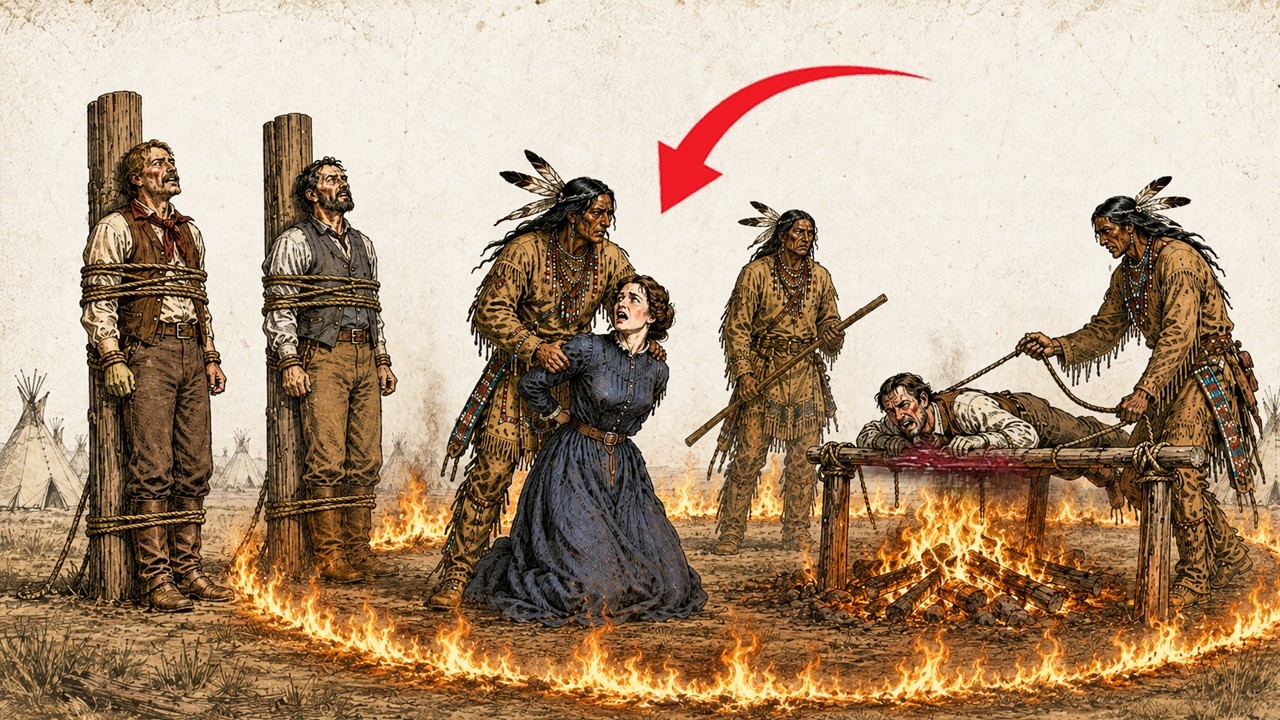
Josiah Kelly chose to talk.
The riders slowed. They came in, and for something between 10 and 20 minutes, the two groups stood in a kind of terrible pantomime of peace. Warriors examined the wagons. Immigrants offered tobacco.
Fanny remembered trying to smile. She remembered handing food out with hands she could not stop from shaking. She remembered thinking over and over that if they were kind enough, if they were generous enough, this would end well.
Every second she stood there offering flour to a man with a painted face was a second Josiah could have shouted a warning and reached for a rifle. Every second was a bet. She was betting her daughter's life on courtesy. She was betting Frank and Andy's lives on the goodwill of strangers who owed her nothing.
Historians have argued for nearly two centuries over whether Fanny truly believed the party might survive by kindness, or whether she already knew in some deep place that the parlay was theater and the ending was coming. The emotional truth of the moment is beyond dispute. A 19-year-old woman stood at a creek in Wyoming and chose to hope.
The warriors were not waiting for the tobacco. They were waiting for the men to relax. They were waiting for Josiah and Andy to wander off toward the treeline for firewood, which right on cue the two of them did. They were waiting for the rifles to be out of arm's reach.
When the last piece slid into place, the parley ended. Nobody was looking. That is the phrase every surviving account uses.
On July 12, 1864, 14 miles west of present-day Douglas, Wyoming, the sun was low enough that shadows stretched across the grass in long unbroken lines. The wagons had crossed Little Box Elder Creek—muddy banks, shallow water, an hour of work getting the oxen and the wheels through. Everyone was tired. Everyone smelled like sweat and river mud and animals.
Fanny was with the wagons. Sarah Larimer was nearby with young Frank. The adopted daughter Mary was close. Reverend Sharp, a minister traveling with the party, was somewhere in the middle of the camp. Noah Larimer was at the driver's seat. Frank, the Black hired hand, was unloading something near the tailgate. Josiah and Andy had walked off maybe 70 or 80 yards, looking for firewood in the treeline along the creek.
The first riders appeared on the bluffs, then more, then more. Fanny would write later that they came at full speed, but her own count settled at about 250, painted, equipped for war, moving with the discipline of men who had done this before.
The distance closed from a few hundred yards to a hundred, then 50, then the lead riders were among the wagons.
Signs, gestures, a word or two of Lakota or trade jargon. Fanny handing out tobacco. Reverend Sharp offering food. Noah Larimer trying to look calm on the wagon seat while his son played a few feet away.
Fanny would describe those minutes in her book with unnerving clarity. She wrote of a small company of immigrants attacked by an overwhelming force, which resulted in the death of a large proportion of the party, her own capture, and a horrible captivity of five months' duration. She wanted the reader to understand it in one breath, because in one breath is roughly how long it took.
Nobody wrote down what the signal was. Maybe a shout, maybe a raised hand, maybe just a look between Otawa and the two or three warriors nearest him. But at some moment inside those 10 or 20 minutes of theater, the signal passed and the guns and bows came up.
Reverend Sharp was looking somewhere else. Noah Larimer was looking somewhere else. Frank, the hired hand, was looking somewhere else. That phrase—no one was looking—was not a metaphor when Fanny wrote it. It was the literal, unforgivable fact of the moment.
The immigrants had spent 20 minutes convincing themselves that a friendly conversation was in progress. The warriors had spent 20 minutes waiting for exactly the second when everyone's back was turned.
The volley—rifles, arrows, close range, 30 to 50 yards—took perhaps two seconds to fire. Reverend Sharp fell. Noah Larimer fell. Frank fell. A rider who arrived a moment later, a stranger to the party whose name history did not keep, fell. Four men dead in the grass before Fanny fully understood what had happened.
Multiple rifles firing at close range produce a wall of noise that flattens the ears. Then the smell: sulfur gunpowder smoke thick as fog in the still summer air. Then a silence so sudden it felt louder than the shots. Then the screaming started from the treeline.
Josiah Kelly saw it. All of it. He and Andy had gone for firewood, a decision that saved their lives and would haunt Josiah for the rest of his. Now they were 70 or 80 yards away, watching the wagons through brush, watching the warriors move among the bodies, watching their wives and children be dragged from the wreckage of what had been a family four minutes earlier.
Two men with rifles against 250. If he moved, he died. If he shouted, he died and gave nothing to anyone. So he did the only thing left. He stayed. He watched. And he learned in real time what helpless actually means.
Later accounts would summarize what Josiah and Andy saw in the flattest, most terrible sentence in the whole record: they watched helplessly from cover as the warriors murdered three members of the wagon train and seized four others as captives.
That is the whole event compressed into 13 words. Everything else in this story—five months, an arrow at Fanny's heart, a girl who never came home—is the meaning of those 13 words unfolding.
But the shooting was not the end of the attack. It was, in a way, only the announcement of it. Because now Otawa's warriors turned toward the wagons themselves, and toward the four human beings still alive inside them.
With four men dead, the warriors moved to the wagons. Fanny would write about this phase with a level of specific physical detail that suggests she never stopped seeing it.
Trunks were dragged out. Iron latches broken with rifle butts. Feather beds, family heirlooms, the goods a household needed to build a life in Idaho—ripped open and emptied on the ground. Flour sacks slashed. Cooking pots thrown clear of the wheels.
Here is her own description, worth reading in her own uneven spelling, because the spelling is part of the voice: flour sacks and feather beds ripped open and all emptied out on the ground, trunks and boxes thrown out of the wagons and broken open and robbed, and what they could not carry off destroyed there on the ground. Then they packed their ponies.

She does not say the warriors were cruel for tearing open the beds. She does not say they were greedy for taking the trunks. She writes it as reporting, because she understood later, if not then, that the wagons were being unmade in a specific way.
The Lakota did not need feather beds. They needed everything else: metal, clothes, rope, food that would last. And what they could not carry, they broke, because leaving a functional wagon on the trail was leaving a weapon for the next settlers coming through.
This phase, the looting, took at least an hour. Sixty minutes of a woman standing in the wreckage of her household, watching strangers make decisions about which pieces of her life would ride away on the ponies and which would rot in the grass.
Through all of it, four men were still lying in the grass where they had fallen. Reverend Sharp, Noah Larimer, Frank the hired hand, the unnamed rider. Nobody covered them. Nobody said a word over them. They would lie there until the next morning, when a wagon train coming up the trail would find them and dig four graves on the west side of the creek.
Then the warriors turned to the four still alive: Fanny, Sarah Larimer, the little girl Mary, and Sarah's 8-year-old son, Frank. Two women, two children.
Fanny was dragged from wherever she had been standing. Mary was picked up. Sarah was put on a pony. Frank, the boy, was lifted onto another. The word for what was happening here is capture, but the word does not do the work.
This was a 19-year-old woman and an 8-year-old boy and a small girl being loaded onto animals in the middle of a field where the men who loved them were lying dead 10 yards away.
Fanny would remember the sound of the children crying. She would remember the shrieks—hers, Sarah's, Mary's—mixing with the yells of the warriors. She would remember the specific physical sensation of being lifted onto a pony that did not know her, whose neck smelled like sweat, whose gait she had to learn in the next 30 seconds, because falling off meant something worse than staying on.
Focus on one pair of hands. Small hands. A child's hands gripping the mane of a horse she has never seen before, while the woman she calls mother is on another horse 10 feet away, and neither of them will ever ride into Idaho.
The direction of travel changed. The wagons had been going west. Idaho was west. Prosperity was west. The warriors turned the captives north, into Lakota country, into a landscape Fanny had no map of, no name for, and no way back out of.
On that first evening they rode maybe 10 or 15 miles, with halts to redistribute loads, halts to check for pursuit, halts to argue quietly about the captives themselves—what to do with them, who would keep which one, which ones were worth keeping at all.
Fanny understood almost none of these conversations, but she understood at a level below language that decisions were being made about her life, and none of the people making them cared what she thought.
For Sarah Larimer and her son Frank, the first nights were the whole story. Fanny would later describe, with a note in her voice that historians have argued about for a century, that after two nights Sarah and Frank simply disappeared—escaped, aided in the plainest possible language by a friendly Indian in the band, someone who did not agree with what was happening. Someone who cut a rope or turned his head at the right moment or pointed them toward a specific patch of brush.
That single fact—a Lakota man helping a captive white woman escape after 48 hours—is one of the pieces of this story that gets cut from popular versions because it complicates. It suggests that the war party was not a single mind. It suggests that among the 250 men who came down off the bluffs, there was at least one who thought this was wrong, and there is no reason to assume he was the only one.
But Fanny did not escape that night. She did not escape any of the nights that followed.
Fanny was given, sold, transferred, claimed. The language shifts depending on the source. She was placed with a chief in the band who was, in her own description, in his 70s. Later accounts less delicate than hers would use the phrase "trophy bride."
A 19-year-old woman, married two months before her capture to a man she loved, living in the lodge of a man three times her age, performing the domestic labor of a wife she had not chosen to become.
She would not, in her published book, name most of what happened in that lodge. Nineteenth-century readers would not have tolerated the naming, and Fanny knew her audience. But she made sure, with the careful placement of the word coercion, with the description of her fear, with the note that her days involved threat as well as labor, that anyone reading closely would understand.
While she was moving with the band, General Alfred Sully's columns were sweeping the northern plains, burning camps, chasing the Lakota into worse and worse country. The band holding Fanny reacted the only way it could, by running 20 miles a day, sometimes 30—forced marches through August heat and September cold, with a young woman on foot or on pony among them, learning every ridge and every creek in a country she was not supposed to survive.
Sully's own expedition would later report in the flat professional voice of a military dispatch that while on the expedition, they had ascertained that Mrs. Fanny Kelly was a prisoner of the Indians they were then engaged against.
The army knew she was there. The army was still shooting. Fanny Kelly in the fall of 1864 was being hunted by both sides.
Through all of it, she was watching, listening, learning. The Lakota she was living among were not to her the faceless enemy of the newspapers back east. They were specific people with specific names, specific arguments, specific children. She could not forgive them. She would never forgive them. But she could see them. And when she wrote the book seven years later, that seeing would leak through the language, even where she did not intend it to.
Then came the day Fanny nearly did not survive. It happened by her account at a camp somewhere that autumn. The exact date is lost, the exact place unclear.
Property disputes were common in the band. Horses were stolen, retaken, argued over. On this day, a brother-in-law of the chief who held Fanny lost a horse and decided in a rage that was not quite about the horse that the white woman would pay for it.
He drew his bow. He walked to where Fanny was. He raised the arrow. Fanny would write later that she felt her own heart racing in her chest so hard that the pounding felt like it might do the arrow's work for it.
His brother-in-law, enraged at his arrogance, drew his bow and aimed his arrow at my heart, determined to have satisfaction for the loss of his horse. When a young Blackfoot, whose name was Jumping Bear, saved me from the approaching doom by adroitly snatching the bow from the savage and hurling it to the earth.

A young Sihasappa Lakota warrior, a member of the same broad cultural world as the man who had aimed the arrow, stepped forward, took the weapon out of the other man's hand, and threw it on the ground in front of everyone.
Jumping Bear did not just save Fanny's life. He publicly humiliated another warrior over the life of a captive white woman in a camp where captive white women were not supposed to matter. Nobody has ever fully explained why.
Fanny herself did not know why, but she remembered the name Jumping Bear. She wrote it into her book, knowing that thousands of readers who wanted a story of savages would have to read, whether they liked it or not, the name of the man who saved her.
Fanny wrote in the plainest possible sentence that her captivity lasted five months. She was taken on July 12. She was delivered back to United States authorities in December. One hundred fifty days, give or take.
A number any reader can count in their head and no reader can actually understand, because five months is not five months when every day contains the fear of a bow being raised again. Five months is a life.
Meanwhile, remember the other captives. Sarah Larimer and her son Frank had made it back to the Deer Creek Trading Post after only two nights with the war party, aided again by a Lakota man Fanny would never name and history has never identified.
Sarah's captivity was 48 hours. Fanny's was 150 days. Same attack, same wagons, same afternoon. Utterly different lives afterward. History books usually pick one of the two women to remember. The other is a footnote. It is worth asking why.
And Mary, the little girl, Fanny's sister's daughter, the child the Kellys had adopted and taken with them because leaving her behind in Kansas had felt once like the cruel choice—Mary tried to escape. That much is in every account. Whether it was days into the captivity or weeks, the record does not say.
But at some point in that first stretch, the child decided she could not stay and she ran. A warrior caught her and a warrior killed her.
Fanny wrote about it in her book in the way people write about the moments they cannot fully look at: obliquely, briefly, and with a grief that presses through the paragraphs on either side. She had promised her sister she would keep the child safe. She had failed. She would carry that failure for another 40 years.
What ended Fanny's captivity was not a rescue. There was no cavalry charge. There was no daring escape. What ended it was diplomacy—the specific, patient work of Sihasappa Lakota emissaries who saw in Fanny a hostage whose safe delivery could earn favor with the United States.
She was ransomed from the Hunkpapa band that then held her, moved across the northern plains under escort, and in late 1864 handed over to General Alfred Sully at a fort along the Missouri. Most sources say Fort Pierre, though the record wobbles between names.
It is worth pausing on the word ransomed. It suggests goods changed hands. It suggests negotiation. It suggests that the same people the newspapers back east were calling savages had done, in the end, the thing Fanny's own government had failed to do for five months. They had gotten her out.
Somewhere in those final weeks, as she moved from one band to another, as the emissaries prepared their delivery, Fanny obtained information about a planned attack on a frontier post. Numbers, timing, enough to matter. When she reached United States lines, she gave it.
The garrison, forewarned, prepared. The attack, when it came, did not go the way it was planned. Lives were saved.
Not many years later, the United States Congress voted Fanny Kelly $5,000 for her role in saving that fort. A sum that in 1864 was a substantial fortune, and an unmistakable admission that a 19-year-old woman had, from inside a captivity most Americans would not have survived a week of, done a piece of intelligence work that changed the outcome of a battle.
Josiah, the husband who had watched from the brush, was still alive. He had made it to Deer Creek. He had spent five months not knowing whether Fanny was dead, alive, coming back, or gone forever. When she came off the trail at the fort, he was waiting. What the two of them said to each other in that moment is not in any book. Some things are not for books.
Fanny Kelly did not go quietly back into the anonymous life of a Kansas farm wife. She could not have, even if she had wanted to. She had seen things 19th-century America had built an entire literary genre around not quite understanding.
She had lived among the Lakota. She had lost a child in their country. She had been saved by one of their young men, and she had come back with a story that would not sit still.
In 1871, seven years after the attack at Little Box Elder Creek, she published Narrative of My Captivity among the Sioux Indians. It became a bestseller. It went through multiple editions. It shaped, more than most Americans realize, the popular image of the Sioux for a generation.
In its worst passages, it fed the mythology of the hostile savage. In its best passages, it named Jumping Bear. It described the friendly Lakota who helped Sarah escape. It let complications leak through even where the market demanded simplicity.
Modern historians have made increasingly clear that Fanny's own narrative remains cloudy and confused. The band identities in her book do not quite align. She describes her captors as Miniconjou and Hunkpapa under an Aglala chief, and yet the emissaries who ransomed her were Sihasappa, and the Hunkpapa held her at the end.
The Lakota voices in the story survive almost entirely through her pen, filtered through a 19th-century audience that wanted a particular kind of villain. The men who killed her companions were not less real for being defenders of a country under invasion. The friendly Lakota who saved her were not exceptions to their people. They were their people.
Fanny Kelly was still, by any measurement, a young woman when she was taken—19 years old, on a creek in Wyoming, with a pot of tobacco in her hands, betting her family's life on the goodwill of strangers.
She lived another 40 years after that afternoon. She spent much of those years writing, revising, correcting, and defending the account of what had happened to her.
She did not save her adopted daughter. She did save a fort. She wrote the name Jumping Bear into the record, so that no future reader could pretend the Lakota were a single mind.
And when the high hopes and pleasant anticipations of that Kansas morning in May are set against the woman she became—a witness who would not let the story be simple—the arc of her life is not a captivity narrative. It is a testimony.