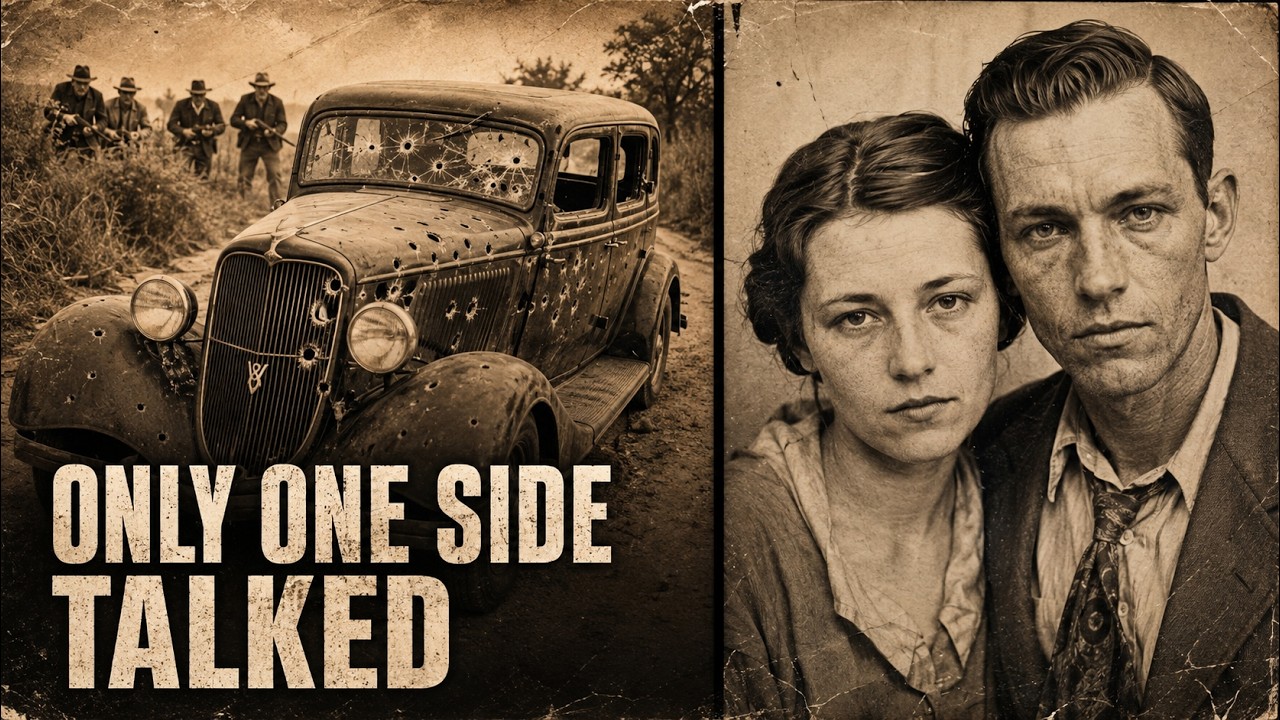
Before 9:15 on the morning of May 23, 1934, six lawmen lay in wait beside a narrow road in Bienville Parish, Louisiana. The road cut through pine country, quiet and rural, the kind of place where an approaching engine could be heard before a car appeared.
Frank Hamer was there, along with his long-time associate Maney Gault. With them were Bob Alcorn, Ted Hinton, Henderson Jordan, and Prentiss Oakley.
They were not standing in the open with badges raised. They were concealed near the roadside, watching for a gray Ford V8. Inside that Ford would be Clyde Barrow and Bonnie Parker.
By then, the two had crossed state lines in stolen cars, escaped gunfights, helped break prisoners out of a Texas prison farm, and traveled with weapons powerful enough to make small-town police departments look badly outmatched. The men in the brush knew all of that.
They also knew something else. If the Ford passed them at speed, this might be their last clean chance.
Then came the sound of an engine. The car appeared. It began to slow near a truck connected to the family of one of Clyde's associates.
What happened in the next few seconds has been repeated for nearly a century. But the surviving accounts do not agree on every detail.
Some say a warning was started. Others describe the first shot coming so quickly that no meaningful chance to surrender ever existed. The men in the Ford left no testimony. The men beside the road did.
And that is where the real Bonnie and Clyde story begins to get uncomfortable. Hollywood turned their deaths into the final scene of a tragic romance. But the greatest myth may not be how Bonnie and Clyde lived. It may be how confidently we pretend to know the exact way they died.
To understand why six men were waiting on that road, we have to go back to a different scene. Not a bank, not a gunfight, but a small apartment in Joplin, Missouri.
On April 13, 1933, local officers approached the apartment expecting to find bootleggers. Instead, gunfire tore through the building. When it ended, two lawmen were dead.
The Barrow gang escaped, leaving behind clothes, weapons, personal belongings, and several rolls of undeveloped film. Those rolls changed everything.
Once the pictures were developed, America saw Bonnie Parker in a way no police bulletin could have created. She stood with a pistol. She held a shotgun. She posed with a cigar between her lips. In one photograph, she pointed a shotgun toward Clyde in a playful, mocking pose.
The pictures were private. The poses looked theatrical. But newspapers stripped away the laughter, the teasing, and the moment before the shutter clicked. What remained was a young woman with a gun. That was enough.
The photographs were real. The story attached to them was constructed. Before Joplin, Bonnie and Clyde were criminals moving through the back roads of the central United States. After Joplin, they became characters.
Bonnie became the gun woman. Clyde became the dark-eyed driver with a fast Ford and a Browning automatic rifle. Together, they became something far more valuable than another pair of thieves. They became a headline.
More than 30 years later, Hollywood took that headline and gave it motion. The 1967 film did not pretend Bonnie and Clyde were innocent. It showed robberies. It showed fear. It showed members of the gang bleeding, breaking down, and dying. Its final scene was brutal enough to shock audiences.
So the lie was not as simple as Hollywood made them look harmless. Hollywood did something more effective. It placed the audience inside their car.
You laughed with them. You waited for them to escape. You watched the police through their rear window. The people they robbed appeared for a few moments. The people they killed became obstacles along the road.
Bonnie and Clyde received faces, jokes, chemistry, music, and style. The victims received screen time. That difference matters. A movie does not have to call a criminal a hero. It only has to make the criminal the person you cannot stop watching.
The film also gave Frank Hamer a humiliation that never happened. On screen, the gang captures the Texas Ranger, photographs him, and makes a fool of him. That scene gives the final ambush a personal motive. It makes Hamer look like a wounded man returning for revenge.
The real Hamer was never captured by Bonnie and Clyde. He did not meet them face-to-face before the ambush. He was hired by the Texas prison system to find them. His family later sued over the way the film portrayed him. The case was settled out of court in 1971.
That is not a small correction. It changes the reason the audience thinks Hamer was waiting beside that Louisiana road. Hollywood gave him revenge. The record gives him an assignment.
The same kind of distortion shaped the Robin Hood legend. Picture the version most people remember. A young couple robs a bank during the Great Depression. The bank is rich. The people are poor. Bonnie and Clyde take from the institution and leave ordinary folks alone.
It is a clean image. It also does not match the pattern of their crimes. The Barrow gang robbed gas stations, grocery stores, roadside businesses, and small banks. They stole cars. They took money from places where the person behind the counter was often closer to poverty than to power.
A small-town store did not look like a Wall Street tower. It looked like a wooden counter, a cash drawer, a few shelves, and a tired owner hoping the day's receipts would cover the bills. Then a car stopped outside. A man came through the door with a gun.
The legend says Bonnie and Clyde fought the system. The person staring down the barrel saw something simpler. The money was leaving. The gun was real, and no political speech was coming.
There are credible accounts that Bonnie brought cash and gifts to relatives during secret family meetings. That detail matters. It tells us they did not always keep every dollar for themselves.
But helping your mother, your brother, or someone hiding you from the police is not the same as redistributing wealth to the poor. It is family support. It is gang support. It is survival.
Their criminal life could produce a burst of cash after a robbery. Then the money bled away. Gas, food, a different car, a new hiding place, a doctor who could not ask questions, weapons, a share for an accomplice, a little money passed to family.
There was no estate, no safe life, no peaceful home purchased with stolen money. There was only movement. A car at night, a motel room under another name, a field beyond the headlights, a knock at a relative's door when the road had run out.
They sometimes helped their own families. That did not make them Robin Hood. It made them fugitives who still needed somewhere to belong.
Money explains how they stayed on the road. It does not explain why Clyde was willing to kill rather than go back to prison. For that, the road leads to Eastham Prison Farm.
Clyde did not arrive there as an innocent boy. He had already stolen cars. He had already committed repeated thefts. He had already learned to run. Bonnie had already helped him escape once by slipping a gun into jail.
But Eastham was different. The prison farm placed men in fields under armed guards. The work was punishing. Violence lived inside the barracks. A small prisoner with no protection could become a target before the first week was over.
Historians who reconstructed Clyde's time there generally described months of abuse by another inmate, Ed Crowder. On October 29, 1931, Crowder was killed with a metal pipe. Another prisoner, already serving a life sentence, took responsibility. But researchers have long attributed the killing to Clyde.
There was no courtroom verdict naming Clyde as Crowder's killer. There was something else. A change in the story people around him told. The young thief who entered prison had crossed a line.
Then came the axe. Clyde wanted out of the fields badly enough to hand another inmate a tool and arrange for two toes to be cut from his foot. No movie lighting. No brave escape. Just a prison floor, a sharpened edge, and a young man choosing permanent damage over another day in the rows.
Six days later, he was released. The injury had been unnecessary. He had mutilated himself to escape a place he was about to leave anyway. He walked with the damage for the rest of his life.
That moment tells us more than any diagnosis could. There is no need to put a modern psychiatric label on Clyde Barrow. Look at what he did.
He entered Eastham as a repeat thief. He left after a killing had been attributed to him. He left with part of his foot gone. He left with a hatred of the prison farm. And from that point forward, the weapons around him grew heavier. The risks grew larger. The cost of capture became, in his mind, worse than death.
Prison did not create every violent impulse inside Clyde, but it gave those impulses a destination. He would not go back, not quietly, not alive, if he could help it.
That explains Clyde. It does not settle Bonnie. Her photograph made her look like a killer. The newspapers helped finish the picture. The record is less certain.
Bonnie helped Clyde escape from jail. She traveled in stolen cars. She moved with the gang. She carried supplies. She stood beside men who had already killed. She remained after gunfights, robberies, kidnappings, and the Eastham prison break. None of that makes her an innocent passenger.
But a different question has followed her for generations. Did Bonnie Parker personally kill anyone?
The most important dispute centers on April 1, 1934, near Grapevine, Texas. Two highway patrolmen were shot and killed. Clyde, Bonnie, and Henry Methvin were in the area.
A witness account helped create a savage story. A woman had taken part. She had approached a fallen officer. She had fired again. She had spoken with cruelty. Newspapers had everything they needed. The woman in the Joplin photographs had finally become the woman readers expected her to be.
There were problems. The witness was not standing beside the victims. Other accounts pointed to two men. Henry Methvin was with Clyde. Later researchers argued that Clyde and Methvin were the likely shooters. Even the FBI's historical summary used cautious language, saying Bonnie probably never fired a shot. Probably. Not certainly.

There is no surviving evidence that conclusively proves Bonnie killed either officer. There is also no honest way to make her helpless. She knew the kind of men in the car. She knew what their weapons could do. She knew people had died. And she kept moving with them.
The absence of a proven kill does not erase willing participation in a violent criminal enterprise. But it does expose the way myth works. The public wanted a gunwoman. The photograph supplied the face. Grapevine supplied the blood. Uncertainty disappeared between the two.
And the man who may have been pushed out of that story, Henry Methvin, became the key to the final trap.
Bonnie and Clyde were never simply two lovers against the world. The Barrow gang changed shape again and again. Buck Barrow, Blanche Barrow, W.D. Jones, Raymond Hamilton, Henry Methvin, relatives who carried messages, people who offered food, shelter, information, or silence.
Every added person created another weakness. Someone could be arrested. Someone could talk. Someone could decide that saving a father, a son, or himself mattered more than loyalty.
Methvin had escaped from Eastham in January 1934 during a breakout supported by Bonnie and Clyde. Five prisoners got out. Two guards were shot. One later died. The prison system did not see that attack as another robbery. It saw an open wound.
Less than three weeks later, Frank Hamer was working the case. Hamer did not need to know where Clyde slept every night. He needed to know where Clyde would eventually return.
Fugitives still needed people, a mother, a brother, an old friend. A place where someone would recognize the car and not call the sheriff. The Barrow gang could cross a state line in an hour. It could not outrun hunger, injury, family, and habit.
Hamer studied those habits. He watched the routes. He worked the human connections. Then the Methvin family became part of a bargain tied to leniency for Henry.
The broad shape of that bargain is well supported. The exact mechanics are not. Accounts differ over who proposed what. They differ over how willing Ivy Methvin was. They differ over how the truck came to be positioned beside the road.
That uncertainty should not be hidden. It should be seen for what it is. The plan depended on making Clyde slow down near someone or something he trusted.
By the night before May 23, Hamer had a location. He had a route. He had six armed men. He also had experience.
The real Hamer was not the humiliated fool from the movie. He was a veteran lawman from the violent history of the Texas Rangers. He understood ambushes. He understood that Clyde had used Browning automatic rifles and that local officers carrying handguns could be badly outgunned.
He knew the gang had escaped before. He knew men had died. That explains why the posse feared hesitation. It does not automatically answer whether every shot that followed was necessary.
Hamer was officially recognized after the ambush. He received a special citation from Congress for his role in bringing down Bonnie and Clyde. So the claim that he died ignored and unrecognized does not hold up.
The truth is more complicated. He was honored by the government. Then Hollywood damaged his public image. History gave him a citation. The movie gave him a grudge.
And on the morning of May 23, the real man waited in the brush with five others. Hamer, Gault, Alcorn, Hinton, Jordan, Oakley.
The truck connected to Ivy Methvin was near the road. Some versions say Ivy was there as part of the plan. Others suggest he did not willingly play every part later assigned to him. The truck still served its purpose. It gave Clyde a reason to slow.
The Ford came into view. The men raised their weapons. Then the record narrows to a few seconds.
The posse's later accounts generally place Prentiss Oakley among the first to fire. Some versions say an officer began to call for Clyde to stop. Others leave so little space between recognition and gunfire that the warning becomes little more than a fragment.
There was no trial afterward, no cross-examination, no surviving account from inside the Ford. Only the men who fired lived to describe the beginning.
According to those accounts, the opening shot struck Clyde. The Ford kept moving, rolling or drifting toward the roadside. To the hidden men, movement meant danger.
Maybe Clyde was still controlling the car. Maybe his body had fallen against the controls. Maybe the car was simply carrying its last momentum.
They opened fire. Rifles, shotguns, handguns. A wall of sound in a place that had been quiet seconds before.

Later retellings would argue over the number. 130. More than 150. 167. But those numbers often count different things. Shots fired, shell casings found, holes in the car, wounds on the bodies. They are not interchangeable. The exact total remains disputed.
The physical result does not. The fusillade was sustained. It was overwhelming. It was designed above all else to make escape impossible.
The defense of the posse is easy to understand. Clyde had escaped before. He traveled with weapons that could tear through a police car. Men had died after giving the gang even a moment to react. No one behind the brush wanted to become the next name on that list.
The criticism is just as easy to see. If Clyde was hit at the beginning, the threat may have changed instantly. No clear completed chance to surrender has been established beyond dispute. Bonnie had not been conclusively proven to have killed anyone. The volume of fire eliminated arrest, testimony, and trial.
The ambush solved the immediate danger. It also ended every possibility of hearing the story tested in court.
Then the gunfire stopped. Smoke hung near the road. The Ford rested damaged and silent. No one stepped out. No one raised empty hands. No one gave a final statement.
The officers approached the car filled with weapons, maps, luggage, personal items, and the remains of two people already turning into legend.
The public arrived quickly. So did the appetite for souvenirs. The scene became a spectacle. People reached for pieces of clothing, hair, glass, metal, anything that could turn death into something they could carry home.
Hollywood had not yet filmed Bonnie and Clyde, but the audience was already there. That is the darkest part of the story. Not a sandwich, not a disputed amount of cash, not a perfect final line. The speed with which two violent lives became public property.
Bonnie and Clyde had chosen violence again and again. They had stayed on the road after blood had been spilled. They had helped build the chain of fear that led six armed men into the Louisiana brush.
The posse chose the final method. No chase, no courtroom, almost no time between recognition and death. And while the car became famous, the people killed along the way faded.
At Joplin, John Harriman and Harry McGinnis approached an apartment expecting bootleggers. They carried handguns. Inside were men with far greater firepower. The gunfight killed them. The gang escaped. The photographs left behind went nationwide.
Two lawmen died in the same event that created Bonnie's most famous image. Most people know the picture. Far fewer know their names. That is how a myth edits history. It does not only add scenes that never happened. It decides who stays in the frame.
By 1967, America was ready to see Bonnie and Clyde again. The country was divided. Young audiences distrusted authority. The old clean-cut hero no longer felt honest.
Arthur Penn's film arrived with beautiful actors, modern energy, sudden comedy, and shocking violence. It did not need to prove Bonnie and Clyde were good. It only needed to make rebellion feel alive. The film became part of American culture.
Then came another layer. Documentaries, books, television specials, internet videos promising banned facts, hidden truths, and the one story Hollywood did not want anyone to know. The language changed. The method did not.
Pick the cleanest villain. Choose the most dramatic number. Remove uncertainty. Tell the audience that everyone before them was fooled.
But a video can lie while accusing a movie of lying. It can turn probably into never. It can turn a settlement into a courtroom defeat. It can turn a disputed ammunition count into a perfect number. It can replace a romantic myth with a moral one just as simple.
Look at the Ford. The bullet holes prove the ambush was violent. They do not tell us whether a warning was completed. They do not tell us the exact number of shots. They do not tell us whether Bonnie killed anyone at Grapevine. They do not tell us how willingly every member of the Methvin family cooperated. They do not tell us whether the lawmen intended an arrest that collapsed in a second, or an ambush in which arrest was never realistic.
What the record does show is enough. Bonnie Parker and Clyde Barrow chose to remain inside a violent criminal life. The Barrow gang was believed responsible for at least 13 deaths. Their usual targets do not support a Robin Hood legend.
Hollywood invented a personal humiliation for Frank Hamer and compressed a shifting network of criminals, relatives, witnesses, and informants into a cleaner story of love, revenge, and betrayal. The real ambush was built to overwhelm. That is darker than romance.
But darkness does not give us permission to invent certainty. Hollywood created one myth by making Bonnie and Clyde more beautiful than the record allows. Modern storytellers create others when they pretend every disputed detail has already been solved.
The real story is darker for a different reason. Violence, poverty, publicity, family, fear, and memory became so tangled that even the final seconds cannot be told in only one voice.
The car slowed on an empty Louisiana road. Six men raised their guns, and after the first shot, history belonged to the people who survived.