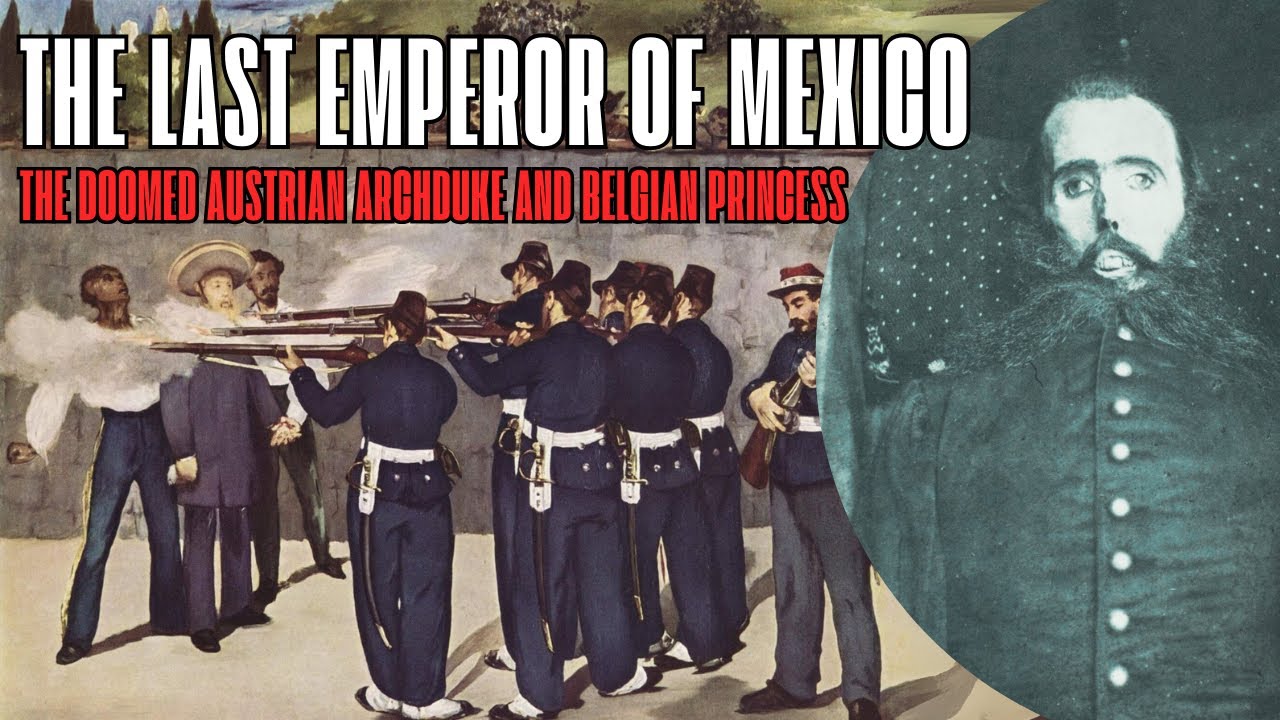
On the morning of June 19, 1867, Mexico’s last emperor faced a firing squad on a hill outside Querétaro. Maximilian I, pushed against a wall by Mexican Republican troops, was overheard uttering his final words as dawn broke: “May my blood, which is about to be spilled, end the bloodshed which has been experienced in my new motherland. ”
Maximilian and his wife, Empress Carlota, had arrived in Mexico City just three years earlier, having accepted an offer from Napoleon III of France to become the sovereigns of a new Mexican Empire. The couple landed at Veracruz on May 29, 1864, unaware of the grim fate awaiting them.
Born on July 6, 1832, Maximilian was the younger brother of Emperor Franz Joseph of Austria. His rigorous education began at age seven, with 32 hours of weekly study, and by 17, he was spending 55 hours each week on history, law, languages, diplomacy, and fencing. In 1857, he married Belgian Princess Charlotte, the daughter of King Leopold I, who had encouraged the match. The couple relocated to Milan that same year when Maximilian was appointed viceroy of the Kingdom of Lombardy-Venetia, but he was ordered to resign just two years later.
Mexico had been torn between liberal and conservative factions since gaining independence from Spain in 1821. The conservative monarchists, desperate to reclaim power after losing a three-year civil war, saw a European prince as their path back to control. Maximilian had initially declined the Mexican crown four years earlier. This time, however, with the international context shifted, the opportunity appeared more promising.
He agreed to accept the throne only under two conditions: that the Mexican people personally requested his rule, and that both France and Britain guaranteed their support. The new emperor’s reception was muted, partly due to a yellow fever outbreak. Although Maximilian and Charlotte—known as Carlota in Mexico—were officially crowned at the Mexico City Metropolitan Cathedral, liberal forces led by President Benito Juárez refused to recognize their rule. The United States government also refused to recognize the empire and ignored all of the emperor’s correspondence.
The situation deteriorated rapidly. Juárez’s supporters were shot by the thousands under the new imperial regime. As republican forces closed in, Maximilian contemplated abdication while Charlotte rushed back to Europe to seek aid for her husband. She arranged an audience with Napoleon III himself, but the French emperor could not be persuaded to help.
Charlotte traveled to the Vatican and desperately petitioned Pope Pius IX. So distressed that she refused to sleep in her own hotel room, she became the first woman to stay the night within the Vatican walls. Her Belgian family decided that she was not to be told of Maximilian’s execution. By the following year, Juárez’s troops had pushed back into Mexico City.
Maximilian was captured on the morning of May 16, 1867. Just one day after his trial began, he was sentenced to death. On June 19, 1867, at 6:40 in the morning, Maximilian and two of his generals were executed atop the hill where the Emperor Maximilian Memorial Chapel now stands. Charlotte, who had faded from public life, remained unaware of her husband’s fate.
Living as a virtual prisoner in Miramar Castle, her lady-in-waiting later described how the deposed empress was “absorbed in long silences or on the contrary in heated discussions in French, English, German, Italian, Spanish with imaginary interlocutors. ”
Carlota lived through World War I and the German invasion of Belgium. A sign was attached to the gates of the castle where she lived, reading: “This domain, property of the crown of Belgium, is occupied by her… I order the German soldiers passing by here not to ring the bell and to leave the place untouched. ”
Maximilian’s embalmed body was kept in Mexico and put on public display for six months before being sent back to Austria aboard the SMS Navara—the same ship that had brought the imperial couple to Mexico years earlier.
Carlota never set foot in Mexico again. She died from pneumonia on January 19, 1927, at the age of 86.