On May 23, 1945, a dusty jeep rolled to a stop outside a run-down farmhouse near Berchtesgaden, close to the Austrian border. The war in Europe had officially ended two weeks earlier, but southern Germany was still in chaos. German soldiers were surrendering by the thousands, Nazi officials were burning papers and scattering into the countryside, and American units were moving from farm to farm in a massive manhunt.
Four American paratroopers climbed out of the jeep. They were exhausted, covered in dust, and thirsty. They wanted nothing more than a glass of milk. Their commanding officer walked into the farmyard, where an old man in a stained shirt and worn trousers leaned against a wall with a paintbrush in his hand, an unfinished canvas in front of him.
The officer had no idea what he was looking at. The bearded man with the paintbrush was not a farmer, and he was not a painter. He was one of the most wanted men in Europe. Within the next sixty seconds, an American Jewish major named Henry Plitt would recognize his face, and neither man would ever be the same.
To understand the significance of that moment, it helps to understand who Henry Plitt was. He was not a lucky staff officer. He was a young Jewish man from New York City who could have spent the war behind a desk at home, and no one would have blamed him. Instead, he volunteered.
He parachuted into Normandy on D-Day with the 101st Airborne, among the first men on the ground before the beaches were even secured. Months later, he jumped again into Holland during Operation Market Garden, which turned into one of the war's worst disasters when reinforcements failed to arrive in time. He was wounded there, one of four times he was wounded before Germany surrendered. He earned two Silver Stars, a Bronze Star for valor, and four Purple Hearts.
By the spring of 1945, Plitt had given the Army more than most men are ever asked to give. Yet he was still there, still searching.
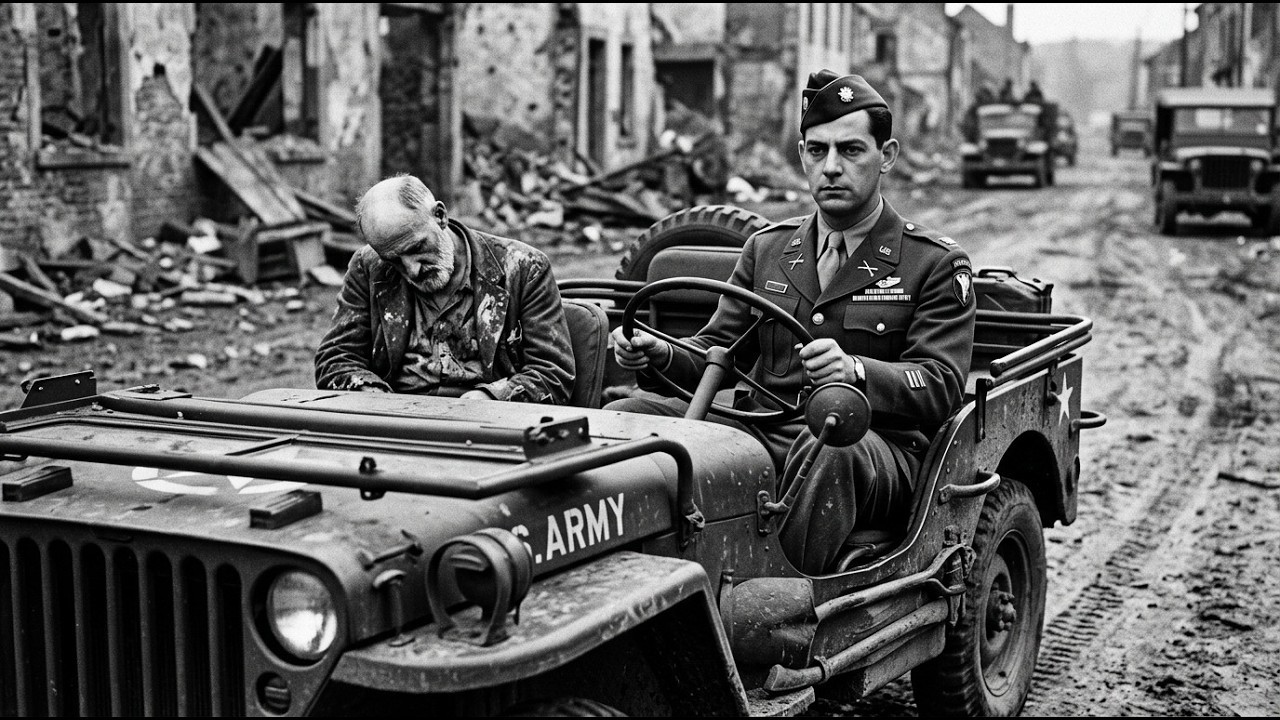
Now place him in that farmyard, facing a man who called himself Josef Sailer, a modest painter who insisted he knew nothing about politics, nothing about the Nazis, and nothing about the war that had just torn his country apart. Plitt had learned some German from two refugee cousins his family had helped bring out of Vienna years earlier, before the war reached American shores. He tried the language on the old man now, addressing him the way one might greet any farmer tending his land.
The man talked back without hesitation. Just a painter, just an old man with a canvas, waiting out the end of the world in quiet isolation. But Plitt kept studying that face. He had seen it before, printed on a wanted poster among dozens of others. It was the kind of paper that crossed an officer's desk a hundred times a week and was usually forgotten by lunch. This face had not been forgotten. Something about it had stuck.
It was the face of Julius Streicher.
If the name means nothing, his actions will. Streicher was the publisher of Der Stürmer, the most viciously antisemitic newspaper the Nazi regime ever produced. For more than a decade it blanketed German cities, feeding ordinary citizens steady doses of hatred dressed up as news. He personally helped push through the Nuremberg Laws of 1935, stripping German Jews of their citizenship years before the first deportation train ever moved.
Even other Nazi officials found him repulsive. A 1940 party investigation into his corruption stripped him of every official position he held. Yet Hitler protected him, because Hitler admired exactly what Streicher's paper was doing to people's minds. He was not a general. He commanded no military units. He ran no camps directly. He was something else entirely: a man who spent a decade convincing ordinary Germans, one by one, that their neighbors deserved everything that was about to happen to them.
Now that man stood in a farmyard at sixty, disguised as a tired old artist, hoping to disappear quietly into the collapse of a country. Plitt looked at him and said it plainly: "You look like Julius Streicher."

The old man's composure collapsed instantly. "How did you know me?" Six words. That was all it took. The most famous propagandist of the Third Reich was unmasked in his own courtyard by an American Jewish officer who had crossed an ocean and jumped from two planes into two different war zones to fight the very hatred this man had spent a decade manufacturing on a printing press.
They put him in the jeep. And here the story becomes uncomfortable, because this is where it was supposed to end.
On the drive back to headquarters, sitting feet away from the man who had helped poison an entire nation against his people, Plitt seriously considered ending his life right there on that mountain road. One move, no trial, no courts, no lawyers, no years of appeals. Just a quiet highway in Bavaria, and a man who had every reason in the world to hate what was sitting beside him.
He did not do it. Instead, he drove Julius Streicher to headquarters and handed him over to be treated as an ordinary prisoner of war, which meant Streicher was about to face something more lasting than a bullet on a back road. He was about to face a courtroom, a verdict, and a hangman's rope in front of the entire world.
When the press learned who had been captured, and that the officer was Jewish, the story crossed the ocean within days. Streicher, the man who built his entire career on convincing Germans that Jews were less than human, had been personally tracked down in a farmyard and delivered to justice by one of them.
Plitt did not stop there. Shortly afterward, he captured another prisoner he did not immediately recognize, a well-dressed man. As the man walked past a barn holding captured Nazi officers, Plitt watched them all instinctively snap to attention and salute. That was how Plitt knew who he had caught: Robert Ley, head of the entire German Labor Front and one of the most powerful men left in Hitler's government. Ley never faced trial. Eaten by shame, he hanged himself in his Nuremberg cell before the court even opened.

Streicher was not given that exit. He was tried at Nuremberg alongside the surviving leaders of the Third Reich: Göring, Hess, Ribbentrop, Keitel, and the rest of the men who had commanded armies and built the machinery of the Holocaust with their own signatures. Streicher had commanded none of it directly. He had no military units, no camps under his personal control. His weapon was ink and print, spread across an entire nation for more than a decade. The court argued that words like his had paved the road the killers eventually walked.
On October 1, 1946, Julius Streicher was convicted of crimes against humanity. That verdict went beyond his own case. It set a precedent still cited today: that propaganda is not merely ugly opinion protected by free speech, but a weapon in its own right, and the man behind it can be held accountable for where it leads.
Fifteen days later, in the early hours of October 16, he was led to the gallows inside Nuremberg prison, one of ten men executed that night. The sentence did not come from a jury but from four judges representing the nations that had defeated Germany: the United States, Britain, France, and the Soviet Union.
As guards walked him forward, Streicher shouted, "Heil Hitler!" Asked if he had any last words, he issued a threat against the Soviets. Then, facing the witnesses, he screamed something else: "Purim 1946."
It sounded like madness in the moment. It was not random. Purim is the Jewish holiday commemorating the ancient story of Haman, the man who plotted to exterminate the Jewish people and was hanged for it, along with his ten sons. That night in Nuremberg, ten Nazi leaders climbed the gallows. To his final breath, Streicher believed he was living that story in reverse, and he wanted those present to know it. It was the last confirmation of everything the trial had already proven: this was a man who never believed he had done anything wrong.
Justice, in this case, did not come from a battlefield or a bullet on a quiet mountain road, however much anyone might have wanted to pull the trigger with no one watching. It came from a courtroom, a judicial verdict, and the stubborn decision of an American officer, the very kind of man Streicher had spent his life trying to dehumanize, to refuse to become what he was hunting.
He brought him back alive. And that single decision is why the entire world was able to watch justice finish its work properly, in the light, and on the record, forever.