Two police officers walked into Annabelle’s casino in Leicester, England, in 1997 after staff called them to stop a man before he left the building. The American, in his late 30s, had registered two days earlier with no ID and no membership history. Now he was trying to cash out £10,000 in winnings. Security couldn’t explain how he kept winning.
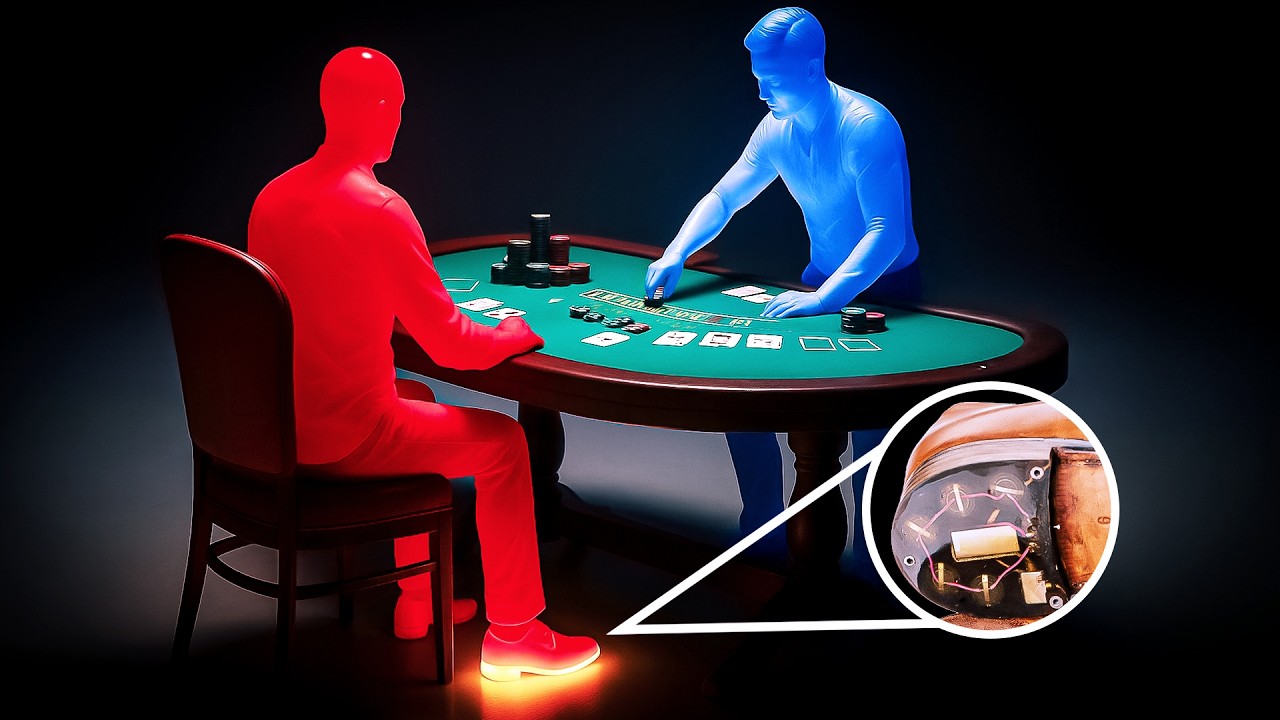
He didn’t count cards visibly. He barely talked. He didn’t even seem to watch the cards closely. One dealer mentioned hearing a faint buzzing sound under the table when the man placed bets.
Another said they saw him tapping his feet in an odd rhythm. But there was no visible cheating, no signals, no accomplices in the casino. Still, something felt wrong. The man didn’t resist when police arrived.
He smiled politely, nodded, and agreed to cooperate. Officers separated him from his friend and brought both to their hotel room across the street. There, they searched the room, opening drawers, tearing through luggage, slicing open a guitar case, and scattering casino loyalty cards across the bed. The cards came from London, Amsterdam, Brussels, and Berlin.
Then they found a locked metal briefcase. Inside were custom switches, lithium batteries, replacement insoles, and detailed maps of four different casinos. But the biggest clue wasn’t in the suitcase. It was still on his feet.
When an officer lifted the man’s pant leg, he saw a battery pack strapped to his ankle. Inside the heel of his right shoe was a buzzing circuit board hardwired with pressure switches near the toes. It wasn’t a lucky streak. It was a winning machine built to beat blackjack in silence.
Unbeknownst to that casino and the police that day, the device had already earned its creators more than a million dollars across six countries. Daryl Purpose’s story began decades earlier. In 1975, at 16 years old, he finished reading Edward Thorp’s Beat the Dealer. The next morning, he packed a small bag, took $50, and left home without telling anyone.
He boarded a Greyhound bus to Las Vegas with one goal: count cards and beat blackjack. At first, he practiced quietly, betting low and watching every card. He ran decks over and over in his motel room until he could track them effortlessly. Then he caught the attention of Ken Austin, who ran the most successful blackjack team in the country.
His players made thousands every week using card counting, a method casinos couldn’t legally ban. But not just anyone could join. The team tested for speed, accuracy, and nerves. Daryl passed the initiation test in under 10 seconds, a record for the team.
He was brought on immediately, not as a big player but as a spotter. His job was to blend in, play minimum bets, and keep the running count. When the deck turned favorable, he signaled the big player with subtle gestures. A scratch of the chin or a tug of the ear told the player when to approach and bet heavily.
The big player acted like a reckless gambler, loud and unpredictable. But every bet was timed perfectly off Daryl’s signal. The system worked. Within months, Daryl was earning more than he ever imagined.
Hotel suites, free drinks, endless chips. Every night meant a new casino. Every morning meant new cash. But Vegas in the 1970s was dangerous.
The mob still controlled parts of the strip, and they didn’t like losing to a teenager with a quiet smile and quick math skills. The team understood the risks, but Daryl kept playing and kept winning. By the summer of 1976, the operation ran with machine-like precision. Daryl worked five nights a week or more.
They had a pattern: get in, make money, rotate casinos, and leave before questions started. Casinos tightened surveillance, but nothing stuck. The team was careful, the spotters stayed quiet, and no one got greedy. That was the rule.
Still, the house was watching. Daryl’s face began showing up too often. At one casino, a pit boss paused behind his table longer than usual, just watching without expression. Two nights later, a floor manager at a different casino followed him for several minutes.
Then came news that changed everything. Ken Austin was pulled into a back alley behind the Hilton. There was no confrontation, no warning, just two men who knew where to find him. When Ken came out of the hospital, his face was broken in 19 places.
There was no police report and no complaint filed. Everyone understood why. There was a limit to how far you could push in Vegas, and the team had just found it. Daryl stayed low for a few days but eventually returned to the floor at a smaller casino off the strip.
He kept play short, bets small, and used no signals. His chip stack still grew slowly and steadily. Then it happened. A man in a black jacket tapped his shoulder.
He had no badge and offered no introduction. “Grab your chips,” he said. Daryl followed without speaking. He was walked through an employee hallway behind the pit and down a service corridor.
The air turned colder and quieter. They passed several closed doors and stopped outside a plain, unmarked room. Inside, two men sat at a small table. One had a pair of stainless steel pliers resting on the table in front of him, not held, just sitting there.
Minutes passed. No one explained anything. Then the door opened again. An older, calm man in a blazer stepped in.
He walked to the table and laid a folded paper in front of Daryl. It showed a precise number. “That’s how much you’re up right now,” the man said. “We’ll give you half.
You leave. That’s it. ”
Daryl didn’t flinch. He didn’t ask questions.
The man added, “You’re not invisible. We let you play. Don’t mistake that for permission. ” He left without waiting for a response.
Daryl was led out the same way he came in. No threats. No violence. Just a message, clear and final.
Back at his hotel, Daryl counted what was left: half the win. No paperwork, no explanation, just a new rule. If he wanted to keep playing, he couldn’t be seen. Not like this.
Not as himself. Daryl knew he needed a new way in, something quieter that they wouldn’t be able to trace. He met with his friend Craig, a shoemaker who was methodical and good with his hands. Craig wasn’t a gambler.
Daryl laid out the problem: he needed to count without being seen. No eye movement, no gestures, no traceable patterns. They sat with a deck of cards, a notebook, and a stopwatch. Daryl ran through dozens of hands while Craig watched how he tapped and calculated.
They tested different movements. Hand signals were too risky. Knee tapping was inconsistent. Then the idea formed: what if the signals didn’t come from Daryl at all?
What if they came from the shoes? They sketched a design. A circuit board small enough to fit in a heel. Two toe-activated switches under the insole.
A tiny buzzer inside the arch. The system would be powered by a lithium battery strapped to the ankle with medical tape, hidden under pants and socks. Tap the front toe to add to the count. Tap the back to subtract.
When the count hit a threshold, the buzzer would activate. A short buzz meant the deck was hot. A long one meant cool off. No words, no looks, just vibrations.
Over the next few weeks, Craig built the first prototype. It was crude, with wires exposed and parts scavenged from radio components and an old kitchen timer, but it worked. They tested it in Craig’s workshop. Daryl wore the shoe while Craig dealt cards.
The buzzer vibrated exactly when it should. They refined the design, making the boards smaller, the wires thinner, the switches cleaner. By the end of the month, the entire system fit into a dress shoe without raising suspicion. The battery lasted six hours.
The signal was silent. The wearer’s movements were minimal. It was ready. But Vegas was too risky.
The team was still known, casinos were on edge, and security had grown more aggressive. They needed a softer target. After research, they settled on England. Casinos there were smaller, surveillance was lighter, and card counting wasn’t yet a known threat.
They packed light: two pairs of shoes, spare circuit boards, extra batteries, and a cover story. They landed in London on tourist visas and took the train to Leicester. Their plan was to test the system live, take low risks at first, and cash out quickly. They hit a problem immediately.
UK casinos didn’t allow walk-ins. New players had to register for membership, and processing took 48 hours. They used the delay wisely, scouting every local casino and taking notes on table layouts, camera placement, and exit routes. Back at the hotel, they rehearsed chip handling, pacing, and hand movement.
They calibrated the buzzers to stay quiet even in crowded rooms. When the 48 hours were up, they chose their first test site: a small casino called Annabelle’s. Daryl stepped inside wearing a tailored black suit, low-profile shoes, and a battery taped to his leg. No one looked twice.
He sat down, bought in, and started low. The dealer began to deal. Daryl tapped his toe, then again, then once more. The shoe buzzed short and clear.
He raised his bet. Five hands later, the shoe buzzed again, this time longer. He dropped back to minimum. The system worked.
No one noticed a thing. Within an hour, Daryl was up over £10,000. The dealer changed his shuffle. The pit boss glanced his way.
It was time to leave. At the cashier, the staff apologized that they didn’t keep that much cash on hand. They offered a check or asked him to return the next morning. He agreed, keeping his voice steady, and walked out.
The real test came the next morning, because that’s when the police showed up. Daryl and Craig returned to Annabelle’s expecting to collect the £10,000 and play a few more hands. But the atmosphere had changed. No greetings, no smiles.
Two uniformed officers stepped forward. One gestured for Craig to follow. The other turned to Daryl. “Step this way.
”
They didn’t resist. They were separated immediately, with no chance to speak or adjust their stories. In a back room, Daryl sat across from a detective. There were no threats, no raised voices, just calm questioning.
Name. Where are you staying. What do you do for work. Daryl stuck to his script.
Real estate, visiting friends, new to blackjack. But the detective kept circling back. “You’re a professional gambler, aren’t you? ” Daryl said no.
“You’re using something, aren’t you? ” Daryl didn’t answer. After nearly an hour, the detective ran out of questions, and Daryl’s story didn’t move. Meanwhile, another team searched the hotel room.
They pulled open drawers, dumped bags, flipped the mattress, and emptied the rubbish onto the floor. They found a guitar case and opened it. Nothing inside. Then they saw the briefcase.
Inside were wires, switches, circuit boards, lithium batteries, and membership cards to casinos in London, Belgium, the Netherlands, and Germany. An officer picked up a switch, stared at it, and set it back down. He didn’t ask questions. He closed the case and moved on.
At the station, it became clear the officers didn’t understand what they were looking at. No law had been broken. No device had been caught in use. There was no proof, only suspicion.
After a short discussion, Daryl and Craig were released with a warning to leave quietly. They walked back to the casino that afternoon and collected the £10,000. No one stopped them. The shoes had worked.
The plan held, and the system passed its first real test. But Daryl knew they had gotten lucky. The officers hadn’t recognized the hardware, and the casino hadn’t recorded anything suspicious. That wouldn’t always be the case.
Back in the US, Daryl and Craig reviewed everything step by step. They knew they got out clean, but they also knew why. The British police hadn’t understood the device. They weren’t looking for circuit boards hidden in footwear.
They didn’t know what the switches looked like or what a silent signal felt like. And without that, they had nothing. Daryl knew that wouldn’t last forever, so they upgraded the design. The buzzer got smaller.
The circuit boards were rebuilt. Craig rerouted the internal wires to reduce heat. The toe switches were replaced with thinner pressure sensors stitched invisibly beneath the insole. The battery was swapped for a lighter lithium cell with more capacity, wrapped in elastic and sewn into a band that fit around the ankle like a compression brace.
It could now run for eight hours straight. Daryl began planning the next run, not in Vegas and not in England. This time, it was the continent. He started in Amsterdam, then Brussels, then Hamburg.
Everywhere he went, he applied for membership cards under different aliases, all legitimate and documented. He changed his haircut, his suits, his posture. Even the shoes were rotated to different colorways, same structure, different designs. He took smaller wins and faster exits.
No long sessions. No repeated visits. He never hit the same casino twice. It worked.
In under six months, Daryl played in over a dozen casinos across Europe and walked away clean from every single one. But slowly, things began to tighten. At a casino in Frankfurt, security started asking questions about his chip cash-out. Not enough to press charges, just enough to make him leave early.
In Geneva, a floor manager spent too long behind his table. Daryl cashed out and left. The tools were better, but the industry was smarter too. Casinos began coordinating information across borders.
Staff were trained to look for unusual betting rhythms. Some brought in off-duty law enforcement for special guests. New rules required ID scans before cashing out. Daryl noticed his name, and even his aliases, flagged more often.
Eventually, a list circulated with faces, photos, and descriptions, and Daryl appeared on it more than once. He started taking fewer trips, then shorter ones, until he stopped altogether. By the early 1980s, he was out. He wasn’t caught.
He wasn’t exposed. He just left quietly. In the years that followed, Daryl was unofficially banned from casinos across six continents. Some wouldn’t let him past the entrance.
Others let him sit down and then removed him within minutes. There were never charges or confrontations, just silent acknowledgments that he wasn’t welcome. Daryl didn’t fight the bans. He didn’t return to the floor.
His work was already done. In 2010, Daryl Purpose was inducted into the Blackjack Hall of Fame, not just for the money he made but for how he made it, for the innovation, the precision, and the control. Most players tried to beat the house by counting in their heads. Daryl did it with a circuit board in his shoe.
By that time, Daryl wasn’t gambling anymore. He was on stage, not at the table, performing folk music across the country with a guitar and small crowds. His songs were quiet, measured, and honest, just like the way he played. He wrote about real moments, like a New Year’s Eve in Killington, Vermont, where he sang: “Passing on the left, passing on the right.
I left my helmet back at the bar. There was ice on the road. There was ice on my bike. ”
In one verse, a cop who pulled him over gave him the lecture.
“It’s a very dangerous game you’re playing. ” Daryl sang his reply: “I know one. ”
But in every modern casino, under every table, behind every camera, and inside every software update, there’s a system that exists because of players like him.
Because someone, somewhere, realized that if you can hide a computer in your shoe, you can hide anything.