In the early 1860s, the western frontier of Texas was a place of promise and peril. One family's story, near Mason, Texas, became a lasting legend of the Comanche wars. It began in Fredericksburg in the late 1850s, at the far edge of the German settlements in the Apache Hill Country.
John Todd stopped his covered wagon in front of a trading post and walked inside with his six-year-old daughter, Alice, and his three-year-old son, Johnny. Six Indian warriors were preparing to leave through the back door. They were the largest Indians John had ever seen.
Despite their bright feathers, glossy paint, and gleaming bracelets and earrings, the warriors looked as fierce as hawks. Each carried a sharp scalping knife along with his bow and arrows. For a moment, everyone stood still and stared at Alice's golden-red hair.
The warriors then walked out of the store with great dignity. John remarked that they acted like masters of the plains. The storekeeper smiled and replied, with a slight German accent, that they were indeed. They called themselves Nermernuh, meaning "the people," while white men called them Comanche.
John said his family was headed to Comanche country, the land the Texas Rangers called San Saba. The storekeeper knew the region well. It was the rich country between the Llano and San Saba rivers, a hunting paradise, and other tribes envied the Comanche bands who lived there.
The storekeeper warned John that reaching the land alone would be nearly impossible, especially since the warriors had noticed his daughter's red hair, which they considered a good omen. He advised John to join a wagon train forming nearby. John took the advice.
The next morning, his wagon became part of a caravan heading north toward the upper Llano River. As the travelers neared San Saba, game became incredibly abundant. There was no need to hunt for meat; deer, antelope, and wild turkeys filled the country, and black bears fled to the hillsides at the sound of the train.
Stray black cattle roamed the brush, and herds of buffalo and wild horses were constantly visible. The lead wagon reached the Llano crossing when the driver pointed to dust clouds in the west. He shouted for the wagons to form a circle.
Water barrels and household goods were turned into breastworks. Men crouched behind them while women sat on the ground nearby to reload weapons. At the critical moment, the attacking horsemen reached the top of a slight rise, and the travelers saw a detachment of federal cavalry approaching instead.
The whole camp breathed a sigh of relief. The young officer in command introduced himself as Lieutenant Stewart. Alice ran from her father's wagon and gave him a charming curtsy. The officer knelt on one knee, opened his arms, and called her Goldilocks. Without hesitation, Alice wrapped her arms around his neck and kissed him.
The lieutenant said his unit was from the newly established Fort Mason. He explained they had been on a long scouting mission beyond the Concho River, where the plains swarmed with Comanche and seemed to hold a million buffalo for every Indian. John asked whether there was fertile land in the country that could be taken or bought cheaply.
Lieutenant Stewart said Fort Mason stood several miles up Honey Creek, which flowed into the Llano from the north. There was much fertile land nearby, but it lay on the edge of the settlements. The Todd family decided to settle there at once.
The wagon train was reorganized, and the cavalry helped the settlers cross the Llano River and escorted them into San Saba. According to Lieutenant Stewart, no organized Indian tribes were raiding the area at that time. The other wagons separated from the cavalry and turned northeast.
The Todds built a comfortable cabin about five miles above Fort Mason, beside a mineral spring that flowed into Honey Creek. Their nearest neighbors were the Tom Woods family, about three miles away, from whom John later obtained a basic stock of horses and pigs.
When he was not clearing land or plowing for next year's corn and wheat, John explored the plains and valleys. He roamed the brush searching for unbranded cattle and dogs. With Lieutenant Stewart's help, he persuaded the fort blacksmith to make and shape a branding iron marked "JT," hoping to register it when conditions allowed.
Branding dogs and any unbranded cattle over a year old was legal and proper. John Todd was now a businessman and looked to the future with confidence. He secured a contract with the fort to supply firewood, and the income provided his family with essentials and ammunition.
Settlers continued entering San Saba in growing numbers, and the Comanche grew increasingly unsettled. Reports came repeatedly of a farm family killed and scalped, a lone rider killed, and a survey team ambushed and wiped out. Among the victims was a well-known Methodist preacher, Jonas A. Dancer, who had prayed with the Todd family and other Fort Mason settlers only days before he was scalped.
By the fall cattle-gathering season, John began acting as a cattleman. He sold his two-year-old steers and bought his family some comforts. The sale also provided money for Alice's tuition and a three-month stay in the town of San Saba.
The corn and wheat harvests were abundant. In the midst of the general joy, Lieutenant Stewart received news of his promotion to captain. Sarah arranged a party with two purposes: to celebrate the brave officer's promotion and to say goodbye to Alice.
At the party, Captain Stewart and John found themselves in a relatively quiet corner. The officer suddenly grew serious. He said slowly that he hoped they had not rushed the celebration, because his letters from home suggested the Southern states were in a mood to secede unless certain concessions were granted.
John asked whether he thought secession meant war between the states. The captain hoped not, and Virginia, he said, would certainly not secede if the hotheads could be restrained. When Alice returned home for Christmas, the clouds of civil war were gathering ominously.
South Carolina seceded on December 20, and other Southern states soon followed. A small group in Texas, led by Governor Sam Houston, kept the state in the Union until radicals seized power in February and joined Texas to the Confederacy.
In San Antonio on February 18, General David E. Twiggs, commander of the Department of Texas, signed an agreement with Texas commissioners for a peaceful evacuation of United States Army posts by federal troops. A few days later, Captain Stewart entered Todd Clearing looking deeply grieved.
He had come to say goodbye. Everything at the fort was in chaos, he said. Colonel Lee had long since been reassigned, and the new commander acted as though he believed he must arrest someone. Many officers and soldiers from the South were openly declaring they intended to leave for the Confederacy.
Stewart said that, like Virginia, he had to join. His purpose in coming was to urge the Todds to withdraw until things settled. The Comanche would learn of the army's departure, and it would not be long before they struck.
The Todds were silent for a moment in shock and sorrow. Sarah thanked him gently for his great kindness and expressed her sincere hope that God would keep him in the years ahead. John shook his hand warmly and hoped they would all meet again in peace.
Alice, who had never cried, broke into sobs as though her heart would break when the officer turned to leave. Goldilocks told the captain, as he knelt before her, that a soldier should never be sent away with tears in his eyes. She rushed to him and kept begging him not to go.
He kissed her tenderly, gently set her on her feet, and rose. He saluted, turned on his heel, mounted his horse, and rode quickly down the road. It was a final goodbye. About three and a half years later, he lay in the mud, dying of wounds suffered at the Battle of the Wilderness.
After they sat in silence for a few minutes, John said they had struggled to reach what they had. The war that might be coming could last for years. If they withdrew now, nothing would remain when they returned, if they returned at all. He asked what they should do.
Sarah answered that whatever he saw fit was what she saw fit. He held her to his chest and said they would think about it and talk tomorrow. The next morning, Tom Woods came to announce excitedly that the cavalry had indeed abandoned Fort Mason.
Woods said the settlers agreed on that development, but none of them were thinking of withdrawing. Instead, they were calling a meeting that afternoon to plan a militia company for defense against the Comanche, and they wanted John to attend.
Woods had just left when the Todd hound gave a frightful cry and ran toward the edge of the clearing. John looked and could not believe his eyes when he saw a party of horsemen accompanied by a woman dressed in white man's clothing riding behind one of them.
After a minute of hesitation, John stepped from the cabin and signaled the Indians to come closer and dismount. A warrior held the woman's horse's reins in a clear gesture to keep her from riding off as he led her to the cabin. He wore a gold cross and moccasins instead of shoes.
He dismounted, removed his wide-brimmed hat, and revealed thick black hair instead of the slight baldness usual among Comanche warriors. He bowed gracefully. In Spanish, he said his name was Manuel Castro. Manuel was called the Lone Wolf.
Manuel was half Mexican and half Indian. He asked John, pointing to his village called Rosie, to be a friend of the white man. The chief of the Buffalo Hump band was named Rosie, but Manuel called her Rosita.
When the girl heard her name, she raised her head and smiled a quick smile. Her thick black hair was braided into two large braids decorated with shining feathers. The Comanche usually forced their women to cut their hair short.
She wore a fringed buckskin dress decorated with shiny shells and some beads. Her shoes were also decorated with brightly colored shells. She looked very clean.
The Indian continued that the chief of the Long Knives was a close friend of Manuel and Rosita. He asked why the Long Knives had left the fort. John hesitated, unsure whether telling the Indian that the soldiers had withdrawn for good would be a good idea.
He finally said the Long Knives had gone on a long scouting mission. The Lone Wolf asked whether the Long Knives would return to the fort. John thought this required a precise answer. He finally said yes, someday.
The Comanche said, pointing northwest, that Manuel had left one of his sons there, toward the direction of ninety. The chief of the Long Knives should not let the white man shoot Manuel or Rosita. Now, if the white man found them, he should shoot, but if he did not, then Manuel and Rosita would be friends of the white man and help New York there.
He waved his hand in an arc toward the northwest, but if nine came, Manuel warned his white friend. John said to himself that this was a one-sided peace treaty. He turned and eagerly explained the conversation to Sarah.
Sarah said respectfully that this represented direct help from their blessed Lord. John agreed and said he would tell Manuel they were happy to accept his proposal. When Manuel was informed, he bowed in his gentle manner and put his hat back on.

He turned and lowered a thick roll from his horse. He handed John two fine buffalo robes and said they were for the mister and missus. Then he presented a small, finely carved bow with a small quiver of feathered arrows with fire-hardened heads instead of flint heads.
He said it was for the Ninito. Manuel clearly knew something about the whims of little boys. He then presented a decorated buckskin suit with moccasins that looked like a miniature version of the outfit Rosita wore. He said the Ninito should never see a small sun.
At that moment, Sarah stepped from the cabin. She handed him John's pride and joy, a sharp hunting knife with an inlaid handle, and said it was for Manuel. Then she placed her own necklace of semiprecious stones in his hands and said it was for Rosita.
Manuel bowed deeply again and said, "We are brothers." Then he turned, mounted his horse, and the two Comanche rode away into the brush. John said with a broad smile that it was obvious Manuel had been spying on them, since he knew the composition of their family. He added that he hoped Manuel would not scalp them with his knife.
John Todd attended the militia meeting. The group agreed to make every effort to live in peace with the Comanche. Until further notice, no settler would go deep into the northwestern lands searching for strays or for any other purpose, or do anything that might provoke the Comanche.
But if the Comanche raided the settlement area, the militia men were to gather as quickly as possible and seek to kill every raider. Encouraged by this, John decided that he and his companions would hold out on their open farm.
Then came the fateful day of April 12, when hotheads on both sides staged the tragic affair at Fort Sumter in South Carolina. The Civil War had effectively begun, though acting Governor Clark did not declare war in Texas until June 8. Governor Houston had stepped down from office and retired rather than go back on his oath of loyalty to the Union.
San Saba was soon emptied of its young men who answered the call to arms. One morning, the Todd dogs attacked Indians fiercely. Manuel and Rosita were sitting on their horses at the edge of the clearing. The Todds waved to them with broad smiles and signaled them to dismount.
Manuel handed Sarah a buckskin bag full of smoked buffalo tongues. She said with a smile that they were very glad to see him and invited them in. He understood what she meant, took Rosita by the arm, and led and pulled her at once into the cabin.
Inside, Manuel explained that he and Rosita had been on a long buffalo hunt behind the Pecan. He said that nine buffalo would come to Manuel's cabin while Manuel and Rosita hunted buffalo. They should leave a message and take Rosita's brother.
Those cousins raise two fingers, he said. Those warriors raise three fingers. They hunt horses, but they do not hunt here because Manuel refused. They hunt a son there, he said, pointing northeast. Manuel followed the trail a short distance. Ninety buffalo pass near this cabin, perhaps.
He warned them to watch the small exploding star, because the situation was very bad. This information made Sarah, busy as a beaver in her kitchen, stop in confusion and fear. But work, prayer, and hope were the only salvation on this frontier, so she returned to her cooking, praying silently that God would protect them all.
She said it was a feast fit for an emperor. Under her gentle urging, Rosita overcame some of her shyness. She was fascinated by Alice and her golden-red hair. The Comanche left shortly after eating, proud and pleased with their friendship with the Todd family.
About ten days later, as the sun set, the Todd dogs sounded their horns again to alert them to Indians. Manuel and Rosita entered the clearing and approached the Todd cabin without waiting for an invitation. This time Manuel was armed to the teeth, with white man's weapons as well.
He was leading two good horses on either side of his mouth. Rosita, carrying a bow and quiver of arrows on her back, led four loaded horses in a single line. Three were loaded with tanned hides and bundles of fur. The other was loaded with pots and the remains of their demolished cabin.
It was clear that Manuel was not interested in any of these slow Indian matters. The Indian said at first that the council had said the scalps of Manuel and Rosita should be taken because they were friends of the white man. Manuel was a great warrior and had taken many scalps in his ninety battles.
Chief Buffalo Hump had given Rosita to Manuel. But now, Manuel and Rosita were no longer friends of the tribe because they had become friends of the white man. John asked what they would do now.
Manuel and Rosita would travel by night to reach Fredericksburg, trade horses and furs, and perhaps some horses, then go to Mexico. Sarah said to ask him if there was anything they could do to help him. John answered that Manuel said it was the Todds who needed help.
Rosita's brother had warned that the Comanche would come to take their scalps when the moon was full, and they were planning to invade this country. They knew about Alice. He drew their attention to the fact that the moon was nearing full and urged them to leave the place immediately.
Manuel and Rosita mounted their horses sadly and rode southeast into the deep darkness. The Todds considered their predicament. An examination showed the moon would be full in three nights. John decided to leave the next day as quickly as possible, bury their valuables, and gather the horses.
He would warn the other settlers of the imminent attack and keep his family in the settlement area near the fort until the Comanche left the country. Everything was awake before dawn, preparing to depart.

John mounted a horse that was in the barn and rode out to gather the other horses. By the time the family was ready to set out for the settlement, the sun was almost rising. John tied the horses and two young horses with ropes, leaving the young colt Fili to follow, and tied them to the saddle horn. Then he threw a bag of clothes in front of his saddle.
He called Alice, who came out of the cabin glowing in her clothes for the exciting trip to the settlements, in the outfit Rosita had made for her. The reddish-yellow color of the beautifully tanned buckskin matched her coloring. Her hair was thick, and she already looked like a little sunbeam.
Her father carried her behind his saddle, and her mother did the same with little Johnny, and they set off along the road leading to Honey Creek. They had just reached the creek and turned south toward the settlements when a turkey gobbled from upstream, not far away.
John froze in place. From a distance that seemed far downstream, another turkey gobbled in reply. "Comanche, God help us," Sarah moaned through her teeth in pain. John kicked the bag of clothes and threw down the lead ropes.
He said to hurry and cross the hill. If they could get around them, they could approach the settlement from the south. He would go about 200 yards ahead. If they were intercepted, it would be by that group coming from downstream. In that case, he would try to hold them off while Sarah went back over the hill to the Honey Creek road.
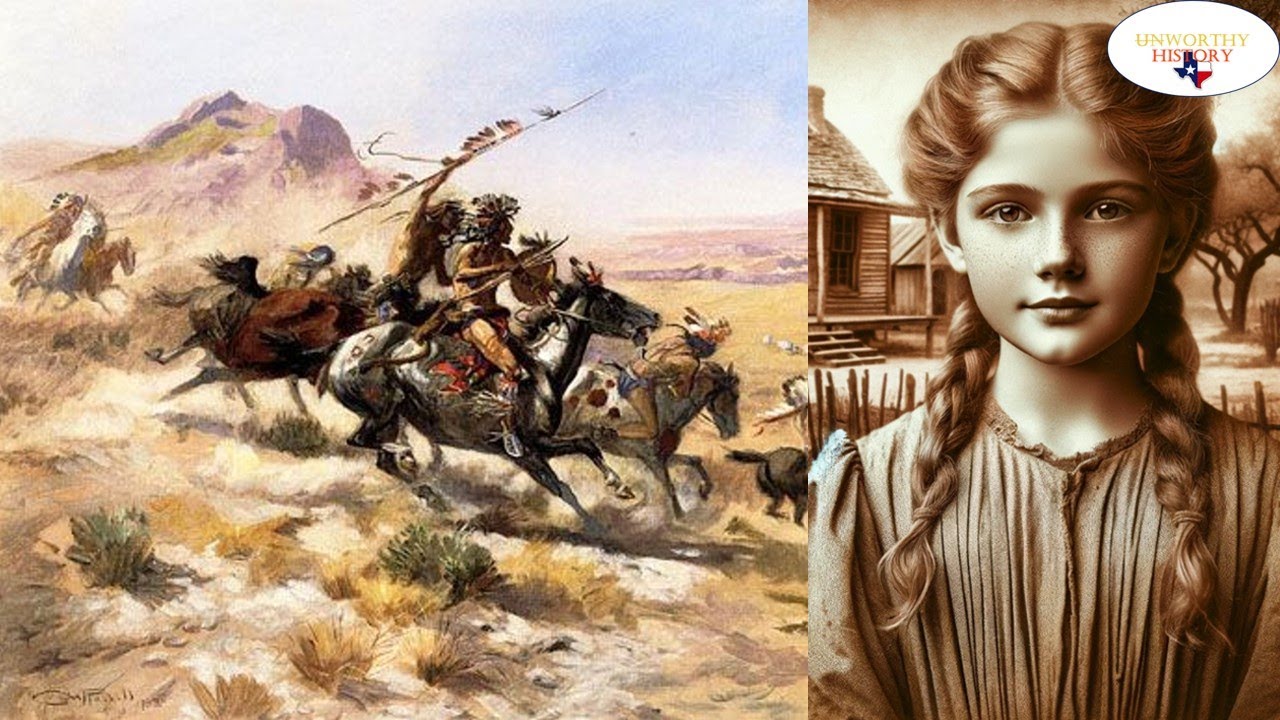
The Todds rode their horses about a mile down the valley, and their hopes renewed when a party of about forty warriors suddenly burst from a western ravine overlooking Honey Creek, cutting between the fleeing Todds. They were only fifty yards from Alice and her father.
About half the party turned toward Sarah, and John saw his beloved wife turn her horse back toward home. His only hope was that she would be captured and that he could later rescue her or arrange a ransom. The rest of the party rushed toward John and Alice.
John steadied himself on his horse, and it picked up speed, widening the gap between him and the pursuers. When the Comanche saw this, they opened fire with arrows, forcing John to maneuver his horse. The maneuvering cost him time, and the Indians began closing the distance.
Suddenly the horse stumbled, and Alice was thrown to the side. The brave horse regained its balance without falling, but the Indians were surrounding Todd. He escaped being lanced only because he suddenly moved his horse to the left.
He kept turning left in the now-wide valley, determined to get back to the wagon where Alice was. He looked behind him and saw several warriors carrying her joyfully, but no one tried to hurt her. He felt that if he fired, the Indians would kill the child and scalp her.
He decided that if he sacrificed his life now, many days would pass before the Indian raid was discovered, and it would be too late to save his family. So he lowered his horse and rode toward the settlement with all his strength. Under his light load, he soon left the Comanche so far behind that they gave up the chase.
In the following days, some settlers blamed John Todd for these events. He rode quickly to the settlements and found most of the people busy with a community project to prepare a place for a camp meeting on the Landu River. Todd could not gather a group of eight old men and boys until late afternoon.
Riders were sent east and south to spread the alarm and recruit more men. The small group accompanied Todd bravely back along his trail. No trace of Alice or her captors was seen, but when they reached the place where Sarah had turned her horse, they found the remains of Mrs. Todd and little Johnny, their cut scalps missing.
The group gathered the pieces in a blanket and carried them toward Todd Clearing, where smoke was rising among the trees. The Indians had burned the cabin to the ground. All the horses and two young horses were stolen. The colt Fili and many pigs and cattle lay here and there, their bodies pierced by arrows.
Todd's neighbors dug two shallow graves, and one of them led him away mercifully while the others buried his wife and son. All night, the remaining men of San Saba rode to Todd Clearing. At dawn, the rescue party, now about 25 strong, set out on the Comanche trail heading northeast toward the lower San Saba River.
It seemed a sign that the Indians intended to steal more horses and could be caught. The trail was easy to follow, and the white men rode their horses swiftly. By nightfall, they reached Turkey Creek, which runs through what is now the famous Sloan Ranch in San Saba County.
There, below a high bluff, was a heavily used Comanche camp. The murderous band had camped there the night before. On the face of the white bluff, the rescue party found two bloodstained handprints, sized and shaped to confirm they belonged to a girl about eight years old, perhaps left as she bent forward in exhaustion to rest her tired head.
Apparently the Comanche had tied Alice's wrists with green rawhide, so that as the hide dried, the bonds tightened and tore the flesh. The Comanche band seemed to have changed its plans and decided to abandon horse stealing on this raid, heading instead toward its stronghold in the northwest.
The white men pressed the trail with all their strength, but the land grew rougher and rockier, and the trail grew darker. Despite the danger and their small number, Todd and his companions continued the pursuit until they reached the slopes of the Santa Ana Mountains, the heart of the Southern Comanche country. There the trail disappeared completely.
With heavy hearts, this small brave group was forced to return empty-handed. In fact, it was later believed that the bloodstained handprints on the bluff face were an elaborate Indian painting, but from them had sprung the legend of the bloodstained handprints of the child Alice Todd.
Comanche tales of the later years of their life on the open ranges often refer to a great chief who had a thick beard with hair like sunbeams. Was this famous girl once the beloved little daughter of John Todd with the golden-red hair? That is all for this episode.
To this day, nothing is known of what happened to Alice Todd after her capture. The story mentioned Lieutenant Stewart, who was with federal troops at Fort Mason before the war began. This is believed to refer to James Ewell Brown Stuart, who was stationed at Fort Mason.
Stuart was a prominent general during the Civil War. The story said he died at the Battle of the Wilderness on May 5, 1864, but he actually died on May 11 at the Battle of Yellow Tavern in Henrico County, Virginia. It is unclear whether Stuart actually met the Todd family or whether this was an embellishment by the author of this story.
A later account of the same story, from one of Alice Todd's schoolmates in San Saba, differs in some details from this version published in Frontier Times. That account also includes other stories of Indian attacks in San Saba and Llano counties during the same period.