Every monarchy runs on a single fuel, and it is not gold, land, or divine right. It is children. That is the whole game, from beginning to end. You invade a kingdom, build a castle, sit on a throne, and then produce an heir, and the machine keeps turning after you are gone.
The Tudors understood this so well that they cut off their wives' heads over it. The Habsburgs married their cousins for centuries to keep the bloodline sealed tight. The Windsors, the royal family that changed its name during the First World War because its German title sounded a little odd at garden parties, understood it more deeply than anyone alive.
Because the British Crown does not merely want heirs. It needs them. The entire constitutional system, the glittering machinery of monarchy, depends on one biological act repeated generation after generation. A chain of christenings stretching from the Middle Ages to the maternity ward. If that chain breaks even once, you do not just lose a king. You lose the system.
When Edward, King of England, Emperor of India, Defender of the Faith, the most eligible bachelor on earth, gave up the most powerful throne in the world for an American divorcée named Wallis Simpson in December 1936, the entire British Establishment went taut and asked one question.
It was not: Will he be happy? Nobody cared about that. It was not: Will she fit in? They already knew the answer. The only question that mattered to the grey-suited men of Whitehall, to the Archbishop of Canterbury, to King George VI sweating in his coronation robes, carried the weight of centuries. Would they have children?
Because a child, even one born to a disgraced former king living in exile on the French Riviera, would open a gap in the line of succession wide enough to trigger a constitutional crisis. The calculations terrified them. A son of Edward and Wallis was supposed to become a myth, a living question mark hanging over the new king and his two small daughters, one of whom would grow up to be Queen Elizabeth II for the rest of their lives.
Every diplomat, courtier, and constitutional lawyer in the British Empire knew exactly what a Windsor child in exile would mean. But no child was born. No sons, no daughters, no heirs, no babies, no christenings, no small hands waving from balconies. For nearly 90 years, the world has wondered why.
The answer that comes to mind first is obvious and simple: they refused. They looked at parenthood, compared it to cocktail parties in Paris and a rotating collection of pampered pugs, and chose the pugs. If you have seen photographs of the Duke and Duchess of Windsor in their later years, elegant, frail, childless, surrounded by barking dogs in specially tailored coats, you might believe that story. It looks tidy, like a choice.
But easy answers and the House of Windsor have never met. The real story behind the empty nursery involves measles, abuse, a hysterectomy, and a barbed remark that echoed through decades of royal conversation, pillow talk, and love letters capable of making Freud weep. A war between biographers that turned into a real war. And a father who prayed out loud that his son would never have children.
This is not a story of refusal. It is a story of a question no one involved could answer, because the truth was buried under layers of shame, speculation, royal secrecy, and the usual British silence. So let us uncover it.
Before Edward became the man who gave up the throne for love, the version he preferred, he grew up as the most watched child in the British Empire, raised inside a system designed to produce exactly one thing: a proper king.
Edward Albert Christian George Andrew Patrick David was born on 23 June 1894, the boy who would become Edward VIII, with enough names to fill a small parish register and expectations heavy enough to crush anyone who paused to think about them. His family called him David. His father, King George V, called him a disappointment, though usually not to his face.
George V ran the royal household the way a retired naval officer runs a ship: rigid schedules, cold formality, and the kind of emotional warmth you might expect on a January morning in Aberdeen. Warmth frightened him. Obedience, punctuality, and children who stood straight, stayed quiet, and prepared for duty. That is what he expected, and that is precisely what his eldest son refused to deliver.
Instead, the boy fidgeted and dazzled every room he entered, radiating a desperate need to be loved by everyone, which his father correctly considered a catastrophic weakness in a future king.
At the Royal Naval College in Dartmouth, the young Edward contracted measles during a documented outbreak, a footnote in his biography that soon became one of the most persistent medical rumors in royal history. His biographer Philip Ziegler confirmed the measles in his official 1990 biography, "King Edward VIII." Though Ziegler, a careful and measured historian, never claimed it caused any lasting damage, rumor told a different story.
Whispers spread for decades that the measles led to mumps, that the mumps caused orchitis, a painful inflammation of the testicles, and that the orchitis left Edward permanently sterile. None of this chain of events received medical confirmation, but it clung to Edward's reputation the way cigarette smoke clings to velvet, impossible to fully erase.
What is certain, beyond any doubt, is what he wrote in his own hand. During his long engagement to Wallis Simpson in the 1930s, Edward wrote letters that revealed a psychological world so strange it unsettled even his most sympathetic biographers. Published in Michael Bloch's 1986 collection, "Wallis and Edward: Letters 1931-1937," they show the future King of England referring to himself constantly as "E" or "the boy," addressing the woman he loved as "Mama," and adopting a babyish style of speech that cannot be dismissed as mere joking.
Edward did not merely love Wallis. He needed her the way a small child needs his mother, possessively, with none of the demands of parenthood. We will return to those letters later.
Edward's romantic life before Wallis included a series of long-term mistresses. Freda Dudley Ward, Thelma Furness, and others whose names fade into the footnotes of royal history like candles in a draft. None of these relationships produced a known illegitimate child, not even one. For a man of his position, era, and access, that absence is significant, even without a medical diagnosis.
There are many explanations that do not involve infertility: contraception, discretion, or plain chance. But the pattern sits in the record, silent and unanswered, alongside the measles and mumps rumors and the baby talk, forming a body of circumstantial evidence no one has been able to assemble into a conclusive picture.
Now we must meet the woman on the other end of those letters. Bessie Wallis Warfield was born on 19 June 1896 in Blue Ridge Summit, Pennsylvania. With no money, no present father, and no reason to believe she would ever reach a throne, her childhood swung between genteel poverty and the charity of wealthy relatives.
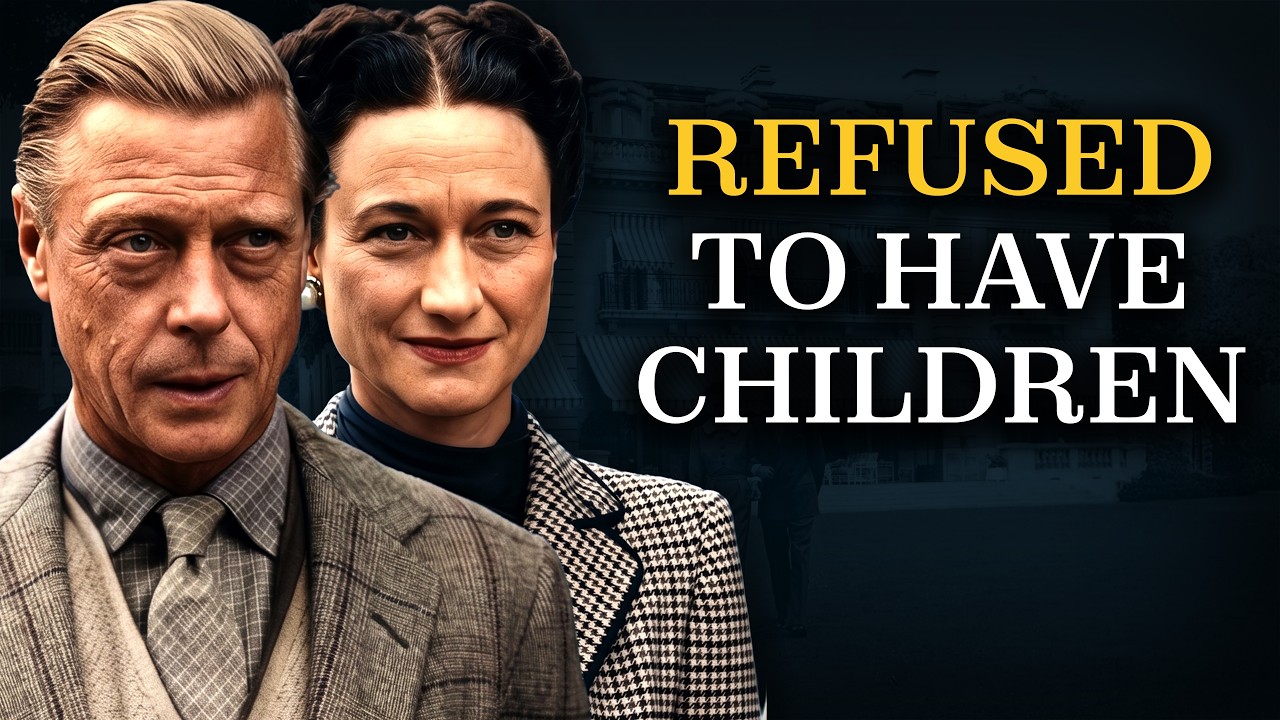
She was close enough to privilege to understand what it was, and far enough from it to develop a fierce lifelong hunger for it. She grew up clever, sharp-witted, funny, and entirely aware that her survival depended on her ability to charm rooms full of people who considered themselves better than her. She learned to use her intelligence as a weapon the way other women of her era used their beauty.
Wallis was never counted among the great beauties of her generation, and she knew it, and she did not care, because she had grasped something more dangerous: making powerful men laugh gives you more control than making them stare.
Her first marriage, to a naval aviator named Earl Winfield Spencer Jr., ended in a nightmare in 1916. Spencer was an alcoholic and, according to a contemporary friend's later testimony, beat Wallis severely enough to cause internal bleeding. Wallis herself acknowledged suffering from acute kidney inflammation during the marriage, which some biographers read as the polite language of the era for injuries caused by sustained domestic violence.
The question remains whether those injuries caused permanent damage to her reproductive organs. But the marriage produced no children across 11 miserable years before ending in divorce in 1927. Her second marriage, to Ernest Aldrich Simpson in 1928, brought her stability and refinement, and a social circle that eventually introduced her to the Prince of Wales. That marriage, too, produced no children across nine years.
Two marriages, no pregnancy. By the time Wallis met Edward, her reproductive life had already begun telling its quiet story, though no one in the frenzy of popular press coverage during the abdication crisis bothered to read it.
One theory about this period comes from an unexpected source. Barbara Cartland, yes, the romance novelist famous for her pink dresses and false eyelashes, was a friend of Maud, the sister of Wallis's husband, through Ernest Simpson. Cartland claimed that Wallis underwent a tubal ligation during her second marriage, a contraceptive procedure Cartland noted was becoming popular among wealthy women of the era.
No one can confirm this. If true, a tubal ligation would explain, surgically and definitively, why Wallis had no children with Edward or anyone else. But Cartland offered no documentation, and the medical records of deceased women are not normally opened to public inspection.
What we do know from documented surgical history is that Wallis underwent stomach surgery in 1944 and, seven years later, in 1951, a full hysterectomy. By the time she was 55, the question of childbearing was closed permanently, medically and irreversibly, regardless of what had prevented pregnancy in the decades before.
But we are getting ahead of ourselves. Before the surgeries, before the exile, before the pugs and the Paris apartments and the decades of elegant silence, came the moment that broke everything.
You know this part: the speech, the grainy footage, the headlines. Edward wanted to marry Wallis. But the British government, the Church of England, and the Dominion prime ministers blocked him, not because she lacked charm or intelligence, but because she was twice divorced. And the King of England also held the title Defender of the Faith, supreme governor of a church that explicitly forbids the marriage of divorced people whose former spouses are still living. Both of Wallis's former husbands were still living.
Prime Minister Stanley Baldwin made it clear with polished brutality, like a man who would rather be doing anything else. The King could have the throne or the woman, not both. Impossible.
On 11 December 1936, Edward chose the woman, announcing his decision to the nation and the Empire in a radio address. He delivered the most famous sentence in British royal history, a statement about being unable to bear the burden of responsibility without the help of the woman he loved. The words left his mouth in clipped aristocratic tones, faintly nasal, sounding even then like a voice from a world drawing its last breath.
Then he left. He left Buckingham Palace, Britain, and the succession, for a life that would prove emptier than he imagined on that dramatic December evening. His brother Albert, the man who stammered in his speeches and never wanted the throne, became King George VI. The Crown crushed him. His ten-year-old niece, Princess Elizabeth, moved one step closer to a fate she would carry for seventy years.
Edward, now styled His Royal Highness the Duke of Windsor, was stripped of everything but the title and the grudge, and sailed across the English Channel toward France, toward Wallis, and toward the quiet disaster of a life defined by what he gave up rather than what he gained.
The abdication itself lasted barely a year, from crisis to conclusion. Its consequences lasted forever. They married on 3 June 1937 at the Château de Candé in France, in a ceremony so modest and so thoroughly boycotted by the royal family that it resembled a defiance staged in an elegant living room rather than a wedding. No member of the British royal family attended. The Church of England refused to sanction the rite, so a clergyman who defied convention performed it.
That month, Wallis Simpson, now the Duchess of Windsor, turned 41, while Edward had turned 42. Even setting aside every rumor, theory, and speculation about infertility, surgery, and trauma, simple biology was against them. Fertility declines with age, and it declined faster in the 1930s, before the interventions and technologies modern medicine would later develop.
A couple in their early forties, marrying for the first time, she after two childless marriages, he after a series of mistresses who bore no illegitimate children, faced conditions any statistician would describe as poor.
But biology was not the only obstacle waiting for them on their wedding day. Five days before the ceremony, King George VI issued a warning whose effects the Duke and Duchess would feel for the rest of their lives. On 28 May 1937, the new King issued letters patent, a formal legal document published in the London Gazette, granting Edward the title His Royal Highness.
Generous wording, but the fine print stung. The document specified, in precise language only lawyers enjoying themselves could draft, that Edward's wife and his descendants, if any, would not hold that title or style. Read that again. If any. The British Crown, Edward's own family, his own brother, planted a legal landmine on the path of unborn children, and its effects reached everywhere.
The cruelty crept in quietly. Any child born to the Duke and Duchess of Windsor would inherit the dukedom, but neither sons nor daughters would carry the style of His or Her Royal Highness. Royal enough to attract attention, not royal enough to command respect. Descendants of a king denied the one honorific that signaled membership in the family.
Wallis's exclusion from the style of Her Royal Highness became a wound Edward nursed with compulsive fury for decades. He raised it in his letters, in his conversations, in formal appeals to every monarch who succeeded his brother.

It remains impossible to prove whether the letters patent discouraged the couple from having children, or whether Edward and Wallis read that document and decided that bringing sons and daughters into legal humiliation from birth was not worth the trouble. No entry in their memoirs, no letter addresses the point directly. The silence on the point is suggestive, but silence is not evidence, however eloquent it seems.
What the letters patent accomplished, without question, was something else. It told Edward and the world that the British Crown regarded his line as a dead end. Whatever happened in the bedroom at the Château de Candé, whatever happened in the apartments and hotel suites and rented villas of their long exile, the family had settled the matter. No heirs, from him or from her, and there never would be.
Despite all the medical theories, all the quarrels among biographers, all the archive digging and amateur detective work that consumed royal watchers over the following eight decades, the clearest evidence about the childless Windsors came not from a doctor's report or a legal document, but from Wallis herself. It came with the precision of a woman who devoted her life to turning pain into jokes.
When an acquaintance in society, whose name varies depending on who tells the story, asked why she and the Duke had no children, Wallis reportedly replied, "David is not equipped."
Consider that for a moment. It is a joke. A devastating joke, tightly constructed and extremely effective. The pun fuses two meanings in four words. "Equipped," suggesting a mechanical deficiency in Edward's biology, and "equipped," pointing directly at his inability or unwillingness to produce offspring.
The joke hints, without stating outright and without surrendering deniability, that the problem lay with Edward, not with her. Wallis did not use this joke in her own memoirs, but in social conversation, which means she wanted it repeated. She wanted it to spread. She wanted it lodged in the gossip columns and the drawing rooms of postwar high society. Whatever the reason for the empty nursery, do not look at me. Look at him.
Whether that joke reflected a medical truth, such as Edward's infertility, or a psychological truth, such as his inability to play any role but that of the child in their relationship, or simply a woman's refusal to accept the blame society automatically assigns to childless wives, we cannot say. But the joke tells us something no biography can. Wallis thought about it. She prepared an answer. And her answer was aimed directly at her husband.
If Wallis's joke was aimed indirectly at Edward, his father's words were a direct insult. King George V, the dour, dutiful, hard-hearted monarch, spent the final months of his life watching his eldest son lurch toward a scandal that threatened to destroy the monarchy. Fear replaced disappointment. The old King's feelings for his heir turned to something colder.
Shortly before his death in January 1936, George was said to have confided to someone close to him a sentence so harsh and so blunt it sounded less like a private remark than a royal curse. He said: "I pray to God that my eldest son will never marry and have children, and that nothing will come between Bertie and Lilibet and the throne."
Bertie, his second son, the reluctant prince who would become George VI, and Lilibet, his ten-year-old granddaughter Elizabeth, the girl the old King recognized as the future of the monarchy. A father praying that his son would have no children. Consider that for a moment.
A dying man, stripped of all the trappings of monarchy and its constitutional implications, asking God to ensure that his eldest son's line would end with him. Not out of cruelty, but out of cold dynastic calculation that placed the institution above the individual with a ruthlessness that would shame even the wealthiest chief executives. George V looked at his eldest son and saw not a person but a risk. A reckless man whose descendants might destabilize a crown that had survived wars, plagues, and the occasional beheading.
And it seems God answered his prayer.
Royal families attract biographers the way roadkill attracts vultures, with patience, inevitability, and growing numbers as the subject becomes less able to resist. The childlessness of the Duke and Duchess of Windsor became a private obsession for a generation of writers who circled the question with theories ranging from the medically sober to the entirely unhinged.
The most controversial theory belonged to Michael Bloch, who claimed in his 1996 book "The Duchess of Windsor" that Wallis may have been biologically male, or more precisely, intersex. The theory exploded immediately. Bloch claimed a gynecologist examined Wallis before her third marriage and declared her incurably sterile, which Bloch interpreted through the lens of a disorder of sexual development.
Anne Sebba expanded on this in her 2011 biography "That Woman," arguing that Wallis may have suffered from androgen insensitivity syndrome, a condition that would explain her slender physique, her inability to conceive, and her alleged reluctance toward intimacy. The theory found a wide audience.
Hugo Vickers, author of "Behind Closed Doors," a biographer who spent decades defending Wallis against what he considered unfair attacks, responded with the suppressed fury only an English historian can display. The intersex hypothesis? Vickers called it utter rubbish. He argued that Bloch and Sebba pursued sensation at the expense of a dead woman who could no longer defend herself, and that the entire intersex theory was disguised misogyny, a polished version of the same old impulse that led people to invent lurid explanations for how an American commoner, twice divorced, could captivate a British king.
Vickers earned his suspicions, but more damaging than his rhetoric was the testimony of Dr. Jean Thin, the physician who cared for Wallis until her death. Thin addressed the intersex speculation with a bluntness that left no room for ambiguity. Her genitalia were simply normal female genitalia, and you can quote me on that.
Then the medical records delivered the decisive blow in 1951. Wallis underwent a full hysterectomy, a procedure that removes the uterus, an organ patients with androgen insensitivity syndrome do not possess. You cannot remove what does not exist. The surgical documents alone demolished the Bloch-Sebba hypothesis with the quiet authority of a fact that needs no interpretation.
Philip Ziegler, who wrote the official 1990 biography, handled the question with the restraint expected of a historian granted access to the Royal Archives. Discretion was the hallmark of his approach. The Dartmouth measles cases appear in Ziegler's pages, as do the fertility rumors. But Ziegler stopped there, refusing to assert what the evidence did not support, leaving the reader to draw conclusions from a carefully arranged absence of evidence.
Greg King, whose 1999 biography "The Duchess of Windsor: The Uncommon Life of Wallis Simpson" remains the most factual and document-based, built his analysis on what can actually be verified. That includes Wallis's age at marriage, her two previous childless marriages, her 1944 stomach surgery, her 1951 hysterectomy, and, in a detail more revealing than any medical theory, the couple's brief consideration of adopting a child in the 1950s.
King noted that they ultimately chose pugs, directing what remained of their instincts into a succession of yapping little dogs that the Duke's valet observed were treated exactly like children. Adopting pugs is not the behavior of people who refused to have children. It is the behavior of people who wanted something they could not have and found the closest available substitute, even if that substitute urinated on the furniture and required custom clothing.

Because the Duke and Duchess of Windsor left no joint medical statement and no explanatory letter in the archive, biographers have built five competing theories from fragments, rumors, and the occasional documented surgical record. None can be confirmed conclusively, but all of them tell us something.
The orchitis theory: mumps following Edward's documented measles at Dartmouth, leading to orchitis, then permanent sterility. This is the chain rumor built, link by link, through speculation. The measles outbreak is confirmed, but everything after it passes through secondhand accounts without medical documentation. No one can bridge that gap. Edward fathered no known illegitimate children among his many mistresses, which looks suspicious in theory but falls short of a clinical diagnosis. Many fertile men father no illegitimate children, especially those with access to contraception and the resources to handle consequences discreetly.
The tubal ligation theory: Barbara Cartland's claim that Wallis underwent the procedure during her marriage to Ernest Simpson. A simple, clear, devastating theory. Medically plausible, socially plausible for a woman of her class and era, and brutally simple as an explanation. If a surgeon tied Wallis's tubes in the early 1930s before she met Edward, the entire mystery dissolves, because she could not conceive after deciding years earlier to prevent it permanently. But Cartland offered no evidence beyond her word, and her word, however confident over champagne, is not a medical record.
The domestic violence theory: when Wallis was abused by Spencer during her first marriage, severely enough to cause internal bleeding according to a contemporary friend's account, the damage may have extended to her reproductive organs. Perhaps the scars ran deeper than skin. Wallis acknowledged a kidney infection during this period, and biographers read between the lines and see a woman concealing the consequences of sustained physical abuse in the most respectable language available to her. This theory carries the heaviest emotional weight, but it rests on inference, linking documented abuse to undocumented reproductive damage through a chain of logic that seems plausible but cannot be proven.
The age and circumstance theory: the simplest explanation, requiring no conspiracy, no secret surgery, no hidden condition. Wallis married Edward at nearly 41 after two childless marriages. Edward was 42 with no known children. They married late. Their individual reproductive records suggest difficulties. Nature took its course. Greg King's analysis here rests on unglamorous biological probability, and it holds up precisely because it requires believing nothing that cannot be documented.
The psychological theory: this does not explain biological infertility, but it may explain why neither spouse pursued medical intervention, adoption, or any visible effort to build a family. Look at the letters. Edward's correspondence with "E" and "Mama," his talk of children, his suffocating dependence, all reveal a man who was already functioning as a child within his marriage. Biographers who studied this correspondence concluded that Edward needed Wallis as a mother figure so desperately that real children would have disrupted the arrangement rather than strengthened it. Shared parenthood was never on the table. What he wanted, intensely and irrevocably, resembled mothering, and there was already a child sharing his bed.
Five theories, no conclusive answers, and a medical record so incomplete that every biographer who examines it ends up building a different house from the same bricks.
Let us talk about those letters, because they deserve more than a passing mention. When Michael Bloch published "Wallis and Edward: Letters 1931-1937" in 1986, readers expected passionate, romantic, perhaps slightly scandalous love letters. What they got was closer to intercepted correspondence from an expensive nursery.
Edward, the man who ruled the British Empire, commanded armies and navies, shook hands with presidents and dictators, wrote to Wallis in a style that can only be described as infantile. E, the boy, Mama. These were the names he chose for himself and for the woman he claimed to adore as an equal partner. Not occasionally, not in jest, not as the playful pet names couples use in private and deny in public, but consistently, relentlessly, across years of correspondence, the pattern never broke.
Baby talk permeated his writing like a stain that would not lift. The deeper you read, the more you realize it was not an affectation but something structural in Edward's psyche. A total dependency that consumed the space where mature partnership, mutual respect, and fatherhood might have lived.
Think about what fatherhood demands and what it imposes on a man psychologically. Authority, responsibility, the ability to act as an adult in a household that now contains a real child. Edward already occupied that position, arriving at marriage prepared for the role of the cared-for child. And Wallis, whether willingly or in exhausted resignation, accepted the role. Managing the household, organizing their social calendar, controlling the finances, the staff, the travel, the dinner parties. She handled everything.
Edward's function, by all contemporary accounts, was essentially to be the Duke of Windsor, which turned out to resemble nothing so much as a very elegant golden retriever: charming, affectionate, ever-present, and entirely incapable of acting independently. Into this arrangement, add an infant. A real child. A human baby that screams, eats, and demands, competing with Edward for Wallis's attention, disrupting the delicate balance of their small closed world, and forcing Wallis to redirect the maternal energy Edward consumed entirely.
You can understand why it never happened. Not because they sat down and agreed to remain childless, not because they weighed pros and cons over cocktails and reached a rational decision. The explanation runs deeper. The structure of their relationship, that deep, strange, mutually dependent architecture they built together, left no room for a third person. Edward needed all of Wallis. A child would have required part of her, and in the unspoken arithmetic of their marriage, that was an unbalanced equation.
Every royal story accumulates myths the way a ship accumulates barnacles, slowly, stubbornly, and in a pattern that tells you more about the ocean than the ship. The Windsors' childlessness generated persistent, poisonous, and thoroughly debunked legends that deserve burial here, if only to stop them resurfacing.
The Ciano abortion myth: biographer Charles Higham, whose 1988 book "Mrs. Simpson: The Secret Life of the Duchess of Windsor" reads as though written with one hand on the keyboard and the other on a tabloid headline, promoted a rumor that Wallis had an affair with the Italian Count Galeazzo Ciano while stationed in China during her first marriage. According to Higham, Wallis became pregnant, suffered a botched abortion, and was left permanently sterile.
A bizarre and almost entirely fabricated story. Documents confirm Wallis fell ill during her time in China, but the medical intervention she received upon returning to the United States was limited to surgery for an intestinal blockage, not a gynecological injury. Higham offered no primary-source evidence for the abortion claim. He simply wrote it down and published it, which in the world of royal biography apparently counts as scholarship unless the publisher's lawyers object.
Higham himself claimed, again without primary documentation, that Wallis did not want children. A flat, unambiguous assertion inserted into the biography like a cherry on a cake, except no one can find the cherry tree. No interview transcript, no letter, no memoir, no contemporary witness supports the claim. It remains, as historians politely classify it, an unsubstantiated inference, which is the academic way of saying he made it up, heard it from someone who made it up, or decided it was true enough to print.
The Shanghai technique: of all the rumors attached to Wallis Simpson, this one reeks most strongly of xenophobia and misogyny wrapped in a thin coating of prurient curiosity. Pure fantasy dressed as racism. The story circulated in British society for decades, claiming Wallis kept Edward faithful through exotic sexual techniques she supposedly learned in Chinese brothels during her time in the Far East.
It worked on two levels at once. It explained Edward's fascination by implying supernatural seduction rather than genuine emotional connection. And it portrayed Wallis as a foreigner who acquired dangerous alien knowledge to ensnare a British king. Hugo Vickers and other biographers, weary from decades of debunking, have pointed out that no primary-source evidence supports the claim, not even a shred. No witnesses, no documents, no contemporary account resting on anything firmer than one person whispering to another at a dinner party that Wallis must have done something to make Edward behave that way.
The Shanghai technique revealed nothing about Wallis Simpson. It revealed everything about its inventors. A society desperate enough to explain a woman's power over a man reached for the most orientalist and misogynistic fantasy available and served it as an appetizer.
A separate but no less notable claim came from her biographer Donald Spoto, who stated that on the eve of her wedding to the Duke, Wallis confided to her closest friend, Herman Rogers, that she had never had sex with either of her first two husbands. Her French lawyer, Suzanne Blum, went further, insisting Wallis remained a virgin her entire life.
If true, a claim verifiable only through these two people's testimony, it demolishes the Shanghai technique theory from an entirely different angle. It is impossible to attribute extraordinary sexual prowess to a woman who may never have slept with anyone. One of these accounts must be wrong. The evidence, where it exists, strongly favors the brothel story being false and points toward a quieter, stranger, more private truth.