On the morning of February 19, 1913, a half-built country house in Surrey stood silent after an explosion. Two bombs had been planted in the foundations of David Lloyd George’s home at Walton Heath. One detonated; the other did not. The Chancellor of the Exchequer’s property had been chosen, according to the woman who took responsibility the next morning, because he was the most powerful man in the cabinet—and because the cabinet would not listen.
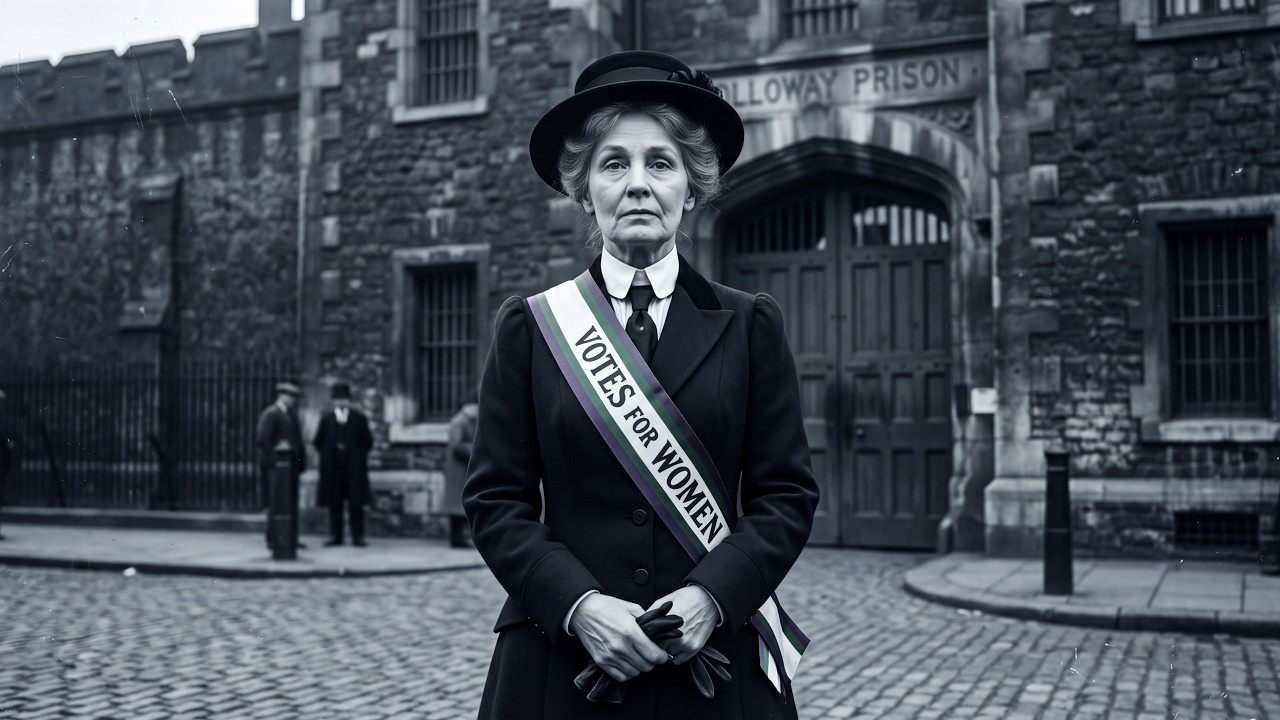
Emmeline Pankhurst, 54 years old and dressed in black, walked toward the cameras and confessed. Long before that morning, she had learned what it meant to be excluded. At 11 years old, she overheard her father say it was a pity she had not been born a lad. Her brothers were being sent to school; she would not be.
Robert Goulden, a Manchester cotton printer and a progressive man by the standards of the 1860s, still believed his daughters did not need an education. The moment settled into her, she later wrote, like a piece of cold metal pressed into a bruise. She educated herself instead, reading Carlyle, Mill, and the Brontë sisters. At 14, her mother took her to a suffrage meeting led by Lydia Becker.
She walked in accepting that women had no political voice. She walked out understanding that the absence of a voice was a wound—and that the wound had been deliberately made. After three years at a progressive school in Paris, she returned to Manchester and met Dr. Richard Marsden Pankhurst, a barrister 24 years her senior.
He shared her beliefs completely. He was a Republican, a former parliamentary candidate, and the only barrister in Manchester who would draft legal documents for married women without first obtaining their husbands’ consent. She proposed a free union without marriage, arguing that marriage was an institutional fraud against women. He refused, explaining that her political future would be destroyed by living openly outside marriage—and that she would carry the disgrace.
She accepted his reasoning. They married in December 1879 and had five children. Their first son died of diphtheria at age four; their second son died at 20 from paralysis of the spinal cord. Through the 1880s, Richard contested four parliamentary elections and lost every one.
The cumulative cost reached nearly £1,000—roughly £120,000 in modern purchasing power—and the family budget could not bear it. At their London home in Russell Square, the Pankhursts hosted the leading radicals of the era: Keir Hardie, George Bernard Shaw, Annie Besant, Eleanor Marx. The drawing room became a second home for the British radical movement. In 1898, while Emmeline was on holiday in Switzerland, a telegram arrived.
Richard’s ulcer had perforated. He was dead at 63. She returned to Manchester with four surviving children, debts of £500, and no insurance. She refused a public subscription opened by Keir Hardie, writing that she would not be made an object of charity.
Instead, she accepted an unpaid appointment as registrar of births and deaths in Chorlton-on-Medlock, moving her family into a small house at 62 Nelson Street. For five years, working-class women came to her front parlor. They registered births and deaths. They declared illegitimate children when fathers refused to be named.
They asked whether the law would protect them from violent husbands. It would not. They asked why the workhouse had separated them from their children. The workhouse was permitted to do so.
She promised them what she had seen would not be permitted to continue. On October 10, 1903, she invited seven women to her parlor. She proposed a new organization with a single rule: no man could be a member. Its name would be the Women’s Social and Political Union.
Its motto would be “Deeds, not words. ”
The vote was unanimous. The WSPU was founded that night. She wrote one line in her diary: “Deeds, not words, begun.
”
She did not know, she later reflected, that she had given herself ten years to live as anything other than a public criminal. The first two years were quiet. The Union published leaflets, corresponded with MPs, and attempted the procedural persuasion that every nineteenth-century pressure group had tried. It did not work.
In May 1905, a women’s enfranchisement bill was talked out of the House of Commons. Members spoke for an entire day against a bill regulating roadside lighting, preventing the women’s bill from being reached. Emmeline sat in the ladies’ gallery, watching through the wooden lattice that screened women from the men below. She walked out at 11 o’clock and made a decision.
No further private members’ bills would receive the Union’s support. Six months later, at a Liberal Party meeting at the Free Trade Hall in Manchester, her daughter Christabel and the seamstress Annie Kenney stood and asked the question: “Will the Liberal government give votes to women? ” They were ejected, arrested, and imprisoned—Christabel for seven days, Annie for three. The press coverage was enormous.
The WSPU’s membership rose from a few hundred to several thousand by Christmas. In June 1908, the Union staged Women’s Sunday in Hyde Park. Twenty special trains were chartered. Six processions converged on the park, and 30,000 women marched in white dresses with sashes in the Union colors.
The crowd was estimated at between 200,000 and 500,000—the largest political assembly London had ever seen. She spoke for 27 minutes without notes. The Liberal cabinet did nothing. Asquith, the Prime Minister, told a delegation that the demonstration had not changed his mind.
She understood the lesson immediately. The largest peaceful demonstration in British history had been ignored. The cause would have to be won by making the cost of refusal greater than the cost of consent. On November 18, 1910, a deputation of 300 women marched to Parliament to demand a meeting with the Prime Minister.
The Home Secretary, Winston Churchill, had instructed police to make no arrests—to turn the women back by force instead. The result became known as Black Friday. For six hours, women were knocked to the ground, thrown into the road in front of motor buses, and dragged by their hair. A photographer captured Ada Wright lying on the pavement, blood on her face, a constable standing above her.
Of the 300 women who marched, 115 later submitted formal complaints of sexual assault. Three women died over the following months of injuries sustained that day. All charges were withdrawn the next morning at Churchill’s personal direction. The withdrawal was intended to bury the day.
It did not. That night, she wrote in her diary that she had seen the police state in operation against women in the streets of the capital—and that the time for the constitutional method had ended. In November 1912, Christabel, operating from France to evade a warrant, summoned her mother to Boulogne. Over three days, mother and daughter agreed on the next phase: the deliberate destruction of property belonging to the political class.
The targets would include the unoccupied country houses of cabinet ministers. The arson and bombing campaign of 1913 and 1914 targeted country houses, sporting pavilions, historic churches, railway carriages, and public buildings. Over 18 months, there were 347 confirmed attacks. No civilian was killed.
The damage was estimated at roughly £27 million in modern purchasing power. The first bomb attack on a cabinet minister’s country house was at Walton Heath. The morning after the bombing, she gave a speech in Cardiff and accepted personal responsibility. She had not lit the bomb.
But the legal doctrine of incitement made any speaker who openly accepted responsibility liable for prosecution. She was arrested three days later, charged with inciting the bombing, and tried at the Old Bailey. She conducted her own defense. The jury returned a guilty verdict on the count of incitement, adding a rider recommending mercy.
The judge ignored the rider and sentenced her to three years’ penal servitude. She refused food from the moment the cell door closed behind her. The Cat and Mouse Act was drafted three weeks later, specifically to deal with her. It permitted the Home Secretary to release any prisoner whose health was endangered by hunger strike—then rearrest them once health had recovered.
The act was designed, in the Home Secretary’s private words to the cabinet, to break the political force of the hunger strike by refusing to allow any hunger striker to die in custody. She was released and rearrested 12 times in 1913. She undertook ten hunger strikes and five thirst strikes. Her weight fell from nine stone three pounds to six stone eleven.
Her hair turned white. She suffered chronic gastritis, anemia, and a tubercular lesion of the right lung. Forcible feeding had been introduced in 1909. The procedure was painful, dangerous, and humiliating.
Several prisoners were permanently injured. She had been force-fed twice in 1912 and swore she would tear the throat of the next medical officer who approached her with the tube. The Home Secretary accepted the message and ordered her release instead. A bodyguard of approximately 30 women, trained in jiu-jitsu, was formed to defend her from rearrest.
At a Glasgow meeting in March 1914, police attempted to take her from the platform. The bodyguard held the platform for several minutes before officers broke through. She was beaten with truncheons during her removal. Her physician wrote in May 1914 that any further imprisonment was likely to be fatal.
The Home Secretary ordered the next rearrest nonetheless. She continued to speak. In June 1914, she told an audience in Mile End that she did not expect to live to see the franchise—but that it would come anyway. She was rearrested on her way out of the theater.
When Britain declared war on Germany on August 4, 1914, she suspended the militant campaign the next morning. The cause would wait. The war transformed her. She became a vocal supporter of conscription, supported the Order of the White Feather, toured munitions factories, and lectured in the United States, Russia, and France in support of the Allied cause.
The Union’s newspaper was renamed Britannia and became fiercely nationalist. In 1918, the Representation of the People Act extended the franchise to women over 30 who were householders or married to householders. She accepted the partial measure because the government would not pass a fuller one. She voted for the first time on December 14, 1918.
She told a victory dinner that the cause was substantially won—and that the remaining one-third would follow within ten years. The WSPU dissolved itself by formal resolution in November 1918. She was 60 years old, with no money, no organization, and all three living daughters estranged from her in degrees of severity. The years between 1918 and 1925 were her diaspora years.
She accepted a paid lecturing contract from a Canadian public health body and sailed to Halifax in March 1919. For six years, she traveled by train across the Canadian provinces, speaking about venereal disease and social purity in church halls and YMCA meeting rooms. She legally adopted four orphaned girls between 1919 and 1920—the children of servicemen whose mothers had died in the influenza pandemic. None of the girls remained close to her in adulthood.
She returned to England in 1925. In 1926, she was approached to stand as the Conservative candidate for Whitechapel and St. George’s—a working-class East End seat the Conservative Party had no realistic prospect of winning. The candidacy was offered as a public honor.
She accepted. The decision astonished her former colleagues. Sylvia wrote publicly that her mother had ended her life in the wrong political party. Her health collapsed in early 1928.
The diagnosis was septicemia originating from a chronic infection of the gums, dating from the forcible feedings of 1912. She was admitted to a nursing home in May. In the same weeks, the Equal Franchise Bill—extending the vote to every woman over 21—was passing through the House of Commons. She was told of its second reading by Christabel, who attended her bedside.
She wept. She died on June 14, 1928, at 2:25 in the afternoon. The cause of death was recorded as septicemia of the gums. Eighteen days later, the Equal Franchise Act received royal assent.
Fifteen million women became eligible to vote. She did not live to know that her work was finished. Her funeral was held at St. John the Evangelist Church in Westminster.
The mourners included Prime Minister Stanley Baldwin and the Lord Chancellor. Christabel traveled from America to bury her mother. Sylvia did not attend. Adela did not attend.
She was buried in Brompton Cemetery under a simple Celtic cross. The inscription gives her name, her dates, and a single line of biblical reference. There is no mention of the cause she gave her life to. The decision was Christabel’s.
A bronze statue was unveiled in Victoria Tower Gardens in 1930, facing the Houses of Parliament. A second statue of Christabel was added in 1959. Mother and daughter stand together, facing the building they had made tremble. A statue in Manchester was unveiled in 2018, depicting her standing on a chair as she had done in her parlor in 1903 to address her first colleagues.
The deeper truth of her life, the story concludes, lies in the relationship between architecture and political power. The British political system she fought was not abstract. It was a building. The franchise was the password into that building.
Without the password, no woman could enter. Her campaign of fire was not vandalism. It was strategic communication that the buildings the political class believed permanent could be burned in their absence by women who had not been invited inside. From 1913 onward, the great house in England held within itself the consciousness that it might be burned by an unarmed woman with a candle stub and a tin of paraffin.
The Equal Franchise Act opened the door. The great houses themselves could no longer stand once the political nation included those who had been kept outside. Her victory and the lost grandeur of Edwardian England are, the story argues, one and the same victory, seen from opposite sides. The sentence of her life that remains in British memory is the one she spoke at the Royal Albert Hall on October 17, 1912: “I incite this meeting to rebellion.
”
The cabinet did not take her seriously. The buildings did. By the time the government took her seriously, the buildings had already begun to fall.