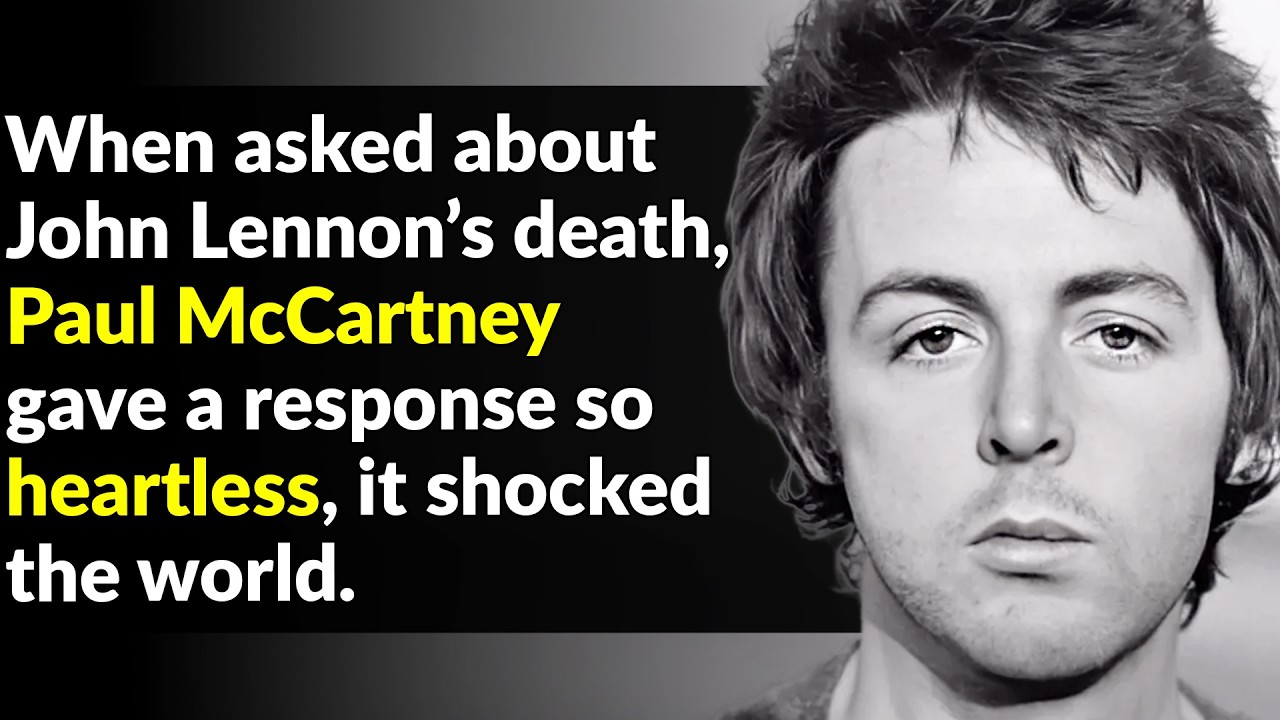
When reporters asked Paul McCartney about John Lennon’s murder, his response was so brief and dismissive that it stunned the public. He later admitted the remark came from sheer shock, but at the time it seemed heartbreakingly cold. It was one more painful chapter in the long, complicated story of the Beatles, a band that changed music forever and then fell apart under the weight of its own success. The Beatles began in 1956, when 16-year-old John Lennon formed a skiffle group with friends from Quarry Bank High School in Liverpool, called the Quarrymen.
The next year, 15-year-old Paul McCartney joined as a rhythm guitarist. McCartney had to persuade Lennon to let his friend George Harrison into the band, and Harrison’s second audition reportedly took place on a Liverpool bus. Lennon finally agreed the teenager was a good fit on lead guitar. By 1959, the original schoolmates had left, leaving only Lennon, McCartney, and Harrison.
After several name changes, they settled on the Beatles but were still short one member. In 1960, drummer Pete Best and bassist Stuart Sutcliffe joined, making them a five-piece. Over the next two years, the band played exhausting residencies in Hamburg, Germany, where they relied on the stimulant Preludin to keep up with their grueling schedule. The Hamburg years took a heavy toll on Sutcliffe, who decided to quit the band to focus on a new relationship and his art career.
Lennon was devastated. The friendship between the two was deeply close, and some have suggested it crossed into physical intimacy. One night, Lennon punched Sutcliffe, leaving him bleeding. It was a bitter, violent end to their years-long bond.
Not long after, tragedy struck. While the Beatles, now a four-piece, were fulfilling one last recording obligation in Hamburg as a backing band for another artist, they learned that Sutcliffe had died suddenly of a brain hemorrhage. Meanwhile, manager Brian Epstein was fighting to get the band a record deal. After being rejected by Decca, who claimed guitar groups were on the way out, producer George Martin signed them to EMI’s Parlophone label.
Recording began on June 6, 1962, at EMI Studios, which would later become Abbey Road. There was an immediate problem: Martin did not like Pete Best’s drumming, and neither did the other three Beatles. Best was replaced by Ringo Starr, and the classic lineup was complete. Their first album, Please Please Me, was released on March 22, 1963, and shot straight to number one in the UK, where it stayed for 30 weeks.
The album that replaced it was also by the Beatles. After touring the UK three times, the band appeared on Sunday Night at the London Palladium, drawing screaming fans in the audience and an estimated 15 million television viewers. The next day, a journalist coined the term that defined the era: Beatlemania. When the band arrived at JFK Airport in February 1964, thousands of adoring fans greeted them.
Days later, roughly 73 million people watched them perform on The Ed Sullivan Show, just before their first live concert at the Washington Coliseum. Over the next two years, the Beatles released platinum albums, made movies, and broke touring records with number one song after number one song. By 1966, the chaos of Beatlemania had worn them down. The band wanted to focus on making music, not performing, and they made the difficult decision to stop playing live altogether.
With more time in the studio, their sound grew more complex. Sgt. Pepper’s Lonely Hearts Club Band took 129 days to record, around 400 hours in the studio, compared to the ten hours it took to record their first album. Released in May 1967, the experimental album sold two and a half million copies in its first few months.
That same year, Brian Epstein died from complications related to his drug use. Epstein had not only managed the band but had also mediated their increasingly frequent, ego-driven arguments. With him gone, the Beatles were left to manage themselves, and tensions escalated quickly. In 1968, the band traveled to India for a three-month meditation retreat, which sparked a highly creative period.
But John Lennon was now constantly accompanied by his girlfriend, Yoko Ono, and her presence in the studio caused friction. Without Epstein to smooth things over, the tension grew. Lennon was moving toward experimental work with Ono, while McCartney continued writing traditional pop songs. George Harrison also felt a patronizing attitude from McCartney and watched Lennon disappear into drug use and his relationship outside the band.
When McCartney pushed forward with a live recording project called Get Back, Harrison walked out after just eight days of rehearsals. McCartney eventually convinced him to return, and the band finished the album, performing some of the songs on the rooftop of Apple headquarters. It would be their final live performance. In 1969, a bizarre rumor swept through the press: Paul McCartney had died in a car accident and been replaced by an impostor.
A University of Michigan newspaper reported the story, and fans pointed to supposed clues, like Lennon singing “I buried Paul” in Strawberry Fields Forever and McCartney appearing barefoot on the cover of Abbey Road. The rumor faded after McCartney gave an interview to Life magazine, but it never completely disappeared. By then, Lennon had announced the Beatles were splitting. A depressed McCartney began secretly recording a solo album.
The band’s relationships had always been close but complicated, and now they were finally free of one another. All four members went on to successful solo careers. On December 8, 1980, a deranged fan shot and killed John Lennon outside his New York apartment building. The remaining Beatles were devastated, facing both the loss of a friend and colleague and the fear that other crazed fans might come for them.
When reporters asked McCartney how he felt about Lennon’s death, he answered, “Drag, isn’t it? ” and walked away. The flippant remark shocked everyone. McCartney later said the response came from overwhelming shock, from not knowing how to put his feelings into words.
He has said he remains devastated by the senseless murder. The assassination also made the surviving Beatles fear for their own safety. McCartney had a scare when authorities revealed that a group was planning to kidnap his wife for ransom. George Harrison responded by building up security at his mansion, installing razor wire and CCTV.
But it was not enough. On December 30, 1999, an intruder broke into Harrison’s home and stabbed him repeatedly. Harrison remembered a deliberate thrust to his chest and said he heard his lung exhaling, with his mouth full of blood. His wife, Olivia, grabbed a fireplace poker and attacked the intruder, hitting him with a lamp until he stopped.
The would-be killer was sent to a psychiatric institution and later apologized. Harrison had already been diagnosed with throat cancer in 1997, treated with radiotherapy. He later faced lung cancer, which some attributed to the stress of the attack, and finally a brain tumor. On November 29, 2001, George Harrison died at home, surrounded by his wife, friends, and a few Hare Krishna devotees.
In 1985, Michael Jackson bought the Beatles’ publishing catalog for $47. 5 million, outbidding McCartney, who had actually encouraged Jackson to get involved in music publishing in the first place. The friendship suffered badly, and Jackson later sold the catalog for a substantial profit. Financially, McCartney has had the last laugh: with a net worth of $1.
2 billion, he is by far the wealthiest Beatle, more than $850 million ahead of Ringo Starr. The Beatles broke up because of creative differences, but behind those differences were strong personalities, and none more explosive than John Lennon’s. At McCartney’s 21st birthday party in Liverpool, Lennon, who later admitted he was out of his mind with drink, attacked a popular DJ named Bob Wooler after Wooler joked about Lennon missing the birth of his son to go to Spain with Brian Epstein. Lennon beat Wooler with a stick in a brutal frenzy, later confessing, “It was the first time I thought I could kill this guy.
” His girlfriend at the time, Cynthia, claimed he swore he would never lose control like that again. Ringo Starr, who had survived multiple life-threatening illnesses as a child, has fared better in his later years. Now in his 80s, he remains healthy, splitting his time between Los Angeles and London with his wife, actress Barbara Bach.
He meditates daily, avoids meat, and lives by a simple motto: peace and love.