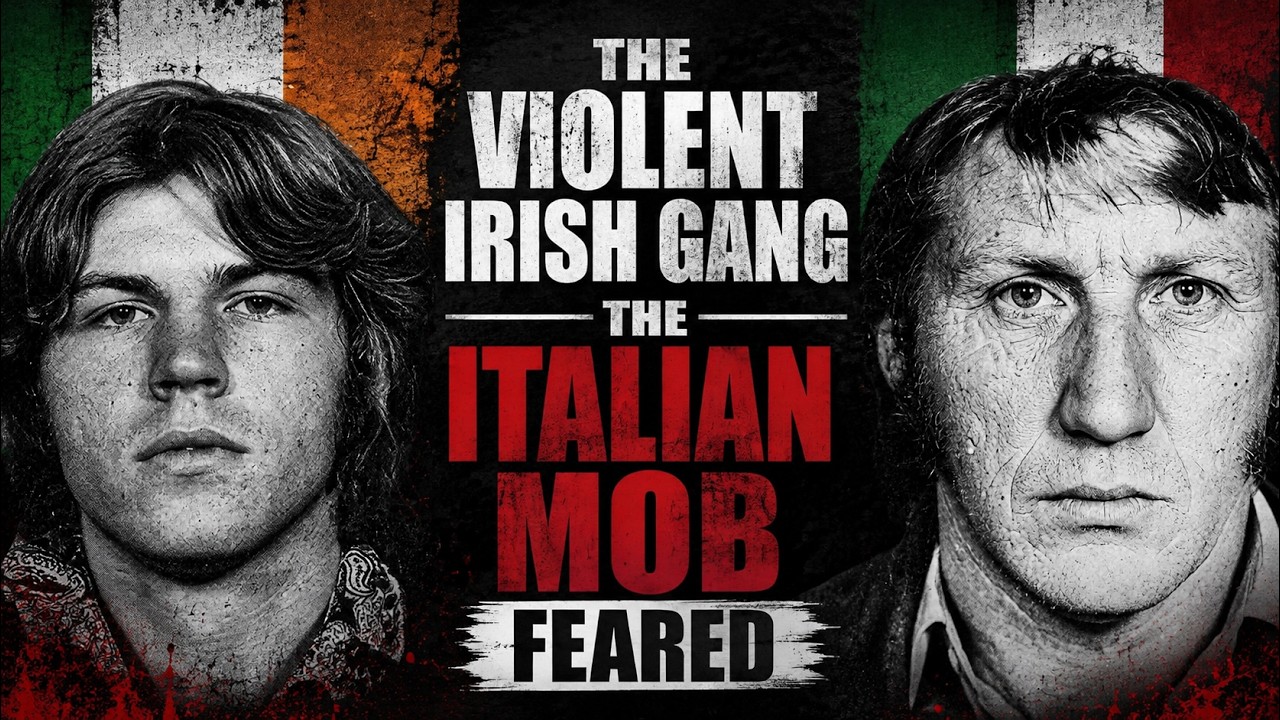
On November 15, 1986, at 2:45 in the afternoon, inside a federal courtroom in Lower Manhattan, Mickey Featherstone raised his right hand and swore to tell the truth. He sat across from the man who had once tried to bury him under concrete. Jimmy Coonan did not blink. He simply stared at his closest friend, the man who had stood beside him at his wedding, the man with whom he had shared blood oaths in the back rooms of Irish bars on Tenth Avenue.
Calmly, almost like a priest, Featherstone opened his mouth and began to recite the names of the dead. Seven of them. Then eight. Then ten. Every body Coonan had dumped into the Hudson River. Every human limb cut apart in a bathtub on Ninth Avenue. Every envelope of money Coonan handed to Paul Castellano as tribute. Featherstone revealed everything. The entire empire, brick by bloodstained brick.
To understand what happened, you have to understand who these two men were. Jimmy Coonan was not just another gangster. He was the Irish kid from Hell's Kitchen who did what no one believed possible. He turned a neighborhood of dockworkers, bartenders, and small-time thieves into a criminal enterprise that earned the respect of the Gambino family. He made the Italians come to him.
Mickey Featherstone was a Vietnam veteran, a decorated soldier with a metal plate in his head and demons in his eyes, and the most terrifying killer on Manhattan's West Side. Together, they ran the Westies. For nearly 15 years, they were untouchable.
This is the story of how paranoia, jealousy, and a framed murder brought down the most violent Irish American gang in American history. This is how the code of silence died in the streets of Hell's Kitchen. This is the great betrayal.
But here is what most people do not know. Featherstone did not flip because he was arrested. He did it because his closest friend tried to send him to prison for a murder he did not commit. And the moment Jimmy Coonan made that decision, he signed a death sentence for everything he had ever built.
To understand how it all fell apart, you have to grasp how strong the bond between these two men once was. Jimmy Coonan was born on December 21, 1946, into a middle-class Irish family. His father, John, was an accountant. Yes, an accountant. The father of the most sadistic Irish gangster in New York history balanced ledgers for a living.
Jimmy grew up on West 43rd Street. He was a quiet, skinny, watchful child. He had three siblings and a grudge in his heart the size of the Empire State Building. When Jimmy was 12 years old, a neighborhood thug named Mickey Spillane kidnapped him, beat him, and held him for ransom. At 12 years old. And Jimmy Coonan spent every waking moment since that day planning how to kill Mickey Spillane. That is who Coonan was. A grudge walking on two legs.
Mickey Featherstone was different. Born on September 2, 1948, two years younger than Coonan, he grew up in harsher, poorer, more ferocious circumstances. His father died when he was a child. His mother struggled. Featherstone joined the Army at 17. He went to Vietnam and came back with a Bronze Star, a head injury, and PTSD so severe that VA doctors gave him enough medication to sedate a horse.
He stood about 5 feet 7 inches and weighed barely 140 pounds. But when his eyes went flat and his voice dropped, tough men crossed the street, because Mickey Featherstone was willing to kill you. Not for money. Not for respect. He killed you because he was already somewhere else in his mind, and you had just walked into the wrong memory.
The two met in the early 1970s. Hell's Kitchen was a war zone. Irish gangs fought other Irish gangs over loan-sharking, robbery, and the lucrative payoffs from the construction of the Jacob Javits Center, which had not yet begun. Coonan recruited Featherstone. He saw something in him, a weapon he could aim. Featherstone saw something in Coonan too. A brother, a leader, someone who gave meaning to the chaos in his head.
They became inseparable and they began to kill. In 1975, they killed a man named Paddy Dugan. Then they moved his body to an apartment on Tenth Avenue. And here Coonan's dark side emerged. He pulled out a boning knife. And he began to cut. Featherstone later testified that Coonan told him, "The cops can't prove a murder without a body."
Coonan did not just kill people. He erased them. He dismembered them in bathtubs. He put the parts in gym bags. He drove to piers and threw them into the Hudson River. He turned Hell's Kitchen into a graveyard no one could find.
By 1977, Jimmy Coonan had his revenge. Mickey Spillane, the man who had kidnapped him 15 years earlier, was gunned down outside his apartment in Woodside, Queens. The hit was arranged through the Gambino family, specifically through a sadistic butcher named Roy DeMeo. Coonan had made a deal. The Italians would kill Spillane. In return, Coonan would pay tribute to Paul Castellano. He would work for the Gambino family. And the Westies would become the Gambino family's muscle on the West Side.
That deal is what made Jimmy Coonan a legend. And that deal is what ultimately destroyed him, because Mickey Featherstone hated it. He hated the Italians. He hated taking orders. He hated watching the money his crew earned flow to Howard Beach. Featherstone was a child of the Hell's Kitchen streets. He believed the neighborhood was sacred. And Coonan had just sold it.
For a while, though, the money was too good to argue with. The Westies were not just a bunch of drunks waving pool cues. Their operation was sophisticated. Here is how the construction extortion worked. The Jacob Javits Convention Center was being built on the West Side beginning in 1979. Billions of dollars in contracts. Every union on that site was either controlled by organized crime or paying tribute to it.
The Westies got their cut through a man named John Cody, president of Teamsters Local 282. Cody controlled the concrete trucks. No concrete, no construction. The Westies provided the brute force. They intimidated contractors. They threatened foremen. They made sure every no-show job on the site went to a Westie or a relative. Coonan took his cut. Featherstone took his cut. And they paid 15 percent to the Gambino family.
In a good month, the Westies pulled in $100,000 from the Javits site alone. Construction workers were terrified, because everyone on the West Side knew what happened to people who said no to Jimmy Coonan. They ended up in suitcases.
Then there was the loan-sharking. The Westies lent money on what was called "5-4-6." You borrow 500, you pay back 600 in a week. That is 20 percent interest per week. If you missed a payment, the interest doubled. If you missed two, someone showed up at your home with a baseball bat. The Westies had hundreds of customers, from dockworkers and gamblers to cocaine addicts and small shop owners on Ninth Avenue who needed to make payroll. Loan-sharking alone brought in more than $200,000 a year in pure profit.
Then came the hijackings. The West Side piers were still active in the late 1970s and early 1980s. Containers arrived. Trucks rolled out. The Westies had men inside three different shipping companies. When a truck loaded with televisions, liquor, or cigarettes was about to leave the pier, a phone call was made. The truck was intercepted at a red light on Twelfth Avenue. The driver was pulled out. Sometimes he was bribed. Sometimes he was beaten. The truck disappeared into a warehouse on West 47th Street. Within six hours, the goods were sold wholesale at 40 cents on the dollar. A single hijacking could bring in $50,000 in cash. They ran two or three a month.
And beneath all of it was raw violence. Contract killings. The Westies became the Gambino family's preferred Irish hit squad. If John Gotti or Paul Castellano needed someone eliminated and did not want to leave Italian fingerprints, they called Jimmy Coonan. Coonan charged $25,000 per body. Featherstone and a killer named Jimmy McElroy handled the actual work. They each got $10,000 per hit. The rest stayed with Coonan.
For seven years, this was the rhythm. Extort, hijack, lend, kill, collect, repeat. And no one could touch them. The NYPD tried. The FBI tried. The district attorney's office tried. But every case collapsed. Why? Because the Westies followed their own law. Nobody talked. Nobody cooperated. And every potential witness ended up at the bottom of the Hudson River before a grand jury could call them.
But here is the twist. Because while the Westies were invincible on the outside, something was rotting on the inside. Jimmy Coonan was changing. Power was doing something to him. Money was doing something to him. And his relationship with Mickey Featherstone, the brother he had sworn loyalty to, began to crack.
By 1984, Coonan had become paranoid. Deeply, pathologically paranoid. He trusted almost no one. He suspected everyone. And the more successful the Westies became, the worse it got. He started carrying a gun inside his own home. He kept three different apartments in Manhattan and moved between them at random. He interrogated his own crew members about conversations they had had in bars weeks earlier. He was convinced someone would flip. That someone would go to the FBI.
And the person he suspected most, the person he watched most closely, was his closest friend, Mickey Featherstone. Why Featherstone? Two reasons. First, Featherstone's mental state was deteriorating. His Vietnam PTSD was getting worse. He drank heavily. He took lithium. He had violent mood swings in public, screaming at strangers in restaurants, threatening waiters over nothing. Coonan feared that Featherstone would one day lose his mind, get arrested, and start talking to save himself.
Second, and this is the most important reason, Featherstone openly criticized Coonan's alliance with the Italians. He believed it made them weak. He believed Coonan was taking orders like a servant, and he was not shy about saying so to other crew members in bars. And every time he said it, word got back to Coonan. And every time it got back to Coonan, the paranoia grew.
Then in 1985, something happened that tipped every scale. On April 25, 1985, Michael Holly, a superintendent at a West Side construction company, was shot to death. Holly was gunned down on West 35th Street in Manhattan. Four shots. He was dead before he hit the pavement, at around 10:30 in the morning. Holly's killing was retaliation, over a personal dispute between Holly and a Westies member named Billy Bokun. Bokun blamed Holly for the murder of his brother years earlier.
That killing had nothing to do with Featherstone. Featherstone was not there. He was nowhere near West 35th Street that morning. He had a strong alibi. But here is where Coonan did something that can only be explained by paranoia and cold calculation. He decided to use the Holly murder to get rid of Featherstone.

Here is how the frame-up worked. Bokun was the actual shooter. But Bokun and Featherstone looked somewhat alike. Both white, roughly the same height, both with mustaches. On the day of the shooting, Bokun wore a disguise, a wig, sunglasses, and a fake mustache to resemble Featherstone's. Eyewitnesses on the street described the shooter as a man who looked like Mickey Featherstone. Police pulled Featherstone's photo. They put together a photo array. Witnesses identified him. And just like that, Featherstone was charged with murder.
Featherstone's trial began in March 1986. He pleaded not guilty. He had alibis. He had witnesses. But the eyewitness testimony was strong, and the prosecution pushed hard. In March 1986, despite being innocent of that specific crime, Mickey Featherstone was convicted. He was sentenced to 25 years to life.
And that is when Featherstone realized the truth. He was sitting in a cell at the Otisville Correctional Facility. He had nearly 25 years of prison ahead of him. And he started putting the pieces together. The disguise, the similar build, the witnesses who picked him so easily out of a lineup, and the fact that Bokun was still walking around Tenth Avenue. He understood. Jimmy Coonan had set him up. His best friend had framed him for murder.
You have to understand what that meant to Featherstone. The Westies were not just a gang to him. They were his family. Coonan was not just his boss. Coonan was the man he had trusted with his life for more than 10 years. Featherstone had killed for Coonan. Featherstone had taken risks for Coonan. And Coonan had rewarded him by sending him to prison for the rest of his life.
The decision was not easy. The code of Hell's Kitchen said, "Die before you talk." Featherstone's own father-in-law was a union man who lived by that rule. Featherstone himself had preached it for years. But something had broken. Something Coonan broke the moment he chose to protect himself instead of his brother.
So Featherstone made a call to his wife, Sissy. Sissy Featherstone was a strong woman. West Side Irish, fierce and loyal. She believed in her husband's innocence because he was innocent. And she started making phone calls. She started talking to lawyers. She started talking to investigators in the Manhattan district attorney's office. And she reached out to a federal organized crime task force that had been trying to take down the Westies for years.
The task force had a name they had been hearing for months. Rudy Giuliani, the United States Attorney for the Southern District of New York. And Giuliani had a weapon that had not been used against the Irish before. The RICO Act, the Racketeer Influenced and Corrupt Organizations Act, passed in 1970. For years, the law had gone largely unused. Then Giuliani, beginning around 1983, started using it like a hammer. He used it against the Colombo family. He used it against the Bonanno family. And most famously, he used it in the Mafia Commission Trial that ended in November 1986, where the bosses of four of the five families were convicted in a single indictment.
Giuliani had discovered something no one else had. RICO did not require you to prove a single specific crime. It required you to prove a criminal enterprise and that the defendants participated in it. You could tie 20 years of crimes into one case. You could put an entire organization on trial at once. And now Giuliani was turning his attention to the Westies.
In the summer of 1986, federal investigators met with Mickey and Sissy Featherstone. The conversations were cautious, quiet, and legally complicated. Featherstone had one demand. He wanted his Holly conviction vacated. He wanted his name cleared of a murder he did not commit. In return, he would do something no Irish gangster from the West Side had ever done. He would testify against the Westies. All of them, including Jimmy Coonan. The feds agreed. The deal was made.
In the fall of 1986, the federal government handed down a sweeping RICO indictment against 10 members of the Westies. Fourteen murders, loan-sharking, extortion, hijacking, and contract killing. Everything the Westies had done for a decade was in that indictment. And the star witness was the man Jimmy Coonan had called his brother.
The trial began in September 1987 in federal court in Manhattan. The prosecutors were Mary Lee Warren and David Brodsky, working under Giuliani. The courtroom was packed. There were reporters, FBI agents, and families of the victims. And at the defense table sat Jimmy Coonan, his cousin Kevin Kelly, his killer Jimmy McElroy, Billy Bokun, and the rest of the Westies leadership.
They watched the door open. They saw a federal marshal enter, and behind him came Mickey Featherstone. Featherstone took the witness stand on November 10, 1987. He was calm and composed, his voice flat. He looked Jimmy Coonan in the eye and began to talk.
He talked for days. He told them about the dismemberment of Paddy Dugan in 1975. He described the sound of the bone saw. He told them about the murder of a gambler named Ricky Tassiello in a bar on Tenth Avenue. He told them about the body parts thrown into the Hudson River. He named the victims. He named the killers. He named the dates. He named the bars where deals were made, the apartments where bodies were cut up, and the piers from which bags were thrown into the water.
Then he did something that shocked organized crime in New York. He tied the Westies directly to the Gambino family. He testified formally that Jimmy Coonan and Jimmy McElroy had volunteered to assassinate a union official for John Gotti at the funeral of Frank DeCicco. He revealed the structure of the illegal payoffs. He explained how Paul Castellano had blessed the Spillane hit. He gave federal investigators a road map into the heart of the Five Families.

The defense tried everything. They attacked Featherstone's credibility. They pointed to his mental illness, his Vietnam PTSD, his lithium prescriptions, and his violent history. They painted him as a killer trying to save himself. And all of that was true. But the prosecution had something the defense could not touch: corroborating evidence. Because once Featherstone started talking, the FBI went back and found the evidence. Surveillance photos, wiretaps they had collected years earlier but could not use without context. Phone records, business records, and cooperating witnesses who had been too afraid to talk before but now felt safe once Featherstone broke the silence barrier. The government's case did not rest on Featherstone's word alone. It rested on Featherstone's word backed by 15 years of accumulated evidence that suddenly made sense.
The trial lasted three months. The jury deliberated for eight days. And on March 6, 1988, the verdicts came in. Jimmy Coonan, guilty of racketeering, guilty of multiple murders, guilty of loan-sharking, guilty of extortion, was sentenced to 75 years in federal prison. Kevin Kelly, guilty, 60 years. Jimmy McElroy, guilty, 60 years. Billy Bokun, guilty, 50 years in prison. Every defendant was convicted. The Westies were destroyed as an organization, as a criminal entity, and as a physical presence in Hell's Kitchen in a single trial.
Giuliani called it one of the most important organized crime prosecutions in American history. He was right. The Westies were considered the last gang in New York City that the federal government could not touch. They had no Mafia structure, no initiation ceremonies, no recorded conversations. They operated on pure ethnic loyalty in a neighborhood of 20 blocks, where everyone knew each other and no one talked. RICO and a broken friendship brought it all down.
Here is what happened to the main figures after that verdict, because the aftermath is what completes the story. Jimmy Coonan went to federal prison to serve his 75-year sentence. He was initially sent to a high-security facility. He filed appeals for years. Every appeal was denied. He remains in federal custody according to the latest public records. He will most likely die in prison. He never publicly expressed remorse for any of the murders. He never admitted he framed Mickey Featherstone for the Holly killing. The man who built the Irish gang in Hell's Kitchen took his secrets with him behind federal bars.
Mickey Featherstone's conviction in the Holly murder case was eventually vacated. Federal investigators formally confirmed that Featherstone was not the shooter. Billy Bokun was the actual killer. The New York state conviction was dismissed. Featherstone was placed in the federal witness protection program. He, Sissy, and their children were relocated. He was given a new name, a new identity, and a new life far from the West Side of Manhattan. His story was later told in a prominent book by journalist T.J. English called "The Westies," published in 1990, which became the definitive account of the gang's rise and fall.
Billy Bokun, the actual shooter of Michael Holly, was convicted in the RICO trial on racketeering charges that included the Holly murder. He served decades in federal prison. Rudy Giuliani used the Westies case as another rung on his career ladder. He had already made his name with the Commission Trial. He added the Westies to his resume. In 1989, he ran for mayor of New York City and lost narrowly. In 1993, he ran again and won. He became the mayor who held office from 1994 to 2001.
And over the next 30 years, his name became synonymous with RICO cases and the dismantling of organized crime, and ultimately, in a twist none of the Westies could have predicted, with an indictment against him under the same racketeering law he had used to destroy them. In 2023, Giuliani himself was charged with racketeering in Georgia over alleged election interference. The man who pioneered RICO for modern prosecution became, decades later, a defendant under that same law. History has a sense of humor that the organized crime world never appreciates.
The Westies were finished completely. Some lower-level members tried to keep things going through the 1990s. They failed. Hell's Kitchen itself began to change. The real estate boom of the 1990s and early 2000s transformed the neighborhood. Old tenements were torn down. Luxury high-rises went up. The bars where Coonan and Featherstone planned murders became yoga studios and wine shops. Ninth Avenue, once called "Devil's Kitchen," became a strip of restaurants for Midtown office workers. The neighborhood that produced the most violent Irish American gang in American history erased every physical trace of them within 20 years.
So what does the Westies story actually tell us? Three things. The first is that loyalty in organized crime is an illusion. It always has been. Every gangster sings about it. Every gangster violates it. The code of silence exists until someone faces life in prison, and then it evaporates. Jimmy Coonan did not think he was breaking the code when he framed Featherstone. In his mind, he was protecting the organization. But the moment he put his own self-interest above brotherhood, he created the informant he had always feared. Paranoia is predictive. If you spend years terrified that your best friend will betray you, you will eventually do something that forces him to.
The second is that RICO changed organized crime in America forever. Before RICO, law enforcement had to prove individual crimes. One murder, one robbery, one extortion. A mob boss could insulate himself with layers of soldiers and never be directly tied to a crime. RICO destroyed that model. It allowed prosecutors to treat the entire criminal enterprise as the crime. Once Giuliani proved it worked against the Commission, every organized crime group in America was vulnerable. The Westies were the test case for ethnic gangs outside the Italian Mafia. And it proved that RICO could take down any criminal organization, regardless of its structure, its traditions, or how tight-lipped its neighborhood was.
The third truth, and perhaps the most uncomfortable, is that the romance of the American gangster was always a lie. Jimmy Coonan was not the West Side's Robin Hood. He was a man who cut up bodies in a bathtub on Tenth Avenue. Mickey Featherstone was not an honorable soldier of the streets. He was a mentally disturbed killer who turned on his crew to save his own life the moment he was threatened. The Westies did not protect the neighborhood. They bled it dry. They charged usurious interest rates to the poorest families on Ninth Avenue. They beat union men who refused to pay tribute. They killed their own friends over grudges no outsider could understand. There was no honor in any of it. There was only money, paranoia, and blood.
Mickey Featherstone is believed to still be alive somewhere in America, living under an assumed name, now a grandfather watching old Westerns on television. Jimmy Coonan is behind bars where he has been for more than 35 years, and where he will certainly die. The neighborhood they once ruled was renamed Clinton on official city maps, though older residents still call it Hell's Kitchen. The piers where the bags were thrown are now Hudson River Park, where tourists jog and children play. The tenement apartment where Paddy Dugan was cut to pieces is long gone. In its place stands a luxury glass-and-steel building where a one-bedroom rents for $4,000 a month. No one who lives there knows what happened. No one who lives there has ever heard the names Jimmy Coonan or Mickey Featherstone.
That is the real ending of the Westies story. Not the trial, not the verdict, not the 75-year sentence. The real ending is oblivion. The neighborhood moved on. The city moved on. The only people who remember are a handful of retired detectives, a few aging FBI agents, and the families of the victims who never recovered their bodies, because those bodies are still somewhere at the bottom of the Hudson River.
Jimmy Coonan spent his life building a criminal empire in an area spanning 20 blocks of Manhattan. He made millions. He killed dozens. He made the Gambino family respect him. He outmaneuvered his rivals. He outsmarted the police. And for 15 years, he sat on top of the Irish underworld like a king. But he made one mistake. He stopped trusting his closest friend. And his closest friend, the man he framed for murder, walked into a federal courtroom in November 1987 and destroyed everything Jimmy Coonan had built in six days of testimony.
That is the real lesson of the Westies. Not the violence, not the money, not even the RICO law that brought them down. The lesson is that no criminal empire, no matter how tight, no matter how Irish, no matter how feared, can survive when its leader turns on his closest friend. Betrayal does not come from the outside. It comes from within every single time.