On November 14, 1938, inside the White House, President Franklin Roosevelt finished presenting his sweeping plan to build 10,000 warplanes. One by one, the influential men around the table voiced their complete agreement. Then Roosevelt turned to a brigadier general attending his first White House meeting.
Surrounded by chiefs who had already endorsed the idea, George Marshall responded: "I am sorry, Mr. President, but I don't agree with that at all." The room froze. Everyone believed Marshall had just destroyed his career.
Yet months later, Roosevelt would hand this same man command of the entire United States Army. Why would a president choose a man who had publicly told him he was wrong? This is the story of how one uncomfortable moment of professional tension shaped the most important strategic partnership of World War II.
When a nation stands on the brink of global conflict, the natural instinct of those in power is to surround themselves with agreeable men. But this account is about a very different kind of leadership. It reveals how George Marshall's brand of loyalty, rooted entirely in hard, unvarnished facts rather than comfortable agreement, became the quality the White House desperately needed to survive the coming storm.
In the corridors of Washington, where rank and influence dictated survival, open contradiction was widely seen as political suicide. The central puzzle of this partnership lies in understanding why steadfast honesty was worth infinitely more to a strong, seasoned commander in chief than comfortable submission. It challenges everything we assume about how power works, showing how an outright rejection of a presidential initiative can actually prove to be the ultimate form of reliability.
To understand how Marshall survived what every other general and official in that room considered a fatal career mistake, we must return to that November afternoon. First we must examine the precise political trap Franklin Roosevelt laid on the conference table, surrounded by men eager to please him. And most importantly, we must uncover the catastrophic flaw George Marshall saw hiding inside the president's grand vision for American defense.
To grasp the gravity of what happened on November 14, 1938, you must first understand the power dynamics inside that specific room. The setting was the White House, the absolute center of American executive power. At the head of the table sat Franklin Delano Roosevelt, president of the United States and commander in chief. He was not a man accustomed to having his wishes denied.
Roosevelt possessed enormous political weight and a sophisticated understanding of how to move men and policies to his advantage. Around him sat a collection of high-influence figures. These were senior government officials, veteran politicians, and military leaders of the highest levels. They were men whose careers depended entirely on the approval of the man at the head of the table.
Then there was George Marshall. Marshall was a brigadier general in the Army. He was not a junior officer who could hide in the back ranks, but he was also not at the top of the military pyramid. He served as deputy chief of staff, a vital but subordinate position. Most importantly, this was the first time he had attended a White House conference with the president.
Marshall occupied a precarious spot in Washington's power system. He held a rank high enough that his professional opinion carried weight. If he spoke, he was expected to say something substantive, but he was not at a level that allowed him to survive losing the president's confidence. For a brigadier general attending his first presidential briefing, the unwritten rule was simple. Listen carefully, support your superiors, and never embarrass the commander in chief in public.
Roosevelt had called this meeting for an urgent and specific purpose. He was not inviting abstract theoretical discussion. He was presenting a major shift in national defense policy. The president looked across the Atlantic and saw the rapidly escalating threat of Nazi Germany. Adolf Hitler was aggressively expanding his military, and Europe was sliding inexorably toward war. Roosevelt realized that the United States, still deeply isolationist and clinging to neutrality, was dangerously unprepared.
The president's solution was massive, rapid, and heavily focused on one element: aviation. Roosevelt proposed building an astonishing fleet of 10,000 warplanes. You cannot dismiss Roosevelt's plan as foolish or naive. It had a strong and very logical strategic basis.
From a political standpoint, aircraft were highly visible. They projected power and modernity. A vast fleet of bombers and fighters could serve as an immediate, powerful deterrent against German aggression. They could be used to support friendly nations like Britain and France without the risky political commitment of American ground troops.
Moreover, building aircraft stimulated domestic industry and provided a tangible, easily measurable metric of military buildup that the American public and Congress could understand. For a politician navigating the treacherous waters of prewar isolationism, an aviation-centered strategy was an elegant and attractive solution. It promised heavy strategic impact with a relatively light footprint in terms of manpower.
As Roosevelt presented this grand vision, he circled the table seeking implicit endorsement. One by one, senior officials and generals voiced their agreement. Some genuinely believed in the supremacy of air power. Others recognized the political momentum of the president's proposal and saw no benefit in standing in its way. Consensus quickly solidified inside the room. The president had presented a bold plan, and his advisers were rushing to endorse it.
Then Roosevelt turned his attention to the new man in the room. He addressed Marshall directly and asked whether he agreed with the proposal. This was the moment the trap closed. Marshall could simply have nodded. He could have offered a polite, qualified agreement, perhaps adding a minor caveat to show attentiveness without actually challenging the underlying premise. That is what Washington's survival requirements usually dictated.
But George Marshall looked at Roosevelt's plan and saw a serious, fundamental military flaw. Marshall did not see the 10,000 planes as a magic shield. He saw them as a single isolated piece of a far larger and more complex puzzle.
A warplane, however advanced, is useless without a highly trained pilot to fly it. It requires a skilled mechanic to maintain it, a steady supply of aviation fuel to operate it, and safe, well-fortified airfields to launch from. More fundamentally, Marshall recognized the harsh, unglamorous truth of war. Aircraft do not hold ground. They do not occupy territory. They do not secure supply lines or physically dismantle an enemy's infrastructure.
If the United States devoted its limited defense budget and industrial capacity entirely to building aircraft, it would create a frighteningly unbalanced force. Marshall knew the American Army in 1938 was shockingly small, underfunded, and underequipped. It ranked seventeenth in the world, far behind Portugal. Troops lacked modern rifles, adequate artillery, and basic motorized transport. The officer corps suffered from stagnation, and the logistical infrastructure required to move and supply a modern army simply did not exist.
To Marshall, building 10,000 aircraft while ignoring infantry, artillery, logistics, and the vast training pipeline needed to support them was not a strategy. It was a disaster waiting to happen. It was like building a shiny, prominent roof for a house with no foundation at all.
When Marshall looked at Roosevelt, he did not see a political figure he needed to please. He saw the commander in chief about to make a catastrophic strategic error. Marshall's loyalty was directed at the effectiveness and survival of the U.S. Army. That loyalty required him to speak the unvarnished truth, even if it meant shattering the comfortable consensus in the room.
So when the president asked for his agreement, Marshall delivered his blunt, unequivocal refusal. "I am sorry, Mr. President, but I don't agree with that at all." The reaction in the room was immediate. The silence that followed was not a mere pause. It was the sound of a career hitting a brick wall.
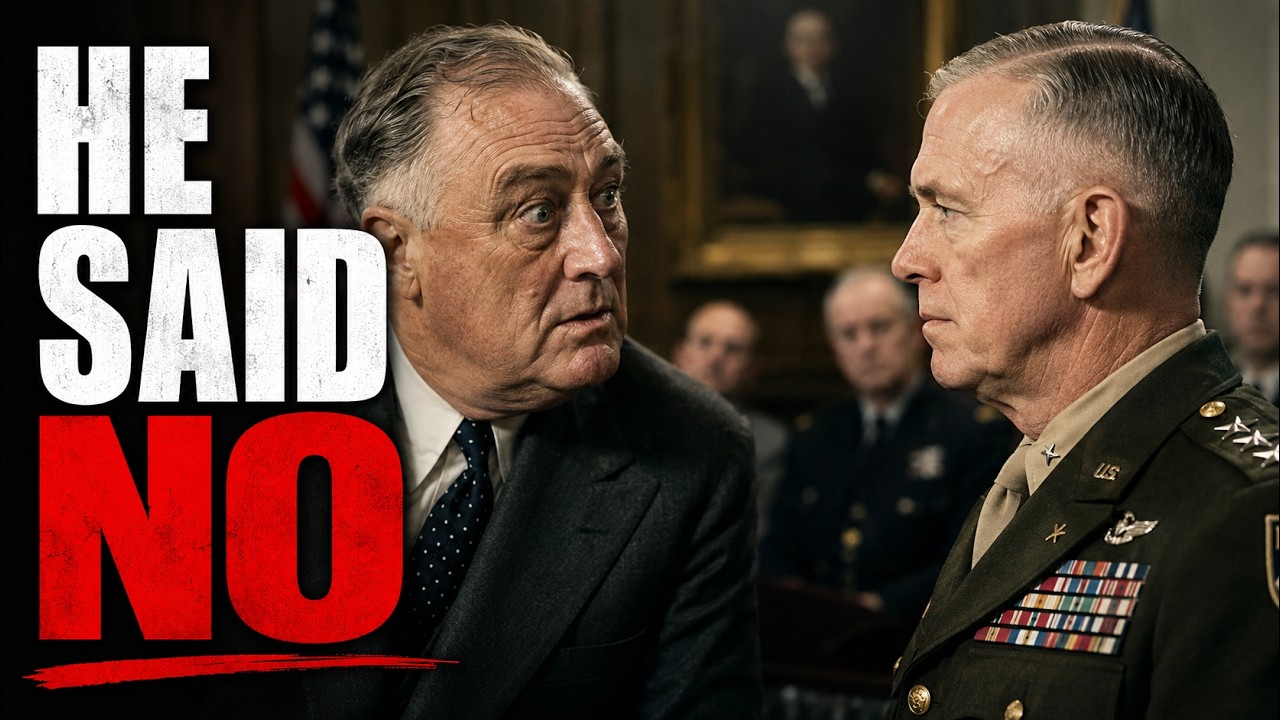
The other men around the table, seasoned in political survival, were internally writing Marshall's professional obituary. In their world, you do not publicly contradict the president, especially at your first meeting, and certainly not after every other senior official had voiced support. They assumed Marshall had just ended his career. They believed he had proven himself uncooperative, troublesome, and utterly lacking the political sense required to work at the highest levels of government.
When the meeting finally ended, participants treated Marshall with the distinct, polite distance reserved for a man who no longer mattered. They assumed he would be quietly reassigned, expelled from the inner circle, and sent to some forgotten post where his bluntness could do no further political damage. They were utterly certain Marshall had failed the test.
But as the room emptied and silence settled, the men who had rushed to agree with Roosevelt missed the most important dynamic of the entire exchange. They focused on the breach of political protocol. They focused on the perceived insult to presidential authority. They failed to realize that while they were busy writing Marshall off as a political casualty, Franklin Roosevelt was absorbing something entirely different.
When the heavy doors of the Oval Office finally opened and the attendees stepped into the White House corridors, the atmosphere around George Marshall was extremely uncomfortable. The men who had just been smiling and nodding at the president now offered Marshall a kind of stiff, sympathetic farewell usually reserved for funerals. In Washington's rigid hierarchy, political mistakes of this magnitude were fatal. You could not publicly humiliate Franklin Delano Roosevelt and survive.
The consensus among the departing cabinet members and senior leaders was absolute. Marshall would be quietly reassigned, buried in some obscure administrative post far from the centers of power, and never invited back. His career was over.
But days passed, and the expected punishment did not come. Roosevelt did not summon Marshall to demand an apology. He did not issue a quiet order to the War Department to reassign the brigadier general. The president simply left the opposition hanging in the air. For the political operators who had witnessed the exchange, Roosevelt's inaction was baffling. But for Marshall, it was a very familiar silence.
He had taken this exact risk once before, under far more terrifying circumstances, and it had shaped his entire understanding of military leadership. Twenty-one years earlier, during the bitterly cold autumn of 1917, American Expeditionary Forces were struggling to establish a foothold in the mud of France. The commander in chief, General John J. Pershing, arrived to inspect the 1st Division.
Pershing was known for his sternness and harsh discipline, a man who relieved generals on the spot and tolerated no insubordination whatsoever. After finding the division's training inadequate, Pershing directed a scathing, humiliating criticism at the division commander, completely ignoring the difficult logistical nightmares the unit faced. As Pershing turned to leave, a young staff officer stepped out of the ranks. It was George Marshall.
Marshall was furious at the unfair rebuke of his superiors, so he bypassed the chain of command and began reciting facts and logistical realities directly to the commander in chief. Pershing tried to walk away, ignoring the young captain. But Marshall physically stepped forward. He demanded to be heard, his voice rising in pitch and force. He laid out the unvarnished truth about supply shortages, broken transport lines, and the impossible conditions his men were operating under.
Other officers stood frozen in terror. They were watching what they assumed was the tragic end of a young officer's military career. You do not shout at "Black Jack" Pershing and remain in the United States Army. Yet Pershing's reaction was not anger. It was intense curiosity.
Instead of ordering a court-martial, the commander in chief stopped, listened, and absorbed the harsh facts he had just been given. Pershing did not dismiss Marshall. In fact, he did the exact opposite. He recognized that this young officer possessed a rare courage in prioritizing his men's survival over his own career advancement. Within months, Pershing brought Marshall directly into his inner circle and made him one of his key operational planners.
That confrontation in France instilled a permanent philosophy in Marshall's mind. He realized that mediocre leaders demand constant agreement. But exceptional leaders, the men who actually carry the heavy burden of war, desperately crave the truth. They know that comfortable lies on maps translate into dead soldiers in the field.
When Marshall sat in the White House in November 1938, he was not committing an act of blind insubordination. He was executing a calculated test. He was applying the lesson of 1917 to the president of the United States. Marshall understood that if Roosevelt was the kind of leader who needed flatterers, then there was no place for Marshall in his high command anyway. The looming global crisis was far too dangerous to be entrusted to a commander in chief who accepted only applause.
Roosevelt's refusal to fire Marshall was the turning point. The president was a seasoned politician, surrounded every day by men who adjusted their assessments to match the shifting moods of the Oval Office. He was suffocating from too much agreement. In that brief, sudden moment of challenge, Roosevelt saw beyond the breach of protocol. He recognized the same quality John J. Pershing had seen decades earlier. He was looking at an officer whose strategic judgment could not be bought, intimidated, or subdued by the enormous pressure of executive power.
By the spring of 1939, the unspoken tension from that November meeting had transformed into a silent professional evaluation. The term of the current Army chief of staff, General Malin Craig, was nearing its end, and Franklin Roosevelt faced the most important personnel decision of his presidency. He needed a commander who could take a small, marginalized military institution and prepare it for a mechanized world war that now seemed mathematically inevitable.
There were 34 officers senior to George Marshall on the active Army list. Prevailing Washington custom dictated that Roosevelt choose a comfortable, politically attuned general who would fit into the bureaucracy without challenging the Oval Office. Instead, on April 23, 1939, the president summoned the man who had publicly rejected his aviation plan five months earlier and offered him the highest operational post in the United States Army.
Marshall did not respond with immediate gratitude. Standing before the president, he set a stern condition for accepting the position. He looked directly at Roosevelt and said: "Mr. President, I want the right to say what I think, and to say it often, and it may not be comfortable." Roosevelt did not blink. He looked at his future chief of staff and replied: "I know all that, George."
That brief exchange formed the unwritten constitution of their leadership partnership. Roosevelt was not hiring an obedient subordinate. He was deliberately retaining an independent strategic observer. Yet neither man realized the terrifying speed with which that partnership would be tested.
On September 1, 1939, the day George Marshall formally took the oath as chief of staff, German armored columns and Luftwaffe bombers crossed the Polish border. World War II had begun. As reports of rapid German advances poured into the War Department, Marshall examined the actual instrument he had been given to defend the United States.
The inventory was a record of institutional neglect. The U.S. Army numbered roughly 174,000 soldiers on active duty. It possessed fewer than 1,000 modern field guns, a handful of obsolete tanks, and ammunition reserves so depleted that soldiers during training maneuvers had to simulate artillery fire by chalking tree trunks. The only motorized transport for several infantry regiments consisted of borrowed civilian delivery trucks.
While Roosevelt confronted powerful domestic isolationism that blocked immediate intervention, Marshall launched a relentless offensive inside the corridors of Congress. He did not ask for incremental adjustments. He entered congressional committee rooms with large tactical maps and stark statistical charts, demanding billions of dollars in immediate appropriations.
When legislators resisted by arguing that the Atlantic Ocean provided sufficient natural defense, Marshall refused to soften his tone. During one heated budget session, when an influential senator tried to cut his request for infantry equipment in favor of cheaper coastal defenses, Marshall stated plainly that an army lacking modern, balanced ground forces was merely a paper garrison waiting to be destroyed. He argued that aircraft and warships might buy time, but they would never prevent an industrial enemy power from seizing the resources of Europe and Asia.

Through sheer persistence and an absolute refusal to engage in partisan flattery, Marshall began extracting money from a reluctant Congress. But funding was only the first step. The money had to be converted into physical military structure under crushing time constraints.
To build the balanced war machine he had advocated in the White House in 1938, Marshall began the largest organizational overhaul in American military history. He knew the existing officer corps, aged by decades of peacetime routine, was incapable of leading fast-moving mechanized corps. He ruthlessly purged hundreds of senior officers who could not adapt to the speed of modern operations, replacing them with a generation of younger, more aggressive commanders.
Men like Dwight Eisenhower, Omar Bradley, and George Patton, who understood logistics, combined arms, and rapid maneuver. In the summer of 1940, following the sudden collapse of France, Marshall took his most politically dangerous step. He publicly advocated for the Burke-Wadsworth Act, demanding the first peacetime military draft in United States history.
In an election year, pushing for conscription was considered toxic by Roosevelt's political advisers. Yet Marshall testified before Congress repeatedly, presenting the raw mathematics of mobilization. Without conscripted manpower entering training camps immediately, the nation could not even form an initial defensive army of one million men before 1942. The measure passed by a narrow margin.
Within months, empty fields across the South and Southwest were transformed into sprawling training installations. Tens of thousands of new civilian recruits poured into newly built barracks every week. Across the Atlantic, the American military expansion did not go unnoticed, but it was viewed through a lens of deep professional contempt.
Inside the German High Command, foreign army intelligence analysts tracked Marshall's mobilization with clinical skepticism. In their official assessments throughout 1940 and early 1941, German intelligence officers dismissed the U.S. Army as an amateur organization. They classified American ground forces as a domestic police force capable of minor border security, but structurally and psychologically unfit for modern high-intensity continental warfare.
General Kurt Student and the German General Staff observed American training maneuvers, where units still lacked adequate armored vehicles and modern communications equipment, and concluded that even if the United States could muster a large army, its inexperienced personnel would never solve the complex logistical equation of moving, feeding, and commanding millions of men across 3,000 miles of ocean.
To the German Wehrmacht, which had just executed the fastest military conquest of Western Europe in history, Marshall's growing army was merely an industrial bluff. They estimated that American domestic politics and administrative inefficiency would delay any serious continental intervention until at least 1945, by which time Europe would be permanently secured under German control.
That assessment was a catastrophic analytical error. What German intelligence failed to measure was the speed of Marshall's organizational system. Unlike European armies that built their forces around rigid traditional doctrines, Marshall organized the expanding U.S. Army around standardized industrial efficiency and functional simplicity.
He established the Army Air Forces as an integrated partner with ground forces, ensuring aviation production was permanently linked to infantry support and logistical transport. He created the Armored Force as an independent command, demanding that factories in Detroit immediately convert from passenger car production to standardized medium tanks on round-the-clock assembly lines.
By the autumn of 1941, the results of Marshall's relentless pressure materialized in the Louisiana and Carolina maneuvers. Nearly half a million soldiers participated in the largest simulated combat operations ever organized in the Western Hemisphere. These were not flawless military displays. They were chaotic, grueling exercises designed to expose leadership failures, test communications under stress, and force officers to coordinate infantry, artillery, tanks, and air support across thousands of square miles of unfamiliar terrain.
Marshall watched the maneuvers closely, using them as an organizational screening tool. Officers who failed to supply their troops or lost their units in the field were quietly removed from command within 48 hours. Those who demonstrated speed, adaptability, and clear communication were promoted immediately.
When German military attachés and intelligence observers reviewed reports of the late 1941 maneuvers, the tone inside the German High Command began to change. The amateur police force they had mocked 12 months earlier had grown into an organized, heavily equipped field army of more than 1.5 million men. More alarming to Berlin, the American industrial supply line was now delivering standardized transport trucks, modern artillery, and tactical radio networks at a rate no European economy could match.
Initial German disdain evaporated, replaced by a growing sense of quiet awe among senior German staff officers. They began to realize the United States was not merely building a collection of units. It was building an integrated, sustainable military system designed for sustained global wars. The highly balanced force structure Marshall had risked his career to defend in 1938 was rapidly becoming a reality: infantry supported by heavy artillery, mechanized logistics, and coordinated air power.
By December 1941, on the eve of America's entry into the conflict, Marshall had succeeded in expanding the Army by more than 800 percent. He had secured funding, built training camps, selected field commanders, and laid the structural foundation for a military force that would soon deploy across the Atlantic and Pacific simultaneously.
Yet creating the physical instrument of war was only the first phase of Marshall's responsibility. Now that the United States was about to enter active global conflict, he faced an entirely different operational challenge. He had to prove that his unyielding honesty could withstand the immense pressure of managing a world war, and that he knew how to lose a bitter strategic argument with Roosevelt without breaking the high command.
The real paradox of their partnership was not that Marshall argued with Roosevelt. It was that he knew exactly when and how to yield. His inflexible honesty was never an act of insubordination. It was a disciplined professional tool. He earned the job because he spoke hard truths, but he kept it because he understood the absolute limits of military authority in a democracy.
This delicate balance faced its ultimate test in the summer of 1942. The United States was fully engaged in the war, and the pressure to achieve a tangible, immediate victory against Nazi Germany was enormous. Soviet leader Joseph Stalin was desperately demanding a second front in Europe to relieve the crushing pressure on the Red Army in the East.
Marshall, supported by his ambitious young operational planners like Dwight Eisenhower, forcefully advocated for a massive direct cross-Channel invasion of northern France, codenamed Operation Sledgehammer. To Marshall, this was the only mathematically sound way to defeat Germany. Concentrate all available ships, aircraft, and divisions on the shortest, most direct route to the industrial heart of the Reich.
However, British Prime Minister Winston Churchill vehemently opposed any premature invasion of France, fearing a catastrophic bloodbath on the beaches. Instead, Churchill proposed Operation Torch, the Allied invasion of French North Africa. Marshall was deeply dismayed. He saw North Africa as a dangerous logistical diversion.
He argued forcefully in highly classified strategy sessions that committing American troops to the Mediterranean would drain shipping, disperse air power, and scatter the divisions he had carefully concentrated over three years of buildup. He warned Roosevelt that invading North Africa would inevitably delay the real invasion of Europe by at least a year, giving Germany time to fortify the Atlantic Wall.
He fought Churchill's proposal with cold statistical ferocity, presenting the president with grim logistical projections and warnings of strategic exhaustion. But Franklin Roosevelt, balancing the complex political realities of the alliance and the urgent need to engage the American public with a tangible victory before the end of 1942, made his decision. He sided with Churchill. He issued a direct, unambiguous order to his chief of staff. The United States would invade North Africa.

In many senior military leaderships, this is the moment where deep fractures occur. A lesser general, publicly overruled on a major strategic question, might have leaked his opposition to sympathetic senators or the press. He might have quietly worked to slow the flow of resources, ensuring the operation stumbled just enough to prove his earlier warnings correct. He might have resigned in protest, creating a political crisis for the commander in chief.
George Marshall did none of those things. The moment Roosevelt issued the final political decision, Marshall's opposition vanished instantly. The argument was over. He walked out of the Oval Office, returned to the War Department, and immediately ordered his staff to tear up the France plans and redirect the entire industrial and logistical power of the U.S. Army toward the Mediterranean.
He did not complain to his subordinates. He did not attempt to undermine the operation from within. He applied the same ruthless efficiency he had used to build the Army to execute a strategy he despised in principle. He marshaled the ships, finalized the complex command structures, and ensured that the inexperienced American troops heading to North Africa possessed every tank, rifle, and artillery shell the factories could produce. He organized the execution of Operation Torch flawlessly.
This reaction crystallized the trust between the two men. It proved to Roosevelt that Marshall's forceful arguments were never driven by ego or a desire for political power. When Marshall objected, he was fighting for the lives of American soldiers and the fastest path to victory. But when civilian leadership made a final decision, Marshall's loyalties were absolute and unbreakable.
Roosevelt realized he possessed the rarest of assets. An adviser who fought him with savage honesty behind closed doors, but executed his orders with absolute fidelity in the field. This dynamic forged a deep, unshakable reliance. Roosevelt knew he could entrust Marshall with the fate of the nation precisely because Marshall knew how to submit to the president's constitutional authority.
And it was this specific trust that would soon dictate the most important and painful personnel decision of the entire war. By the autumn of 1943, the strategic focus of Allied forces finally settled on the English Channel. The massive invasion of Europe across the Channel was no longer a distant theory. It was a concrete reality being marshaled in the staging grounds of Great Britain. The vast military machine recruited, trained, and equipped over the past four years was ready.
Now, a supreme Allied commander had to be appointed to lead the liberation of the continent. At the highest levels of command in Washington and London, the assumption was absolute. George Marshall would lead the invasion. It was universally understood that the man who built the weapon had earned the absolute right to wield it.
For a professional soldier who had spent his entire life studying the operational art of war, this was the ultimate pinnacle. Leading the largest amphibious assault in human history meant securing a permanent place in the record of military legends. Marshall wanted this command intensely. He had already allowed his wife to begin packing their belongings at their military residence in Virginia, fully expecting his headquarters to move to London.
But as Allied leaders prepared to meet at the Cairo and Tehran conferences in late November to finalize the command structure, Franklin Roosevelt hesitated. The president was managing the overwhelming, exhausting burden of a global coalition. He had to balance the competing geopolitical demands of Winston Churchill and Joseph Stalin, oversee the mobilization of the entire American industrial economy, and direct a raging war simultaneously across two oceans.
At the center of that unprecedented chaos, George Marshall had become the president's indispensable anchor. If Marshall went to London to lead the invasion forces, he would effectively be removed from the global strategic center. Someone else would have to manage the turbulent politics of the Joint Chiefs of Staff. Someone else would have to enter hostile congressional hearings and secure billions in emergency funding. Someone else would have to solve the agonizing mathematical equations of allocating scarce landing craft and heavy bombers between the Pacific islands and the European theater.
Roosevelt looked at the list of American generals. He had excellent field commanders. He had men who could direct the invasion fleet, coordinate the airborne drops, and breach the concrete defenses of the Atlantic Wall. But he had only one George Marshall.
The final decision came to a head in a private meeting in Cairo. Roosevelt summoned his chief of staff to his quarters. The president was fully aware of what he was asking Marshall to sacrifice. He knew that history ultimately remembers the victorious generals in the field, not the men sitting at desks in Washington managing shipping schedules and supply quotas.
Roosevelt gently encouraged Marshall, giving him the opportunity to ask for the post directly, offering him the chance to claim the historic glory everyone agreed he deserved. True to the dynamic they had established five years earlier at their first meeting, Marshall refused to make the decision for the president. He looked at Roosevelt and stated that the choice must be based solely on what was best for the country, not on what was best for George Marshall's personal ambitions. He would cheerfully and effectively execute whatever order the commander in chief issued.
Roosevelt looked at the man who had once risked his entire career to tell him he was wrong. He looked at the general who had built an army of millions from nothing, yet refused to claim the ultimate prize. Roosevelt made his decision. Command of the invasion of Europe would go to Dwight D. Eisenhower. Marshall would remain at his desk in Washington.
When the president delivered this brutal professional blow, denying his top general the ultimate field command, he offered no complex strategic formulations or political excuses. Roosevelt explained his painful decision to Marshall with one profound truth. He looked at his chief of staff and said simply: "I feel I could not sleep at night with you out of the country."
That quiet admission from the commander in chief represents the final resolution of a gamble that began five years earlier. To measure the full distance this partnership traveled, we must return to that silent, tension-charged room in the White House on November 14, 1938.
Look again at that conference table. The president had just laid out a massive, politically elegant plan to build 10,000 warplanes. The most influential men in Washington, veteran cabinet secretaries, seasoned politicians, and senior military leaders, had lined up with remarkable speed. They had prioritized the immediate comfort of executive approval over the harsh, complex calculations of actual military readiness. They had given Franklin Roosevelt exactly what he wanted to hear.
Then a relatively unknown brigadier general, attending his first presidential briefing ever, looked into the eyes of the most powerful man in the country and flatly rejected the entire premise. "I am sorry, Mr. President, but I don't agree with that at all."
The men sitting around that polished wooden table thought George Marshall had just committed a spectacular professional suicide. In the normal machinery of peacetime politics, they would have been entirely correct. But an impending global catastrophe does not operate on the mechanics of conventional politics.
As the world stood on the edge of an unprecedented abyss, Roosevelt recognized a terrifying truth. The illusion of consensus is the most dangerous trap a wartime leader can fall into. A commander in chief who isolates himself with comfortable opinions and false flattery is a man flying blind into the heart of a hurricane.
By risking his life's ambition to speak a blunt, uncomfortable truth on his first day inside the inner circle, Marshall set a standard of absolute, uncompromising integrity. He proved immediately that his strategic judgment could not be swayed by the overwhelming weight of the Oval Office. He demonstrated that his ultimate loyalty was to the survival of the nation's armed forces, not to the advancement of his personal rank.
This is the decisive answer to why a master political tactician chose a soldier who did not know how to compromise to build, equip, and direct the largest military machine in American history. The calculations were simple but exceedingly rare. Roosevelt understood that a room full of yes-men provides temporary comfort, but it does not win world wars.
He kept the dissenting general by his side always because Marshall's courage to say "no" carried incalculable value in saving lives. It meant that when the global stakes were at their absolute highest, when the margin for error had vanished completely, and when George Marshall finally said "yes," the president could be entirely certain he meant it.
George Marshall did not become the greatest architect of American military victory because he always agreed with his commander in chief. He became that because Roosevelt knew that when Marshall saw danger, he would speak plainly, even if the man behind the desk held all the power.