Ten American Marines fought more than 100 Japanese soldiers on a trail above the Lunga River on Guadalcanal on November 30, 1942. The engagement lasted about half an hour. Not one of the 10 Marines was hurt. The confrontation was the result of a month-long patrol through the island’s interior by the 2nd Marine Raider Battalion under Lieutenant Colonel Evans Carlson.
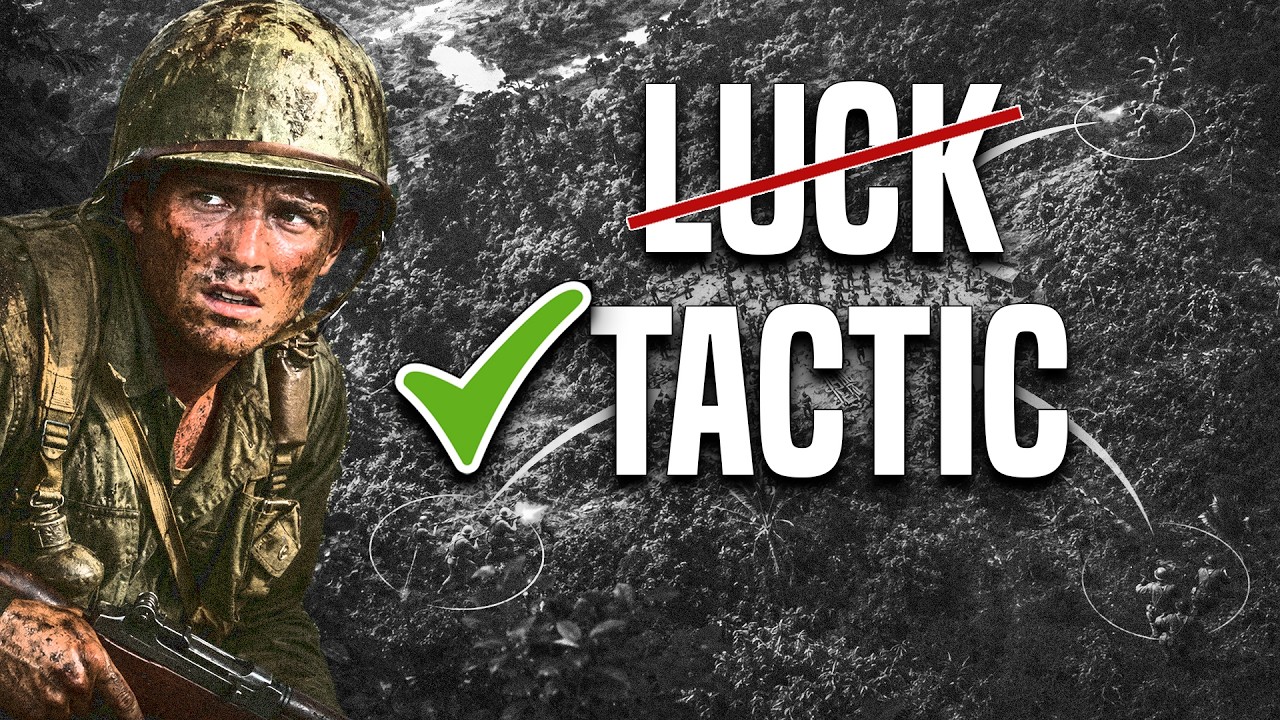
It also capped a radical experiment in infantry organization and firepower that would outlast the unit that tested it. The operation began on the night of November 4, 1942, nearly a month earlier. Martin Clemens, a British district officer who had stayed on the island after the Japanese took it, and John Mathers, an Australian officer, lit a bonfire on the sand at Aola Bay, about 30 miles east of the Marine perimeter. It was a prearranged signal.
Boats came out of the dark toward it before dawn, carrying two companies of Carlson’s raiders. The ground behind the beach was swamp, and the airfield the Americans had come to build there never materialized. Instead, the raiders were ordered inland to harass a large Japanese force from behind. That force, roughly 3,000 men of the 230th Infantry Regiment reinforced by a battalion of the 228th, was trying to slip out of an American ring near Koli Point under Colonel Toshiro Shoji.
The Japanese units in the hills had already spent three months fighting Americans. They had measured a Marine rifle line at the Tenaru in August and on the ridge south of the airfield in September. They had a working picture of what an American formation could do and how many men it took. Over the following four weeks, that picture came apart in a way their own reporting never accounted for.
The key was how Carlson had rebuilt his squads. Washington had given the raider battalions first call on men and equipment and the freedom to draw non-standard weapons. Carlson used that freedom on a single idea. Instead of an eight-man squad acting as a single lump, he built a squad of 10 men: a leader and three teams of three.
Every team carried a Browning automatic rifle, a Thompson submachine gun, and one of the new semi-automatic Garand rifles, at a time when the rest of the Corps was still going ashore in the Solomons with bolt-action Springfields. A loaded Browning weighed over 20 pounds and its 20-round magazine could be emptied in under four seconds. The automatic rifleman in each team walked with a belt of spare magazines, and the two men beside him carried more. Roughly a third of what a raider squad hauled through the jungle existed to keep three guns fed.
A Japanese rifle company of the period fielded 181 officers and men with 139 rifles, almost all of them the 6. 5mm Type 38 bolt-action weapon in service since 1905. Its firepower was built on aimed single shots and nine light machine guns. The arithmetic favored the American squad on sheer volume.
Three Brownings, three Thompsons, and four Garands in the hands of 10 men who could all shoot put more rounds into a tree line in the first 60 seconds than every bolt-action rifle in that enemy company firing together. Captain Oscar Spietros, who commanded one of the raider companies, later put his squad’s firepower as superior to anything known to exist in a unit of that size anywhere in the world. None of those figures survive contact with a jungle, though. At 20 yards in second growth, a man does not pick out a target so much as put metal into the place a noise came from.
The side that manages it first tends to decide what the next three minutes look like. None of it worked without the islanders. The battalion could carry four days of canned food and no more. Everything after that had to come up from the coast on somebody’s back.
The somebodies were Solomon Islanders working under Mather and under Sergeant Major Jacob Vouza of the Solomon Islands police force. Rear echelon men at Aola loaded a boat every four days and ran it to an agreed spot on the shore. Carriers met the boat and walked the load inland to wherever Carlson had put his base camp that week: rice, tea, raisins, bacon, and ammunition. Scouts went ahead of the column and found the tracks because the tracks were on no map the Marines owned.
A crate of . 30-caliber ammunition is a two-man load over broken ground. A squad with three automatic weapons is only as good as the pouches it can keep filled, and those pouches were filled by men who were not in the Marine Corps and had volunteered for a war that had arrived on their islands without asking them. At first light on November 6, Carlson took his command group, two companies, 267 Marines, and the scouts and carriers out of Aola and turned inland.
The tracks were narrow and grown over, and almost none ran where the Americans expected. It rained on most days. Men crossed the same river four and five times in an afternoon because the river bent back across the only footing a column had. At the Rekko Crossing in the first days of the march, the point ran into a small enemy party.
The first man hit was the islander walking at the head of the Marines. He was shot and badly wounded. Two Japanese were killed and the march went on. That is who was in front on the first day of contact, and it stayed that way for the rest of the month.
On November 9, the Marines reached Binu, a village on the Banu River about eight miles inland, and Carlson made it his base. From there he pushed patrols out to find the enemy. On the nights of the 9th and 10th, roughly 3,000 of Shoji’s men slipped out of the American ring and started the long march back around the perimeter to the west. They were hungry and worn out and had been ordered to retrace ground they had already covered once.
They were also moving through country they took to be their own back area. On November 11, Carlson had four companies out on independent patrols with a fifth holding Binu, each carrying a radio. At midmorning, Charlie Company crossed a wide field of grass and pushed its advance guard into the trees on the far side, straight into an enemy bivouac. The grass stood chest high and offered a man nothing to get behind.
The advanced guard hurt the enemy badly in the first few minutes. Then the rest of the company was caught in the open, and rifle fire, machine gun fire, and mortar rounds came down on it and held it there. Five Marines were killed and three wounded. Easy Company, sent to help, crossed the Matapona and met a second body of the enemy coming the other way, more of them than there were Marines.
Major Richard Washburn got his men reorganized and attacked as they came over the river, hurting them, but could not break through to Charlie. Dog Company was held down all afternoon by a third group and lost two killed. Carlson took Fox Company forward himself in mid-afternoon, worked it around the flank, and by dusk the camp was empty. Charlie had already pulled itself back out of the grass under covering fire from its own 60mm mortars.
That day cost the battalion more men than any other of the operation. It was also the day the new organization got a full-scale test against troops who were awake, dug in, and shooting back. The next day, Carlson took two companies back to the same patch of woods and sat in it. Enemy messengers kept walking in through the trees all day, still under the impression the ground belonged to their own side.
The raiders killed 25 of them. On November 13, Carlson watched groups of the enemy moving through the low ground below the ridge, sent the map coordinates back, and brought artillery and mortar fire down on five different parties. On the 14th, a patrol wiped out a 15-man outpost the scouts had located. By the middle of the month, the main enemy body had gone.
Carlson walked into the American perimeter on the 17th, took a new set of tasks from General Vandegrift, and went back out to hunt for the artillery piece shelling Henderson Field and the tracks the Japanese used to get around the airfield. Able Company came up from Espiritu Santo on the 25th. The battalion split into three groups of two companies apiece and went deeper into the high ground between the headwaters of the Tenaru and the Lunga. On November 29, they came up against a steep spine of ground dividing the two river valleys.
The men went up it and down the far side on ropes. On the 30th, they found a telephone wire, followed it, and walked into a large camp holding an unattended 75mm mountain gun and a 37mm anti-tank gun. The Marines pulled the working parts out of both weapons and threw them down the hillside into the trees. Then the squad split up to check two rain-soaked tracks near the Lunga.
Corporal John Yancey of Fox Company was on one of them with his men when the ground ahead opened into another camp. There were about a hundred Japanese soldiers in it. Their rifles were stacked several paces off, the way rifles get stacked when troops are resting in their own rear. Both sides saw each other in the same instant.
Yancey went straight in firing and shouted for his squad to follow. Somebody back in the trees called across to ask what was happening. “I have flushed a covey,” Yancey shouted. Men went for the rifle stacks and did not reach them.
Others went for the trees. The raiders worked to better ground and fired from it, one team holding while another moved, shouting a recognition phrase at each other through the noise so the men coming around the flanks would not shoot into their own. When it stopped, the survivors had gone into the bush. The Marines had lost nobody.
No ammunition expenditure return survives for the patrol. The Navy Cross citation written for Yancey afterward says his squad killed over 50. Carlson’s own account, and the Marine Corps monograph that draws on it, says 75. What can be said is why 10 men could do it at all.
A squad cut into three teams can be three things at the same moment: one team fires and holds the enemy in place, one moves, one waits. A squad that has to act as a single body picks one of those three and gives up the others, and picking takes time it does not have. Carlson’s men had spent months at Jacques Farm learning to work in threes at night, and by the end of November they had spent three and a half weeks doing it in country where nobody could see more than 20 yards. A Japanese platoon commander looking at those trees had no reason to think the fire coming at them from three directions was 10 men, because in his army, and in most armies in 1942, it could not have been.
The squad was only on that track because Vouza’s scouts had found it, and it only had full magazines because carriers had walked the ammunition eight miles inland from a beach. The exchange for the whole month was 488 Japanese killed against 16 Marines dead and 18 wounded, over more than a dozen actions and 150 miles of walking. Carlson credited his guerrilla methods, and he was partly right. He was also operating in an area where the enemy was behind his own lines and had grown careless.
The organization outlasted the men who invented it. In January 1944, the Marine Corps disbanded all four raider battalions on the reasoning that a war of assaults on fortified islands no longer needed light units that could vanish inland for a month. That same winter, the Corps rewrote its infantry tables. The new rifle squad was 13 men in three fire teams of four, each team built around a Browning automatic rifle.
It was Carlson’s structure, with one more man in each team to absorb losses. Every Marine rifle squad has been organized that way ever since. Carlson himself did not have long. Malaria and jaundice took him off the line in the spring of 1943, and on Saipan the following year he was badly wounded in the arm and the leg while pulling his radio operator out of a machine gun’s line of fire.
He died in 1947 at age 51. The battalion’s own bill does not appear in the exchange figure. Two hundred and twenty-five men were sent to the rear during the patrol, sick with malaria, dysentery, and ringworm, worn down by short rations and constant wet. Charlie and Fox had landed at Aola on November 4 with 133 officers and men apiece.
When they walked into the Marine perimeter on December 4, the two of them together numbered 57. Fever had taken most of the difference. The carriers who kept their pouches full walked home to their villages, and nobody counted them at all.