Driving from New York City toward Long Island, you pass over the Brooklyn-Queens Expressway just after emerging from the Manhattan tunnel. Directly below lies one of the largest cemeteries in the country: St. John Cemetery in Queens.
Few people realize how many former mob figures are buried there. Founded around 1872, the cemetery has been called the "Boot Hill" of gangsters. It is run by the Catholic parish and spans roughly 169 acres, filled with mausoleums, headstones, and family plots.
One man recalls driving over that expressway as a child while his father told him stories. His father claimed a friend once offered him good money to walk through the cemetery at night, and he did it. Whether the story was true or not, it was easy to imagine the place as an eerie experience after dark.
The family connection runs deeper. His grandfather, known as "Tony the Lion," came from Italy and bought about 25 burial plots for the whole family more than 100 years ago. He and his wife had 19 children, and the hope was that the Francese family would one day rest together.
Many relatives are buried at St. John today. The cemetery is a remarkable place, though cemetery traditions differ around the country. In New Orleans, for example, people are buried in above-ground tombs because of the water level. St. John is different, but just as striking.
The sad truth about reviewing the men buried there is that many did not die well. Some died in prison. Others were killed. It is a somber story, and it raises a question anyone might ask: after living a full life, where do you end up in the end?
For one former mob associate, faith provides the answer. He speaks openly about his Christian belief that if a person confesses their sins and accepts Jesus Christ, they can go to heaven regardless of their past. God knows what is in every heart, and no one can fake that. After leaving his old life, he has tried to live the right way.
He also recalls a speaking event in Springfield, Missouri, where a federal prison hospital is located. Many men were sent there before they died, including John Gotti. A nurse who cared for Gotti shared stories with him. Gotti suffered for months and died of cancer, a hard death by her account. He hopes Gotti confessed his sins and made peace with God, because even in your final moments, you can change course.
With that in mind, here are 21 men buried at St. John Cemetery, many of them well known to anyone who has studied the Mafia.
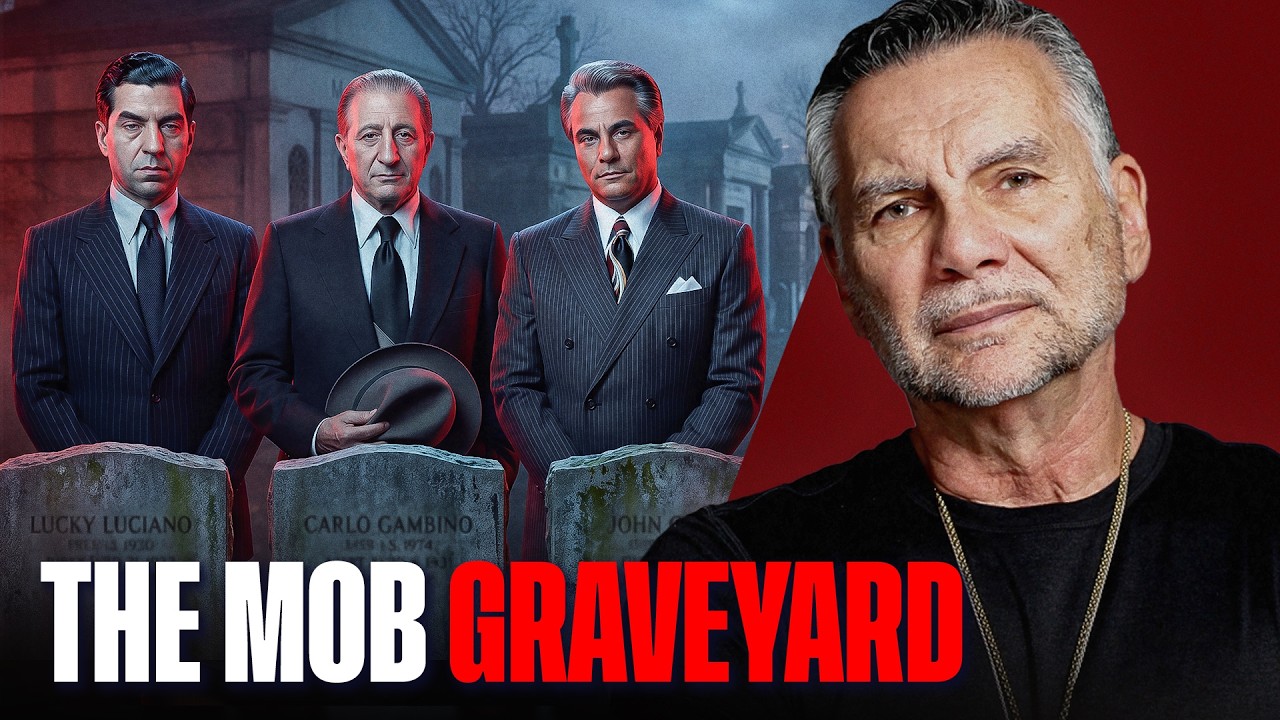
Just past the gates, a stone building surrounded by Greek columns bears the name "Luciano." It is the mausoleum of Lucky Luciano, and it is large, beautiful, and hard to miss.
One of the oldest men buried there is Salvatore "Toto" D'Aquila, who came from Sicily around 1906. He is considered by some histories to be the first boss of the Gambino family. He led for about 10 years until he was killed, shot multiple times after leaving his home, reportedly on his way to a doctor's appointment. He has an ornate mausoleum and was among the first buried there.
Charlie "Lucky" Luciano is a name everyone knows. He was deported to Italy and tried to return to the United States but could not. He died of a heart attack in Italy at about age 64, and his body was brought back to the country where he wanted to be buried. He rests at St. John in a grand mausoleum. Luciano effectively founded Cosa Nostra in America and established the Mafia Commission. If anyone deserves the title of the original "Godfather" of American organized crime, it may be him.
Joe Profaci is another familiar name. He rests in a mausoleum and led his family for about 30 years. He was nicknamed the "Olive Oil King" and also came from Italy. After his death, his aide Magliocco took power briefly until the Commission intervened. Carlo Gambino was part of that, and then Joe Colombo became leader. Colombo's aide for a long time was the father of the man telling this story.
What is striking is how close all these men are to one another. The cemetery is huge, but their resting places seem clustered together. Close in life, close in death.
Vito Genovese also has a grand mausoleum. He took over after Lucky Luciano, and he and Frank Costello were rivals. Costello served as acting boss while Luciano was in Italy, and a rift grew between them. Genovese wanted power and took it. There was an attempt on Costello's life, reportedly orchestrated by Vincent "the Chin" Gigante. Costello survived, grazed by a bullet to the head. Genovese later faced a major narcotics case, received a long sentence, and was imprisoned. He is buried at St. John, and the family name still exists today.
James "Jimmy Nap" Napoli was from the same Greenpoint neighborhood as the narrator. He ran very large gambling operations and was a captain in the family, a well-known figure at the time. He was met a few times, including alongside the narrator's father when the narrator was younger. Jimmy Nap is buried there too. Interestingly, he was charged in a conspiracy to kill John Gotti, a part of his story that is not what he is best known for.
John Gotti, as in life, stands out in death. He is in an elaborate building near the center of the cemetery, and everyone knows it is his burial site. Many tourists come to see it, which cemetery management does not particularly enjoy, though visitors are allowed in at certain times.
Carlo Gambino led the Gambino family for more than 20 years and was once called the "boss of bosses." He is one of the most notorious men buried there. Gambino had a better end than most. He died at home on Long Island at 75 or 76 and spent very little time in prison. He was, in one view, the model of what a mob boss should be: low-key, out of the spotlight, and never caught in a case despite numerous investigations. He lived the way a boss should, in the shadows, in contrast to Al Capone, John Gotti, and others who craved attention.

Frank Abbandando, nicknamed "the Dasher," was part of Murder Inc. He reportedly had many victims and used an ice pick to stab people in the heart. Murder Inc. was said to be responsible for more than 200 murders. They were contract killers used by Luciano and Meyer Lansky at the time. Abbandando was a key figure in that group and is buried at St. John.
Joe Colombo was from the narrator's own family and was known well. Everyone knows his story: the Italian-American Civil Rights League, the shooting, and how he lingered for six or seven years in what was essentially a brain-dead state before he died. He is buried there, another boss at St. John.
So you have Carlo Gambino, John Gotti, and Salvatore Accella, major figures buried in that cemetery. It is almost a tourist attraction. People enjoy coming to visit the grave sites.
Johnny "Dio" Dioguardi was met once, long ago, when the narrator was a child. Johnny Dio was a major labor figure, very active with the Teamsters. He was charged with labor racketeering several times, but he also helped Jimmy Hoffa become president. Anyone who studies organized crime knows the name. He is buried there.
Salvatore Maranzano was one of the original "Mustache Petes" who came to America early. He was part of the Castellammarese War against Joe Masseria. Charlie "Lucky" Luciano was responsible for the deaths of both Masseria and Maranzano. Maranzano was a boss, another one buried at St. John.
Roy DeMeo is a name many people ask about. He had a very dark reputation and was said to be responsible for hundreds of murders, many committed personally. The narrator once had two Jaguars stolen and made a few phone calls, knowing DeMeo owned car dismantling shops. By the end of the day, both cars were recovered, and DeMeo was involved. He met DeMeo a few times and found him a tough man, as his reputation suggested. He is buried there.
Carmine Fatico, nicknamed "Charlie Wagons" for his love of hijacking trucks, was a Gambino figure known as a mentor and an early mentor to John Gotti alongside Neil Dellacroce. Fatico was one of Gotti's mentors.
Willie Boy Johnson is a name many have heard. He was not a formal member of the Mafia because he was Native American, but he was an associate. He was an informant for the government for more than 20 years, from 1965 until the mid-1980s, when he was killed. The story goes that he became an informant because he spent time in prison and was supposed to be looked after by Carmine Fatico, who was to care for his wife and children but never did. Whether that is true or not, it is what was said.
The narrator once ran a loansharking operation with Willie Boy and liked him. He asked John Gotti if it was okay to lend money through him, and Gotti said yes. More than $100,000 was put on the street, and Willie Boy paid the interest every week. When it was discovered he was an informant, the narrator and Gotti were in a federal correctional facility. Gotti sent a message asking for confirmation. The narrator showed Willie Boy some papers and asked if it was true. Willie Boy shook his head in a way that suggested not to worry, and he never said anything about the narrator, not a word. That was appreciated, because he could have exposed the loansharking operation.

Willie Boy Johnson was killed by Tommy Pitera, who did John Gotti a favor by getting rid of him. Pitera was charged but reportedly acquitted and did not go to prison for that crime. Willie Boy Johnson is another person in St. John Cemetery, though the narrator never saw the grave.
Carmine Lombardozzi was known well. A former associate, Larry Carrozza, was very close to him, and they sat together a few times. Lombardozzi was a very smart man with several nicknames: "the Doctor," "Alberto," "the King of Wall Street," and "the Italian Meyer Lansky." He was known as one of the biggest earners for the Gambino family at the time. He lent money to Larry Carrozza, who may have used it to start his funeral business. Lombardozzi was a wise old man who lived his life the right way, and he is buried at St. John.
Vincent Papa was a Lucchese man and a made member. He is known for stealing heroin from the New York City Police Department, heroin that had been seized in the French Connection case. How he did it is unclear, but that is what he is known for.
Philip Rastelli, known as "Rusty," was boss of the Bonanno family for a time and lived in Greenpoint. He was absent for most of his time as boss. The narrator knew him; his cousin Tutti, a made member in the Colombo family, was very close to him, and the narrator met Rastelli a few times at his home. Rastelli was reportedly home for only two or three years during his time as boss. Joey Massino took over after Rastelli, though the circumstances are not entirely clear. Massino was later convicted of murder, sentenced to hundreds of years, and eventually became an informant who damaged the Bonanno family. Rastelli is another boss buried at St. John.
Frank "Funzi" Tieri was met a few times when the narrator was younger. He was boss of the Genovese family and, in 1972, was a low-profile man. He was diplomatic and well liked. Soldiers under him reportedly loved him because he believed in sharing the wealth. He was another mob boss buried at St. John.
Neil Dellacroce is familiar to everyone. He was a top figure in the Gambino family. He was passed over for boss when Carlo Gambino died, and Gambino's son-in-law Paul Castellano was appointed instead. People were not happy about it. Dellacroce was highly respected and was a mentor to John Gotti, who loved him. Gotti was very upset when Dellacroce was overlooked for the top position and never got along with Castellano. Gotti later arranged the murder of Paul Castellano and became boss himself. Neil Dellacroce, another top figure, is buried at St. John.
Finally, and unfortunately, there is the narrator's own father, Sonny Francese. He is one of about 20 people from the family buried at St. John with his parents, the narrator's grandparents. There are believed to be about 25 bodies buried there, stacked perhaps three, four, or five levels deep. The family has a large plot with big headstones. The narrator's mother is buried there too, as are two of his sisters. He will not be buried there. He lives in California and will one day rest beside his wife. It is something people do not want to think about, but it must be planned, because everyone has to go somewhere, and it is easier on family to have arrangements made in advance.
If you are in New York and drive over the Brooklyn-Queens Expressway, you cannot miss it. Look down and you will see a vast expanse of headstones and mausoleums. They are the grave sites of St. John Cemetery.
The narrator considers himself very lucky to have gotten away from that life and avoided the fate of some of these men. Many died in prison. Many were killed. He spoke that morning with someone from Netflix working on a documentary series about certain Mafia bosses. They asked about the difference between today's mob bosses and those of 40, 50, 60, or 100 years ago. Law enforcement made the difference, he said, because of laws passed in the mid-1980s: racketeering laws, bail reform, and sentencing reform. They were devastating. Many men were sent to prison, and many became informants. Life simply changed because the government built up its arsenal to pursue the Mafia, and they targeted it directly.
It was different in the days of Luciano and Capone. Dewey, the prosecutor at the time, pursued Luciano relentlessly and put him away for a long time, with a 50-year sentence. Whether the charges were fabricated is unknown. Many people say Luciano was not really involved in prostitution, one of the crimes he was convicted of, but who knows. The bottom line is that things were largely similar, but law enforcement changed, strengthened its arsenal, sent many men to prison, and changed the course of life for many people.
The narrator is glad he is not one of those lying in that cemetery, having died in prison or under unfortunate circumstances. He is happy to be here to talk about it rather than be locked up again. He will get there someday, he says, but he hopes it will be under different circumstances.