Andrea Bocelli has one of the most recognizable voices in the world, but behind his extraordinary career lies a family story that took three very different paths. The legendary tenor has three children, and none of them simply became copies of their famous father. One son walked away from a musical career despite having the talent for it. Another chose to sing professionally while knowing he would forever be compared to one of the greatest voices in history.
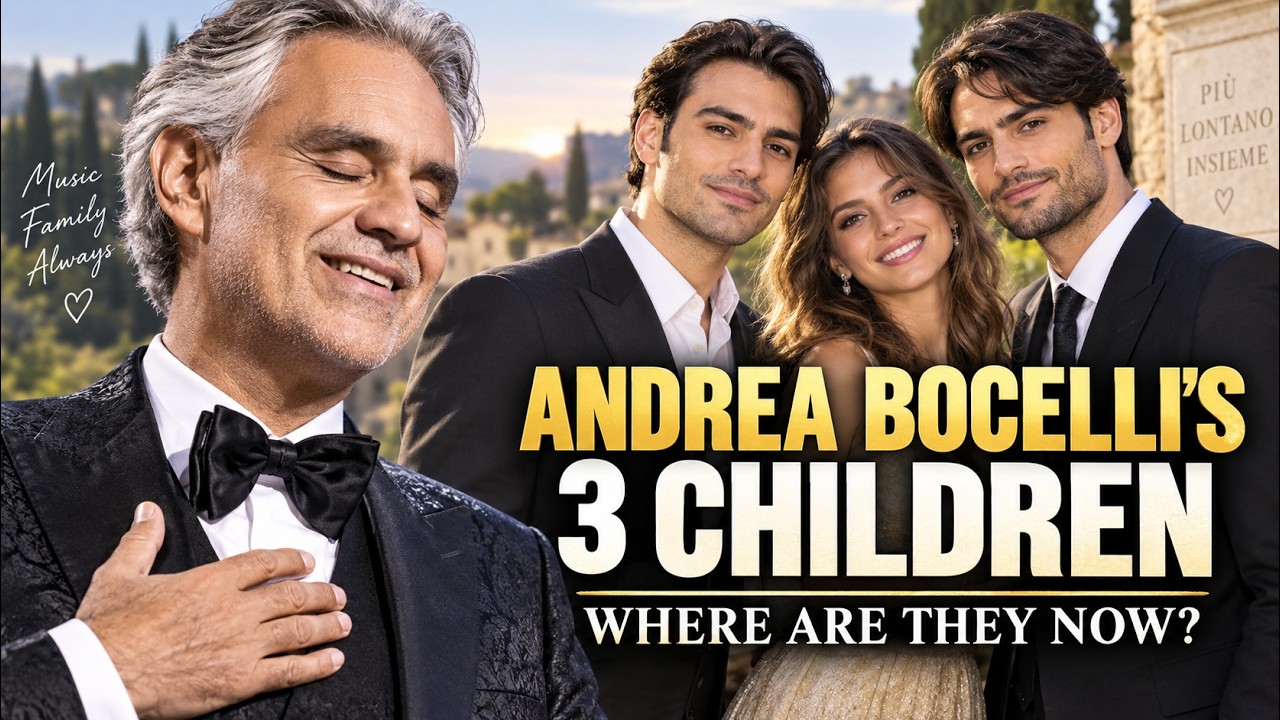
And a daughter entered the public eye almost by accident, during one of the strangest moments in recent history. Bocelli was born on September 22, 1958, in Tuscany, Italy. He experienced serious vision problems from childhood and became completely blind at age twelve following a football accident. Music had already become central to his life by then.
He learned piano at an early age and later studied several other instruments. He loved opera and listened obsessively to the great tenors of the past. For years, however, music remained more of a passion than a profession. Bocelli studied law at the University of Pisa and briefly worked in the legal field while performing in piano bars at night.
During those years, before Sanremo, before global fame, and before selling millions of albums, he met Enrica Cenzatti. She was there before the world knew the name Andrea Bocelli. They fell in love and married in 1992. That same year, Bocelli’s career began to change dramatically.
Italian singer Zucchero was looking for a tenor to record a demo version of the song “Miserere,” which was intended for Luciano Pavarotti. Bocelli recorded the tenor part, and that performance helped place the then-unknown singer in front of people who could change his life. In a short time, he went from piano bars to performing with Zucchero. Then came the Sanremo Music Festival, where he won the newcomers category in 1994 with “Il mare calmo della sera.
”
His rise was meteoric. “Con te partirò” became a massive hit, and the duet version, “Time to Say Goodbye,” with Sarah Brightman, turned Bocelli into a global star. Yet at the very moment the world was discovering Andrea Bocelli, Bocelli himself was discovering fatherhood. On February 22, 1995, Enrica gave birth to their first son.
They named him Amos. Amos arrived during one of the most chaotic periods imaginable. Bocelli’s career was taking off, with international travel, recording sessions, television appearances, and concerts becoming everyday life. At home, there was now a baby.
Bocelli chose the name Amos in honor of Amos Martellacci, an important mentor from his younger years. From the beginning, music naturally surrounded the Bocelli household. Amos learned to play the piano and became seriously proficient at it. From the outside, his future seemed clear.
The eldest son of Andrea Bocelli played beautifully, with access to musicians, studios, concert halls, and opportunities that young artists around the world could only dream of. Surely Amos Bocelli would become a musician. But he did not. At least not as a professional.
As he grew older, Amos developed a completely different passion: science. He pursued advanced technical studies covering aerospace engineering and related fields, gradually building a life that existed largely outside the entertainment industry. For the eldest son of Andrea Bocelli, this was a private and unexpected path. He did not avoid music because he lacked talent.
He had talent. He simply did not seem to want the life that came with it. There was one platform, however, that Amos could not completely escape: Sanremo. In 2013, Bocelli returned to the festival that had played such an important role in his career, and Amos sat at the piano beside him.
It was a remarkable full-circle moment. Bocelli had arrived at Sanremo as a young singer trying to prove himself. Years later, he returned as one of Italy’s most famous musicians, accompanied by the son born exactly as that extraordinary journey began. Amos also occasionally contributed piano playing to his father’s recordings.
But he never seemed interested in turning those appearances into a career of his own as a famous artist. Two years after Amos was born, Bocelli and Enrica welcomed another son. Matteo Bocelli was born on October 8, 1997. With Matteo, the story developed very differently.
Like his older brother, Matteo grew up surrounded by music. He learned piano and trained his voice, and over time it became increasingly clear that he had genuine singing ability. Bocelli once described Matteo as having grown up on bread and music. But talent was only part of the equation.
Matteo faced a challenge that almost no other young singer has to deal with: his father is Andrea Bocelli. For most artists, sounding even slightly like Bocelli would be a source of pride. For Matteo, every similarity raised a question. Was he talented in his own right, or just Andrea Bocelli’s son?
Would audiences come to hear Matteo, or would they come because they wanted to see the son of a legend? The famous family name can create opportunities, but it can also create expectations that are nearly impossible to meet. Bocelli seemed to understand this. Instead of immediately presenting Matteo as a child star, Matteo spent years training.
He studied classical singing and developed his voice, only gradually beginning to appear in public. Then, in 2018, father and son stood together in the spotlight. Bocelli was preparing the album “Sì,” and one of the songs was called “Fall on Me,” recorded with Matteo. For many people around the world, that was the first time they heard Andrea Bocelli’s son sing.
The duet worked. “Fall on Me” reached listeners beyond the traditional classical music world and was tied to the Disney film “The Nutcracker and the Four Realms. ” The song introduced Matteo to millions. For the first time, he was no longer just a child occasionally appearing beside Andrea.
He had become a singer. But “Fall on Me” also created a new problem: it made Matteo famous alongside his father. The next challenge was proving he could exist without him. After “Fall on Me,” Matteo began taking increasingly deliberate steps toward an independent career.
He released his own music and performed without Andrea. Rather than building his identity around traditional opera, Matteo moved toward a more contemporary pop-influenced sound. In 2023, he released his debut album. The title was simply “Matteo,” a choice that seemed symbolic.
Not Bocelli. Not Andrea and Matteo. Just Matteo. He worked with prominent songwriters and producers and began touring as a solo artist.
By that point, comparisons to Andrea were inevitable. But Matteo gradually stopped treating that comparison as something to overcome. Realistically, what would it even mean to surpass Andrea Bocelli? He had already sold tens of millions of albums, sung before popes and presidents, performed with some of the biggest names in music, and become one of the rare artists who bridge classical and pop while being recognized in almost every part of the world.
Trying to replicate that exact career would almost guarantee disappointment. So Matteo began carving out a different path, more pop-oriented, with a younger audience and his own songs and performances. The question became not whether he could become the next Andrea Bocelli, but whether audiences would keep listening when Andrea was not beside him. While the brothers were charting their own courses, something had changed inside the Bocelli family.
Andrea and Enrica separated in 2002 after about a decade of marriage. Their relationship had begun before Andrea became famous. Enrica witnessed his transformation from a piano-bar singer to a global superstar and was the mother of Amos and Matteo. After the separation, Bocelli began a new chapter with Veronica Berti.
Veronica did not only become Bocelli’s partner; she also became a significant figure in his professional world, closely involved in managing his career. Then, almost fifteen years after Matteo was born, Bocelli became a father again. On March 21, 2012, Andrea and Veronica welcomed a daughter. They named her Virginia.
Bocelli was 53 years old. By that time, his experience of fatherhood was completely different. When Amos and Matteo were young, Andrea was in the middle of an extraordinary rise, and his schedule was growing almost as fast as his fame. By the time Virginia arrived, Bocelli had already achieved the kind of career that most musicians never experience.
He no longer had anything to prove, and he spoke about his experience of fatherhood differently the third time around. Virginia became the youngest member of a household where music was simply part of daily life. But there was no immediate reason to assume she would follow her father onto the stage. She was just a child, with two much older brothers.
While Matteo was developing himself as a singer, Virginia’s future remained unwritten. Then the world stopped. In 2020, the COVID-19 pandemic halted concerts around the globe, forcing musicians to rethink how they performed. That December, Bocelli prepared a special Christmas concert called “Believe in Christmas.
” Virginia was eight years old. During the concert, Bocelli performed Leonard Cohen’s “Hallelujah” with his daughter standing beside him. Until that moment, audiences knew Bocelli had a young daughter. They did not necessarily know her as a performer.
Then Virginia began to sing. The performance was quiet. There was no attempt to turn an eight-year-old into a vocal spectacle. She simply stood beside her father and sang.
But something about that moment touched people. Perhaps it was the unusual pandemic circumstances, or seeing Bocelli not just as a famous singer but as a father, or simply being struck by the possibility that there was another Bocelli with the same musical instinct. Whatever the reason, the performance spread widely online. Virginia entered the public story almost by accident.
After that, she did not disappear from view. More performances followed. Bocelli began bringing his daughter to major theaters, and gradually what first seemed like a sweet family moment between father and daughter began to look like the start of something bigger. In 2022, the Bocelli family took a step that would have been hard to imagine when Amos was born.
Andrea, Matteo, and Virginia recorded a Christmas album together: “A Family Christmas. ” In theory, the concept was simple. In practice, it represented nearly three decades of the Bocelli family story. Andrea was the established legend.
Matteo was now a young man trying to build his own career. Virginia was the little daughter who had only recently begun performing publicly. The album and accompanying performances allowed audiences to see three entirely different life stages together. But perhaps the most telling part of the project was the person who was not present: Amos.
Not because of any dramatic family rift. Not because he was excluded. Simply because he had chosen a different life. That absence says more about the Bocelli family than any carefully staged family showcase could.
The Bocellis were not a manufactured dynasty where every child was expected to perform. One son chose science. One son chose music as a profession. The youngest was still discovering what she loved.
“A Family Christmas” became hugely popular. Audiences responded to the chemistry among Andrea, Matteo, and Virginia. There were beautiful performances, but there were also small moments, jokes, teasing, and gentle interaction between a father and his children. For someone who had spent decades being presented as a serious international artist, Andrea seemed noticeably different around them: more relaxed, less like an icon, and more like a father.
Virginia’s public life continued to develop after the Christmas project. She began exploring not only music but also acting, appearing in film-related projects and participating in music aimed at a younger generation. That does not mean anyone can predict where her career will actually go. Virginia is still young, and that matters.
It would be easy to look at her famous father, her singing brother, and her early performances and assume her future is already written. But Amos proves why that assumption would be wrong. Having the ability to perform does not necessarily mean choosing a life of performing. Matteo chose it.
Amos largely did not. Virginia still has plenty of time to decide. Bocelli’s massive thirtieth-anniversary celebration in Tuscany offered another glimpse of how unusual this family truly is. The events attracted major global stars, including Ed Sheeran, Johnny Depp, Russell Crowe, Shania Twain, and Will Smith.
It was a guest list that only someone with Andrea Bocelli’s career could assemble. Behind the scenes, however, Matteo later recalled spending the night mingling with friends and celebrity guests, staying awake until the early hours. For all the glamour surrounding the Bocelli name, Andrea was still experiencing something every father eventually understands: his children grow up, develop their own lives, and ultimately, even when your name is Andrea Bocelli, you cannot control where their story goes next. So what happened to Andrea Bocelli’s three children?
The answer is more interesting than simply saying they all inherited his musical talent. Amos, the eldest, became the most private. He pursued technical and scientific interests and chose a professional life largely outside the entertainment world, keeping music as something he could return to without needing fame. Matteo took the opposite path.
He stepped onto the stage fully aware of the comparisons that would follow. His name opened doors, but it also meant he would have to prove again and again that people were listening to him rather than just looking for a younger version of Andrea. As for Virginia, her story is just beginning. She entered public life almost by chance through a performance with her father during one of the strangest periods in modern history.
Since then, she has continued exploring music and performance, but her future remains her own choice. Perhaps that is the most revealing aspect of Andrea Bocelli’s family. When Bocelli was young, his future was anything but clear. He was blind, he studied law, and he sang in piano bars.
Then one recording opened a door that eventually led him around the world. He could not have planned everything that followed. Maybe that is why his children’s lives were allowed to take such different paths. One chose privacy.
Another chose the stage. The third is still choosing. The world may remember Andrea Bocelli for his voice, but his three children reveal a different kind of legacy: not three copies of their father, but three different people who grew up beside an extraordinary career and somehow found space to become themselves.
Their stories are not over yet.