Sergio Leone's "Once Upon a Time in America" is widely regarded as one of the greatest crime films ever made. The sprawling, operatic epic stars Robert De Niro, James Woods, Danny Aiello, William Forsythe, and Joe Pesci.
Leone, who directed classic westerns such as "For a Few Dollars More," "The Good, the Bad and the Ugly," and "Once Upon a Time in the West," was once approached to direct "The Godfather." He refused the offer and later regretted it, a decision that led him to make his own epic gangster movie.
The film follows two best friends, Noodles, played by De Niro, and Max, played by Woods, as they lead a group of youngsters who rise to fame as Jewish gangsters in the world of organized crime. Their journey through life is marked by violence, love, lust, greed, betrayal, loss, and remorse.
The story is framed around an older Noodles returning to Manhattan, where he grew up, after decades in exile. He has realized that someone has deduced his true identity.
Through a series of flashbacks, viewers learn that Noodles was once part of a youth street gang with three other friends, including Max. All of them eventually die, with Max being burnt beyond recognition during their youth.
The gang originally worked for a crime boss named Bugsy. After they rose in power and became a threat to him, Bugsy ambushed the youths and murdered one of them, leading Noodles to kill Bugsy and injure a police officer in a fit of rage.
Released from prison as an adult, Noodles rejoins his friends, who are now prosperous bootleggers during the Prohibition era. They enjoy success, performing a diamond heist and even providing protection for Teamsters union boss Jimmy O'Donnell.
Schisms eventually fractured the relationship between Noodles and Max, with both men envisioning different futures. Max, the more ambitious of the two, appeared increasingly unhinged.
Max planned to rob the New York Federal Reserve Bank, a suicide mission. In order to stop him, Noodles tipped off the police to stop his friends, leading them to their doom.
After regaining consciousness from a brief fight with Max, Noodles learned that his friends had been gunned down by the cops. Guilt-ridden, he fled town under an alias.
Decades later, Noodles returns and finds a key to a locker the gang used to use in their youth. The locker is full of money and a note stating that this is a down payment for his next job.
He watches news of an assassination attempt on controversial U.S. Secretary of Commerce Christopher Bailey, with Teamsters union boss O'Donnell distancing himself from Bailey, who is in the middle of a corruption scandal. After meeting faces from his old life, including his former love interest Deborah, Noodles uses an invitation to a party at Bailey's mansion.
There he comes face to face with the man who, as it turns out, is Max. After all these years, Max had faked his death.
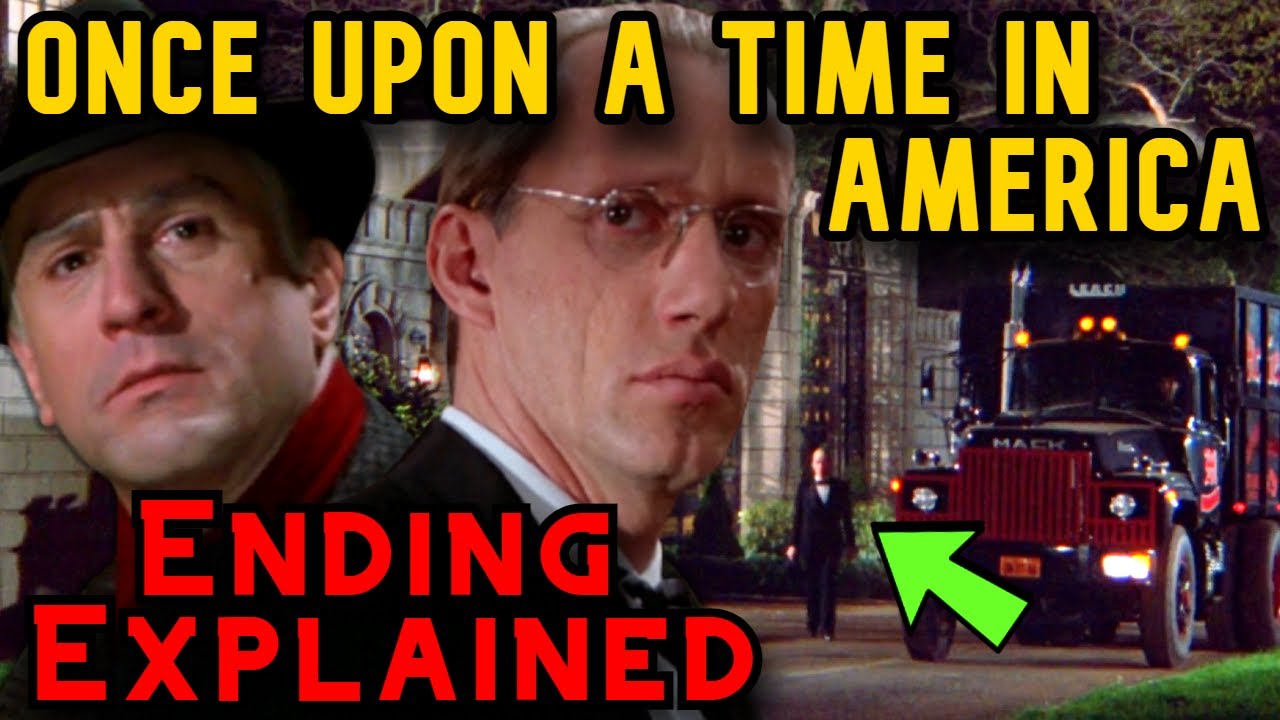
In a private meeting, Max reveals that the police and the syndicate helped him fake his death, that he stole the gang's money, and that he reinvented himself as a wealthy politician. He also took Noodles' girl and allowed him to live with the guilt of having killed all his friends for all these years.
Explaining that he is facing inevitable ruin and assassination, Max finally reveals the job he has for Noodles: to kill him there and then, as he is the only man Max can accept it from. Noodles refuses, making a point to refer to Max by his Bailey identity, saying that in his eyes Max died all those years ago.
To kill Mr. Bailey would be to accept that reality. When Max asks if this is Noodles' idea of revenge, Noodles simply replies, "No, it's just the way I see things."
Then comes the scene that has intrigued audiences for years. Noodles leaves the house and notices a garbage truck parked outside the Bailey home.
The truck's engines come on, and from the home a figure emerges who is dressed and looks like Mr. Bailey. The truck moves slowly forward, obscuring Mr. Bailey, who was slowly walking toward the truck in Noodles' direction.
He was also still very close to the home's gate, so he could easily have turned around after he was out of sight and gone back inside. But given the metallic screech filling the night with the dump truck's trash compactor in full swing, and Mr. Bailey disappearing, viewers and the bewildered Noodles are left asking a single question: did Max throw himself into the garbage truck?
It is the movie's biggest talking point, one that people have discussed for years. One popular theory holds that not only did Max not kill himself, but that the scene never even happened, because everything with old man Noodles is actually an opium-induced dream.
This is a very popular theory regarding the film, one that even director Sergio Leone discussed. The idea is that Noodles was so guilt-ridden about getting his friends killed that he started to frequent opium dens and smoked in order to take his mind off what he had done.
This is pretty much indisputable, as it is shown in the film. The argument is that all of the material with Noodles being old and returning to Manhattan did not really happen, and is instead something Noodles' consciousness made up to relieve him of his guilt.
It makes sense in that regard. Excluding the old man Noodles scenes, Noodles is a man who got his best friends killed and violated the love of his life.
Taking into account Noodles returning to Manhattan, we discover that Max manipulated Noodles into tipping off the police, stole Noodles' money and woman, and left him with the guilt. Deborah, still as young and beautiful as ever, has pretty much forgiven Noodles for what he has done, and she herself has betrayed him.
It is all a bit too perfect. Even the actor himself, James Woods, does not know if the opium dream theory is to be taken as fact.
If it is, then this mystery is answered as having no answer, because in dreams there are no answers and things are not run by logic and rationale. What is actually happening is that Noodles' mind has doubled back on itself, coming up with a bizarre dream scenario that begins with Max faking his death and then possibly faking his death again at the end.

Noodles choosing not to take the gun and kill Max, and Max subsequently disappearing behind the dumpster, could be Noodles' defiant, opium-laden mind in this fantasy convincing this fictional Max that it was not Noodles who had killed Max all those years back, but that he had faked his death.
Setting the opium theory aside and imagining that the scene takes place in the real world, the actor who played Bailey in the garbage truck scene was not James Woods, according to Woods. There is therefore no point in trying to find clues in the scene itself, because it was directed to be ambiguous.
Maybe it was not even him. Maybe it was just the butler about to ask Noodles if he wanted to stay for dessert.
What is a garbage truck even doing there at that time? It is surely there for an untoward reason, and not just a case of some bin men on their rounds.
Could it be that Max, after Noodles refused to kill him, wanted the men in the truck to kill Noodles and dump him in the truck as a kind of curtain closer for the duo? Then, when Noodles did not go through with it, Max rushed downstairs to stop the guys from killing Noodles.
It does seem strange that Max would so adamantly want Noodles to kill him and then himself have Noodles killed. Maybe the truck was there to actually dispose of Max's body on Max's orders after Noodles was supposed to have killed him, and seeing as none of this actually takes place, the cleanup guys simply drive away.
Is it feasible that Max would throw himself into the dump truck? The motivation is there: the wolves are closing in, and he wants to go out on his own terms and settle his score with his old best friend.
But being ripped apart by a dump truck is an awfully painful way to go. Surely there are much easier ways, like using the gun in the office.
There was also a noticeable lack of blood on the truck, and this is a film that is not afraid to shy away from blood. Then again, "Once Upon a Time in America" is not exactly a film obsessed with realism.
It is a poetic film, operatic, and Max throwing himself into a dump truck has a romantic air about it that fits with the melodramatic nature of the movie. It does not appear realistic, but the film is something of an adult fairy tale, hence the name "Once Upon a Time in America."
After all he has done, all he has put Noodles through, and all the regret and guilt he now has, it is fitting and works in the fairy tale sense that Max throws himself into the truck. Maybe he did not even throw himself in, but was thrown in, as the guys driving the truck were assassins from the Teamsters.
Maybe it was Frank Sheeran, the same man De Niro played in "The Irishman," a film very similar to "Once Upon a Time in America." But the idea that a scuffle took place behind the moving truck, ending with Max being thrown in and the killer jumping back onto the truck out of shot, seems silly even in an adult fairy tale.
Perhaps Max wanted Noodles to think he had thrown himself in the truck, to think he had died, and thus in a manner of speaking redeemed himself, so that he does the very thing he once pretended to do. In actuality, he may be far too slimy to go ahead with it, and instead runs back into the house.
It would not be the first time Max faked his death. We have the opening of the movie, but also the part during their youth where Noodles thinks Max has drowned during one of their jobs.
There is a fitting sense of cycles repeating themselves, a limbo in Noodles' life where Max continuously dies but returns. Or maybe it is a metaphor, with Max literally dumping himself, in other words a message for Noodles to discard old memories and relationships as garbage, to move on and live in bliss.
One theory worth proposing takes into account Max's personality, the scene between him and old man Noodles, and the situation Max was in. It is very much possible that Max, who knows Noodles closely as his best friend, would call him to do the deed knowing full well that Noodles would refuse.
Noodles was seen on the security cameras coming in. He would be seen leaving through the secret exit by the guys in the truck, so they could say they saw him if they were questioned by the cops or other gangsters.
But Max could make it look like Noodles really did kill him. Noodles has a motive, and Max could escape and go into hiding with the Teamsters thinking he was dead.
More sinisterly, maybe Max planned to have Noodles thrown into the truck and have the cops believe that the mangled body was that of Mr. Bailey, in a kind of twisted, ironic nod to earlier in the film when Max's supposed body was burned beyond recognition. Because of the way Noodles carried himself, and because of what he said in their meeting about having an old friend, Max changed his mind about killing Noodles and using his body in this grand scheme.
Or maybe, quite simply, he came out to say one last thing to Noodles, changed his mind, and went back inside. As I see it, Max was genuine when he wanted Noodles to kill him.
There is a lot of evidence for this. It was one last debt that Max owed, one he wanted paid off in his final hours.
After becoming a wealthy businessman who never looked twice after betraying his friend, he was now feeling the regret, now remembering the more important things in life. When Noodles refused, Max was forced to live the remaining time he had contemplating his decisions in life, before he was given a visit from someone who would not hesitate to pick up the gun.
It is worth mentioning that if you watch this scene carefully, you can see the actor walk up to the truck, and momentarily you can make out his feet lifting up. He probably hoisted himself up to some kind of ramp on the side of the truck, which gives way to the theory that Max faked his death yet again, though this is more likely an error and probably is not worth looking into too much.
Interestingly, Sergio Leone had around 10 hours worth of footage after filming, and his initial plan was to release two three-hour films. When the studio rejected this, we ended up with the version that is almost four hours long.
It could be that there are clues to what happened to Max that we will never get to see, because the scenes ended up having to be cut. In fact, there is some truth to this.
In a restored scene from the 4-hour, 11-minute version of the film, there is a scene between Bailey and O'Donnell in which Bailey, defeated, essentially hands over everything he has, signing a document he refers to as his last will and giving it to O'Donnell. It is heavily implied that whatever the deal was, it had to involve Bailey's death.
O'Donnell says something about Max taking care of this himself, adding, "I'd be very happy for you tonight if during all the noise of the party I heard a shot." Max replies, "Maybe you will."
The implication is that Max very much will die tonight, and even if he does not, he has signed over everything he has. It is implied he will commit suicide, but both he and the viewers know, or will know in a couple of scenes, that he wants Noodles to do the deed.
This actually makes the discussion around the garbage truck scene redundant in a way, as whether he threw himself in there or not, he is finished. Much like the discussion about Tony Soprano at the end of "The Sopranos," the whole question of whether Tony died is a bit of a redundant conversation, because whether he did die or not, Tony Soprano is finished.