In the autumn of 1887, a letter arrived for Walter Crane, a 39-year-old copy clerk living alone in a narrow brick house on the eastern edge of Hollowbrook, Pennsylvania. It was delivered on a Tuesday, during a thin gray drizzle, and it came sealed with wax bearing the impression of a leafless tree. His name was written across the front in long, leaning script. Walter was a man of precise habits.
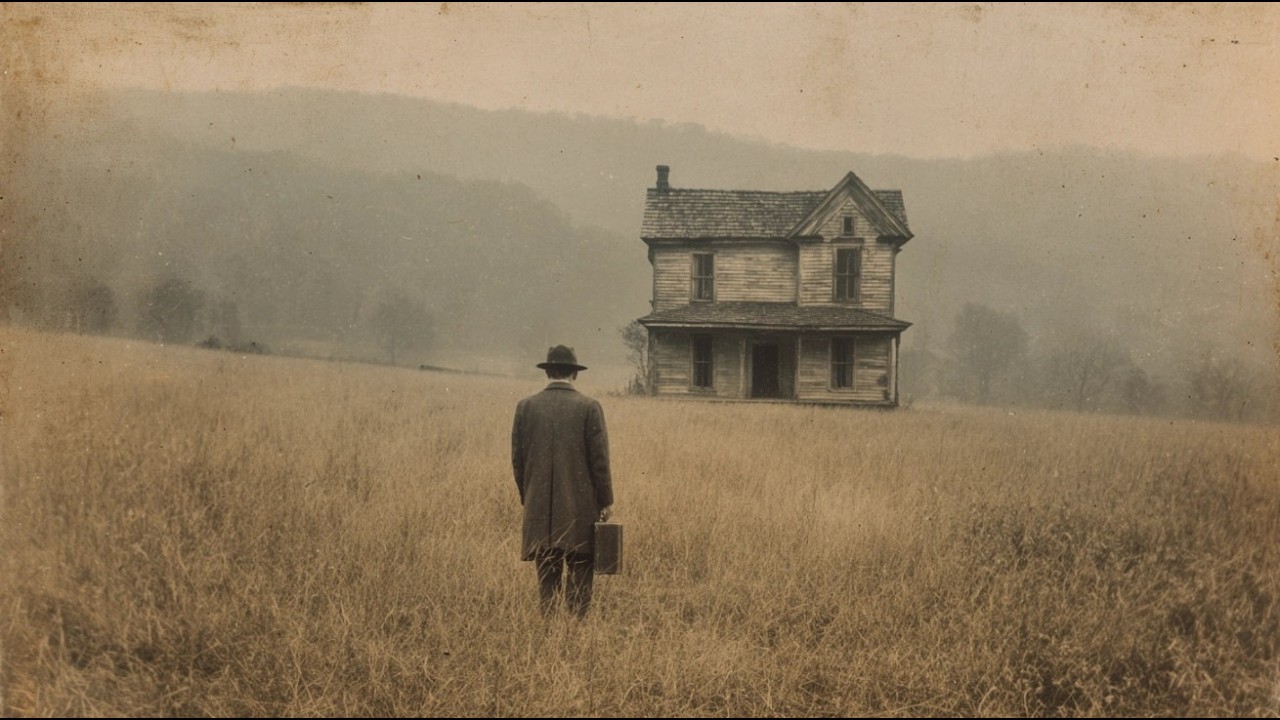
He took his coffee black, wrote his shopping list on Sunday evenings, and parted his dark hair neatly to the left every morning of his adult life. His mother had once told him that steady hands were the only inheritance she had to give him. As he stood in the rain, staring at the envelope, he later told a friend he could not explain why he hesitated. But the moment his eyes touched it, the bottom of his stomach felt suddenly cold.
Inside, the letter carried no greeting. It read: “To the last living son of the Crane line, by the terms set forth in the year 1826, and renewed faithfully in every generation since, you are required to come to the property at Vesper Hollow before the close of the harvest moon. The house has been kept for you. The fields have been kept for you.
The matter waiting beneath the South Stone has been kept for you. Come alone. Bring nothing that does not belong to you. ” It was signed only with a single initial: D.
Walter had never heard of Vesper Hollow, nor of any property held in his family’s name. His mother had died when he was 21, his father long before that, and he believed he was the last person in the world carrying the Crane name. But the letter reminded him of something his mother had said on the afternoon she died in 1869. Weak and tired, she had told him: “Walter, if a letter ever comes for you with a tree on it, you must burn it.
You must burn it before you read it. ” He had asked what tree. She only shook her head. He had assumed her mind was wandering.
Eighteen years later, the wax seal on the desk in front of him was the shape of a tree without leaves. Instead of burning it, Walter requested two weeks of leave from the law office and went to the county records office. He asked the clerk, a man named Hollis Reagan, whether he had ever heard of a place called Vesper Hollow. Reagan went very still.
He had worked the records for almost 30 years and knew every town, road, and farm within four counties. Reagan told him that three times in his thirty years, a letter had come into town for a man named Crane. Three times that man had gone to the place the letter said. Three times that man had not come back.
He showed Walter a thin folder of records. A parcel of land east of the Allegheny Ridge had been kept in the Crane family name since 1826. Taxes were paid on it every year by a bank in Philadelphia no one could attach to a living person. The deed had been signed and re-signed every 15 to 20 years, always by a different Crane, each one a son, nephew, or cousin.
None of them ever returned. In Reagan’s time, three men had gone. Before his time, records noted nine more. Twelve Cranes.
Twelve last living sons. The most recent, a 42-year-old watchmaker named Selwyn Crane, had signed the deed in 1871, hired a wagon at two in the afternoon, and was never heard from again. There was no grave for him anywhere Reagan could find. “Why has no one ever investigated?
” Walter asked. “Because the Cranes who go east,” Reagan said, “are always the last of their line. There is no one left to ask after them. There is no one left to send a sheriff.
” He urged Walter not to go. Walter thanked him, left the records office, and went home. Then he packed the valise. Walter rode the morning train to a junction called Sherbrooke, where he hired a thin, patient man named Otis Llewellyn to drive him east into the hills.
They traveled for the better part of two days. As they passed small farms, Otis would lift a finger from the reins in greeting. Walter noticed that the closer they came to the eastern hills, the less anyone waved back. “Not unfriendly,” Otis said.
“Tired. Different kind of tired. ”
On the first afternoon, they passed a small village and a stone marker by the road. Most of the carving had worn away, but one word was still clear near the bottom: Vesper.
Walter asked whether Otis knew where Vesper Hollow was. “I know where it is, Mr. Crane,” Otis said. “I have driven men to the edge of it before.
I have never gone in myself and I will not go in now. I will take you to the last fence line. Past that, the road is yours. ”
Otis told him that in his life he had driven two men to the same gate.
He waited three days for both, the same way he would wait for Walter. Neither came back. “You are the first one,” he said, “who has ever asked the question. ”
That night, camping beside the road, Walter woke near the middle of the night to a stretch of total silence.
There was no wind, no bird, no insect. Even the horses had stopped breathing audibly. Otis was sitting up, awake, watching the trees. “Don’t sit up.
Don’t move. It will pass,” he said. After a long time, the forest sounds returned. Neither of them spoke about it in the morning.
They reached the last fence line on the second afternoon. A gray old split-rail fence crossed a narrow valley between two low hills. The road stopped at a wooden gate. Past it, the road continued, overgrown but faintly visible.
Otis offered his hand. “I will wait 3 days, Mr. Crane. There is a small spring half a mile back.
If you come back within 3 days, I will drive you home. After that, I cannot stay. ”
Walter stepped through the gate and began to walk east. He walked into a long, narrow valley between two ridges of mixed forest.
The valley floor was a long uneven meadow with a small creek running down the center. The creek was clear, slow, and almost soundless. After about an hour, he could no longer hear birds. After about two, he could no longer hear the creek, even though he was walking along its bank and could see the water moving over the stones.
The light was strange. The sun was bright enough behind a thin layer of cloud, but it cast almost no shadow. Walter lifted his hand and watched his fingers. There was no shadow on the grass beneath them.
He later told his friend that this was the moment he understood, in the slow and physical way the body understands things before the mind catches up, that he had walked into a place where some of the rules he had taken for granted his entire life were not in operation. Near sunset, the house appeared at the far end of the valley. It was tall, three stories, narrow and dark, with a steep slate roof and tall narrow windows. There was a long porch and a heavy wooden door painted black.
Behind it, a small barn leaned slightly to the east. The fields had been neatly cut. The fence lines had been mended. Someone had been keeping the property.
There was no smoke from the chimneys, no animals in the barnyard, no figure in any of the windows. Yet Walter became certain he was being watched in return. He crossed the last stretch of meadow, climbed the three wooden steps, and raised his hand to knock. As his knuckles came within an inch of the wood, the door swung inward on its own.
Slowly, the way a door swings from an internal draft. There was no draft. Inside, the house was clean. The wooden floors were swept.
The brass on the lamps was polished. On a console table inside the door sat a vase of six fresh chrysanthemums, white and yellow, cut that morning. There was no dust. There were no footprints.
When Walter called out a quiet “Hello,” his voice did not echo. The dining room table was set for one. A porcelain plate, a single silver fork and knife, a linen napkin folded into a soft white peak. A small card at the head of the setting read: “Welcome, Mr.
Crane. The matter beneath the south stone will keep until tomorrow. Tonight, please rest. ” The card was written in the same long leaning script as the letter.
A meal sat under a silver cover at the far end of the table. Roasted chicken, still hot. Bread, still soft. Pickled beets.
A glass of water beaded with cold. Walter stood in an empty house in a valley where the creek made no sound and his hand cast no shadow, looking at a meal prepared by no one he could see. Later he often said he should have walked back out. He did not.
He sat down and ate slowly, carefully. Upstairs, a candle burned on the staircase. It had not been burning when he came in. A single bedroom door stood open at the end of the hall.
Inside, the room was small and clean. On the bedside table was a framed tintype. The photograph showed a man of about 35, standing before a stone wall, with a long, careful face and dark hair parted neatly to the left. His hands were folded in front of him, ink-stained at the knuckles.
The man was unmistakably a Crane. Walter had never seen him before. Along the bottom edge of the image, a date had been etched into the metal: 1841. On a small shelf above the washstand was a single book, bound in dark green leather with no title on the spine.
The pages were yellowed. It contained a list of twelve names in twelve different hands, some written firmly, some shakily, with dates ranging from 1826 to 1871. The last name was Selwyn Crane. Below it, in a thirteenth hand, in fresh dark ink, one line was written: “Walter.
”
Walter lay down without undressing, leaving his boots on. Somewhere just before midnight, he fell asleep. He woke because someone was sitting at the end of his bed. He felt the weight of them; the mattress shifted, the blanket tightened across his ankles.
By moonlight, he could see a thin man in a dark coat of an old cut, his dark hair parted neatly to the left, his ink-stained hands folded in his lap. He could not move. The man did not turn around. He spoke quietly, in a voice that seemed to come from no particular direction.
He said he was sorry. “Each of us tries,” he said. “The hand writes it anyway. I did not want to bring you here.
But there are things older than wanting. ”
He told Walter about the South Field, and the flat stone, and the chamber beneath it. “It is not a person. It is not, I think, a thing.
It is a debt. Our great-grandfather signed it in 1826. He did not understand what he was signing. None of us have understood.
We have all only paid. ”
He told Walter the story of the man who started it: a farmer named Cornelius, who had lost three of his fields to drought and whose wife was sick. One evening he walked out into the South Field at sunset and asked aloud, to whatever was listening, for the rain to come back. The rain came back that night.
The fields recovered. His wife lived another nineteen years. He thought he had been lucky. He did not understand until he was an old man that the thing that answered him was not the kind of thing that gives without taking.
“The taking is slow. The taking is patient. The taking does not happen in your lifetime. It happens in the lifetimes that come after you.
”
The man at the foot of the bed told Walter that he was the one who had come in 1841. “There was another after me and another. You are the next. You will not be the last.
There will be one more after you in 1912. That is as far as I can see. ”
When the man finally turned, his face was not Walter’s. It was the face from the tintype: tired, thin, the eyes set slightly closer together.
He looked at Walter with a sadness so complete that Walter reached out his hand. The man reached back. Their fingers did not quite touch. “In the morning,” the man said, “go to the stone.
It is not as bad as you think. It is not what you think. Go to the stone and listen. And then walk back the way you came, and do not look behind you, and do not stop until you reach the gate.
There may be a chance. There has not been one before. There may be one for you. ”
Then the weight on the foot of the bed lifted, and Walter was alone in the room.
In the morning, Walter went to the stone. It was a flat slab of gray granite, about four feet across, set flush with the ground in the middle of a gentle slope. There was no marking on it. The grass around it had been recently cut.
He knelt and pressed his hands flat against the surface. The stone was warm, the same temperature as a living body. It should not have been. He sat back on his heels and listened.
For a long time, nothing. Then, beneath his knees, something began to speak. It was not a voice; he later was careful never to call it a voice. He said it was more like the feeling of having been understood.
Words came up through him from beneath the stone, but they were his own words in his own thinking, arranged in an order he had not arranged. It said: “You are not what was promised. You are only what was sent. The man who signed in 1826 did not understand.
I do not require you. I require what was promised, and what was promised was the line, not the man. ”
Then it gave him a question: “Will you end the line? ”
Walter understood what that meant.
It meant he would never marry. It meant there would be no children. It meant the name Crane would end with him. If there were no more Cranes, there was no one to renew the contract.
If there was no one to renew, the chamber beneath the stone would close, and whatever existed there would, in its own slow way, go quiet. He understood then that the man at the foot of his bed had told him the truth. There was a chance. He was the only one of all the Cranes who had come to that valley who had been told.
The man who had come in 1841 had been trying for 46 years to send the message back up the line. He had finally found the right son. Walter pressed his hands harder against the stone. He said out loud into the warm gray morning: “Yes.
”
The stone beneath his hands grew slowly cooler. Then it was simply a stone. He walked back to the house but did not enter it. He did not collect the valise.
He did not look at the chrysanthemums or the empty plate. He walked back across the meadow along the bank of the creek. He could hear the water moving now. He could hear birds in the trees.
His hand, held out in front of him, cast a soft and clear shadow on the grass. He walked back through the gate and did not look behind him until he was at least a mile down the road. When he finally did, the valley was simply a valley. Trees and grass and an old fence.
No house was visible from the road. He later wondered whether the house had ever been visible, or whether each Crane had only seen it because each Crane had been expected. Otis Llewellyn was waiting at the spring exactly where he said he would be. He did not ask what had happened.
He looked at Walter’s face for a long, careful moment, then held out a hand for him to climb up beside him. They drove west together in silence. Walter Crane lived another 41 years. He returned to his job as a copy clerk at the law office on Mercer Street and kept the small brick house on the eastern edge of town.
He never married. He never had children. He gave small amounts of money to families on his street whenever winters were hard. When Walter came back into the records office that autumn, Hollis Reagan stood up from his desk, came around it, took him by both shoulders for a long time, and asked quietly: “Did you sign?
”
Walter shook his head. Reagan let out a breath he seemed to have been holding for thirty years. They went through every page of the Crane folder together that afternoon, though they did not discuss what Walter had seen in the valley. Reagan argued against burning the folder.
“If we burn it, and the line ever comes back somehow through some cousin we don’t know about, there will be no one to warn them. Better to keep it. Better to leave a record. ”
Walter agreed.
The first year was the hardest. He would wake sometimes at three in the morning, lying very still, half expecting to feel a weight settle at his feet. It never did. The dreams came less often.
The listening went away. He told no one what had happened for many years. The friend he eventually told was a printer named Garrick Onslow, who moved into the brick house next door in 1896. The two men became friends slowly, sitting on porches in summer evenings, saying small true things to each other.
Fifteen years after the night in Vesper Hollow, Garrick finally heard the whole story and wrote it down. His papers, after his own death in 1934, made their way into the same state archive in which the original folder had been preserved. Neighbors respected Walter, but agreed he was lonelier than a man his age ought to be. He was offered more than once the chance to court a widow or a school teacher, and he always declined gently.
He gardened. He kept a single soft gray cat he called Beatrice. He read the same six books over and over and began in his late 60s to write a small unpublished history of the law office on Mercer Street. He told Garrick near the end of his life that he had stopped being afraid of dying.
“There is a man waiting for me, Garrick. He has been waiting for a long time. I do not think he is angry. I think he wants to thank me.
”
He died in 1928 at the age of 80. His will instructed that the brick house be sold, the proceeds given to the local library, and that one final document, sealed in wax with the impression of a tree without leaves, be carried by hand to the office of the county records and given to the next clerk. The clerk by then was a woman named Hesper Mowbray. Hollis Reagan had told her when he handed her the keys that there was a folder in the bottom drawer of the back cabinet she should never throw out, and that if a sealed letter ever arrived bearing a tree without leaves, she should put it in the folder and tell no one.
She did exactly as she was told. The folder, with its two letters now, sat in the bottom drawer for the next 63 years. In 1912, no Crane came to Vesper Hollow. There were no Cranes left to come.
The fields were no longer cut. The fence lines began to fall. The slate roof of the tall, narrow house began to slip and break over the following decades. The harvest moon came and went.
Nothing answered. Whatever had been beneath the South Stone, whatever debt had been signed in 1826 by an ancestor whose name no one remembers, simply, slowly, faded. It was not killed. It was not banished.
It was, in the only way such a thing can be ended, allowed to forget. The folder was found in 1991 when the old county records office of Holbrook was closed and its papers transferred to the state archive. Both letters were photographed. The originals were filed under a long catalog number that almost no one has ever requested.
The clerk who logged them assumed they were the records of some old land dispute. She did not read them carefully. The account includes records of the other men who went into the valley, the strange story of the Philadelphia bank that paid taxes on the parcel until the early 1960s before stopping without notice or record, and a single grainy photograph taken by a hiker in 1947 showing a tall narrow house at the far end of a long meadow, with a face visible in one of the upstairs windows if you look very carefully.