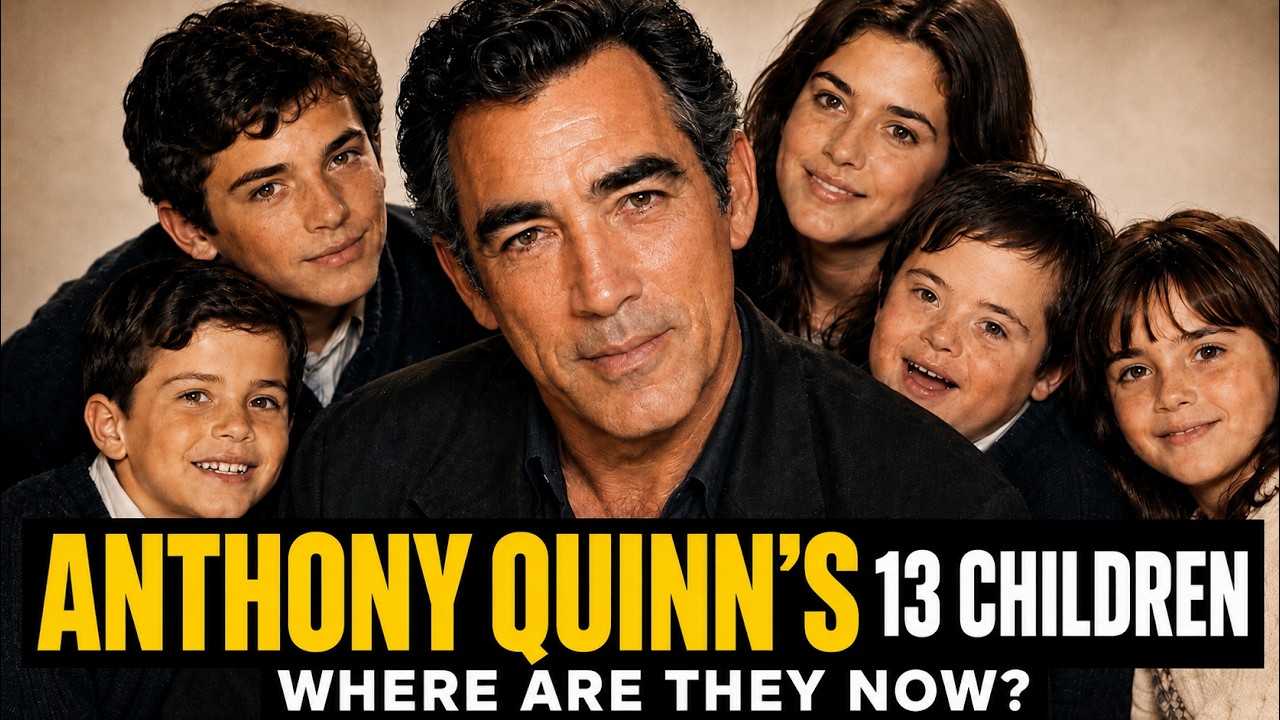
Anthony Quinn was known to have fathered 13 children, but public records only ever clearly account for 12 of them. The missing thirteenth child has never been identified, leaving a mystery at the heart of one of Hollywood’s most complicated family stories. Quinn’s family life spanned nearly six decades, multiple marriages, several countries, and relationships that overlapped in ways that made simple definitions impossible. Each of his children grew up with a different version of the same man, from the struggling young actor to the international superstar to the aging father who knew time was running out.
Before he became “Zorba,” before the Academy Awards and the legendary reputation, Anthony Quinn was a child himself. He was born in Chihuahua, Mexico, in 1915 during the Mexican Revolution. His family moved to the United States while he was very young, and his childhood was shaped by poverty, immigration, and survival. Hollywood later transformed him into an actor who seemed capable of becoming anyone: a Mexican revolutionary, a Greek peasant, an Arab leader, an Italian strongman, a tortured painter.
That versatility made him famous, but it also meant Quinn spent much of his adult life changing identities. His first family knew him before that transformation was complete. In 1937, Quinn married Katherine DeMille, the adopted daughter of legendary director Cecil B. DeMille.
For a young actor from an immigrant background, the marriage connected him to one of Hollywood’s most powerful families. Their first child, Christopher, was born in 1938. For a brief period, Quinn was not yet the grand international star. He was a young husband, an aspiring actor, and a father to a small child.
Then, in March 1941, everything changed. Christopher wandered onto the neighboring property of comedian W. C. Fields and fell into a pond.
He drowned before he could be saved, not yet three years old. The tragedy happened before Quinn reached the height of his fame and before most of the children in this story were born. It cannot fully explain every decision Quinn made afterward, but it established something essential: before Anthony Quinn was a legend, he and Katherine had already endured the worst loss any parents can face. Their next child arrived less than a year later.
Christina Quinn was born in December 1941, followed by Catalina in November 1942, Duncan in 1945, and Valentina in 1952. These four children grew up during Quinn’s first marriage, though they did not all experience the same stage of his career. Christina and Catalina were born while he was still rising. Duncan arrived as Quinn’s opportunities were expanding.
Valentina was born when he was moving toward the global fame that would define the following decades. Catalina later described the years before the complications of major stardom. She remembered a cohesive household that included Quinn’s mother, Manuela, and his sister Estella. For Catalina, the man the world would later see as a force of nature was simply “Dad.
”
She also recalled one of the strange realities of being a child of an actor. When she watched her father die in Western after Western, she was too young to understand it was only performance. Her mother had to explain that the man on screen would come home. That image captures the split at the heart of celebrity childhood.
Millions of strangers believed they knew Anthony Quinn through his films. His children had to learn that the man dying on screen was not the father at the dinner table. Catalina eventually became an artist herself, building her life around painting, travel, and community arts rather than Hollywood stardom. Duncan had a direct connection to his father’s on-screen life in “The Children of Sanchez,” appearing as a fictional son to the character Quinn played.
For a moment, the real father and son embodied that relationship on camera, but Duncan did not build a long public career around the role. Valentina had a more visible connection to acting. She appeared in film work and was later present during the final days of Quinn’s life. Years after the first family had been changed by divorce, distance, and new relationships, she remained close enough to visit him shortly before his death.
She later recalled being able to talk to him, hug him, and laugh with him. The next group of children entered a very different world. While still married to Katherine DeMille, Quinn began a relationship with Iolanda Addolori, an Italian costume designer he met while working in Europe. Their first son, Francesco, was born in Rome in 1963, followed by Danny in 1964 and Lorenzo in 1966.
This was not an orderly transition where one marriage ended before another family began. The new family had already started before the first marriage legally ended. Quinn and Katherine divorced in 1965. He married Iolanda the following year.
Francesco, Danny, and Lorenzo knew the global star. They grew up between Italy and the United States, surrounded by cinema, art, travel, and a family name that carried immediate expectations. Francesco Quinn resembled his father so strongly that comparison was almost inevitable. He also chose the same profession.
His big break came in Oliver Stone’s “Platoon,” where he played the character Rah, a quiet, spiritual soldier who seemed able to see beyond the madness around him. For a moment, Francesco had what every child of a famous actor needs: a role strong enough to make audiences look beyond the family name. But the name never disappeared. Francesco later spoke about the strange double effect of being Anthony Quinn’s son.
The name helped him get through the door, then it became a burden. Directors expected to see Anthony Quinn in front of them. They wanted the same energy, the same intensity, sometimes the same performance. Francesco recalled a director who asked him to handle a scene the way his father had in “Lust for Life.
” His reaction captured how absurd that comparison was. Anthony Quinn had won an Academy Award for that performance, while Francesco was in one of his earliest auditions. Francesco built a long career in film and television. He spoke several languages, worked internationally, and developed a life beyond the role audiences knew him for.
He was also physically active, involved in cycling, skiing, motor sports, and diving. In August 2011, Francesco collapsed near his home in Malibu while outside with his children. He was 48 years old. Reports suggested a possible heart attack.
Anthony Quinn had lived to 86. Francesco, who spent much of his career trying to escape his father’s shadow, died before turning 50. Danny Quinn also became an actor. Born in Rome in 1964, he worked in European and American productions and eventually expanded into writing, directing, and producing.
His public perspective on his father was more complicated than Francesco’s. During the difficult end of Anthony and Iolanda’s marriage, Danny became part of legal proceedings and public claims related to the home. These claims must be handled with care; they were presented through testimony and accusations without independent evidence. But Danny’s perspective tells us the Quinn family was not held together by creativity and charisma alone.
There were also wounds. Lorenzo Quinn was born in Rome in 1966. Like his brothers, he grew up surrounded by creativity, but he soon discovered that carrying his father’s name could make it hard for anyone to see him clearly. Lorenzo studied art and initially explored acting.
He even portrayed Salvador Dali, but acting always kept him inside his father’s space. Every role invited comparison. Every success could be dismissed as privilege. Every failure could be treated as proof that he was not Anthony Quinn.
Lorenzo eventually chose sculpture. It was not a rejection of creativity but a search for a form that could belong to him alone. His work became internationally known, especially monumental sculptures built around hands, balance, human connection, and the fragile relationship between people and the world around them. He created a visual language immediately recognizable and clearly separate from his father’s film career.
Lorenzo once spoke about the pressure of being constantly defined as Anthony Quinn’s son. The family name that opened doors for one brother could make another feel invisible. Yet his relationship with Anthony was not defined only by resentment. Near the end of Quinn’s life, Lorenzo was at his side.
He later recalled that his father asked him to promise to help keep the family together. It was a remarkable request. Anthony Quinn had fathered children across several families, countries, and generations. Many had barely shared a childhood.
Some had different memories, different loyalties, and different reasons to stay away. Now the father who had divided his life among them was asking one son to create unity after he was gone. Lorenzo agreed. He was holding Anthony’s hand when his father died.
One detail captures the strange scale of the Quinn family. When Lorenzo called his father to tell him he was expecting another child, the elderly Anthony reacted with surprise. He, too, was about to become a father again. In the same period, Anthony Quinn could be a father, grandfather, and great-grandfather simultaneously.
During his marriage to Iolanda, Quinn also had two sons with Friedel Dunbar. Sean was born in 1973, followed by Alexander, often called Alex, in 1976. Again, the families overlapped, and again, the children entered a family structure that could not be explained through marriages alone. Sean did not follow the most obvious Hollywood path.
He worked in technology and later built a life far from acting. When Anthony Quinn died, Sean spoke about how each child knew a different version of their father because Anthony himself changed significantly over time. He recalled his father saying he wanted to change his skin every 10 years. Alex studied film and used family footage to create a short personal montage for one of his father’s birthdays, setting the images to “What a Wonderful World.
” After Quinn’s death, the family used that film at his memorial. It was an intimate detail revealing that some sons also held tenderness, even in a family often described through affairs, divorces, and numbers. Now to the thirteenth child. The official Quinn estate stated that at the time of Quinn’s death, he was survived by Antonia and Ryan, along with 10 surviving children from earlier relationships.
This creates an important calculation. Christopher died in childhood. If Quinn had 10 older surviving children plus Antonia and Ryan, that means 12 children survived him. Adding Christopher brings the total to 13.
But the publicly listed names before Antonia and Ryan appear to contain only nine surviving children: Christina, Catalina, Duncan, Valentina, Francesco, Danny, Lorenzo, Sean, and Alex. That leaves one additional surviving child from an earlier relationship not included in the public list. Some biographical references describe an unnamed son born to a French woman, but they do not reliably provide his name, birth date, or later life. The evidence suggests there may indeed be another son whose identity never became part of the public family record.
Perhaps he chose privacy. Perhaps his mother protected him. Perhaps documents still exist in family archives. Or perhaps the wording itself was based on an old count no one corrected.
The mystery remains unresolved. Once a number becomes part of a legend, it can survive for decades without explanation. Anthony Quinn had 13 children. That sentence appears again and again.
But one of those children seems to exist publicly only as an absence. In the 1990s, Quinn began another family with Katherine “Kathy” Benvin, who worked as his secretary. Their daughter, Antonia, was born in 1993. Their son, Ryan, was born in 1996.
Quinn was 81 years old. The age gap in the family was extraordinary. Christopher was born in 1938. Ryan was born 58 years later.
Some of Quinn’s older children were old enough to be grandparents to his youngest. The father Antonia and Ryan knew could not resemble the man Catalina remembered from the pre-fame years. He was elderly. His great cinematic victories were already history.
He spent more time painting, sculpting, and pursuing the private creative work that had always accompanied his acting career. Antonia later spoke about one of the most significant personal aspects of the legacy: the drawings her father made of her when she was a child. For millions, Anthony Quinn was the face of Zorba, the rebel, and the passionate outsider. For Antonia, part of the legacy was her father studying her features on paper.
Ryan was only four years old when Anthony died. Antonia was seven. Their direct memories were limited by time, but their connection continued through possessions, art, and the foundation created around his creative legacy. Anthony had separated from Iolanda and married Kathy in 1997.
He remained with her until his death in 2001. By then, he had spent more than six decades moving between marriages, relationships, and different versions of fatherhood. What did all these children actually inherit? Some inherited acting.
Francesco and Danny pursued it directly. Duncan and Valentina experienced it for a shorter time. Some inherited the visual arts. Catalina built her life around painting and community creativity.
Lorenzo became an internationally recognized sculptor. Alex used film to preserve family memories. Others deliberately lived far from the spotlight. Some children spoke about him with affection.
Others spoke about struggles. Still others remained silent. The family offers no single verdict on Anthony Quinn, which is exactly why the story is so compelling. A famous person can create an illusion of constancy.
Audiences see the same face on posters, in interviews, and on television for decades. But a family experiences time differently. A child born in 1941 does not meet the same father that a child born in 1996 meets. One child remembers a young father at home.
Another remembers the weight of his name in audition rooms. Another remembers conflict. Another remembers holding his hand at the end. Another remembers drawings made during her childhood.
These are not competing versions that must be forced into a single answer. They are pieces of the answer itself. Anthony Quinn completed his last film work shortly before his death. By then his body was weakening, but his need for creativity had not disappeared.
Many of his children were able to see him or speak with him near the end. Valentina remembered his laughter and hugs. Lorenzo stayed close, holding his hand. Sean had visited him not long before.
A family scattered across homes and generations came together in the face of the impending loss of the man at its center. Quinn died in Boston on June 3, 2001, at age 86. He left behind films, paintings, sculptures, memoirs, and a family too complicated to be reduced to a single obituary. Even the question of how many children he had remained unresolved in the public mind.
Anthony Quinn was said to have 13 children. Twelve can be traced through names that consistently appear in public records. The thirteenth remains uncertain, a child protected by privacy and absent from public accounts, preserved only within a number no biography has fully explained. But the missing name is not the deepest mystery.
The deeper mystery is how one man could belong to so many separate family worlds. Christopher knew him only as a young father before tragedy ended the child’s life. Christina, Catalina, Duncan, and Valentina knew the actor before witnessing his rise. Francesco, Danny, and Lorenzo knew the global star and the weight of his name.
Sean and Alex knew another home at another stage of self-reinvention. Antonia and Ryan knew an elderly father whose greatest performances were already behind him. They were all Anthony Quinn’s children, but they were not children of the same Anthony Quinn. Some inherited his features.
Some inherited his creativity. Some inherited the burden of comparison. Some inherited unanswered questions.
And perhaps one inherited only silence.