For 53 years, the man who stepped out of the rear stairway of a Boeing 727 into a freezing rainstorm over southwest Washington was known only by a name that was never really his: D.B. Cooper. He was never seen again. Not his body, not the parachute, not the $200,000 in ransom cash he clutched against his chest as the black sky swallowed him whole.
The FBI called it the only unsolved skyjacking in American history. The case generated more false confessions and dead-end tips than almost any other in the bureau's files.
Now, a quiet re-examination of the physical evidence — trace particles clinging to a clip-on tie, and a fresh look at DNA that the original agents could never have tested — has pointed toward an answer. And it is not who most people expected.
It was not the ex-paratrooper. It was not the flamboyant con man. According to the trail that emerged, it was someone almost entirely forgotten — a man who may have hidden in plain sight for the rest of his life.
To understand why this matters, you have to go back to a rainy Thanksgiving Eve at Portland International Airport in 1971.
A man bought a one-way ticket under the name Dan Cooper. He was somewhere in his mid-40s, investigators later estimated. Maybe six feet tall, olive-skinned, calm to the point of eerie.
He wore a business suit, a white shirt, and a narrow black clip-on tie fixed with a mother-of-pearl tie clasp. He carried an ordinary briefcase. He was the kind of man you would forget the second he passed you in a terminal.
He paid $20 in cash for a short hop to Seattle aboard Northwest Orient Airlines flight 305. He took seat 18C near the back of the cabin. He ordered a bourbon and soda. He lit a cigarette.
Shortly after the plane lifted off into the gray November afternoon, he handed a note to the flight attendant seated near him. She did not read it at first. Women on flights in 1971 were handed notes by lonely businessmen all the time, and she assumed it was a phone number. She slipped it, unopened, into her pocket.
Then the man leaned toward her and murmured something she would never forget. He told her quietly that she had better look at the note. He said he had a bomb.
She opened it. The handwriting was neat. It stated in plain language that the briefcase held a bomb, and that he wanted $200,000 in negotiable American currency and four parachutes delivered to the aircraft when it landed in Seattle.
He told her to sit beside him. When she asked to see the bomb, he opened the briefcase just enough for her to glimpse a tangle of red cylinders, wires, and a large battery. She believed him. Almost everyone who dealt with him that night believed him.
He was unfailingly polite. He was never loud. He tipped the crew. He seemed to genuinely know the aircraft, its systems, and the geography beneath them.
The plane circled Seattle for two hours while authorities scrambled to gather the money. He sat calmly, sipping his drink, watching the lights of the city smear through the rain-streaked window.
On the ground, the FBI moved fast. They assembled 10,000 $20 bills, every serial number photographed and recorded — a detail that would matter enormously in the decades to come. They gathered four parachutes: two main chutes and two reserves, deliberately including a mix so the hijacker could not easily rig a foolproof setup.
When Flight 305 finally touched down at Seattle-Tacoma, the exchange was made on the tarmac with quiet efficiency. The money and the parachutes were brought aboard. The 36 passengers, none of whom fully understood what was happening, were released. Only the pilot, the co-pilot, the flight engineer, and one flight attendant remained.
Cooper had a plan, and it was specific. He instructed the crew to fly toward Mexico City at a low altitude of no more than 10,000 feet, at the slowest safe speed the 727 could manage, with the landing gear down and the wing flaps set to 15 degrees. He wanted the cabin unpressurized. He wanted the rear airstair — the retractable staircase that folded down beneath the tail of the 727 — left operable.
That last request was the tell. The Boeing 727 was one of the only commercial jets of its era with a rear ventral stairway that could be lowered in flight. A person who knew that, who knew it could be opened at altitude and used as an exit, was not a random opportunist. He was a man who had studied the machine he was riding.
The crew argued. They negotiated a refueling stop and a compromise on the route. But at around 7:40 in the evening, the plane lifted off from Seattle a second time, banking south into the storm with its strange, quiet passenger alone in the darkened rear cabin.
The crew were sealed in the cockpit, forbidden to come back. They communicated with him through the intercom. He asked how to lower the airstair. They told him to wait until they landed. He told them he would manage it himself.
Somewhere over the black wilderness of southwest Washington, near the Lewis River and the tangled forest below the Cascade foothills, the crew felt it. A change in cabin pressure, a shift in the aircraft's attitude, a small dip in the tail, a subtle bump — the sensation the pilots later described as the plane momentarily curtsying to something.
The warning light for the rear airstair blinked on in the cockpit. It was 8:13 in the evening. Outside, the temperature was well below freezing, the rain was hammering, and the wind at that altitude was screaming at 200 miles an hour.
Into that roaring frozen dark, with a bag of cash strapped to his body and a parachute on his back, the man who called himself Dan Cooper stepped off the staircase and dropped out of the world.
When the plane finally landed in Reno, Nevada, agents boarded with weapons drawn. The rear cabin was empty. The airstair hung open. The briefcase bomb was gone, and so was he.
All that remained were a few tantalizing scraps: two of the four parachutes, a scattering of cigarette butts, a handful of hair on the headrest, and left draped over a seat, that narrow black clip-on tie with its mother-of-pearl clasp. He had taken it off at some point before he jumped, and in his haste or his calm, he had left it behind.
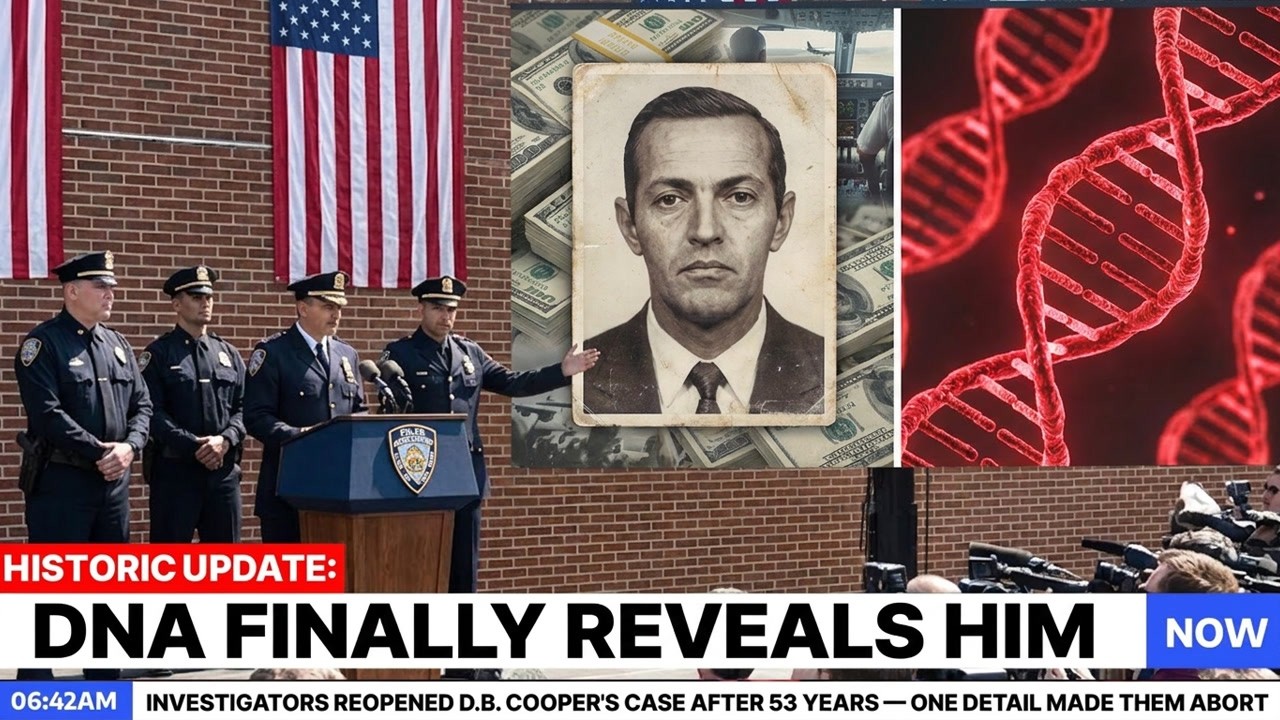
Nobody in that cabin could have guessed that a cheap tie abandoned on a seat would one day become the most important piece of physical evidence in the entire case.
The manhunt began before the wheels stopped turning. Within hours, the FBI had a name for the file: Norjak, short for Northwest hijacking. Within days, it had ballooned into one of the largest and strangest investigations the Bureau had ever mounted.
Agents fanned out across three states. They interviewed the flight attendants who had sat closest to him, one of whom described a man so unremarkable, so utterly forgettable, that she struggled to give the sketch artist anything to draw.
He had olive or swarthy skin, she said. Dark hair combed back, a receding hairline, brown eyes, perhaps 45 years old. He had ordered a bourbon and soda and tipped politely. He had spoken quietly with no accent she could place.
He was, in every meaningful sense, a ghost who had walked onto a plane in a business suit and dissolved into the night.
The first assumption was that no one could have survived the jump, and it was a reasonable assumption. Consider the conditions: a man leaping from the tail of a jet at 10,000 feet into a winter storm, wearing loafers and a thin suit, with no helmet, no gloves, no jump goggles, and no knowledge of the terrain hurtling up toward him in total darkness.
The wind chill alone at that speed would have been savage, somewhere near 70 below. He had chosen, or been given, a parachute that was in some accounts a non-steerable military model — a canopy he could not guide, that would simply carry him wherever the wind decided.
Below him lay a landscape of jagged evergreen, icy rivers, and ravines a man could fall into and never be found. The FBI's own analysts concluded, early and often, that Cooper had almost certainly died on impact or frozen in the wilderness within hours. They believed they were not hunting a fugitive so much as recovering a body that the forest had simply not yet given back.
But the forest never gave anything back, and that was the first crack in the theory.
Within 18 days of the jump, the FBI launched a ground search of staggering scale. Soldiers from a nearby army base swept the woods in long, disciplined lines. Helicopters thudded low over the treetops. Search planes crisscrossed the drop zone, and boats dragged the reservoirs and rivers below.
They were looking for anything: a torn canopy snagged in the branches, a scrap of the $20 bills, a scuffed shoe, a body. They found nothing. Not a thread, not a coin. It was as though the man had never touched the ground at all.
That absence became the engine of the legend. If no body was ever found, then Cooper might have lived. And if he had lived, then somewhere out there was a man who had done the impossible — robbed an airline, terrorized a crew without harming a soul, and vanished with a fortune into thin air.
Ordinary Americans, exhausted by a decade of assassinations and scandal and an unpopular war, found something almost intoxicating in the story. He had not shot anyone. He had been polite. He had left a tip. He had beaten the system with nothing but his nerve and his knowledge of a specific airplane, and then he had leapt into the storm and won.
Songs were written about him. Bars named drinks after him. A small town in the drop zone began holding an annual celebration in his honor. The criminal became a folk hero, and the folk hero became a myth.
But the FBI did not deal in myth. They dealt in serial numbers.
Because the one thing Cooper could not change was the money. Before handing over the $200,000 in Seattle, the Bureau had done something clever and quiet. They had photographed every single bill — 10,000 $20 notes, each serial number recorded on microfilm, all of them beginning with the letter L, all issued through a single Federal Reserve District, most printed in the same series.
It was a marked fortune. The moment any of that cash surfaced — passed at a bank, spent at a store, deposited in an account — it could be flagged, traced, and followed straight back to the man who jumped.
The FBI distributed the serial numbers to banks and businesses across the country. They offered a reward for any bill that matched, and then they waited for Cooper's own greed to betray him.
It never did. Year after year, the money simply failed to appear. Not one of those 10,000 bills turned up in ordinary circulation. No spending spree, no sudden wealth, no bragging fool cashing 20s at a casino.
To investigators, this was maddening and revealing all at once. Either Cooper was dead and the money was rotting somewhere in the forest with him, or he was disciplined beyond belief — a man capable of sitting on a fortune for a decade or more, never touching a dollar of it, letting the trail go stone cold on purpose.
Both possibilities pointed to the same unsettling conclusion. Whoever this man was, he had planned better or fallen harder than anyone wanted to admit.
And then, nine years after the jump, the money spoke.
In February 1980, a young boy on a family camping trip along the Columbia River was smoothing out a patch of sand to build a fire. His name was Brian, and he was eight years old. His fingers brushed against something buried a few inches down.
He dug. He pulled up a rotting, disintegrating bundle of paper. It was cash — three packets of $20 bills still held together by decaying rubber bands, weathered and pulped by years in the ground, but unmistakably money.
His father contacted the authorities, and when the FBI ran the serial numbers, the room went silent. Nearly $6,000, all of it beginning with L, all of it matching the microfilm from that night in Seattle.

After nearly a decade of nothing, the Cooper case had finally produced a piece of physical, undeniable proof. The ghost had left a footprint. But the footprint made no sense.
The money had been found at a place called Tena Bar, a sandy stretch along the Columbia, miles from the calculated drop zone, downstream, in a location that fit almost none of the existing theories about where Cooper had landed.
How had a few thousand dollars traveled there while the rest of the fortune and the man himself remained utterly missing? Had the river carried it? Had a dredging operation buried it? Had Cooper stashed it there himself deliberately as a decoy?
Geologists were called in. They studied the sand layers, the way the bills sat in the sediment, the erosion patterns of the riverbank, and they came away arguing with one another rather than reaching agreement. The discovery that should have narrowed the search had instead splintered it further.
By now, the suspects had begun to pile up. Over the years, the FBI would examine more than a thousand names, and the public would offer up countless more.
There was the ex-paratrooper with a criminal record and a face that resembled the sketch. There was the man who confessed on his deathbed, swearing to his family that he had been Cooper, though the details never quite fit. There was the shadowy figure with military training and a grudge, and the one whose own relatives came forward, convinced by an old photograph and a lifetime of strange silences.
Each new candidate arrived with a flurry of headlines and the promise of a solution, and each one, in the end, dissolved back into the same fog that had swallowed everyone before him.
The problem was never a shortage of suspects. The problem was that not one of them could be tied to the plane by anything harder than resemblance, rumor, and the strange gravitational pull the Cooper legend exerted on lonely, secretive men and the families they left puzzled behind.
Then came the deathbed confessions, and there was more than one. A dying man would gather his children close, lower his voice, and tell them that the secret he had carried his whole life was that he had once jumped from a jet with $200,000 strapped to his body.
The families believed. Why wouldn't they? A father's last words carry a weight that no forensic report can match. They came forward with old ties they swore matched the one Cooper left behind, with faded snapshots they held up against the sketch, with stories of unexplained cash and sudden trips and a lifelong refusal to discuss the winter of 1971.
Investigators listened and checked, and again and again found the same thing: that memory is a soft and forgiving substance, that a man near death may confess to a legend simply to feel, for one last moment, that his ordinary life had brushed against something extraordinary.
And through all of it, the tie remained.
That was the one object the man on the plane had left behind by accident rather than design — a black clip-on necktie, the cheap kind sold in department stores by the thousands, unclasped and abandoned on his seat before he stepped into the storm.
For years it sat in an evidence locker, an unremarkable strip of dark fabric that seemed to offer nothing. Fingerprints had been lifted from the aircraft, but they belonged to too many people — passengers, crew, cleaners, mechanics — and none could be cleanly assigned to Cooper. The tie, though, had been his and his alone.
As the science of forensics advanced through the 1990s and into the new century, that forgotten scrap of polyester began, quietly, to matter more than anyone had imagined.
Because a necktie is worn against the throat. It rides against the skin all day, catching sweat, catching stray hairs, catching the microscopic debris that a person carries through the world without ever knowing it. In the era when Cooper stepped onto that plane, no one had the tools to read such traces. But a tie sealed in an evidence bag is, in its own way, like the sealed ground of an archaeological dig — an undisturbed context, a time capsule preserving the residue of a single man on a single night.
When a team of investigators, working alongside a private group of citizen sleuths who had refused to let the case die, finally reopened that bag, they were not looking for fingerprints anymore. They were looking for particles.
Under a scanning electron microscope, the surface of the tie revealed a hidden landscape. Trapped in its fibers were more than 100,000 microscopic particles, the ordinary dust of a life. Most of it was unremarkable — fragments of skin, textile fibers, the general grime of 1971.
But scattered through the sample were things that did not belong in the world of a mid-level office worker, which is what many had assumed Cooper to be. There were traces of pure titanium, a metal that in that era was rare and difficult to work, used in only a handful of specialized industries. There were particles of stainless steel, of aluminum, of a rare earth metal, and tiny spheres of what appeared to be titanium bonded to other elements in a way that suggested not casual contact, but a working environment — a place where such metals were being cut, machined, or fabricated.
In 1971, titanium was not something a man encountered by accident. It was the metal of aerospace, of advanced manufacturing, of the chemical plants and research facilities where the future was being welded together.
The presence of those particles suggested that Cooper had not been a disgruntled clerk or a small-time crook improvising a scheme. He had been, or had recently worked closely alongside someone in, a high-technology industry — perhaps at a plant that built aircraft, perhaps at a factory producing titanium components for the very kind of jet he chose to hijack.
Suddenly, the man's eerie competence made a different kind of sense. He had known exactly which aircraft to demand. He had known how the rear stairway operated. He had understood pressurization and altitude and the mechanics of the plane in a way that spoke of familiarity rather than research.
The tie had not given up a name, but it had given up a world, and that world reframed everything.
For decades, the profile of Cooper had drifted between two poles: the desperate amateur who got lucky, and the trained paratrooper who executed a flawless plan. The particles suggested a third figure entirely — an insider, a man of the aerospace age, comfortable around jets not because he had jumped from them in war but because he had helped build them or had walked the floors where they were made.
Investigators began to look with fresh eyes at the great manufacturing hubs of the Pacific Northwest, at the sprawling plants where titanium was machined into wings and fuselages, at the thousands of men who had passed through those gates in the years before 1971 wearing cheap clip-on ties exactly like the one on the plane.

But here, the science demanded honesty, and the honest scientists gave it. Particles on a necktie are suggestive, not conclusive. A man might pick up titanium by working with it, or by borrowing a tie from someone who did, or by buying it secondhand, or by brushing against a contaminated surface in a shop or a bar.
The microscopic evidence narrowed the field of possibility. It did not close the case. It was a lead of extraordinary quality in a case that had produced almost none, but it was still a lead, not a verdict.
Then the citizen investigators, unwilling to stop at the particles, turned to the one thing everyone had assumed was impossible after half a century. They asked whether it might still be possible, after all these years, to pull a genetic signature from the tie itself.
It was a long shot bordering on fantasy. The clip-on had been handled by dozens of hands over five decades — agents, technicians, evidence clerks, everyone who had ever opened that envelope and lifted the fabric to the light. Contamination was not a risk; it was a certainty. Any DNA recovered would be a chaotic braid of profiles, most of them belonging to the very people trying to solve the case.
But the citizen team pressed on, working with private laboratories willing to attempt what the Bureau had never publicly pursued. They swabbed the knot, the inner folds, the places a man's neck would have touched but a clerk's careless fingers likely had not.
From that fabric, they teased a partial profile — degraded, incomplete, a ghost of a genetic fingerprint rather than the whole hand.
That partial profile became the strangest chapter in the entire saga, because it did something no fingerprint, no composite sketch, no titanium particle had ever done. It gave the internet a target.
Amateur genealogists — the same breed of relentless hobbyists who had cracked cold murder cases by uploading crime scene DNA to public ancestry databases — began comparing that fragile signature against family trees stretching back generations. They were not searching for Cooper directly. They were searching for cousins, for the faint genetic echoes a person leaves scattered across the descendants of shared ancestors.
In the autumn of the case's 53rd year, one of those searches returned something that made the hobbyists sit very still in front of their glowing screens.
The signature did not point to a paratrooper. It did not point to a career criminal or a decorated veteran or any of the famous suspects whose names had been argued over for half a century.
It pointed, according to the genealogists who ran it, toward a family line rooted in a modest industrial town not far from those very aerospace plants. A line that had produced, among its many ordinary members, a quiet machinist who had worked with metals in the years before the hijacking and who had died decades ago having never once been suspected of anything at all.
Not a legend. Not a mastermind. A man whose own neighbors would have struggled to remember his face.
And that was the twist that landed hardest of all. After 53 years of chasing giants, the trail seemed to end at someone almost aggressively unremarkable.
Here is where the honest voice must speak the loudest, because this is exactly the moment the story wants to run away from the evidence. A partial profile pulled from a contaminated tie is not a confession. Genealogical matching can suggest a family, even a branch, but a degraded signature widens the margin of error enormously, and the man the amateurs named has no living defenders and no way to answer.
Investigators who reviewed the work called it fascinating and deeply unproven in nearly the same breath. It fit the titanium. It fit the geography. It fit the profile of an insider who understood jets because he had helped shape their bones. But fitting a story is not the same as filling a grave with certainty. And the people who did the work were the first to say so.
So why did the truth, if this even is the truth, stay buried for so long?
The answer is not a conspiracy, though the case has never lacked for those. It is something quieter and sadder. It stayed buried because the man was ordinary, because he left no manifesto, no deathbed letter, no fortune that anyone noticed. Because the ransom money, most of it, was never found — only a rotting bundle a boy dug up on a riverbank years later, a discovery that raised more questions than it answered.
It stayed buried because a machinist in a small town is invisible in a way a folk hero can never be. And the legend the public built around Cooper was so much larger, so much more thrilling than the plain man the evidence now gestures toward.
We did not miss him because someone hid him. We missed him because he was the last kind of person a nation hungry for a daredevil ever wanted the answer to be.
And the skeptics are right to hold the line. They point out that the tie could have belonged to anyone, that the DNA is too fragmentary to convict a dead man in the court of history, that genealogical leads have misfired before and destroyed innocent reputations in the process. They remind us that the Bureau itself closed the active investigation years ago — not because it was solved, but because the trail had gone cold enough to justify walking away.
Extraordinary claims, they say, still require extraordinary proof. And a handful of titanium specks and a smear of degraded genetic code do not clear that bar.
The believers answer that no other suspect in 53 years has ever aligned this many independent threads at once. The metallurgy, the geography, the profile, the family line — all pointing the same direction, like compass needles finding north.
Both sides are arguing in good faith. Both sides are looking at the same fragile evidence and seeing a different man.
What we can say is this. The particles are real, examined under real microscopes by real scientists who published what they found. The partial profile is real, and the genealogical method behind it has genuinely cracked other cold cases. The insider theory is stronger today than it has ever been — not proven, but no longer the fringe idea it once was.
And the portrait that emerges is not the parachuting phantom of the legend, but something stranger and more human: a man of the aerospace age, comfortable among jets because he built them, who stepped onto a Boeing one rainy evening in 1971, took what he wanted, and walked back into a life so ordinary that the world spent half a century looking straight past him.
Maybe that is the real reason the mystery endured. Not because Cooper was too clever to catch, but because the truth was too small to believe. We wanted a giant. The evidence keeps handing us a man.
So the case is not closed — not honestly, not yet. The tie still waits in its envelope. The partial profile still sits in its database. And somewhere out there, in the branches of a family tree that no one has finished climbing, there may be a living descendant whose cheek swab could turn a fascinating theory into settled history.
Until that day, the airstairs stay frozen mid-fall over the black Washington forest. And the man who stepped off them stays exactly where he has always been: just out of reach, hiding in plain sight.