A British lawyer who had never set foot in India was given five weeks to divide a subcontinent of 400 million people into two new nations. The border he drew in searing heat, with outdated maps and no local knowledge, triggered the largest migration in human history and left a legacy of violence that still defines South Asia today. By the summer of 1947, Britain was bankrupt and exhausted after World War II. London was still in rubble, food was rationed, and the public had no appetite for keeping control of a distant colony caught in sectarian violence.
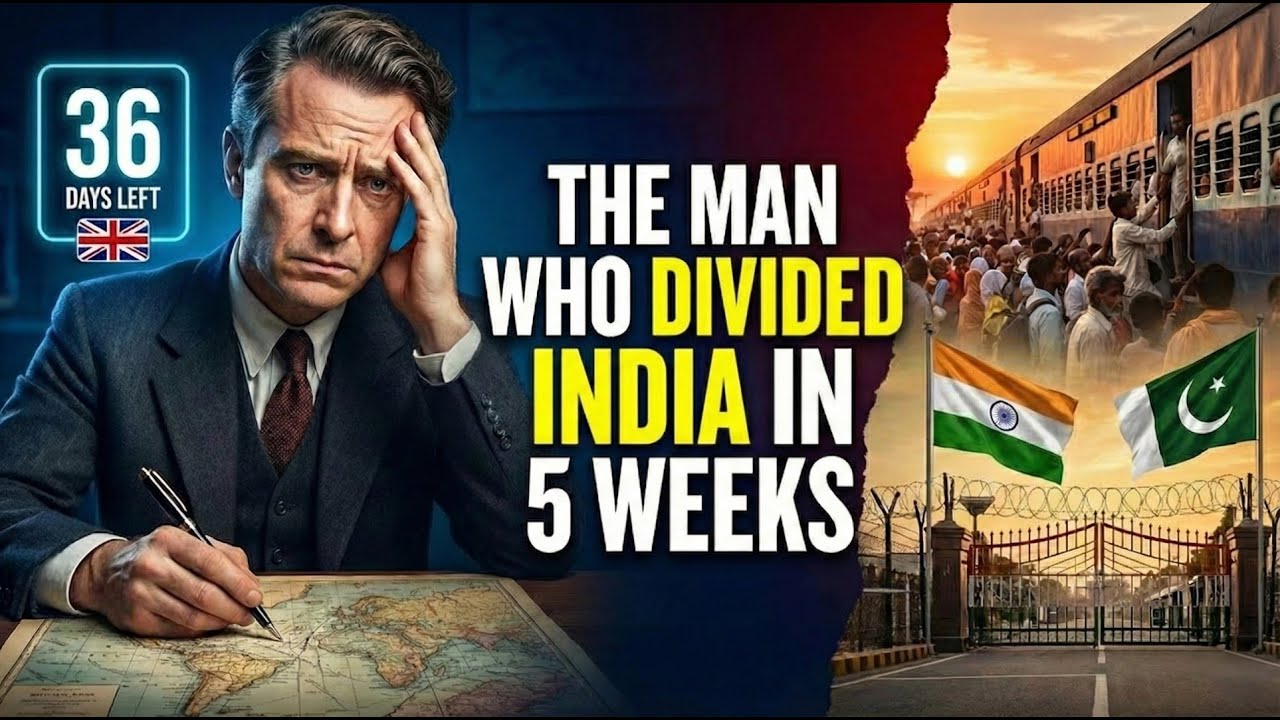
The Labour government in London wanted out of India, and fast. But simply leaving invited civil war. The British decided to split the colony into two states: a Muslim-majority Pakistan and a Hindu-majority India. The problem was that nobody knew where the border should actually run.
The viceroy, Lord Louis Mountbatten, needed someone to draw the line. He refused to use Indian politicians, who would be seen as biased, and rejected British administrators with long India experience for the same reason. Instead, he concluded that complete ignorance was the same as impartiality. He chose Sir Cyril Radcliffe, a brilliant Oxford-educated lawyer with no knowledge whatsoever of Indian geography, culture, or demographics.
Radcliffe initially accepted the job thinking he would have a few months to complete it. He was wrong. When Radcliffe arrived in Delhi on July 8, 1947, Mountbatten told him the date of independence had been moved up. The new deadline was August 15.
Radcliffe had barely 36 days to do what would normally take five years. He was horrified and protested, but the violence was already beginning in the streets. He was told delay was not an option. Radcliffe was placed in a bungalow and given a team of four judges: two Muslims who backed Pakistan and two Hindus who backed India.
They cancelled each other out and turned meetings into shouting matches. Soon Radcliffe locked himself away and worked alone. The maps he was working from were decades old. Drawn in the 1920s, they missed entire villages, new irrigation canals, and vital shifts in population.
Radcliffe could not see that a canal owned by a Hindu landlord watered Muslim farmland, or that Sikh shrines sat beside Muslim graveyards. He saw only topography and drew along rivers, unaware that those rivers changed course and that people on both banks had intermarried for generations. The pressure broke him physically and mentally. He was terrified of assassination and refused to meet Indians socially for fear of being influenced.
He worked 16-hour days, lost weight, and wrote letters home describing the heat as appalling and admitting that people would suffer because of his work. In Punjab, he had to decide how to split a province where Sikhs, Hindus, and Muslims lived together. The Sikh leaders wept and pleaded, but their holy lands were scattered and could not be circled. Radcliffe gave Lahore to Pakistan and the Sikh holy city of Amritsar to India.
The line looked neat on paper, but left Sikh farmers ten miles west of Amritsar suddenly alien in their own homes. In Bengal, he had to choose the fate of Calcutta, India’s industrial hub. The Muslim League argued that without the port, East Pakistan would be economically crippled. Congress insisted Calcutta was a Hindu-majority city at the centre of Bengali culture.
Radcliffe gave it to India, a decision that would doom East Pakistan to decades of underdevelopment. He also made a rapid call on Gurdaspur, a district with a slight Muslim majority that should have gone to Pakistan by his own rules. But it controlled the road to Kashmir. He drew the line to give Gurdaspur to India instead, a single stroke of the pencil that would lead to wars still being fought today.
The absurdity of the process was total. The border cut through houses, fields, and even a mental asylum in Lahore. He finished the work by August 12. He gave the maps to Mountbatten and expected them to be published immediately so people could prepare and the army could guard the new boundaries.
Mountbatten made a decision that even sympathetic historians have struggled to forgive. He looked at the maps, saw that they would cause outrage on both sides, and locked them in his safe. He refused to publish the border until August 17, two days after independence, so that British rule would officially be over before the bad news broke. On August 15, 1947, millions of people celebrated freedom without knowing which country they lived in.
The police did not know whose laws to enforce. The soldiers did not know which generals to obey. In the borderlands, rumors swept villages, first that they were in Pakistan, then in India. Each rumor triggered panic.
Into that vacuum of fear stepped the militias. The extremists on both sides had been stockpiling weapons. They saw the confusion as an opportunity and spread the message that safety meant cleansing the land of the other side. Where the border was unknown, people made their own border with the sword.
This was not a war between armies. It was a war between neighbours who had attended each other’s weddings and shared festivals. In the Punjab, mobs surrounded settlements, set fire to the perimeter, and butchered the inhabitants. The railways became the arteries of death.
Refugees packed trains so tightly that some suffocated before the whistle blew. Trains were sabotaged and ambushed on the tracks. Men with swords moved systematically from compartment to compartment. When a train pulled into its destination, the doors would open to silence.
These became known as ghost trains, and they ran in both directions. Those who walked formed columns up to 50 miles long, carrying children and bundles of clothes in the brutal heat. The elderly died by the roadside. Mothers who could no longer carry their babies had to choose between abandoning them or dying with them.
Cavalry charged into the defenseless crowds. Women were abducted by the thousands. Fifteen million people crossed the border in a few months, the largest migration in human history. As it happened, the British watched.
There were 50,000 troops still in India, but the orders from London and Mountbatten were to protect British civilians and withdraw. There are terrible accounts of British regiments sitting in their barracks while nearby villages were massacred, with orders not to intervene. Radcliffe was back in London when the worst news arrived. He opened the newspapers and read the estimates of the dead: 200,000, 500,000, then a million, and eventually a figure around two million lives extinguished because of a line drawn in 36 days.
He told friends he could not sleep. He realized that every wiggle of his pencil had been a death sentence. The British government sent him his fee of £3,000. He refused it and sent the money back, saying he could not accept payment for a job that had caused so much suffering.
It was a gesture of conscience that felt hollow. He never returned to India. He went back to his law practice, became a peer, and lived until 1977. He once told a journalist, I suspect they’d shoot me if I went back.
Radcliffe’s line created permanent geopolitical fault lines. Because Gurdaspur went to India, it gave India a road link to Kashmir and the ability to send troops in when the maharaja hesitated. If the line had been drawn differently, Kashmir might have gone to Pakistan automatically. Instead, the two nations fought over Kashmir immediately and have fought three more wars since, developing nuclear weapons pointed at each other across a border that was drawn in just over a month.
Beyond geopolitics lies the human legacy. The trauma of partition is the founding trauma of modern South Asia. Hardly a family in Punjab or Bengal lacks a story of the walk, the lost sister, or the abandoned home. Poets found their readers on the other side of barbed wire, and singers found their audiences divided.
Today the India-Pakistan border is one of the most heavily militarized zones on the planet, visible from space as a bright orange line of floodlights. That line follows the exact path of Cyril Radcliffe’s pencil. Some historians argue the British deliberately left chaos behind, wanting a weak and divided subcontinent easier to manage from afar, or wanting Pakistan as a client state to buffer the Soviet Union. The carelessness of the process makes such theories hard to dismiss entirely.
At best it was criminal negligence. At worst it was calculated destruction. Violence eventually stopped, but the anger did not. The line remains a jagged, arbitrary, accidental line that determines the destiny of a billion people.
It was drawn in haste, repented at leisure, and paid for in blood.