In the summer of 1969, Vince Lombardi gathered his assistant coaches in a room and delivered a message that had nothing to do with football strategy. He told them that one of the players on the roster was gay, and warned that any coach who made a single comment about it would be fired before his backside hit the ground. No one objected, and no one asked why. Everyone in that room knew better than to question Vince Lombardi.
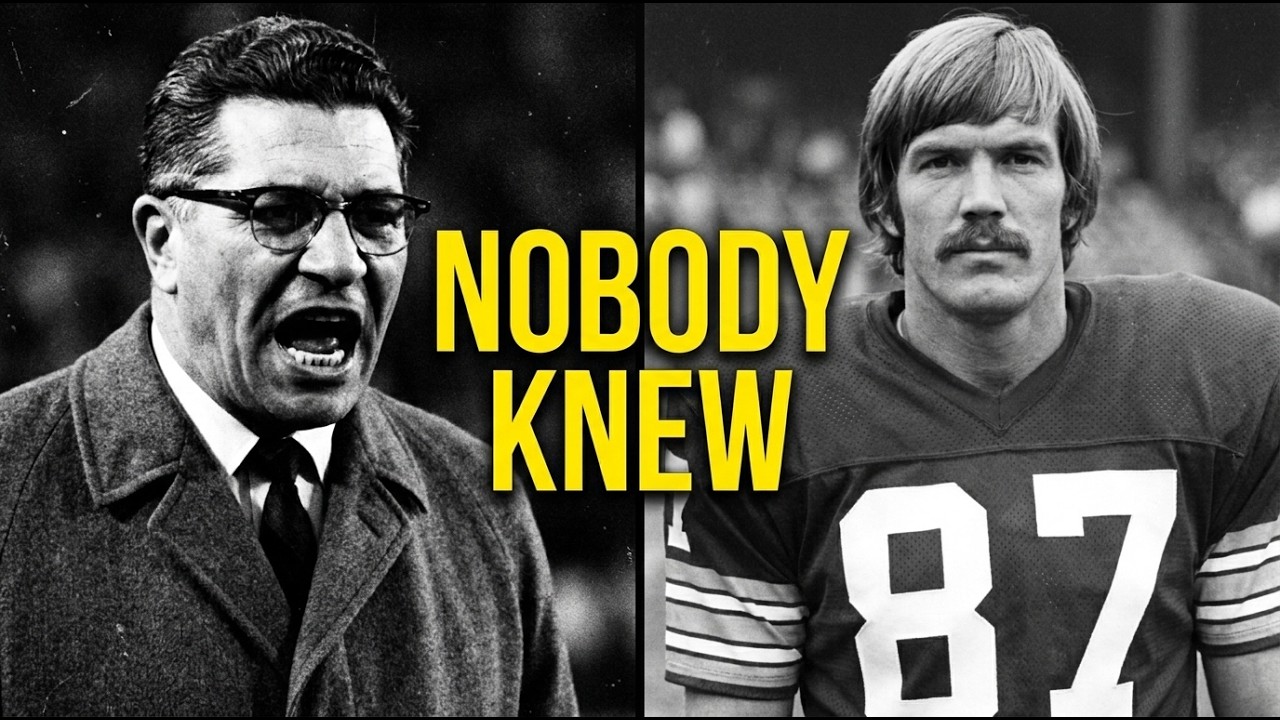
What almost no one outside that room would know for another 40 years is how many players and staff members Lombardi was quietly protecting that season, and why. Lombardi is remembered as the toughest coach to ever walk an NFL sideline, the man whose name is on the Super Bowl trophy, the demanding taskmaster who demanded perfection and won five championships. But what is rarely discussed is what this stern man did in the final year of his life, in a sport that had no tolerance for difference at the time, when he discovered how many people in his locker room were quietly hiding who they were. To understand why Lombardi did what he did in 1969, it helps to understand where that instinct came from, because it did not begin in a Washington locker room.
It began decades earlier, much closer to home. Lombardi grew up as the son of Italian immigrants in Brooklyn, in an era when being an Italian American in professional coaching circles carried a quiet, persistent stigma. He spent years as one of the most respected assistant coaches in football, first at West Point and then with the New York Giants, watching head coaching jobs go to other men year after year while his name was consistently overlooked. His daughter Susan later said her father truly believed some doors stayed closed to him specifically because of his name and his background.
He did not get his first head coaching job in the league until he was 45. The frustration of being treated as an outsider never left him, even after Green Bay made him a legend. He also had a brother. Harold Lombardi was gay, and by every surviving account, Vince knew it and loved him anyway, in an era when that alone could expose a family to scandal and shame.
Watching his brother try to navigate a world that had no patience for his identity left a mark on Lombardi that surfaced decades later in places no one expected, including an NFL locker room in the nation’s capital. By 1969, Lombardi had already built an empire in Green Bay and walked away. Washington lured him back by offering him a share of ownership and full control, hoping he could work the same magic for a franchise that had not had a winning season in 14 years. What Lombardi found waiting in that locker room was a roster that included at least three gay players and two members of his own management staff.
That was a reality virtually no one outside the building knew, and a reality that, if made public in America in 1969, would have ended careers, destroyed reputations, and possibly resulted in criminal charges in several states. To fully understand what that year meant for a gay man in the United States, consider the climate. The federal government had spent nearly two decades actively working to identify and remove suspected gay employees from its workforce, a purge historians later called the “Lavender Scare. ” Just weeks after Lombardi’s first training camp with Washington ended that summer, patrons of a New York City bar called the Stonewall Inn fought back against a police raid in an uprising now remembered as the spark of the modern gay rights movement.
That is the world in which Lombardi’s locker room existed. A country where law, culture, and professional sports offered gay men nothing but silence and danger. One of the players Lombardi inherited that season was a young defensive back named Ray McDonald, the 13th pick in the NFL draft from Idaho, whose promising career had stalled under a cloud of rumors. By 1968, McDonald faced an actual arrest for engaging in sex with another man in a public place.
By the time Lombardi arrived, many coaches in the league would simply have cut McDonald and been done with the distraction. Lombardi did something else instead. According to David Maraniss’s definitive biography of Lombardi, “When Pride Still Mattered,” the new coach gathered his assistants and made his expectations unmistakably clear. He told them he wanted every one of them to work with McDonald and give him every chance to succeed on the roster.
Then came the warning that would decades later become one of the most quoted lines in the entire biography. If any of them referred in any way to McDonald’s manhood, that coach would be fired before his seat hit the ground. That is not a soft, diplomatic version of tolerance. That is Vince Lombardi in his unmistakable voice, drawing a line around a player most of the league had already written off, not because it was strategically useful, but because in his view it was simply the right way to treat a human being on his team.
McDonald’s career ultimately never fully recovered. Football was not easy for him, regardless of the support Lombardi gave him. But another player on that same roster, a tight end named Jerry Smith, was about to have the best season of his career under Lombardi. And the reason ran far deeper than football strategy.
Jerry Smith had already spent four seasons in Washington before Lombardi arrived. A talented player still developing, he lived his entire career hiding his truth completely, as most gay professional athletes of that era had no other choice. What changed in 1969 was not Smith’s talent. It was the environment around him.
Under Lombardi, in a locker room where the head coach had made his zero-tolerance stance on prejudice unmistakable, Jerry Smith had the best season of his career: 54 catches, 682 yards, and his first All-Pro selection. Former teammate Dave Kopay, a running back who later became the first former NFL player to come out publicly, put it as simply as possible. Lombardi protected Jerry, and Lombardi loved Jerry. What almost no one watching football that fall could know is that Lombardi never sat down with any of these men for a big emotional conversation about acceptance.
That was not his way of handling this subject or almost any other. He simply made the culture of the place unmistakable through his actions. Protecting the players who needed protection, making clear there were consequences for anyone who crossed the line, and treating every man on that roster exactly as he treated everyone else, judged entirely on effort and character and nothing else at all. That single season turned out to be the only one Lombardi ever coached Washington.
By the summer of 1970, he was diagnosed with the cancer that killed him just weeks later at age 57. He never got a chance to build on what he had started with that roster. He never got to see how that culture might have developed if he had more time. Instead, he left behind a locker room full of men who spent one season experiencing, for the first time in their careers, what it felt like to be judged only on their work.
Here is what no one outside that building knew for nearly half a century. Jerry Smith played eight more NFL seasons after Lombardi’s death, and by the time he retired he held the record for touchdown receptions by a tight end. He never came out during his playing days because the culture around him, even after Lombardi, offered no safe way to do so. In August 1986, Jerry Smith made a different kind of announcement instead.
He revealed that he had AIDS, becoming the first professional athlete in American sports history to do so publicly. He died just two months later at age 43, becoming the first former professional athlete the world lost to the disease. Even then, to the very end, he never said the word “gay” to any journalist. He did not need to.
Shortly before his death, when a writer asked him to reflect on his career, Jerry Smith did not talk about touchdowns or Pro Bowls at all. He talked about one man. He said everything important he had searched for in his life he found in Coach Lombardi. That Lombardi made them into men.
Consider the weight inside that sentence. A dying man, suffering from a disease that at that time carried enormous public shame and fear, chose to spend some of his final words honoring a football coach who had died 16 years earlier, not for an ingenious game plan, but for the simple, radical integrity of being judged on who he was on that field and nothing else. Lombardi’s family has spent decades trying to make sure this part of his legacy is not lost beneath the championship banners. His daughter Susan has said plainly that she believes her father would have been thrilled to see a contemporary athlete step forward and live openly, something none of his 1969 players could safely do.
She has pointed to her father’s own experience with prejudice as an Italian American passed over for jobs he deserved as the root of everything that came after. How he treated his Black players in an era of segregated hotels. How he protected gay men on his team and staff in an era that offered them only danger. How genuine he was in seeing the whole person in front of him before seeing whatever label the rest of the country would put on that same man.
None of this ever made headlines during Lombardi’s life. He never gave a speech about it. There are no clips of him in the locker room talking about it. No press conference, no public statement to point to.
Only a private warning to a handful of assistant coaches. A player’s career quietly thriving under a coach who made prejudice grounds for dismissal. And a dying man’s final words about what it all really meant to him. That is the whole story.
And it is exactly the kind of story Vince Lombardi would have wanted told, if he wanted it told aloud at all, not through an announcement, but through the way people were actually treated when the cameras were off. Perhaps that is the real legacy beneath all of Lombardi’s championships. We remember him for his offensive schemes, the strict discipline, and the trophy with his name on it at the biggest event in American sports. But in the last locker room he ever ran, in a year that offered no safety anywhere else in the country, Vince Lombardi built something quieter, and in its own way far harder to build than a championship team.
He built a room where a group of frightened, hidden men got to spend an entire season being judged simply on their work. One of them spent the rest of his life, right to the end, completely grateful for that.