In the spring of 1945, the war in Europe was entering its final chapter. The Rhine had been crossed, and the German army was fracturing. Entire units were surrendering in exhausted columns, with thousands of men stumbling toward American lines with their hands raised.
Somewhere in the rolling countryside of Bavaria, a convoy of American military lorries rumbled through a shattered town. Inside a repurposed farmhouse serving as a prisoner processing center, a scene unfolded that would become one of the most quietly satisfying vignettes of the war.
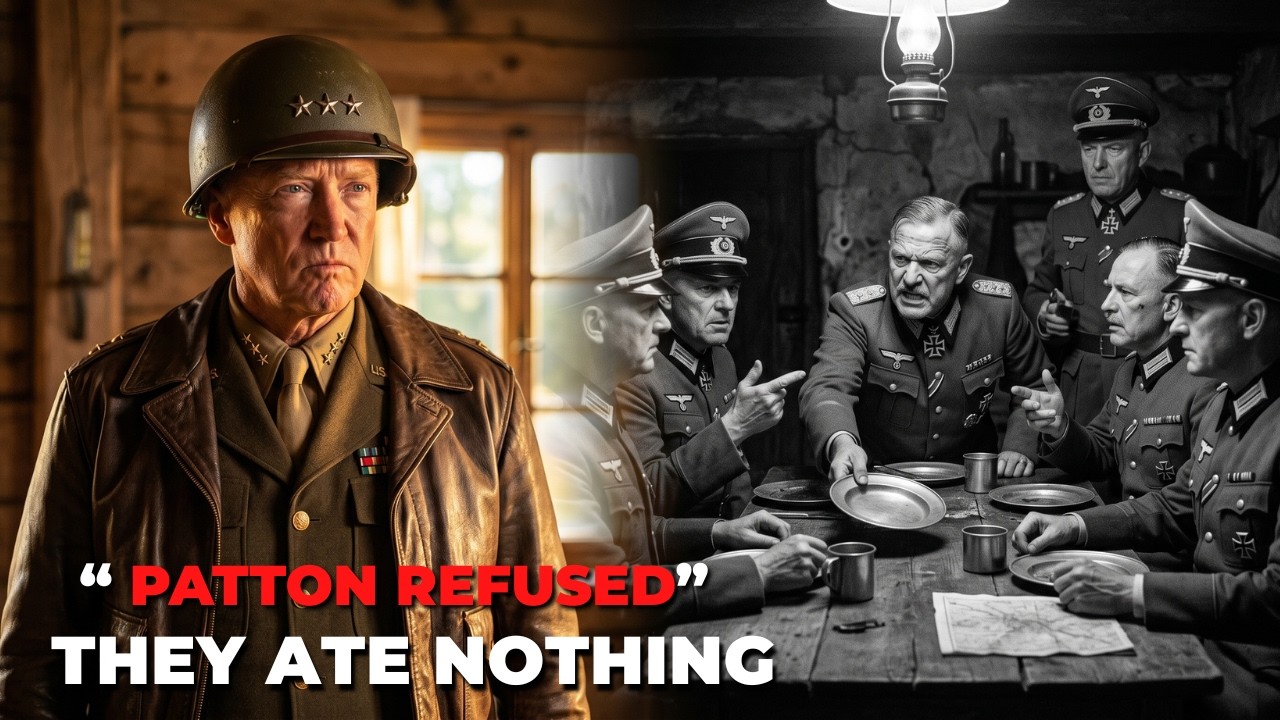
A German officer, a colonel by some accounts, was brought before the American staff managing the intake of prisoners. Though no longer in a position of power, he carried himself as though he still believed he might be. He made a demand. He and his fellow officers expected hot meals. Proper food, not the rations of common soldiers.
The American officer receiving the complaint considered it for a moment. His reply was blunt. The German officers would receive exactly what every other prisoner of war in the facility received. Not a thing more.
That American officer was General George S. Patton. What makes the moment extraordinary is not simply the bluntness of the refusal. It is what it reveals about a man who was one of the most complicated, controversial, and brilliant military commanders of the 20th century.
Patton did not dismiss the German officers out of contempt. He had been deeply and genuinely concerned with how his prisoners of war were treated. The standards he held to were not ones of comfort or indulgence, but of consistent, principled fairness. His prisoners ate what his prisoners ate, officers or not.
By the spring of 1945, the United States Army was processing prisoners of war on a scale never before attempted in human history. In the weeks following Germany's collapse, American forces would eventually hold somewhere in the region of 3 million German prisoners. The logistical challenge was almost incomprehensible.
The system governing prisoner treatment was framed by the Geneva Convention of 1929, which both the United States and Germany had signed. That agreement stipulated that prisoners of war were to receive food of a quantity and quality at minimum equivalent to that of the detaining power's own depot troops.
In theory, this offered a clear standard. In practice, the sheer scale of surrenders meant the system was under enormous pressure. Supply chains were overextended. Infrastructure across Germany had been bombed into rubble.
Into this environment came a class of problem that Patton had little patience for. The German officer who believed that defeat had changed his circumstances but had not fundamentally altered his status. Many Wehrmacht and SS officers continued to conduct themselves as though the ordinary rules of command hierarchy still applied.
The Geneva Convention did make some provision for officers. They could not, for instance, be compelled to perform manual labor. But Patton understood something about the moral architecture of a military force that these German officers did not. The distinction between an officer and his men is earned in the moment of leadership. It does not survive the surrender of that command intact.
Patton's handling of his prisoners was far more nuanced than his popular image might suggest. He was deeply interested in the operational and moral coherence of his command. That interest extended to the treatment of captured enemy soldiers.

What the German officers received was the standard prisoner of war ration as administered throughout his command. It typically consisted of tinned goods, bread, and basic protein. It was not luxurious. In some facilities, it was barely adequate. But it was what was available, and it was what every other prisoner received.
The response from the German officer was reported to be indignant. The precise words differ between sources, but the substance is consistent. You will eat what my prisoners eat because that is what you are.
This was not a universal attitude amongst American commanders. The treatment of German prisoners varied considerably across different commands and facilities. The notorious story of the Rhine Meadows camps represents one end of a very wide spectrum. Conditions in some facilities were, by any honest assessment, inadequate.
Patton's attitude represented something different from the extremes of that controversy. It was the position that the rules apply consistently. Rank does not purchase exemption from the basic conditions of captivity.
Comparing this to the German treatment of Allied prisoners during the conflict is instructive. Western Allied prisoners, particularly officers, were in many cases treated in accordance with the Geneva Convention. Eastern Front prisoners, particularly Soviet soldiers, were treated with a brutality that resulted in millions of deaths.
The Americans, whatever their failures and inconsistencies in 1945, were not operating on those principles.

What is most striking about the Patton anecdote is how it reveals his leadership philosophy. He believed absolutely in the importance of hierarchy and discipline, but a discipline that flowed from demonstrated worth, not from inherited status. He demanded the highest standards from his own men and extended a kind of rough, consistent fairness to those who had been defeated.
There is also a considerable satisfaction the story provides at a purely human level. These were officers of a military machine that had spent years operating on the principle that certain categories of people deserved less. The symmetry of their being told that rank does not buy better rations is not accidental.
The legacy of this episode is not written in grand strategic movements. There is no weapon system or tactical doctrine that traces its origins to a German officer being told he would eat tinned rations like everyone else. The legacy is subtler. It is the legacy of a principle imperfectly held to across the chaos of a collapsing war.
Patton himself would be dead before the end of 1945. A road accident in Germany in December of that year. A conclusion so mundane as to seem almost impossible for a man of his scale and violence.
The story survives him. It survives partly because it is genuinely satisfying in the way that good stories about the collision of pretension and reality tend to be satisfying. It survives partly because it illuminates something real about Patton that the more dramatic stories sometimes obscure.
He was a man of fierce, unyielding standards. On that particular day in that particular farmhouse, those standards served the German officers exactly as fairly as they served everyone else in his command. They were prisoners. They ate what prisoners ate. Nothing more, nothing less.
In the spring of 1945, as the whole apparatus of a regime built on hierarchy and racial privilege came apart at its foundations, there was something quietly, perfectly, just about that.