In the late 1840s, five men from Ohio stopped before a bronze statue of Thomas Jefferson on the White House grounds in Washington. One of them asked which man in their town most resembled the statue. The answer came back from the group in unison: a Black fiddler in Chillicothe named Eston Hemings. He was the son of Thomas Jefferson.
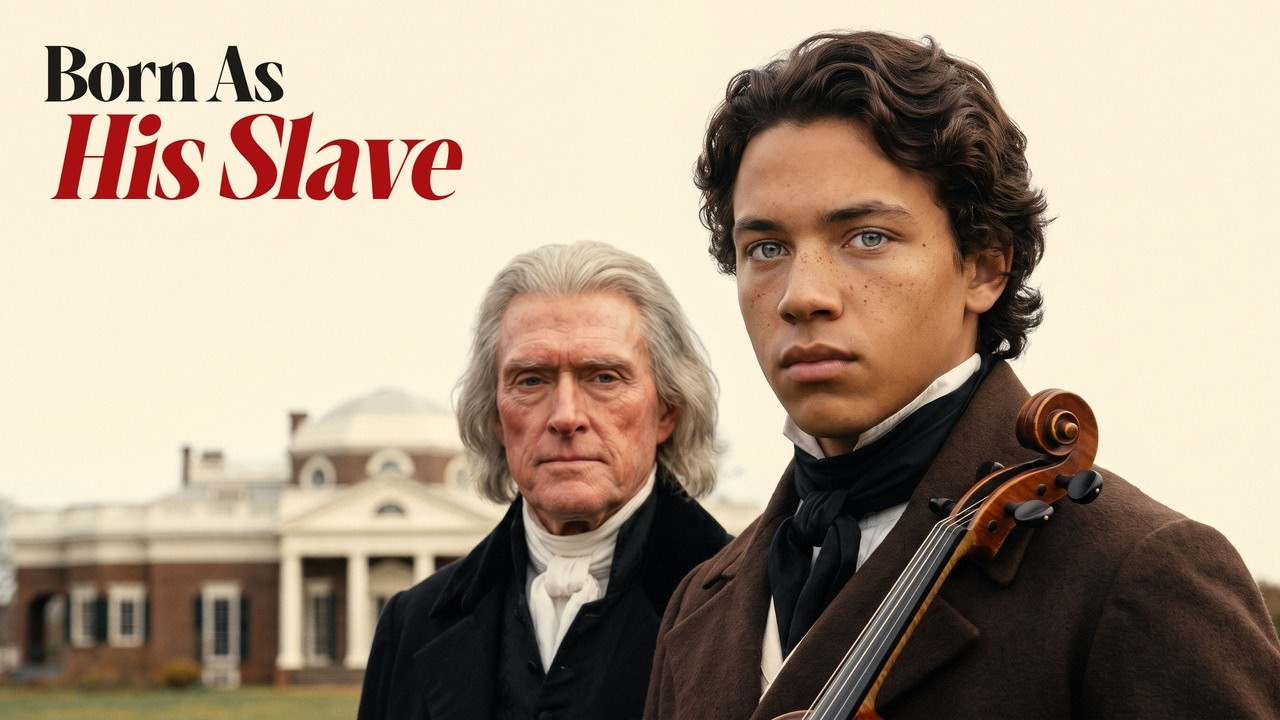
He was also, by law, Jefferson’s property. To give his children a future, he decided to bury his mother’s name. That name would be reclaimed by his descendants’ blood 146 years later. On a summer day in 1850, a census taker walked through the streets of Chillicothe, Ohio, and stopped at a two-story home.
A musician lived there with his wife and their three children. The man gave his profession and the value of his property. The official then wrote an additional word beside his name—a word describing his skin color. Ten years later, in a different state, another official looked at the same family and wrote the exact opposite.
The musician’s name was Eston Hemings. His mother was born into slavery at Monticello, and so was he. His father was Thomas Jefferson, the third president of the United States and the man who wrote that all men are created equal. Eston was born at Monticello on May 21, 1808, the youngest son of Sally Hemings, a woman owned by the president.
In the spring of 1808, Jefferson was spending his final full year in office. The house on the small mountain in Albemarle County, Virginia, was rarely quiet, filled with visitors throughout the summer. Sally Hemings cared for the rooms and wardrobe of the man who owned her—the same man who, 20 years earlier in Paris, had persuaded her to return to Virginia even though French law would have granted her freedom. She was 34 when Eston was born, her fourth child to survive infancy and her last.
Under Virginia law, the child belonged to the man who owned his mother. By the accounting of that household, he was also that man’s son. Nothing in the house openly acknowledged it. These were not rhetorical calculations.
Sally Hemings bore six children over 16 years. Thomas Jefferson ran a country and was often away from the mountain for months or years at a time. Yet he was present at the house each time, nine months before the birth of each of those children. Every time.
Researchers who reviewed the records two centuries later found no exception. Sally Hemings’s children grew up in a strange space within Monticello. They were not sent to the fields. They were not sold.
Madison, Eston’s older brother, wrote years later that they were allowed to stay around the big house, asked only to do light work such as running errands. They carried messages and watched carriages come and go. They spent their childhoods within a few hundred feet of the most famous man in America, who never once called them his sons in any surviving word. Madison stated it plainly in memoirs he dictated to an Ohio journalist in his old age.
He said that Jefferson was not in the habit of showing partiality or parental affection to them. Then came another sentence, direct and dry: they were the only children he had by a slave woman. One thing did pass from that man to those boys, preserved by the family for four generations. It was not land.
It was not a name. It was music. Thomas Jefferson played the violin from his youth. He bought instruments, collected sheet music, and copied melodies by hand.
One such page remains in the Monticello collection today: 17 bars of an old tune called “Money Musk,” written in the president’s own handwriting. His sons also played. Beverly, the eldest, was the family’s first fiddler. In a letter from around 1819, one of Jefferson’s granddaughters planned a Saturday evening: the young people of Monticello intended to go to the south pavilion and dance to Beverly’s music.
Isaac, a man enslaved at Monticello who remembered everyone, described Madison Hemings as a skilled fiddler. Eston, the youngest and quietest, grew to be the most accomplished of the three. At age 14, the Hemings boys were sent to the joinery shop. It was a long, low building on the south side of the house run by their uncle John Hemings, their mother’s brother and the finest furniture maker on the mountain.
He made desks, chairs, and cabinets for Jefferson’s private rooms and could read and write, something almost no enslaved person in Virginia could do. Madison remembered being placed in the joinery trade under John Hemings at 14. Eston followed him into the same shop, learning to sharpen a plane iron and read the grain of wood. There was something worth noting about that shop: the boys were given a real trade, one a man could live on.
Someone decided these children in particular would not spend their lives in the tobacco fields. Madison believed it was a promise. He wrote that his mother had returned from France only after Jefferson promised her extraordinary privileges and made a formal pledge that her children would be freed when they reached 21. In 1822, the two eldest children left.
Beverly and Harriet Hemings left Monticello one after the other and never returned. Eston was 14 and had just begun in the joinery shop. Only two of the children remained with their mother. The mountain was changing around them.
Jefferson was in his 80s. The soil was exhausted, crops were poor, and debts had piled up for years—his own debts and, worse, a large debt he had guaranteed for a friend who died and left him to bear it. Visitors still came and were treated with hospitality while the accounts worsened. The old man rode his horse in the afternoons while 130 people on the property labored in the fields and rooms, waiting to learn what would become of them after his death.
In March 1826, Thomas Jefferson sat down and wrote a codicil to his will. He drafted it with care. He freed five people, all Hemings family members, all relatives of Sally Hemings—no one else among the 130. He asked the Virginia legislature to allow them to stay in the state where their families and ties were, because Virginia law gave a freed slave one year to leave.
Four months later, on July 4, 1826, exactly 50 years after the Declaration of Independence was read aloud in Philadelphia, Thomas Jefferson died in his bed at Monticello. His sons were 18 and 21. In the sentence granting them freedom, their father chose a word to describe their standing to him. That word was not “son.
” It was “apprentices. ” He bequeathed to John Hemings the services of his apprentices, Madison and Eston Hemings, until each reached 21, at which point he granted them their freedom. It was carefully written, legalistic, proper. It was also the last chance for a dying man to say what these boys had meant to him.
He let it pass. Madison turned 21 the year after Jefferson’s death and received his freedom. Eston was 18. In his own account, Madison said the estate simply granted him the remainder of his time shortly after.
Monticello dates his freedom to 1829, the year he turned 21. Either way, it was done quietly, as everything about them had been. What happened around them was not quiet at all. In January 1827, six months after Jefferson’s death, the family sold the people Jefferson had owned to pay his debts.
More than 130 men, women, and children stood on the grass at Monticello and were auctioned off publicly to strangers. Husbands were separated from wives, children from parents, in the snow in front of the house they had built with their own hands. The Hemings brothers were free that winter. Nearly everyone they had grown up beside was not.
Their mother’s name did not appear in the will at all. She left the mountain anyway, moving to Charlottesville to live with her two sons in an arrangement no one ever wrote down. They rented a house at first. Later they bought their own land and built on it: two stories of brick and wood, constructed by two men trained in the best joinery in Virginia.
Eston made furniture and played at dances. Madison worked as a carpenter. Their mother kept house. Madison wrote that he and his brother rented a house and brought their mother to live with them until her death.
For nine years, this was their life. Three free people in a rented, then owned, house half a mile from a mountain none of them could see without remembering. Then in 1830, a census taker climbed the stairs. He counted the family: Eston Hemings, his brother, and their mother.
He filled in the ages, and in the column where the law required him to record what these people were, he wrote one word: white. No one in that house asked him to do it. There is no evidence anyone corrected him. That was simply what the stranger saw standing at the door, looking at a woman who was three-quarters European, and her two adult sons.
It was the first time a United States government document said about Eston Hemings the thing that would define the rest of his life. He was 22, a carpenter and fiddler in a small Virginia town, and the world had just shown him a door he had not asked to see. He did not walk through it. Not yet.
In 1832, Eston married. Her name was Julia Ann Isaacs, and she was 18. Her father, David Isaacs, was a German Jewish merchant who owned a store on the main street. Her mother, Nancy West, was a free woman of color who ran a bakery and owned property in her own name.
Julia had grown up in a family Virginia had no comfortable category for either. Their first child was born in Charlottesville in May 1835. The surname given to him was still Hemings. The two names before it were John Wayles.
The choice deserves attention. John Wayles was the white Virginia planter who fathered Sally Hemings with an enslaved woman he owned, making him Eston’s maternal grandfather—and, through a different path, Eston’s father-in-law’s family connection. Most families in this position would have let the name die out. Eston Hemings gave it to his first son.
Whatever he was hiding, he was not hiding that. That same year, the arrangement collapsed. Sally Hemings died in 1835 in Charlottesville at about 60. There is no grave marker.
No one recorded where she was buried. The woman at the center of the most controversial family in American history left behind almost nothing: a few lines in her son’s memoirs, a name in a record, and three grown sons with no reason left to stay in Virginia. Eston remained for three more years. He sold the property, packed his fiddle and a set of carpentry tools, took his wife and young children, and in the late 1830s crossed the Ohio River with them.
Another man freed from Monticello made the same crossing in those years and later said what it meant to him: when he came to Ohio, he considered himself truly free, and not until then. Ohio was freedom country. Ohio was where a man could own a home, keep what he earned, and raise children who would never belong to anyone. Ohio also had its own laws.
But the laws could wait. First, there was the music. Chillicothe in the 1840s was a bustling commercial town, Ohio’s old capital, full of wealthy merchants and their marriageable daughters. It had dance halls, hotels, and refined taste in dancing.
For about 15 years, when Chillicothe’s leading citizens held a party, the man in charge was a Black carpenter from Virginia named Eston Hemings. He led a trio: his own fiddle, a clarinet played by a man named Graham Bell, and a cello played by a man the town knew as Wamba. A Chillicothe newspaper remembered them 40 years later: when Eston played his fiddle, Graham Bell his clarinet, and Wamba his cello, there was only one thing to do—dance. They played in Chillicothe, Circleville, Lancaster, Portsmouth, and Columbus.
Eston did not just play; he called the dance figures, meaning the hall moved according to his commands all evening. One tune in his book was an old dance called “Money Musk”—the same melody, 17 bars of it, that his father had once copied by hand at Monticello. In 1850, the Chillicothe census taker recorded his occupation as musician and the value of his property at $2,000. In the color column, he wrote: mulatto.
Twenty years earlier in Virginia, another official had looked at the same man and written “white. ” Nothing had changed about Eston Hemings except the doorstep. People in that town knew who he was, or thought they did. In 1902, an old man in Chillicothe sat down to write the local paper what he still remembered about him after more than 50 years.
It is the closest thing to a photograph we will ever have. He wrote that Eston Hemings was of light bronze complexion, a little over six feet tall, well-proportioned, erect, and very dignified. His flowing hair inclined to chestnut, and his face bore a faint trace of freckles. He was quiet, unassuming, polite, and highly intelligent.
Then came the town’s open secret: there was a story about this man, the old writer said, and many people accepted it as truth based on the substantial evidence of his striking resemblance to Jefferson. Which brings us to the statue. After 1847, the writer traveled to Washington with four other men from Chillicothe. On the north lawn of the White House stood a bronze statue of Thomas Jefferson, a gift to the nation, one hand holding the Declaration of Independence.
The five men stopped before it. One asked the others: who in Chillicothe most resembled this statue? According to the old man’s account, the answer came at once, in one voice: why, Eston Hemings. He added later something about the bronze color, that it perhaps made the resemblance more perfect than it was in reality—the kind of thing a man says when he surprises himself.
Sometime afterward, he returned to Ohio and told Eston Hemings what had happened in Washington. This is the full reply, as he remembered it. Eston answered quietly: well, my mother, whose name I bear, was owned by Mr. Jefferson.
Then, after what the writer described as a slight pause, he said another sentence: and she was never married. That was all. It is the only known thing Eston Hemings ever said about his father in his entire life—one sentence, a pause, and a second sentence that tells you he understood exactly what had just been asked of him. “My mother, whose name I bear.
” He was still bearing it then. Now the laws. Ohio was free land, yet it had its own laws regarding Black people. A free Black man in that state could not vote.
He could not hold office. He could not testify in court against a white man. His children—children of a carpenter and bandleader, children with a home, a piano, and a father who owned $2,000 in property—were barred from the public schools that white children attended every morning. Then, in September 1850, Congress passed the Fugitive Slave Act.
Under the new law, slave catchers could come north, swear an oath before a commissioner, and take any Black man away. The accused had no right to testify in his own defense. Southern Ohio filled with men doing exactly that, and free-born people were seized alongside runaways. The river that meant freedom for Eston Hemings in 1838 now saw movement in the opposite direction.
His sons were 15 and 11. His daughter was between them in age. The old writer in Chillicothe, searching for a way to explain what happened next, reached for a phrase from the Bible: between the two sides of that town there was a great gulf, a gulf that could not be crossed. Eston Hemings quietly left Chillicothe, and the writer believed he told no one where he was going.
In the fall of 1852, he sold what he owned and took his family north, out of Ohio entirely. A great-great-granddaughter, asked a century and a half later why he did it, gave the simplest answer: she imagined he looked at his children, saw they were intelligent and getting an education, and thought they should have the opportunities white people had. He was 44 years old, and he decided to stop being Eston Hemings. The new name had been waiting in the family for 17 years.
It had already been given to his eldest son. When Eston Hemings arrived in Madison, Wisconsin, in the autumn of 1852, he arrived as E. H. Jefferson.
His wife became Julia Jefferson. His children took the name Jefferson. The initials kept the old name folded inside them, as one might keep a letter in a coat pocket. No one in Wisconsin asked what the “H” stood for.
From that winter on, the family lived as white people. He worked as a furniture maker. None of the Wisconsin papers seem to have written a single word about the finest fiddler in southern Ohio. That was probably the point.
A man who calls people to dance is a man everyone remembers. A furniture maker is just a man with a shop. He had only three years and two months left. Eston Hemings Jefferson died in Madison on January 3, 1856, at about 47.
He had been free for 27 years and white for three. Whatever he bought his children with that trade, he was gone before he could see them enjoy it. Five hundred miles to the south, his brother had made the opposite choice and lived with it. Madison Hemings stayed in Ohio, kept his name, and remained a Black man in a state that had decided what that meant.
He farmed, did carpentry, and raised his children in Pike County. In 1870, census taker William Weaver knocked on his door, recorded the family’s details, and then added something in the margin no census taker was supposed to add: this man is the son of Thomas Jefferson. Three years later, Madison Hemings told the full story to a local newspaper—about his mother, Paris, the promise, his father, everything. Historians would dismiss that account for the next 125 years.
One detail in the memoir deserves attention. In the middle of it, Madison mentions his younger brother briefly, the way one mentions someone still alive. Eston married a woman of color in Virginia, moved from there to Ohio, and lived in Chillicothe for several years. In the fall of 1852, he moved to Wisconsin, where he died after a year or two.
He left three children. Madison named the state and the years. He did not name the name. The brother who told the world everything kept the one secret that could have cost his brother’s children their future.
Those children grew up quickly. The eldest son, John Wayles Jefferson, went into the hotel business in Madison. When war broke out, he joined the Eighth Wisconsin Infantry in August 1861 and became a major within a month. His military records describe him as gray-eyed and red-haired.
Thomas Jefferson had also been a red-haired man. John was wounded at Corinth and again at Vicksburg. He rose to lieutenant colonel, then colonel, and for a time commanded the entire regiment—hundreds of white men from a northwestern state who had no idea who their commander’s grandmother was. Somewhere during those war years, he met a man from Chillicothe who knew the truth.
It is the same old writer in the same 1902 article. Here is what he says happened: he saw and spoke with one of the sons during the Civil War, who then wore the silver insignia of a lieutenant colonel and commanded an excellent regiment of white men from a northwestern state. The son begged him not to tell anyone of the fact that there was Negro blood in his veins, which he said no one in his command suspected. The writer, of course, kept the secret.
A man in his 20s in uniform in the middle of a war fought over what ran in his veins, asking someone who was almost a stranger to keep silent. He got that silence—for 40 years, until the man who granted it was old enough to decide it no longer mattered. Colonel Jefferson left the army in 1864, went to Memphis, and made a fortune in cotton. He corresponded with the president.
He never married and had no children. Whatever he carried, it stopped with him. His younger brother, Beverly, stayed in Madison and ran hotels, then a transportation company with a fleet of carriages meeting every train. People loved him.
One account described him as a friendly, honest-hearted man. He had a wife and five sons but told them almost nothing. According to one family account, he spoke of his descent from Thomas Jefferson only to his closest friends. Their mother outlived her husband by 33 years.
On March 22, 1889, Julia Jefferson—born Julia Ann Isaacs, daughter of a Charlottesville storekeeper and a free woman of color—wrote to her wealthy son in Memphis. Her descendants kept the letter for nearly a century; it was finally published in 1976. She was dying and knew it. What she wrote was a list of small things.
She wanted a good gold ring for each of her seven grandchildren, if he could manage it. She wanted her husband’s piano to go to one of them. Then she wrote this about herself: bury me beside your father, without pomp or display. Let the headstone be simple.
She died the next day. The Madison paper described her as a good and kind woman, loved by those who truly knew her, and said nothing of her origins. In November 1908, Beverly Jefferson died in Madison. The Chicago Tribune published an obituary that never mentioned Thomas Jefferson.
One of his friends, A. G. Munson, was upset enough to write to the paper. Munson wrote that Beverly’s death deserved more than a passing mention, for he was a grandson of Thomas Jefferson.
That was the last time anyone in that family said it out loud for 65 years. By the 1940s, descendants of Beverly Jefferson had reviewed the family history and smoothed it over. The name Hemings was erased. What remained was a story true enough to tell at a dinner party: the family was distantly related to Thomas Jefferson—through an uncle or a cousin, someone in the general vicinity of greatness.
That was the account passed down through generations. Grandchildren grew up in Wisconsin and New York believing they had a distant drop of Jefferson blood, with no idea that their great-grandmother had been an enslaved woman on a Virginia mountain. One descendant tried in the 1940s to construct a proper family tree. He stumbled.
The lost name, a historian later wrote, was the obstacle—a polite way of saying he could not get past the generation in which his family had cut the thread. While the descendants forgot, the historians denied. Jefferson’s white descendants had settled the matter in their own century: the old man had not been the father. It had been one of the Carr brothers, his nephews—a wayward relative, an unfortunate matter with no connection to the master of Monticello.
Serious historians repeated this for the next 150 years. Madison Hemings’s memoirs, printed in an Ohio newspaper in 1873, were dismissed as a political scheme, a Black farmer used by a Republican editor. For a century and a half, one American family told the truth and was called liars, while another American family told a lie and was believed. Then in 1974, a biographer named Fawn Brodie published a book arguing that the relationship was real, and she named the children: Beverly, Harriet, Madison, and Eston.
In a house on Staten Island, a woman named Julia Jefferson Westerinen read the name Eston. The same name was in her family’s papers. She was in her 40s when she learned that the uncle had never existed, that the man was Thomas Jefferson himself, and that she descended from a woman who had been owned. By her own account, she was still processing it 20 years later.
She told a reporter in 1998: I cannot be Black. I have not suffered the terrible indignities that Black people have suffered. That same year, a retired internist named Eugene Foster set out to settle a 200-year-old dispute with a needle. He did much of the work himself, traveling from place to place to draw blood samples in people’s homes.
He needed men, only men, because the evidence he wanted was the Y chromosome, which passes from father to son essentially unchanged across centuries. He collected samples from five male descendants of Field Jefferson, the president’s uncle—the closest accessible match to the president’s own Y chromosome. He collected samples from three descendants of the Carr brothers. He collected samples from five descendants of Thomas Woodson, another family with an old claim.
He needed one more: a living man descending in an unbroken male line from one of Sally Hemings’s sons. Only one line could provide that. The male line of Madison Hemings could not be traced to a living donor. The eldest brother had left the mountain in 1822 and disappeared into white America without a trace.
The only unbroken chain of fathers and sons anyone could trace began with Eston Hemings through his youngest son, the Madison hotel keeper, down to five generations of men who had grown up believing in the uncle. The sample came from a man in Wisconsin named John Weeks Jefferson, brother of Julia Westerinen. On November 5, 1998, the results appeared in the journal Nature under a title that left no room for imagination: “Jefferson fathered slave’s last child. ” Jefferson’s Y chromosome proved to be rare—a type, the authors wrote, never observed outside the Jefferson family.
The finding was stated in one direct scientific sentence: the descendant of Eston Hemings Jefferson does indeed have the Field Jefferson haplotype. The Carr brothers did not match. The story the white family had told for 150 years simply evaporated in one afternoon of laboratory work. Technically, the test identified a family, not a single man.
Other Jefferson males had lived in Virginia, and a minority of scholars still point to one of them. But only one Jefferson lived on that mountain, was present at every conception, and freed that woman’s children and no one else. In January 2000, the foundation that owns Monticello reviewed the evidence and named him. Now consider the whole matter at once.
The evidence that vindicated Madison Hemings—the brother who kept his name and told the truth, farmed the soil in Ohio and was called a liar for it—came from the arm of a man who existed as “Jefferson” only because Madison’s brother had given up that name to save his children. The branch that hid the secret was the branch that carried it intact in its blood for 146 years. Eston Hemings buried his mother’s name to buy his children a future, and the future he bought them is what finally proved his mother had been telling the truth. The discovery hit the family like a storm.
By that evening, there was a limousine at the door, as Julia Westerinen remembered, and the phone did not stop ringing. Within weeks she sat across from Shay Banks-Young, a Black woman from Ohio descended from Madison Hemings. Two great-great-granddaughters of brothers who had parted at a riverbank in 1852 met for the first time on daytime television before millions of viewers. In 1999, the Monticello Association—the organization of Jefferson’s white descendants, who alone were permitted burial in the family cemetery on the mountain—invited the Hemings descendants to their annual meeting.
In 2002, they took a vote. By an overwhelming margin, they voted no. The family cemetery at Monticello lies about 600 feet from the room where Eston Hemings was born. There is no headstone for Eston Hemings at Monticello.
There is no marker for his mother there either. For two centuries, the mountain kept its silence well. The stone is in Wisconsin. Forest Hill Cemetery sits on a slope on the west side of Madison, under old oak trees, among the ordinary headstones of 19th-century citizens—grocers, city councilmen, young wives who died early.
His marker is not large. It has no inscription. It bears a date in January 1856, and above the date, a name: E. H.
Jefferson. That is all. Two initials and a surname that was not his name. Thirty-three years later, his widow wrote to their son in Memphis to tell him how she wished to be buried.
“Lay me beside your father,” she wrote, “without pomp or display. Let the stone be plain. ” She told him what should be carved on it. Not her real name—not Julia Ann Isaacs of Charlottesville, daughter of a storekeeper and a free woman of color.
She asked that her stone read that she was the wife of E. H. Jefferson. Two people side by side, with not one full name between them.
So we should clarify what the initial stands for. The “H” is Hemings. It is his mother’s name. It is the name he was born with.
It is the name of a woman who was enslaved at Monticello and never married, buried in a place no one knows. When Eston Hemings crossed to the other half of America and became a white furniture maker in a northern city, giving his children a future that included education and the vote, he did not discard that name. He folded it down to a single letter and carried it with him. It is there in the city records of 1852, there on the headstone, and there every time one of his sons signed a hotel register, an enlistment roll, or a cotton contract.
E. H. Jefferson—the initial no one in Wisconsin asked about—was the one thing he could keep from his mother. It was also there in the only sentence of his that anyone bothered to write down.
A man in Chillicothe told him he resembled the statue of Thomas Jefferson, and he neither denied nor confirmed it. He said: my mother, whose name I bear, was owned by Mr. Jefferson. “My mother, whose name I bear.
” He was telling the truth. He was still bearing that name. He simply did not say it loud enough for the nation to hear. The statue still stands.
It was removed from the White House grounds in 1874 and moved to the Capitol, where it stands today in the Rotunda, where millions pass each year by a bronze statue of Thomas Jefferson holding the Declaration of Independence. Six hundred miles northwest of that place, on a slope in Madison, a plain stone bears two initials and reveals nothing. At Monticello, in a climate-controlled room, there is a page of sheet music in Thomas Jefferson’s handwriting: 17 bars of an old tune called “Money Musk. ” Eston Hemings played that tune in the dance halls of southern Ohio for 15 years, and the townspeople said that when he and his band struck up, there was only one thing to do—dance.
His descendants and his brother’s descendants know each other now. They meet. Some are buried in places where the others still cannot be buried.
And the stone on the slope in Madison says what it has always said to anyone who stops long enough to read it: his father’s full name, and his mother’s name reduced to the size of a single letter.