In June 1944, Emil Hartmann was 22 years old and convinced he was about to be killed. The truck had left the paved road 40 minutes earlier, heading west on a white sand track through palmetto scrub and pine. Hartmann had counted the turns, because a man who knows the way back has a chance. But there was no way back from here. No farms. No fields. No work. And prisoners were not transported without work.
He looked at the two guards sitting at the rear of the truck, rifles on their knees. He remembered the stories that followed the Afrika Korps into captivity: that the Americans were sentimental at first, that they fed you and photographed you and let you write home. Then, once the paperwork was done and the letters were sent and everyone believed you were safe, they drove you to a quiet place.
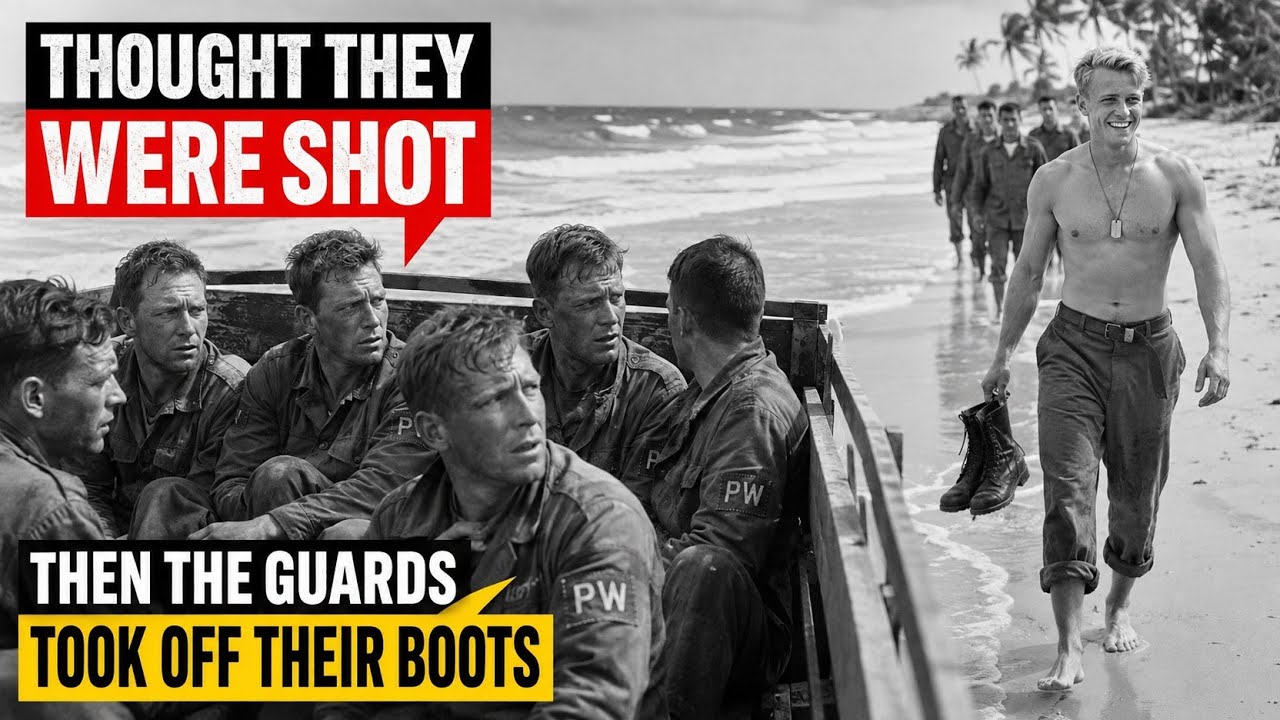
The track ended. The pines stopped. Ahead, behind a low wall of sea oats bending all one way in the wind, was the Gulf of Mexico. No one spoke for a moment. Twenty-eight German prisoners of war stood in the back of a U.S. Army truck in June 1944, wearing dyed military uniforms with the letters PW stenciled between their shoulder blades, staring at a stretch of open water most of them had not seen since the transport ship.
The sand was so white it hurt. The water graded from clear to green to a blue that seemed impossible. Sergeant Delaney, 46 years old, with a knee that ached, opened the tailgate and said something Emil did not understand. Private Zimmer, who spoke a kind of German his grandmother had brought to Wisconsin in 1889, translated. “Two hours. Stay where we can see your heads.”
No one moved. Emil would remember that for the rest of his life: that not one of them moved. Twenty-eight men who had crossed a desert, an ocean, and a continent stood packed in a truck bed, staring at a beach, unable to move their legs because they did not understand the sentence as it sounded. Josef Baumann, a schoolteacher from Kassel before the war, the oldest of the group at 38, said quietly without turning: “It’s a trick. Wait.”
They waited. They waited so long that Sergeant Delaney started laughing, then stopped, because he understood something about the men in his truck that had not occurred to him until that moment. He understood why 28 grown men were afraid of a beach.
You have to go back 13 months, to a peninsula in Tunisia, where the German war in Africa ended. Emil Hartmann was from Bremen. His father drove barges on the Weser River, and his grandfather before him. Emil grew up on the banks of a northern river. He learned to swim before he learned to read, because in his family, a boy who could not swim was not considered trustworthy near the family home.
He trained in a shipyard on the Weser at 15 and was conscripted at 19. He was sent to North Africa in the spring of 1942 as a replacement in a supply unit, which meant he spent the next year driving trucks along a coastal road under fire. When the end came, he was not a hero. He was a thirsty man standing next to an empty fuel vehicle.
The end came in the second week of May 1943. Army Group Africa was trapped on the Cape Bon peninsula, the sea behind it and the British Eighth Army and the Americans in front. Supply convoys from Sicily had stopped because the Allies controlled the skies over the Mediterranean. Nearly a quarter of a million German and Italian soldiers were captured in a matter of days. It was a catastrophe on the scale of Stalingrad. Because it happened in the desert rather than the snow, and because most of the men survived instead of dying, it was almost forgotten.
Emil surrendered on May 9 to a British soldier who was so exhausted he did not bother to aim his weapon. There was no drama. The soldier gestured with his chin toward a road where thousands of men were walking east in a column that stretched beyond sight. Emil joined the column. He had one half-full water bottle. He had not eaten in two days. He walked until dark and slept in the open among other sleeping men. What he remembered about that night was not fear but silence. For the first time in 14 months, no one was shooting at anything. The silence was so complete it kept waking him up.
They were sorted into wire pens near Tunis, then near Oran. They were counted, dusted with white powder, counted again, and asked repeatedly for their name, rank, serial number, and home address. The Americans took over from the British. There, Emil first encountered what would define the next five years of his life: American paperwork. Forms in triplicate. A card with his photograph. A file that would follow him across the ocean and remain in a box in Maryland long after his death.
The Germans had lost the war in Africa. The Americans had already begun to file him.
He crossed the Atlantic in the hold of a Liberty ship from Oran in June, packed into a compartment with hundreds of others, sleeping in stacked canvas bunks four high in air that did not move. The heat was worse than the desert because it had no outlet. Men were constantly sick. The convoy zigzagged, and every time the engine sound changed, 800 men held their breath at once, because they all knew a German submarine commander might be looking through a periscope at an American cargo ship with no way of knowing the cargo was German.
The ship docked in Norfolk on a Sunday morning in the last week of June, and the war began to lose its meaning. The first thing he noticed was the harbor. Emil grew up in a port and knew what a working port looked like. He knew what Bremen looked like in 1942 after the RAF had visited for two years. What he saw in Norfolk was not a port at war. It was a port entirely free of war. Cranes. Dry docks. Gates. Half-built ships in every direction. Welding sparks falling like rain. Not one burning building. Not one.
The men had been told for four years that America was a hollow country full of gangs and jazz, that it would collapse the moment it was squeezed. They looked at the shipyards of Hampton Roads, and some of them stopped talking for the rest of the day.
The second thing was the train. They were taken to a staging point, then boarded real passenger cars with upholstered seats and windows that opened, and headed south through Virginia, the Carolinas, and Georgia in the last week of June 1943. A U.S. Army cook moved through the cars handing out sandwiches: white bread, real butter, meat in every one, and real coffee instead of roasted barley. Emil ate three sandwiches and was secretly ashamed of himself.
From the window, the landscape passed. Farms with equipment in their yards. Lit towns. Cars, not military vehicles but ordinary cars driven by ordinary people doing ordinary errands. Children waving at the train, because children wave at trains without knowing who is inside. Josef Baumann sat across from Emil somewhere in South Carolina, his forehead almost touching the glass, and said in a low voice empty of anger and hope: “They haven’t been touched. Nothing here has been touched.”
A 19-year-old in the car insisted loudly that it was staged, that the Americans had built a corridor of prosperity along the railroad for exactly this purpose, that the whole country was a set. He kept this up for about 200 miles. Then he stopped, because no country on earth could build a set that large, and because every man in the car had done the same calculation at some point and reached the same result. “We will not win this war.”
They arrived at Camp Blanding in Florida in the first days of July. Blanding was vast, 170,000 acres of sand, pine, and lakes southwest of Jacksonville, one of the largest infantry training centers in the United States. Inside it, behind a double fence, was a prisoner of war compound. That compound became the hub of a network that would spread across the state. By the end of the war, Florida had nearly 20 POW camps, most of them small branch camps set up next to crops that needed picking.
Florida was a small part of it. By 1945, the United States was holding about 370,000 German POWs in more than 500 camps in nearly every state. Germans in Texas. Germans in Iowa. Germans in Maine. It was one of the largest movements of foreigners into the American interior in the country’s history, and it happened quietly. Today, most Americans know nothing about it, even in the towns where it happened.
Processing took a day and a half: photograph, fingerprints, medical exam, vaccinations, soap shower, haircut, paperwork. Two blankets. A mattress cover. A mess kit. A towel. Work clothes. U.S. Army uniforms dyed a faded dark blue with PW stenciled in white on the back and trouser leg. The barracks were one-story wooden buildings with screened windows and tin roofs. About 20 men per building, each man with a bed, a small locker, and a shelf. There was a canteen. There were showers with hot water.
Emil stood at the door of his barracks on the first evening, blankets under his arm, feeling a strange disorientation, as if he had been placed in temporary housing rather than prison. That night’s dinner was beef stew, boiled potatoes, bread, canned peaches, and coffee. He sat at a table with a bench and a plate and could not finish it. His stomach had shrunk in Africa and shrunk further on the ship. He sat there looking at food he could not eat, after spending the previous winter dividing a single tin of Italian meat into four parts. His eyes burned with shame and he stared at the table until it passed.
It was Baumann, the teacher, who explained the system, because Baumann paid attention. The Americans had signed the Geneva Convention of 1929, and the convention was not a courtesy but a contract. It required that POWs be housed and fed to the same standards as the garrison troops of the detaining power. It allowed forced labor, but not in anything directly related to the war effort, not in dangerous conditions, and not without pay. It allowed prisoners to write home. It allowed neutral Swiss inspectors to enter any camp and see anything they wanted, with the International Red Cross handling the mail.
Baumann’s point was this: the Americans were not honoring the convention out of generosity. They were honoring it because tens of thousands of American boys were sitting in German camps in Poland and Bavaria. Every humane gesture made in Florida was an argument the U.S. government could use on behalf of an Ohio pilot in a compound outside of a German town. “Mercy is cheaper than you think,” Baumann said, “when it is leverage.”
Emil accepted this explanation. It was clear and rational. It allowed him to eat without feeling indebted to anyone. It explained almost everything he saw over the next three years. Everything except one afternoon on a beach, which it did not explain at all.
Work began within a week, and work was the reason all of this existed. America in 1943 had a severe labor shortage. Sixteen million men and women were in uniform. Millions more had left the fields for defense plants in Detroit, Mobile, and Seattle, where wages were four times what a farm could pay. The crops did not care. Florida citrus had to be picked in winter. Celery had to be cut and stacked around Sarasota and Manatee County. Sugarcane had to be burned, cut, and hauled in the Everglades. Pine trees in the north of the state had to be tapped for turpentine and cut for pulp, because the Navy depended on resin and the Army on paper.
Farmers watched their fruit fall into the sand and rot. They wrote to Congress. Congress wrote to the War Department. The War Department looked at 300,000 able-bodied young men sitting behind barbed wire eating three meals a day. So branch camps opened: a few hundred men, a fence, some tents or converted CCC barracks, a few guards, and a contract with the county growers’ association. The farmer paid the government the prevailing local wage for the work. The government paid the prisoner 80 cents a day in canteen coupons, redeemable only inside the camp, for cigarettes, toothpaste, writing paper, and soft drinks, and kept the difference.
No one was enslaved. No one got rich. It was just a transaction. By the end of the war, prisoner labor had become so essential to American agriculture that when the camps finally closed in 1946, farmers in six states petitioned the government to keep them open.
Emil started by picking citrus in a grove west of Blanding, and he was terrible at it. The quota was set in boxes, and veterans could finish their daily quota by mid-afternoon. Emil finished at dusk, shoulders stiff and hands blistered, while the foreman shook his head at him. He got faster. Everyone got faster. There was a rhythm to the work: take the fruit in your palm, twist it up and out, never pull straight down, into the bag on your shoulder. When the bag got heavy, you knelt and pushed it into the box so nothing bruised. Within a month he could finish by three. Within two months he was among the men who finished early and sat in the shade with a stolen orange watching the American guards, who also sat in the shade eating oranges.
In November, his detachment moved south to a branch camp inland from the Gulf coast, in the flatlands of De Soto and Sarasota counties. He stayed there for two and a half years. Celery in winter. Citrus in winter. Watermelons and cattle fencing and drainage ditches in between. Six days a week, eight hours a day, a truck ride at seven in the morning and a return at five-thirty in the evening, with Sunday off.
The guards at the branch camps were not what propaganda had promised. The Army was not going to waste healthy 20-year-olds on a fence-sitting job in Florida while they were needed in Normandy. The men who watched the prisoners were the leftovers of the American manpower system: middle-aged reservists, men with perforated eardrums, flat feet, and heart murmurs, World War I veterans gone gray. Sergeant Ray Delaney went to France in 1918 at 19 and came back with a knee that predicted rain. He spent 22 years selling farm implements in Georgia before the Army took him again for the only job he had left.
Private Ali Zimmer was 23, rejected from combat for a lung condition. He was from a town in Wisconsin where his grandmother still prayed in German and where the Lutheran church had only stopped preaching in German in 1918, when it was no longer safe. Zimmer was the link. Zimmer could talk to them. What Zimmer discovered and reported to Delaney in his own words was that the men in the camp were not fanatics. There were fanatics. Every camp in America had hardcore Afrika Korps men who ran kangaroo courts in the barracks at night and made life dangerous for anyone caught fraternizing with the guards. In some camps around the country, men were beaten, even killed, by their own comrades for that.
But the majority were bakers, clerks, farmers’ sons, and shipyard apprentices, conscripted at 19, shipped to the desert, decisively beaten, and now wanting three things: food, news of their mothers, and to survive long enough to get home. Letters were the center of everything. Every prisoner had the right to write. Mail went through the Red Cross and neutral channels in Switzerland and Sweden, taking six weeks to six months if it arrived at all. The forms were deliberately small. You were not allowed to mention where you were, what you were doing, or any troop movements, ships, or weather. What remained was the simplest possible positive statement: I am fine. I am not hungry. I am not sick. Don’t worry.
Emil wrote to his mother in Bremen twice a month for three years. He wrote the same four sentences over and over, and the sameness frightened him because he had no way of knowing if the address on the envelope still existed. Bremen was a port city with pen factories and aircraft plants. It was bombed in 1943, bombed in 1944, bombed again. He wrote to a street he could not be sure was still a street. For eleven months in 1944 and 1945, he received no reply at all. This was the norm. It went on for years.
In the spring of 1944, Josef Baumann made a request. The men had noticed the water. It was impossible not to notice it. On truck rides they crossed rivers the color of strong tea. They cut celery in fields surrounded by canals. On clear days, from the top of a citrus ladder, you could see a glint far to the west. Baumann insisted it was light coming off the Gulf. The argument went on for weeks.
They were all filthy in a way that showers could not fix. Florida summer is a wet heat that never lets your clothes dry. The men worked in them, slept in them, and went out to work in them again. The camp had a recreation program because the convention required opportunities for sport, and because the Americans had learned early that an occupied prisoner is a safe prisoner. There was soccer played with passion on a graded dirt field. There was a camp band formed from instruments bought with canteen funds. There was a theater troupe performing Schiller plays with sets made from painted burlap bags. A library. Chess tournaments. An English class taught by Baumann. An accounting class taught by a former bank clerk from Hanover. Movies were shown every Saturday night, especially Westerns, which the prisoners loved and argued about fiercely.
So when Baumann asked, it was not a strange request. He asked Zimmer, who asked Delaney, who thought about it for a week. Could the men be taken to the sea? The request should have been refused. Every logic said refuse. It meant loading prisoners into trucks and driving them over 20 miles away from work to an open, unfenced, unlit coast, 100 miles of water on one side and the entire American continent on the other. Then releasing them from their clothes and putting them in an environment where a guard could not grab a man by the arm and a rifle was useless.
Delaney would be entrusting three, maybe four, middle-aged men with the custody of 30 enemy soldiers on a beach. He agreed anyway. There is no way to know the real reason. Delaney, like most Americans in this story, never wrote a word about it. Some of it was calculation. Escapes from American camps were rare and futile, and guards and prisoners alike knew it. About 2,200 German prisoners escaped American custody during the entire war. Out of nearly 400,000 prisoners, almost all were recaptured within days, usually hungry, usually a few miles away, usually by a farmer or a sheriff. It was impossible for a man in an old military uniform, speaking German, with no money and no papers, to get out of Florida, let alone out of North America.
Part of it was labor management. Delaney’s farmers were happy with their quotas, and a contented workforce is productive. But part of it, and this seems beyond argument, is that Ray Delaney was 19 years old in France in 1918. He knew exactly what it meant to be a young man with a rifle in a country that was not his own. He looked at the men cutting celery in his county and somehow failed to keep hating them. So 28 German POWs were taken to the sea.
On an afternoon in June 1944, Delaney stood frozen in the back of a truck, looking at the Gulf of Mexico, waiting to be shot, and got tired of waiting. He put his rifle in the truck cab. Then he took off his boots. Then, in front of 30 men, a 46-year-old sergeant with a bad knee walked through the sea oats in his socks, rolled his trousers to his knees, and stood in the surf with his hands on his hips, looking at the water like a man on his own porch. That settled it. Baumann was the first to go in, because he was the oldest and it was his role. Then two more followed. Then the rest of them tumbled out of the truck, unbuttoning their clothes, and within four minutes the beach was full of men in their underwear running into the Gulf of Mexico shouting.
Emil did not run. He walked slowly across the sand, stopped at the edge of the wet sand, bent down, and put his hand in the water. It was warm. That was the detail that confused him. He was from the North Sea, from a coast where the water is gray and cold enough to stop your heart in April, where swimming is serious business and boys are warned about it from age four. He had been raised to respect water as something that could kill you if you were careless. Here was an ocean at bathwater temperature, so clear he could see his feet and small fish moving over the sand ridges. Warm enough that a man could stay in it for an hour without shivering.
He put his face in it and tasted the salt, and suddenly thought of his father’s hands on the tiller of a barge on the Weser. He stayed under with his eyes open until his lungs forced him to the surface. Around him, the war stopped for two hours. Grown men stood on their hands in the shallows. A wrestling match in waist-deep water went on until laughter exhausted both parties. Someone found a sand dollar, and it was passed from hand to hand on the beach like an ancient artifact. A group lined up and rode the small waves, then pulled themselves out and did it again, with the complete absorption of children. Two men lay on their backs on the sand, arms outstretched, and did not move for an hour and a half.
A young man from Silesia named Dieter Volk, 20 years old, stood at the waterline and could not go in because he had grown up 200 miles from any sea, had never learned to swim, and was too proud to say so. Emil spent forty minutes in water up to his chest, his hand under the back of a sand dollar, teaching it to float exactly as his father had taught him in a Weser boat in 1927, repeating the same words: “Stop fighting. It wants to keep you up. Stop fighting.” The sand dollar floated and rose to the surface, gasping, angry and delighted.
It is worth noting that this happened in the summer of 1944, six weeks after D-Day, while men of the same two armies were killing each other in the hedgerows of France at a rate of thousands per week. The guards swam. That was the part Emil could never explain to anyone afterward, and the part people in Germany refused to believe. Zimmer went in first, then two others, and Delaney waded to his waist and stood there. They kept their distance. They counted heads. One man stayed dry on the dune with a rifle the whole time. None of that changed the basic fact: for part of that day, American soldiers and German soldiers were in the same water at the same time, for no reason except that the water was there and the air was warm.
Eventually Delaney whistled them in and counted heads: 28. They put on their wet clothes, climbed into the truck, and drove home through the pines, the low sun slanting through the canvas. The truck was silent almost the whole way. Not gloomy. Empty. Baumann sat with his head against the truck frame, eyes closed, and said to himself: “That was cruel.” Emil asked what he meant. Baumann said: “Now we know what is on the other side of the fence. It was easier when it was just a fence.”
They went back four times over the next fourteen months. Not often; it depended on the crop, the trucks, and how many guards Delaney could spare. But it happened. And when it happened, the volunteer list filled within an hour of being posted. The strangest thing was how ordinary it became. Similar things happened all over the United States. Prisoners in Texas swam in stock tanks and rivers. Prisoners in the upper Midwest skated on frozen ponds. Prisoners in the mountain states went on supervised hikes. In dozens of states, prisoners were taken into town with a single unarmed guard to shop, eating in stores and local restaurants while their guard waited outside.
This leads to something that must be said, because it is the shadow over this entire story, and leaving it out would make the story a lie. In most of the American South in 1944, a German prisoner of war was allowed to sit down and eat at a table, while a Black American soldier in U.S. Army uniform was not. This was not an isolated incident or a rumor. It happened in more than one state, was reported at the time in the Black press, and was spoken of bitterly by the men who experienced it for the rest of their lives. Black soldiers escorting prisoners were sent to eat in the back while the prisoners they guarded sat at the tables.
The country that so carefully applied the protections of the Geneva Convention to enemy prisoners was, at the same time, in the same towns, denying its own citizens the most basic human rights. Both things are true. They were true at the same time, on the same day, sometimes in the same building. The humanity in this story is real, and it was not distributed equally. Any account of the humane treatment of German prisoners in Florida in 1944 that does not acknowledge this is comfort, not history. Emil Hartmann knew nothing of this in 1944. He learned of it decades later from a book, and said it was the only part of the entire American experience that made him ashamed of his own good treatment.
The war in Europe ended on May 8, 1945. The prisoners heard the news on the camp radio. There was no celebration and no despair. A strange, long silence. Then the men went looking for maps in the recreation hall to see whose homes were in which occupation zone. Dieter Volk’s town in Silesia was gone. Not damaged, but destroyed, and annexed to Poland. Its German inhabitants were expelled. He sat on his bed and realized at 21 that he had no home to return to.
Within two weeks, the food changed. The news arrived. Belsen. Dachau. Buchenwald. Americans sat in movie theaters and watched the bodies, the survivors, the ovens. The mood of the country turned. Congress heard about it. Food rations in POW camps were cut sharply. Meat almost disappeared. Bread, potatoes, beans, and less of them. Men who had gained 20 pounds picking oranges began to lose it again. There were real reasons for the global food shortage, and the need to feed a starving Europe was part of it. But no one in any camp in America doubted the main reason. Camp commanders did not pretend otherwise.
Worse than hunger came with it. The Army required the prisoners to watch the film. They sat in the recreation hall under the heat, doors open, watching what had been found in the camps in silence. Then they went back to their barracks in silence. For about a week, silence filled the camp. Some men shouted that it was faked. Some men went quiet and stayed that way. Some men cried. Emil, who had spent the war as a truck driver on a coastal road, sat on the edge of his bed, aware that there was no version of the story that cast him as merely a conscripted boy. He had worn the uniform. He had moved supplies. He was 23 years old, and he had been part of something whose full picture he was only now seeing, and he had done nothing about it, and he could not honestly claim he would have done anything if he had known.
The Americans had actually been preparing for that moment for two years. There was a program almost no one had heard of, run from a camp in Rhode Island by a group of German émigré intellectuals and carefully selected anti-Nazi prisoners. The program produced a German-language newspaper distributed to camps across the country and organized courses in American civics, history, and constitutional law. The idea was that these hundreds of thousands of young men would return home to a destroyed country, and that their beliefs on arrival would matter enormously. It was not a secret program, and it did not work on everyone. But thousands of men who would later become teachers, publishers, business managers, and officials in the Federal Republic of Germany learned their first practical lessons in civics in a barracks in rural America. Some of them said so for the rest of their lives.
What is striking when researching all of this is how much remains on the German side and how little on the American side. Every prisoner has a file, a photograph, a card, a work record, a medical report, a mail log. All of it was kept with great care, and all of it is still in the National Archives. The guards left almost nothing. Ray Delaney is a name on a duty roster, a service number, a discharge date, and then silence. That gap is why this story matters. Men like Delaney came home silent, and their grandchildren assume nothing remains. But something always remains. It is filed under a number no one in the family was ever told, because the men who guarded these camps never told their families about them.
Ask in the towns of Florida, Texas, and Nebraska about the location of a branch camp, and you will find that everything disappeared within a decade. No plaques. No reunions. No stories told at the dinner table. There was nothing heroic about it. A man who spent 1944 watching German boys cut celery in Sarasota County found nothing to say to his brother-in-law who had gone ashore in Normandy. So he stayed silent for fifty years, and then he died. That is how an entire chapter of 400,000 men in 500 locations across more than forty states became something most Americans know nothing about.
The prisoners did not go home when the war ended. That is the part of the story Hollywood refused to film. The last German prisoners left the United States in the summer of 1946, more than a year after Germany’s surrender, because American agriculture had come to depend on them and ships were needed for other purposes. Emil left from Norfolk in September 1946, the same port he had arrived at. After three years and three months, the ship did not take him to Germany. It took him to France. Under an Allied agreement, a large number of German prisoners were transferred from American custody to Britain and France for reconstruction work.
Emil Hartmann, captured in May 1943, spent another 19 months as a prisoner in Europe. He worked clearing rubble, rebuilding railway bridges, and for a time demolishing the coastal fortifications the Germans had built. The food was much worse than in Florida, and so was everything else. It was not cruelty so much as the fact that France in 1947 did not have much to give anyone, and what it had it was not going to give to Germans first. The men in his work detail said openly what he had thought hundreds of times: that the luckiest thing that had happened to them was being captured by the Americans early in Africa, before things got worse.
He reached Bremen in the spring of 1948, five years after the last time he had seen it. He was 27. The city he had grown up in largely did not exist. Whole neighborhoods had been burned. The port where he had trained was a field of sunken cranes and broken quays. His mother was alive, in two rooms of a partially restored building with another family. She had received four of his letters out of nearly seventy he had sent. His father had died in 1945, not in a raid but of a heart attack at 54 while clearing a canal. His older sister was alive in Hamburg.
His mother, who had been told her son was in America and could never imagine what that meant, asked him about his experience there. Emil Hartmann stood in his mother’s two rooms and could not answer. He told her about the work. He told her about the food, carefully, because food was very scarce in Bremen in 1948 and he was aware of her reaction. He did not tell her about the beach for eleven years.
He went back to the water because it was all he knew. He worked in the rebuilt shipyards on the Weser, then for a shipping company, then for the port authority. By the mid-1960s he was a neat man with three children and a small house, in a country that had rebuilt itself so quickly and so completely that his children did not believe the stories of the years of destruction. He taught them to swim before they learned to read. His daughter later said he was extremely strict about it, in a way that seemed exaggerated and slightly funny to the family. None of them understood why until much later.
He spoke about Florida once a year at most, usually in summer. In 1979, at 58, he flew to the United States for the first time since the Liberty ship had taken him from Norfolk. His youngest daughter came with him. Through a veterans’ organization and a local historical society, he tried to find Ray Delaney. He learned that Delaney had died in Georgia in 1971. He never found Zimmer. What he found after two days of driving, using a road map and a weak memory of a truck ride from 35 years before, was the coast. The beach was covered with houses now. There was a road, a bridge, a parking lot, and a public walkway with a boardwalk over the dunes. He was not sure, and never became sure afterward, that it was the same stretch of sand.
His daughter said he stood on the boardwalk for a long time looking at it. Then he went down, took off his shoes, rolled up his trousers, and walked into the Gulf of Mexico up to his knees in his shirt and tie. A middle-aged German port official standing fully dressed in the shallow water of a Florida beach, tears running down his face, while American families sat 20 meters away under umbrellas paying no attention. That night, in a motel outside Sarasota, he told her everything: the truck, his certainty that they were about to be shot, the sergeant taking off his boots, the sand dollars floating like deer.
He told her what he had concluded about it over 35 years. He had spent a long time believing Baumann’s explanation that the whole thing was about leverage, reciprocity, and the cold calculations of a signed treaty. He said Baumann was right about the system. The treaty was why the food was good, why the mail came quickly, why Swiss inspectors arrived. The treaty was why he weighed 170 pounds in 1945 instead of being dead. Rules made by governments and honored by another government for reasons of state. He never denied that.
But there is no clause in the Geneva Convention of 1929 about taking prisoners to the sea. There is nothing in any regulation that required a 46-year-old sergeant with a bad knee to load his enemies into a truck, drive them to open water, put his rifle in the cab, and go in with them. That was not the system. That was one man deciding, on his own, in the middle of the largest war in human history, that the boys cutting celery in his county would get an afternoon off. That is what Emil said, and that is the essential difference. Systems can be good, but they are built and maintained by individuals who choose, in split seconds, either to do the minimum the rule requires or to do what the rule never imagined. That second kind of choice is the only reason anyone remembers anything about that beach.
Emil Hartmann died in Bremen in 2003 at 82. Among his possessions was a small envelope his children had seen once or twice and never had explained to them. Inside was a cracked sand dollar, mended at one edge with yellowed glue. And a playing-card-sized photograph of a group of young men in wet underwear, standing on white sand, squinting and laughing, with a middle-aged American sergeant in the middle, trousers rolled to his knees. Nothing on the back. No date. No names. If you did not know, you would think it was someone’s holiday snapshot, and you would put it back in the box. That is exactly the point and the danger. All of this — 400,000 men, 500 camps, a decade of American life, and one German shipyard worker’s 60 years of grief — survives in things like this. Unlabeled photographs. Sand treasures in envelopes. Entries on duty rosters. Things in boxes that outlived the only person who could have explained them. They are sitting now in attics, three or four miles from wherever you are reading this.