Wallis Simpson stood in the gardens of a French chateau in the summer of 1937, just weeks after her wedding, dressed in a pale blue gown that would eventually be named after her. She looked composed and unreadable beside the man who had given up the British throne to marry her. Most people know that part of the story. What is far less known is that this was Wallis Simpson’s third attempt at building a life with someone, and that the two marriages before it were darker and more complicated than the abdication story ever captured.
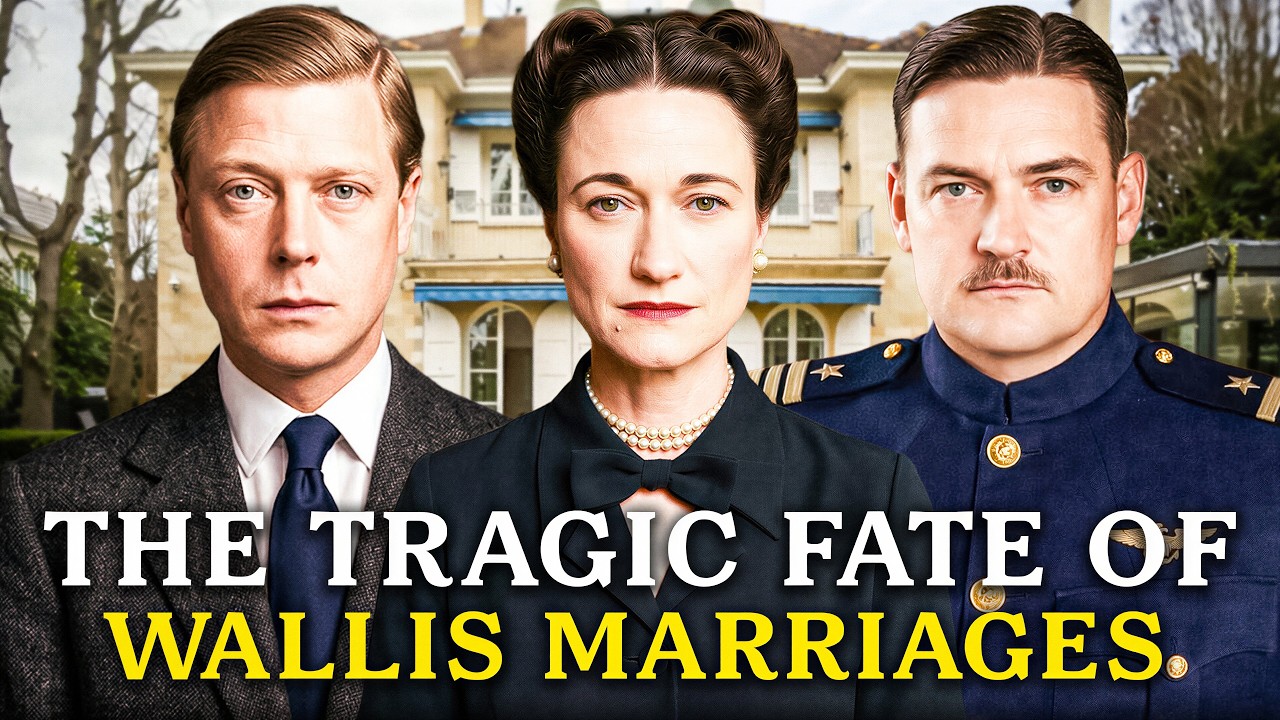
Bessie Wallis Warfield was born on June 19, 1896, in Blue Ridge Summit, Pennsylvania. Her father, Teackle Wallis Warfield, came from a prominent Baltimore family, but he died of tuberculosis when Wallis was just five months old, leaving almost nothing behind. Her mother, Alice Montague, was left dependent on the charity of her late husband’s wealthy bachelor brother, Solomon Davies Warfield, president of the Continental Trust Company in Baltimore. The family moved to Baltimore, and Wallis grew up socially prominent but financially precarious, always aware of the gap between the life expected of her and the life actually available.
Solomon paid for her to attend Oldfields School, the most expensive girls’ school in Maryland, where she became known for her immaculate dress sense and relentless drive to be at the front of everything. She was not considered conventionally beautiful, but she had presence, a sharp unsoftened wit, and the ability to make whoever she was talking to feel like the most interesting person in the room. By 1916, at age 20, Wallis had been through a Baltimore debutante season without finding a husband, and her uncle had made clear that she needed to secure a marriage, as the family’s finances did not allow for extended periods of a young woman simply existing. In April 1916, a visit to her cousin Corinne in Pensacola, Florida, put her in the path of Earl Winfield Spencer Jr.
, a handsome naval aviator stationed at the Pensacola airbase. Wallis wrote to her mother the same day, describing him as the most fascinating aviator she had ever met. Win proposed after just two months of courtship, and the wedding took place on November 8, 1916, at Christ Episcopal Church in Baltimore. What followed was a slow, grinding unraveling.
Win Spencer was an alcoholic, and the full weight of his condition only became clear once they were living together. When he drank, he was actively cruel, directing at Wallis subtle insults and humiliations precise enough to wound without being obvious enough to complain about in public. He locked her in rooms and left for hours. He once crashed his plane into the sea after drinking before a flight.
The marriage became, in her own words, a succession of bitter quarrels. In 1920, Win was posted to Washington and then given command of a gunboat in the Far East. Wallis stayed behind and began what she later described carefully as friendships, including a long relationship with Argentine diplomat Felipe de Espil, which biographers have described as among the most emotionally significant of her early life. In January 1924, Wallis sailed to the Far East to join Win in China, but the attempt to salvage the marriage failed almost immediately.
Their divorce was finalized on December 10, 1927. She was 31 years old, twice separated, once divorced, and almost completely without financial resources. Her uncle Solomon, who had died in 1927, had excluded her from his will precisely because she had divorced. What she did next was find Ernest Simpson.
Ernest Aldrich Simpson was Anglo-American, born in New York in 1897, educated at Harvard, and by the mid-1920s running his family’s shipping business in London. He was steady, cultured, and gentlemanly, offering something Win Spencer had never been able to provide, a stable platform from which to build the life she had always intended to have. Wallis met Ernest while her divorce from Win was still being finalized. Biographers have noted that she accepted his proposal by telegram from Cannes, telegraphed simply, “Yes.
” They married on July 21, 1928, at the register office in Chelsea, London. The life they built together was genuinely comfortable, and Wallis established herself as a hostess of considerable skill, known for her scathing wit and the ability to create an atmosphere in which guests felt simultaneously entertained and envied for being there. Through the social world she was building, she encountered Lady Thelma Furness, the acknowledged mistress of Edward, Prince of Wales. Lady Furness introduced Wallis and Ernest to her circle, which included weekends at Edward’s country estate.
On January 10, 1931, at a weekend house party at Burrough Court, Wallis was formally introduced to the Prince of Wales. He remembered her later as unremarkable at their first meeting, as she had a cold that evening. Between 1931 and 1934, the Simpsons encountered the Prince at various social occasions. By early 1934, while Lady Furness was visiting America, Wallis had quietly become the Prince’s mistress.
He cast aside both Lady Furness and his previous long-term companion without any direct farewell to either, simply stopping returning their calls. By 1935, the affair was visible to anyone who looked. The Prince gave Wallis expensive gifts, they took public holidays together in Europe, and he relied on her judgment in ways he had never relied on anyone else’s. Ernest Simpson understood what was happening and stepped back, giving Wallis room to be wherever she needed to be.
On January 20, 1936, King George V died, and Edward became King Edward VIII. His coronation was scheduled for the following spring, and the question of what to do about Wallis Simpson became almost overnight the most pressing constitutional problem in the British Empire. Wallis had filed for divorce from Ernest on the grounds that he had committed adultery with her own childhood friend, Mary Kirk, an arrangement some biographers have suggested was deliberately orchestrated. The decree nisi was granted on October 27, 1936.
Prime Minister Stanley Baldwin met with the King in October to make clear the government’s position, that a twice-divorced woman with two living former husbands was unacceptable as Queen Consort. The King proposed a morganatic marriage, in which Wallis would become his wife but not his queen. Baldwin took the proposal to the Dominions, and they rejected it. On December 3, 1936, the story broke on the front pages of British newspapers.
Wallis, who had escaped to the South of France, reportedly screamed at the news that Edward intended to abdicate and called him a fool. She had not wanted him to give up the throne. On December 10, 1936, Edward signed the instrument of abdication in the presence of his three surviving brothers. The following day, Parliament confirmed it.
On the evening of December 11, Edward gave a radio broadcast explaining he had found it impossible to carry the heavy burden of royal responsibility without the help and support of the woman he loved. His reign had lasted 325 days. Wallis Simpson found herself the most hated woman in Britain. The mail she received included letters wishing her dead.
The British press described her as a scheming adventuress who had manipulated a weak man into destroying the most powerful institution in the world. She repeatedly offered to withdraw from the relationship, but Edward refused each time. The wedding took place on June 3, 1937, at the Château de Candé in the Loire Valley. There were about 16 guests.
She wore a pale blue dress. George VI denied Wallis the style of Her Royal Highness. Edward was styled His Royal Highness the Duke of Windsor, but Wallis was styled simply the Duchess of Windsor, with the rank visibly stripped from it. Edward found this deeply humiliating and spent years attempting to have it overturned, appealing to his brother, to his mother, to successive governments.
The answer was always no. In October 1937, without government approval, the Windsors visited Germany and met Adolf Hitler at his retreat in Berchtesgaden. Photographs of the Duke shaking hands with Nazi officials circulated globally. American FBI files compiled in the 1930s described Wallis as a possible Nazi sympathizer and included claims, difficult to substantiate, about a relationship between her and Joachim von Ribbentrop.
Neither was ever charged with anything, and historians continue to debate the extent of their sympathy versus their naivety. When France fell to Germany in June 1940, the Windsors fled south, eventually being offered the governorship of the Bahamas, a posting that many noted bore a resemblance to a very comfortable exile. Private correspondence suggests it was at least partly motivated by a desire to get the Duke and his wife as far as possible from the European mainland. They lived in the Bahamas from 1940 to 1945, where Wallis worked for the Red Cross and oversaw improvements to infant welfare programs.
She referred to Nassau in private correspondence as their Saint Helena, a reference to Napoleon’s final place of exile. After Edward resigned the governorship in 1945, they returned to France, traveling between Paris, New York, and the South of France, hosting and being hosted with an elegance their actual financial situation did not entirely support. In 1956, Wallis published her autobiography, The Heart Has Its Reasons, which presented the marriage as a great love story. Whether she believed this version of events is a question her later remarks did not entirely settle, as she once told a close friend that Herman Rogers, the American diplomat who had sheltered her during the abdication crisis, had been the love of her life.
The marriage held for 35 years. Edward died on May 28, 1972, at their home in Paris of throat cancer. He was 77 years old. Wallis traveled to Britain for his funeral, staying at Buckingham Palace, a rare permission from the family that had spent decades declining to formally receive her.
She then went back to Paris and stayed there for 14 years. After Edward’s death, Wallis’s life contracted rapidly. She lived at 4 Route du Champ d’Entraînement, a large house at the edge of the Bois de Boulogne. She had placed her legal affairs in the hands of a French lawyer named Suzanne Blum, who had taken over power of attorney.
A journalist commissioned to write about Wallis discovered that none of her old friends had been permitted to see her. Blum controlled access completely. Wallis had been suffering from arteriosclerosis, and as the years passed, her condition deteriorated into dementia. By 1980, she had lost the ability to speak.
She was bedridden, and her only visitors in the final years were her doctors and nurses. Wallis died on April 24, 1986, in the house on the Bois de Boulogne of bronchial pneumonia. She was 89 years old. Her funeral was held at St.
George’s Chapel in Windsor Castle, the same chapel where she had been denied entry to the royal family for almost five decades. Queen Elizabeth II attended, along with the Duke of Edinburgh, the Prince and Princess of Wales, and the Queen Mother. The silver plaque on her coffin read, “Wallis, Duchess of Windsor. ” No HRH prefix.
The same distinction that had been made on the day of her wedding was maintained on the day of her burial. She was buried at Frogmore at Windsor beside Edward, having converted to Roman Catholicism before her death so her remains could lie in the same tomb with his. After her death, Blum auctioned Wallis’s jewelry collection, one of the most significant private collections in the world. The auction raised approximately $45 million, and the proceeds went, as Wallis had instructed, to the Pasteur Institute Medical Research Foundation in Paris.
Wallis Simpson never had children. She had almost no family by the end, no siblings, no children, no blood relatives close enough to matter practically. The people who had known her longest were not permitted to see her.
The woman whose greatest skill had been the management of human relationships died without being able to speak in a room that almost no one was allowed to enter.