If one man ever embodied the idea of the mid-century playboy, with all the extravagance and women that lifestyle implied, it was Porfirio Rubirosa. He was a Dominican who lived for years in Paris, a man of endless adventures and fleeting romances with women of every class. After decades of that life, he finally met a beautiful young actress named Odile Rodin, married her quickly, and then showed her the dark and frightening side he had always kept hidden. Porfirio Rubirosa was born in the Dominican Republic in 1909, the youngest of three brothers.
When he was just six years old, his father, Pedro Rubirosa, took a diplomatic post in France, and the family moved to Paris. The father cast a long shadow over the boy. Pedro was brilliant at his work, had a distinguished reputation, and moved through society with ease. He had refined taste, a commanding presence, and a lively social life.
Most importantly for the story of his son, he was also deeply fond of women. The young Porfirio was impressionable, and he took after his father in that regard, but there the resemblance ended. The father took both work and pleasure seriously. The son took pleasure seriously and little else.
At seventeen, young Rubirosa returned to the Dominican Republic and followed his father’s path into the military. He rose quickly, and by twenty he had reached the rank of captain in the army and earned a place on the national polo team. It was through polo that Rubirosa first met the brutal Dominican dictator Rafael Trujillo. Rubirosa turned on the charm and impressed the strongman, and Trujillo made him an offer he could not refuse: a new post as a lieutenant in his personal presidential guard.
One of his first assignments seemed simple enough. He was to greet the dictator’s seventeen-year-old daughter at the airport. The moment he saw her, Rubirosa fell for her. She was beautiful, and beautiful women had always been his weakness.
Her name was Flor de Oro, and she had just returned from her studies in France. Rubirosa struck up a conversation with her in French, and with his irresistible charm, he quickly earned an invitation to a dance at the presidential palace. That was only the beginning. At the ball, Rubirosa broke every rule of decorum and danced with the dictator’s daughter for every single number.
He was taking a tremendous risk, and his behavior did not go unnoticed. Trujillo saw it all, and he was furious. The consequence came swiftly. Rubirosa was dismissed from his post in the presidential guard.
He went into hiding, sheltering at his family’s coffee plantation. Eight days later, he received a letter from Flor, inviting him to meet her in secret at a photography booth, away from prying eyes. That secret meeting changed the course of his life. Flor de Oro proposed to Rubirosa, and they married in 1932.
It was a rushed decision, and not a wise one, but for Rubirosa it had one great advantage: the marriage brought him back into Trujillo’s good graces. He followed his father into diplomacy, and his work took him first to Berlin and then to Paris. But marriage did nothing to tame him. He could not resist the temptations of the city, and he became famous for wild parties that lasted all night, coming home with lipstick stains on his collar.
The bitter irony was that he would beat his wife when she dared to ask where he had been. After years of infidelity and mistreatment, the marriage fell apart. Rubirosa and Flor divorced in 1937. Now he was afraid to return to his homeland, terrified of the anger of his former father-in-law.
His finances deteriorated too, once the support of his ex-wife’s wealthy family dried up. But Rubirosa found an unexpected way to make up the difference. With political conditions in Europe worsening and war approaching, many Jews were desperate to escape to safer countries. Rubirosa began selling them visas to the Dominican Republic.
His motives were probably purely selfish, but there is no doubt that he saved many lives this way. The outbreak of World War II brought new challenges. His views on the Germans were unacceptable to the collaborationist Vichy government in France, and he found himself detained for five months in a German-run hotel. Fortunately, he had a beautiful woman in his life at the time, the French actress Danièle Darrieux, with whom he was deeply infatuated.
She managed to secure his release in exchange for some promotional work in Berlin. Once they were free, the couple decided to marry quickly despite the war raging around them. But life together proved harder than either of them expected. In 1944, in Paris, the couple was ambushed on their way home from a nightclub.
They were exposed in an open car, completely vulnerable to their attackers, but Rubirosa shielded his wife with his own body and took three bullets near his kidneys. After that horrifying ordeal, it was clear they needed to leave the city. They went into hiding, spending the remaining months of the German occupation of France on Darrieux’s farm. Even there they were not entirely safe.
Once, they were forced to spend several days hidden in a friend’s barn. The couple had been through so much together, but would their shared trauma keep them together in the long run? Darrieux, coming from the glamorous world of cinema, unintentionally introduced Rubirosa to many beautiful and eligible women. One of them was the journalist Doris Duke, heiress to a fortune of one hundred million dollars.
After conducting an interview with Darrieux in Rubirosa’s presence, the two felt an immediate mutual attraction. Duke became determined to have Rubirosa for herself, and she used her money to get what she wanted. It was rumored that she offered Darrieux one million dollars to divorce him. Whatever actually happened, the divorce went through in 1947, and shortly afterward Rubirosa married Duke.
Just before the official ceremony, however, Duke’s lawyers surprised Rubirosa with a prenuptial agreement. He was reluctant, but he signed it in the end. There was no denying the advantages of marrying one of the richest women in the world. Rubirosa was showered with extravagant gifts, including sports cars, polo horses, and even a World War II-era B-25 bomber.
But would wealth and luxury really produce a long and happy marriage? Disagreements soon arose over what each of them expected from the other. Duke expected her husband to be available to her at all times. Rubirosa had always been fiercely independent, wanting to do whatever he pleased.
That eventually led him into secret affairs with other women, one of whom was his first wife, Flor. When Duke caught Rubirosa and his ex-wife together, the marriage collapsed almost immediately and ended in divorce. Remarkably, it had lasted barely a year. Because he had signed the prenuptial agreement, Rubirosa received only a seventeenth-century house in Paris and a modest allowance of twenty-five thousand dollars a year until he remarried.
His pattern was becoming clear: repeated bachelorhood and a desire to find a rich wife to support him. When he was once asked about work, he gave his famous answer: “Work? It is impossible for me to work. I have no time for it.
” He seemed to consider his real profession to be socializing with women and entertaining them. Among all his various pursuits, Rubirosa found himself drawn to car racing. He made friends with many race car drivers, and the racing world became yet another space for him to meet new women. And what women they were.
Every woman seemed to be of romantic interest to him, even the wives and girlfriends of his peers. One married woman he met was the famous Hungarian-American actress Zsa Zsa Gabor. After a brief encounter at the Plaza Hotel in New York in 1953, she returned to her suite to take a nap. When she woke up, she found her room filled with flowers, accompanied by a note that read: “To the most beautiful women.
” Rubirosa kept pursuing her relentlessly, sending flowers and making phone calls, and day by day Zsa Zsa grew more attached to him. But this passion was only a glimpse of his dark and possessive side. Eventually, Gabor’s husband filed for divorce, and shortly afterward Rubirosa gave her an ultimatum: marry him or end things. Despite her desire for Rubirosa, she remained conflicted because she still loved her husband.
Rubirosa was not satisfied with this situation. On one occasion, he attacked her and beat her. Gabor responded in a surprisingly twisted way, defending him by saying: “His beating me is proof of his love for me. The woman who has never been beaten by a man has never been loved.
” Meanwhile, Rubirosa’s bank account continued to dwindle. So when an extremely wealthy woman entered his life, he found himself drawn to the heiress Barbara Hutton, despite his interest in Gabor. Hutton was in her forties, not the kind of youthful beauty he was used to. But she was rich, very rich.
Strangely, she had been in a long-running feud with Rubirosa’s ex-wife, Doris Duke. If she married him, it would be a satisfying act of revenge. Perhaps for all the wrong reasons, they both agreed to the marriage and tied the knot in a lavish ceremony in New York in 1953. As it turned out, this marriage was no better than his previous ones.
Hutton was in poor health at the time, and with Rubirosa’s complete lack of empathy, the situation was not a good fit at all. Meanwhile, his former lover Zsa Zsa Gabor mocked him, saying: “I bet that man will come back chasing after me within six months and a few weeks. ”
Still, they tried hard to make the relationship work, or at least Hutton did. She showered him with expensive gifts: a huge coffee plantation, forty suits, eight polo ponies, an airplane, and once she gave him two and a half million dollars in cash.
Some reports claimed she was spending sixty-six thousand dollars a day on him. And yet, despite all of this, Rubirosa was, for some reason, unhappy and visibly bored. Even more surprising, this marriage was even shorter than his previous one, which had lasted only a year. After just two weeks, Hutton left Rubirosa and moved in with her aunt.
The relationship went downhill from there, and after only fifty-three days, they separated. Rubirosa was never the husband Hutton needed, especially given her health. He longed to return to his wild bachelor life, complaining: “She stays in bed and reads all day. It’s a very boring life.
”
Despite the shock of that adventure, one thing was true: the marriage had been very profitable for him. He was no longer broke. Now free again, Rubirosa went straight back into the arms of his former lover, Zsa Zsa Gabor, exactly as she had predicted. By 1956, Rubirosa was forty-seven years old and back in Paris.
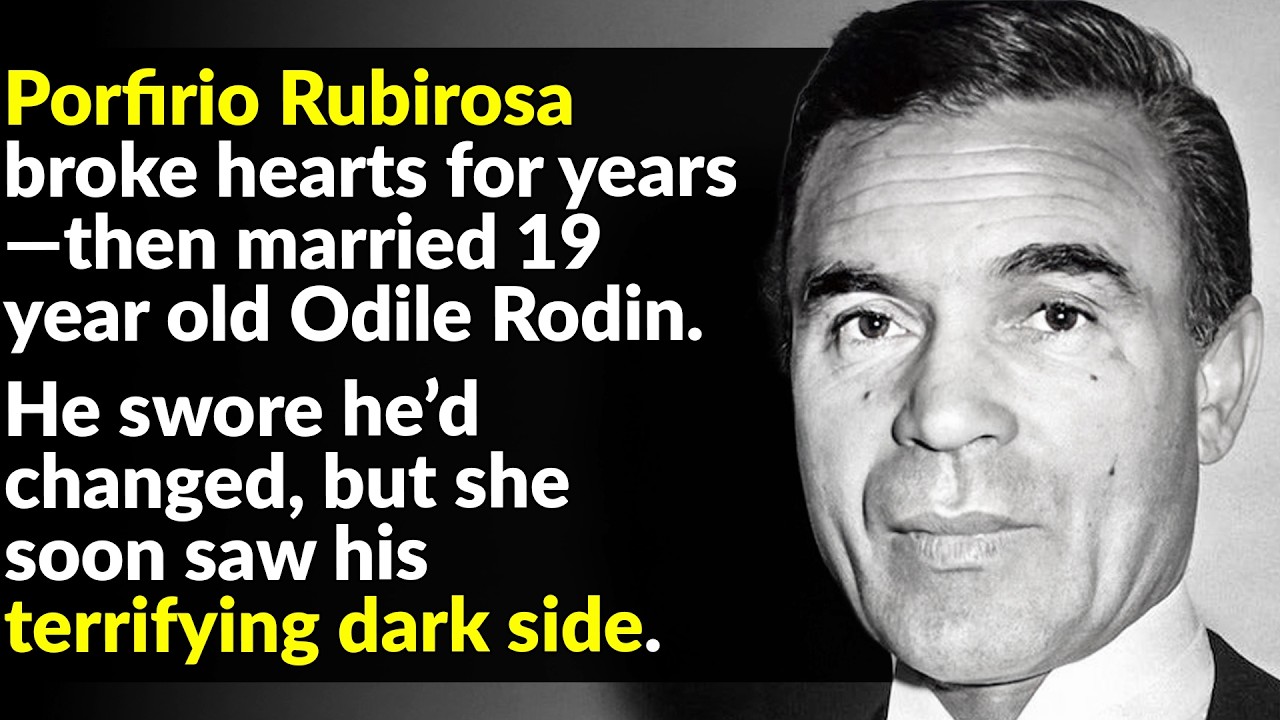
For various reasons, things with Gabor ultimately did not work out, and the two parted ways. But shortly afterward, Rubirosa met a young, ambitious French actress named Odile Rodin and fell in love with her at first sight. He later said: “I fell in love with her from the first moment I saw her. She was young, fresh, very beautiful, and possessed a mysterious charm.
”
Rodin’s mother knew all about Rubirosa’s reputation and forbade her daughter from responding to his advances. But she eventually relented after seeing the harmony between them during a quiet dance. Rubirosa was enchanted by Odile and her vitality. By his side, she greatly enjoyed staying up until the early hours of the morning.
Five months after they met, they married in October 1956. Odile soon discovered a dark side of Rubirosa that had not been visible before: just how controlling he was. He dictated his desires to her about how she should behave, from how much hairspray she used to how modest her clothing should be. At social gatherings, he watched her with intense jealousy, monitoring her every interaction.
He also moved her to the outskirts of Paris, away from the film industry, to tighten his control over her. Despite his overbearing behavior, their marriage was more stable than his previous relationships. On the surface, there was no violence or major problems. But as the years passed, things changed in his homeland.
In 1961, the Dominican dictator Rafael Trujillo was assassinated. His son, Ramfis Trujillo, took over, and he proved to be just as unstable as his father. Ramfis’s leadership was catastrophic for the Dominican Republic. He tried to do away with the Venezuelan president, caused the United States to impose an embargo on the country, and then decided to embezzle two hundred thousand dollars from the treasury and flee the country.
Eventually, a new leader came to power: the elected president Joaquín Balaguer, who quickly removed Rubirosa from his post as a Dominican diplomat. That plunged the aging playboy into immediate financial distress. By that time, many of his wealthy high-society friends had also drifted away from him, and his money worries were weighing heavily on him. Living without money was hard for a man who had been used to a life of pleasure and amusement.
Rubirosa fell into a deep depression. In 1965, Rubirosa died after his Ferrari crashed into a tree. It was never known whether the cause of his death was heavy drinking or depression. Odile later moved to Rio de Janeiro and married a Brazilian businessman.
The playboy who had spent his whole life chasing pleasure, women, and wealth had come to a sudden and lonely end, and the young actress he had once controlled and adored was left to build a new life far away from Paris and everything it had meant.