Henry Fitzroy, the illegitimate son of Henry VIII, was married to Lady Mary Howard in 1533, yet they never truly met until they lay side by side in the grave. He was the king’s unacknowledged secret, a boy raised for greatness who was never meant to wear the crown. His father showered him with titles and groomed him for glory. But fate had other plans, and those plans were cruel.
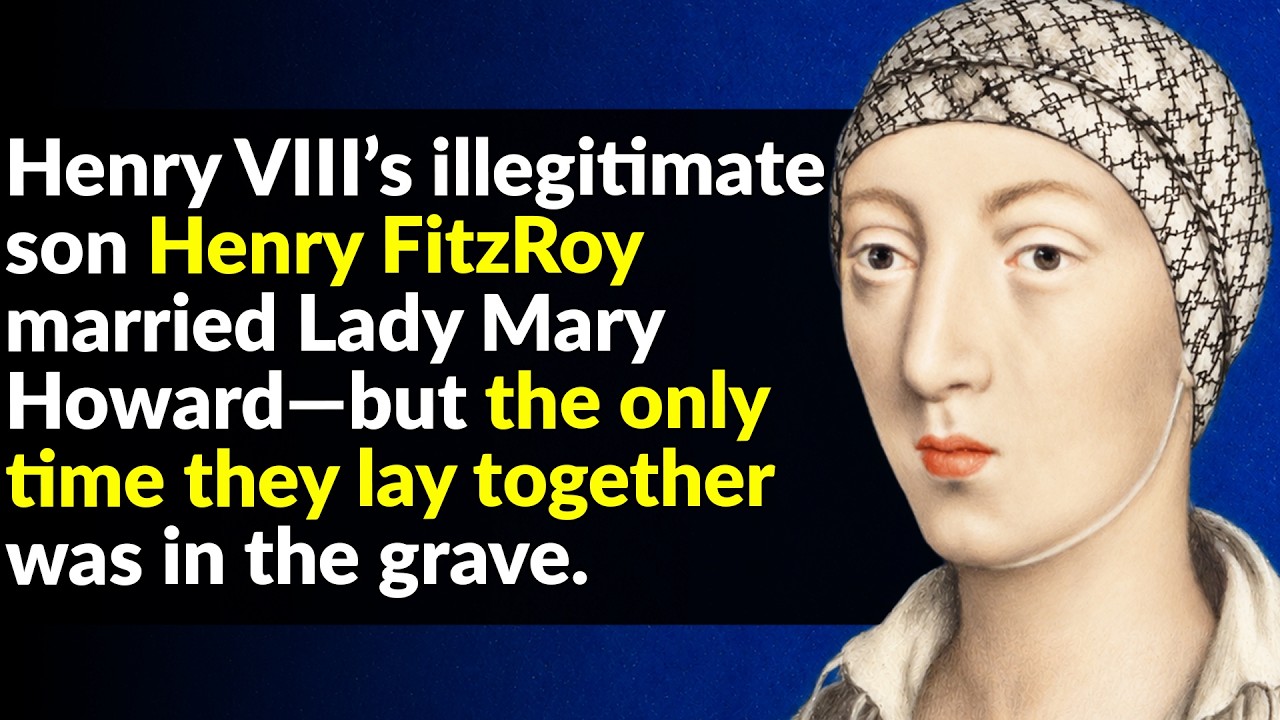
Henry VIII was accustomed to fathering children outside of marriage. Still, Henry Fitzroy would become the only illegitimate child the king ever formally acknowledged. At first, everything had to be handled with extreme care. His mother, Bessie Blount, was the king’s mistress, and she was forced to conceal his birth.
A royal mistress was hardly unusual in a sixteenth-century English court. But Bessie had chosen her moment poorly. When Queen Katherine of Aragon was pregnant and close to giving birth, Bessie was also with child. Tragically, the queen’s pregnancy ended in November 1518 with the birth of a stillborn daughter.
To avoid scandal and the queen’s fury, Bessie quietly left court and retreated to a priory, where she gave birth far from prying eyes. The secrecy surrounding the pregnancy and the remote location meant Fitzroy’s arrival went almost unrecorded in historical records. It kept him safe, but it also made pinning down his birth date nearly impossible. Most historians agree he was born around June 15, 1519, but nobody knows for certain.
The best clue comes from Cardinal Thomas Wolsey, who mysteriously vanished from court that month, only to reappear on June 29, suggesting he had slipped away to attend a secret baptism. Fitzroy was supposed to have had two godfathers at his christening. One was likely Wolsey himself; the other remains unknown. Over the centuries, historians have suggested several high-ranking men, including Henry VIII himself, even though custom would have forbidden it.
Custom never mattered much to Henry VIII. Henry Fitzroy was the younger half-brother of Mary I and the older half-brother of both Elizabeth I and Edward VI. But he was the only one who carried the surname Fitzroy, and that name said everything. Most royal surnames are attributed to royal families.
Fitzroy, however, was royal by definition. Derived from Norman French, it literally meant son of the king. It was more than a name; it was practically a title, leaving no doubt about the identity of his father. To drive the point home, Henry VIII named the boy Henry, after himself.
Legitimate or not, the name proved he was his father’s son, and Henry VIII wanted the world to know it. Despite his unofficial status and secret birth, Fitzroy was raised as a member of the royal family. A letter from a royal nurse suggests the boy spent time in the royal nursery, and after 1530, he appeared at court regularly. Regardless of how the king publicly treated his son’s legitimacy behind palace walls, Fitzroy was family.
In 1519, the three-year-old Princess Mary was Henry VIII’s only surviving legitimate child. That year, records show a reorganization of Mary’s household. Some historians believe the reorganization was no coincidence, pointing out that some of her servants became servants of Fitzroy. A surviving document from the wardrobe records, appointed to Lord Henry, reveals that someone called Lord Henry was receiving clothing and supplies from the royal wardrobe.
The use of the title Lord among the king’s inner circle suggests that those close to Henry VIII knew exactly who Fitzroy was and addressed him with the respect due to a member of the royal family. Though it’s possible some had no idea they were tending to the king’s only son. Where Fitzroy spent his earliest years remains a mystery. There is some evidence he moved between the royal court and a northern household belonging to his mother and her husband, Gilbert Tailboys, the first Baron Tailboys.
If that was true, the young Fitzroy grew up in two worlds, one royal and one rural. By 1525, Henry VIII was thirty-four, Katherine of Aragon was approaching forty, and their only surviving legitimate child was the nine-year-old Princess Mary. Henry VIII seemed unable to produce a male heir, except for Henry Fitzroy. Naturally, his illegitimate birth meant he could not become king.
Or could he? Cardinal Wolsey had been watching Fitzroy closely for years. In a letter dated June 1525, Wolsey wrote to Henry VIII about the child, calling him your beloved son, Lord Henry Fitzroy. The phrasing was unusually warm and possessive, suggesting Fitzroy might not remain illegitimate for long.
Around the time Fitzroy turned five and six, Henry VIII suffered two serious accidents that brought the succession question back to the forefront. First, a jousting accident nearly killed him. Then, in a moment of arrogant carelessness, the king tried to jump over a ditch and landed on his head in the mud, stuck there until his attendants pulled him out. These incidents made things clear.
Henry VIII needed an heir, and he had one ready. In 1525, at just six years old, Henry Fitzroy was given his own residence in London, Durham House on the Strand. For an illegitimate son, he lived an extraordinarily comfortable life. He had grand lodgings, a growing household, and every comfort a young nobleman could wish for.
It seemed the king was raising him like a prince of royal blood. Fitzroy’s official rise began in June 1525. The six-year-old was elected a Knight of the Garter, one of the highest orders of chivalry in England. Then he traveled to Bridewell Palace, where even greater honors awaited.
On June 18, 1525, Henry Fitzroy sailed by barge from Durham Place in Wolsey’s possession to Bridewell Palace. It was a grand entrance, but what followed was even grander. At Bridewell Palace, before the entire court, Henry VIII created his son Earl of Nottingham, then granted him a double dukedom, Richmond and Somerset. At only six years old, Fitzroy became the highest-ranking nobleman in England.
When Fitzroy arrived at court, the king’s most powerful nobles were waiting to serve him, while Sir Thomas More read out the new patents of nobility loudly for all to hear. But the ceremony was not finished. At Fitzroy’s investiture as duke, the entire court seemed to revolve around the small boy. Once the patent was read, Fitzroy was formally given all the insignia and honors of a duke, a very special duke.
Fitzroy’s new titles had no precedent in living memory. No illegitimate son had been elevated to the English peerage since the twelfth century. Fitzroy didn’t just match that honor; he surpassed it. Henry VIII gave him a double dukedom, something no illegitimate son had ever received.
This was more than an honorary title; it carried dynastic significance. Richmond belonged to Henry VIII himself, while Somerset belonged to John Beaufort, the first Duke of Somerset and father of Margaret Beaufort, the matriarch of the Tudor dynasty. By combining these two titles, Henry VIII linked Fitzroy directly to the Tudor and Beaufort lines. The message was unmistakable.
After his elevation, Fitzroy’s official correspondence carried a new title: the noble prince Henry, Duke of Richmond and Somerset. The choice of wording was no accident. Henry VIII wanted the world to know that Fitzroy was his son, legitimate or not, and perhaps the future king. All he needed was some land to complete these titles.
To back the titles with real wealth and influence, Henry VIII granted Henry Fitzroy a large portion of Margaret Beaufort’s estate. The lands included Henry VIII’s own inheritance as Earl of Richmond and the holdings of John Beaufort, Duke of Somerset. At only six years old, Fitzroy became one of the richest men in England. The Richmond title carried deeper meaning.
The Beaufort connection was a strategic move by Henry VIII to prove that an illegitimate branch of the family could be legitimized over time. In practical terms, Fitzroy’s titles represented a roadmap to the throne. And since titles and lands were not enough, Henry VIII gave Henry Fitzroy another valuable gift: a massive royal allowance of 4,845 pounds a year. After the ceremony, the king threw lavish banquets complete with live entertainments.
During this period, the six-year-old duke was the center of the English universe. Fitzroy’s new titles, lands, and allowance came with certain responsibilities, ones he was too young even to pronounce. His new offices included Lord High Admiral of England, President of the Council of the North, Warden of the Marches toward Scotland, and Governor of Carlisle. These positions essentially gave Fitzroy control over northern England, although in practice it was purely nominal.
After these great promotions, Fitzroy moved to Sheriff Hutton Castle in Yorkshire, where he continued to live like a prince with his own household and even a comptroller, Sir Thomas Tempest, who oversaw his affairs. Though some might have seen it as exile from court, it was in truth a carefully constructed princely court, and Fitzroy knew how to use it. From a young age, Henry Fitzroy possessed a talent for diplomacy. In February 1527, he learned from Thomas Magnus that his cousin, King James V of Scotland, wanted hunting dogs.
Fitzroy saw an opportunity to build alliances and responded to the request. He sent twenty hunting dogs and a handler across the border, winning favor with a foreign king. He was clearly skilled. In June 1529, Fitzroy was appointed Lord Lieutenant of Ireland, adding to his previous offices.
In closed sessions, there were serious discussions about making him King of Ireland. It seemed like a perfect plan, but some thought it elevated him too high. The king’s advisors worried that an independent Irish kingdom ruled by someone other than the English king could become a rival power, as had happened in Scotland. Their caution ultimately led to the Crown of Ireland Act of 1542, which permanently bound the English and Irish crowns together, preventing Henry Fitzroy from ever taking an Irish throne.
Despite Fitzroy’s advancement, Henry VIII’s succession crisis continued as he tried to annul his marriage to Katherine of Aragon. Someone suggested that Fitzroy should marry his half-sister, Princess Mary, to strengthen his claim to the throne. It’s said the Pope was willing to grant an exemption for the marriage, but the plan fell apart. Instead of his half-sister, Henry Fitzroy married Lady Mary Howard on November 28, 1533, when he was fourteen.
Mary was the only daughter of Thomas Howard, the third Duke of Norfolk. Fitzroy got along extremely well with his new brother-in-law, the poet Henry Howard, Earl of Surrey. But the marriage, for reasons never fully explained, was never consummated. As Fitzroy’s status and influence continued to grow, Parliament was working on the Second Succession Act.
This new legislation would allow Henry VIII to disinherit Elizabeth and, more importantly, give the king the power to choose his successor regardless of their bloodline. But before Parliament could finalize the details, Fitzroy ruined the entire succession plan on his own. It was clear the Second Succession Act would have allowed Fitzroy to take the throne. Yet there is no definitive proof that Henry VIII intended to declare Fitzroy his heir.
Whether he was waiting for the right moment or never planned it at all, nobody knows, and in the end it wouldn’t matter. On July 8, 1536, the imperial ambassador Eustace Chapuys sent an alarming report. He confirmed that Henry VIII had passed an act allowing him to choose his successor, but he added that Fitzroy would never benefit from it. Chapuys claimed Fitzroy was suffering from consumption and that his doctors believed him beyond hope of recovery.
The speed of Fitzroy’s decline surprised everyone. One prominent historian wrote that the duke had become ill by July 1536. But another biographer points out that records show Fitzroy was still active and seemingly in good health through April and May of that year, with no mention of illness at all. Whatever happened, it happened fast.
Despite conflicting reports, the records make clear that by July 1536, Henry Fitzroy was suffering from consumption, the broad term used at the time for tuberculosis or other serious lung diseases. Whatever illness struck him, he lived only a few more weeks. On July 23, 1536, at St. James’s Palace, Henry Fitzroy, the only acknowledged son of Henry VIII, died at just seventeen years old.
Even five centuries later, it remains hard to say exactly what killed Henry Fitzroy and robbed him of a regency throne. Records suggest consumption, but the precise diagnosis has been lost to time. Despite the suddenness of his death and the severity of his illness, no records suggest any criminal suspicion. Over the centuries, scholars have proposed every possible explanation.
Some pointed to a genetic disorder inherited from the Tudor line, while others suggested plague, but most settled on the simplest explanation: tuberculosis. However, his funeral suggested the matter might have been serious. Thomas Howard, Fitzroy’s father-in-law, ordered his body wrapped in lead and transported in a tightly sealed carriage for secret burial. But his servants had other plans.
They carried Fitzroy’s remains on a cart full of straw, followed by only two attendants at a distance. Whether because of his illegitimate blood or fear of infection from his corpse, it was certainly no funeral fit for a duke. Despite all his titles, Fitzroy’s first resting place was not beside his father’s ancestors or among kings and queens. Instead, he was buried at Thetford Priory in Norfolk, a Howard family mausoleum.
He might have rested there peacefully, but his quiet grave was about to be disturbed. In February 1540, Henry VIII launched his campaign against the monasteries. As a result, his son’s final resting place was scheduled for demolition. Thomas Howard petitioned the king directly, begging him not to close the priory church where Fitzroy and his first wife, Anne of York, were buried.
The king agreed to suspend the dissolution temporarily to allow families to move their relatives’ remains. Howard moved quickly. Before the king’s men could destroy the priory, he transferred Fitzroy’s remains to Suffolk, to a quieter, humbler final resting place, far from his father’s royal lineage. Henry Fitzroy did not remain alone in his grave forever.
When Mary Howard died in December 1557, she was buried beside him. More than two decades after their separation, the couple finally shared one grave. The great irony is that they never consummated their marriage, so it’s likely they lay side by side for the first time six feet underground. Fitzroy’s tomb stands as a testament to his dual identity.
His personal coat of arms is surrounded by the collar of the Order of the Garter and his noble motto: evil to him who thinks evil. Alongside the royal motto, the tomb also bears the Howard family emblem, a reminder that Fitzroy belonged to two great houses but was never fully part of either. In 1537, just one year after Fitzroy’s death, Jane Seymour gave Henry VIII what he had always wanted: a legitimate son. Edward VI inherited Henry VIII’s throne in 1547.
But if Fitzroy had lived, things might have gone very differently. He had his father’s affection and, thanks to the Second Succession Act, a legal path to the throne of England. For a brief moment, everything seemed to be in his favor: titles, influence, power.
But history, as it often does, had other plans.