When the Australians finally entered Rabaul in September 1945, they were prepared for the worst. They expected to find thousands of their own prisoners of war inside the largest Japanese base in the South Pacific, men who had been missing since the fall of Singapore in February 1942. Instead, they found 26 Europeans. That discovery set off a months-long investigation that eventually uncovered one of the war’s most devastating maritime tragedies.
A typed shipping manifest, found in a filing cabinet in Japan, revealed the fate of the missing men: they had been aboard the Montevideo Maru, torpedoed by an American submarine off the Philippines in July 1942. Not one prisoner survived. The ship’s wreck was only located on the seafloor off Luzon in 2023. Rabaul had been an Australian territory since 1914, lost to the Japanese in just five days in January 1942.
What the Japanese built there afterward became the anchor of their entire southern position—five airfields, a fleet anchorage, repair shops, and headquarters for both an area army and a fleet. Every push toward Guadalcanal and every reinforcement sent to New Guinea passed through it. The Allies spent two years trying to take it, then decided not to. At the Quebec Conference in August 1943, military chiefs calculated that an assault would cost more in divisions, shipping, and landing craft than it was worth.
The plan became isolation: seize airfields within fighter range, bomb the base into uselessness, and let it rot in place. The bombing was thorough. Allied squadrons flew 29,354 sorties against Rabaul and dropped 20,967 tons of bombs. The Japanese air garrison was wrecked by early 1944, and surviving aircraft flew out in February.
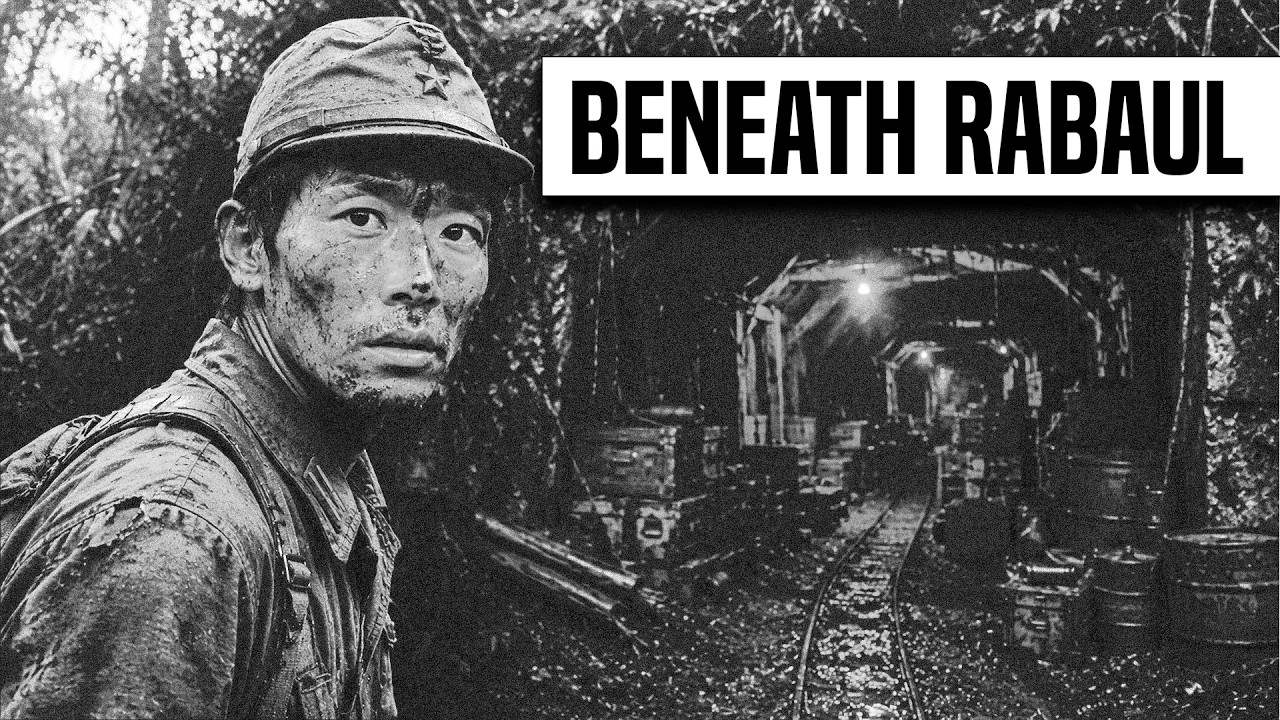
From that point, the largest Japanese base in the region had no aircraft, no warships, and no shipping worth the name. What it still had was about 90,000 men. The garrison’s commanders, General Hitoshi Imamura and Vice Admiral Jinichi Kusaka, responded by going underground. By the end of the war, Japanese forces had dug or improved more than 350 miles of tunnels and caves in the volcanic rock around Simpson Harbor.
Hospitals, workshops, ammunition, rice, fuel, and spare parts all went underground. Barges floated in tunnels driven into the shore, invisible from the air. Much of the digging fell to prisoners and laborers brought from Malaya, Singapore, China, Korea, and Indonesia. Many died at it.
The Japanese solved their food problem themselves, planting gardens across the Gazelle Peninsula and even bombing schools of fish from the air after their trawlers were sunk. By 1945, the garrison was feeding itself and arming itself, manufacturing explosives, mortars, flamethrowers, and anti-tank mines. The blockade that was supposed to starve the garrison actually worked in its favor. Stores meant for Japanese garrisons farther north never left Rabaul; the men at Rabaul ate the rations and used the equipment meant for men dying of hunger hundreds of miles away.
The ground war in New Britain had passed to Australia by November 1944. The 5th Australian Division came ashore at Jacquinot Bay, and the plan was containment—patrols pushed up both coasts and closed the neck of the Gazelle Peninsula. Allied intelligence put Japanese strength on New Britain at 38,000. The true figure was around 93,000, almost all inside the pocket the Australians were watching.
That gap between guess and truth explains why no one could answer the question the public at home cared about: what had happened to the men of Lark Force and other units captured at Rabaul in 1942? Letters had come out once in 1942, a few censored lines each. After that, nothing. Tokyo told the Red Cross early in 1945 that everything that could be passed on already had been.
The surrender came as a sequence of signals rather than a battle. The last Allied air strike on Rabaul went in on August 8, 1945. The emperor’s broadcast came on August 15. The general surrender was signed in Tokyo Bay on September 2.
Four days later, aboard the British carrier Glory, Imamura signed the local instrument of surrender for Rabaul, with Kusaka adding his name for the Southeast Area Fleet and Lieutenant General Vernon Sturdee accepting for the Allies. The instrument covered New Britain, New Ireland, Bougainville, New Guinea, and surrounding islands, listing 139,000 Japanese personnel. Then the Australians started counting, and the first thing the arithmetic showed was that the garrison had never been defeated in any military sense. Of 367 anti-aircraft guns, bombing had destroyed 93.
Of 43 coast defense guns, one. Of thousands of infantry weapons, none at all. Allied aircraft had rarely gone after the ground and beach defenses, and what sat hidden in the caves stayed there. Twenty thousand tons of bombs killed something on the order of 10,000 men, mostly through the wrecking of airfields, shipping, and supply dumps in the open.
The men themselves were in the ground, armed, fed, and—by the summer of 1945—hoping someone would come ashore and give them a fight. No landing was ever made against them. When the Australians did arrive, the numbers of Asian prisoners astonished them. The largest single group, by a wide margin, were 5,589 Indian Army soldiers who came out of the camps in the first fortnight.
They had fallen at Singapore and were at Rabaul because they had refused to join the Japanese-sponsored Indian National Army. The pressure to defect never stopped. One party, ordered to parade on arrival in New Britain to declare for the pro-Japanese force, declined as a body. Guards beat one of the officers, Captain Sadiq Ali of the Madras Regiment, who called out that it was better to die than serve.
They hauled out a lance naik at random, stood him by a trench with a sword at his neck, then put an unloaded pistol to his chest and pulled the trigger. The detachment still declined. In May 1945, men of the 20th Indian Working Party were ordered to wear Japanese badges. Their officers pulled the badges off and threw them on the ground.
A Japanese sergeant major struck them and later went to prison. The administrative instruction written in Australia ten months earlier now applied: clerks documented the men, quartermasters issued uniforms and white muslin for turbans, and paymasters opened paybooks. Indian contact teams came forward to take the men on. But the liberation was not uniformly kind.
John Crasta, an Indian survivor who wrote a memoir, described Australian soldiers eating with the liberated men, ignoring all conventions about rank. He also described British recovery officers, watching for men who might have gone over to the Indian National Army, making them build their own huts as they had under the Japanese, holding back the first payment, and stripping away much of what the Australian staff had offered. Across the same week, other camps came open. On September 13, troops and Red Cross officials reached the internment camp at Rabaul, where about 850 civilians had spent three and a half years behind wire.
Chinese prisoners of war brought down from Singapore came to 1,397 in number, with about the same number again among Malaysians and Indonesians. The trials began soon after. The first Australian war crimes trial opened on November 30, 1945, and over the following five years, Australian military courts tried 814 defendants in 310 trials, a large share at Rabaul. Charges ranged from ill-treatment of Indian prisoners to torture of missionaries and the killing of Chinese civilians on New Ireland.
Imamura himself was held at Rabaul, asked for his own trial to be brought forward so the cases against his subordinates could proceed, and was sentenced to ten years. The Japanese compounds emptied as shipping became available. Indian camps took longer to clear because the men had to go north and west. One photograph from September 17, 1945, shows Indian soldiers sitting on the ground in groups because standing was beyond some of them; a medical officer described carrying men out to a jeep two at a time on his hands, finding that they took up no space at all.
At one camp, men who had spent three and a half years on cassava and beatings put up a guard hut and a flagpole, with whitewash stones arranged to spell out the name of the battalion they had belonged to on the day Singapore fell. It said: “First Hyderabad. ”
The counting that week settled the question that had been open since the guessing started. The Japanese demobilization bureau later put the final figures at roughly 57,500 army and just under 31,000 navy personnel in the Bismarcks at the end.
Rabaul was the only Japanese command in the Pacific for which Tokyo had to find no money at all after the war, because the men there were still feeding themselves. The argument about who exactly was aboard the Montevideo Maru has run for eighty years and continues today. It is the part of the war that takes the longest to put together, because it sits in manifests, camp returns, pay instructions, and the spelling of names.