In the fall of 1941, Washington was a city bracing for war. The United States had not yet entered the conflict, but the capital was already flooded with military contractors, intelligence operatives, and ambitious politicians.
It was the perfect environment for a woman like Inga Arvad. She was a Danish journalist with a remarkable past. She had interviewed Adolf Hitler, attended the 1936 Berlin Olympics in his private VIP box, and fled Germany after the Gestapo tried to recruit her as an informant.
She arrived in Washington with a new identity as a columnist for the Washington Times Herald. Her job was to profile the city’s power brokers. She was good at it. Her charm, European sophistication, and sharp intellect opened doors that male reporters could not access.
Through her roommate, Kathleen Kennedy, she was introduced to the Kennedy family. Kathleen, known as Kick, was the daughter of Joseph P. Kennedy Sr., the former ambassador to the United Kingdom. She introduced Inga to her older brother, John F. Kennedy.
Jack, as he was known, was 24 years old. He was serving as an ensign in the Office of Naval Intelligence. He was not the golden heir of the Kennedy dynasty. That role belonged to his older brother, Joe Jr. Jack was the spare, a physically frail second son with a sharp, cynical mind.
The attraction between Jack and Inga was immediate. She was four years older, intellectually hardened, and entirely unimpressed by his family’s wealth. She had sat across from Hitler. She had navigated the deadly politics of Berlin. She was unlike any woman he had met.
For Inga, Jack was a fascinating contradiction. He appeared to be a wealthy playboy, but in conversation, she recognized a deep, unshaped ambition. She did not treat him like a fragile younger brother. She spoke to him as an equal.
Their relationship escalated quickly into an intense covert affair. Inga offered Jack a sanctuary from the crushing pressure of his family. He could drop his cynical facade with her. She, in turn, found a partner who matched her intellectual pace.
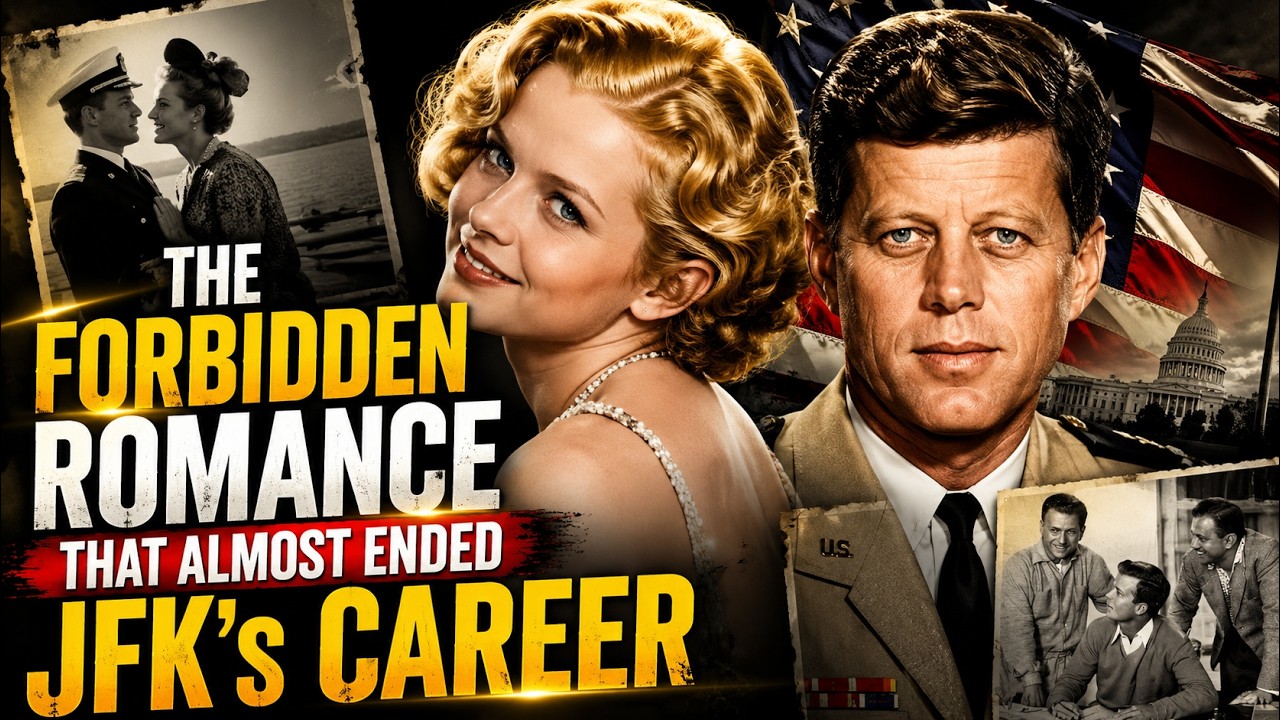
But the security risks were astronomical. It was late 1941. The military was on high alert. Jack was an active duty intelligence officer with access to classified data about American and British naval deployments. Inga was a foreign national with a documented history of close access to Nazi leadership.
By every standard of counterintelligence, Inga Arvad was a massive red flag. Jack ignored the calculus. They believed they were smart enough to keep the affair hidden. They were wrong.
The FBI was already watching. J. Edgar Hoover did not believe in coincidences. When rumors about Inga’s past began circulating in Washington, she made a fateful decision. She walked into FBI headquarters with the 1936 Olympic photograph, hoping to clear her name.
It was the worst decision of her life. Hoover did not see an innocent journalist. He saw a suspected Nazi agent with access to a naval intelligence officer. He classified Inga Arvad as a suspected espionage agent.
Hoover did not order an arrest. He ordered total surveillance. FBI agents tailed her through Washington. They intercepted her mail. They tapped her phones. Then they crossed a definitive line.
Agents broke into her apartment and planted a listening device inside her mattress. Every private moment between Jack and Inga was recorded. The FBI compiled a dossier that swelled to over 1,200 pages.
The transcripts captured everything. Jack’s childish nickname for her, Ingabinga. Their arguments about marriage. And classified information about American fleet movements that Jack carelessly let slip.
Hoover now had the ultimate weapon. He briefed President Franklin D. Roosevelt directly. Then, in January 1942, he dropped the intelligence on the Navy.

The reaction was panicked. Standard protocol called for a court martial. But this was the son of Joseph P. Kennedy Sr. The Navy brass opted for a quiet bureaucratic decapitation.
Jack’s security clearance was revoked. He was transferred to a desk job in Charleston, South Carolina. He was ordered not to travel more than 30 miles from the base.
The Navy underestimated Inga’s resolve. She followed Jack to Charleston. They met at hotels, played golf, and attended church. They believed they had outrun the scrutiny.
They were wrong. FBI agents followed her train. They planted listening devices in the hotel rooms. The surveillance continued.
Hoover then took the evidence to the one person capable of breaking the relationship: Joseph P. Kennedy Sr. The patriarch was furious. He gave Jack an ultimatum. Sever all contact with Inga or face complete financial and familial excommunication.
Joe Sr. did not stop there. He used his political leverage to have Jack shipped out to the Pacific theater. You cannot conduct a weekend affair when one partner is deployed to an active combat zone.
Jack capitulated. He broke off the relationship in March 1942. He understood exactly what had happened. He told a confidant, “They shipped me out of town to break us up.”
Inga was left alone. She was never arrested, indicted, or charged with any crime. The government simply crushed her personal life and discarded her.

She retreated from Washington. In 1946, she married Tim McCoy, a former Hollywood western star. They moved to a quiet ranch in Arizona. She stopped writing. She focused on raising her family.
But the past never fully released her. Jack Kennedy went on to become a war hero, a senator, and eventually president. He married Jacqueline Bouvier. Yet even in the Oval Office, he would occasionally ask mutual acquaintances a quiet question: “How is Inga doing?”
He never contacted her. The security risks were too great. But he never forgot the woman who first listened to his ambitions.
Inga died in 1973 at the age of 60. She took most of her secrets to the grave. But before she died, she shared one final revelation with her eldest son, Ronald.
She told him that Tim McCoy might not be his biological father. She said his real father could very well be John F. Kennedy. She imposed a strict gag order, forbidding him from ever discussing it publicly.
The revelation adds a haunting layer to the story. But the true legacy of Inga Arvad is political. When Kennedy became president, he appointed his brother Robert as attorney general. The Kennedys despised J. Edgar Hoover. They had the authority to fire him.
They never did. Hoover still possessed the 1,200-page dossier. He had the audio recordings of the president discussing classified intelligence in bed with a suspected Nazi spy. The file functioned as invisible handcuffs on the commander-in-chief.
Hoover did not need to threaten openly. The mere existence of the tapes ensured mutual destruction. The woman who wanted to write history ended up becoming the hidden leverage that controlled it.