In October 1942, a Japanese infantryman lay in the tall grass on a ridge overlooking the airfield at Guadalcanal, watching smoke clear after an air raid. The runway below had been built by his own army, carved out of the jungle by Japanese engineers and Korean laborers using shovels, hand carts, and a few machines. Then the Americans seized it before a single Japanese plane could take off, and the campaign for the island turned into a prolonged battle to win it back. For weeks, Japanese bombers had struck the airstrip almost daily.
Naval guns shelled it at night with such intensity that the men who lived through it would talk about it for the rest of their lives. The strategy was simple: if you cannot retake the airfield immediately, disable it. Blow craters in the runway so American planes cannot take off. The soldier on the ridge had watched the bombs fall.
He saw fountains of dirt and coral rise along the strip. He knew exactly what a large bomb crater looked like, having helped dig craters of that size himself. What he witnessed in the next hour was something his experience could not explain. Machines came out onto the runway.
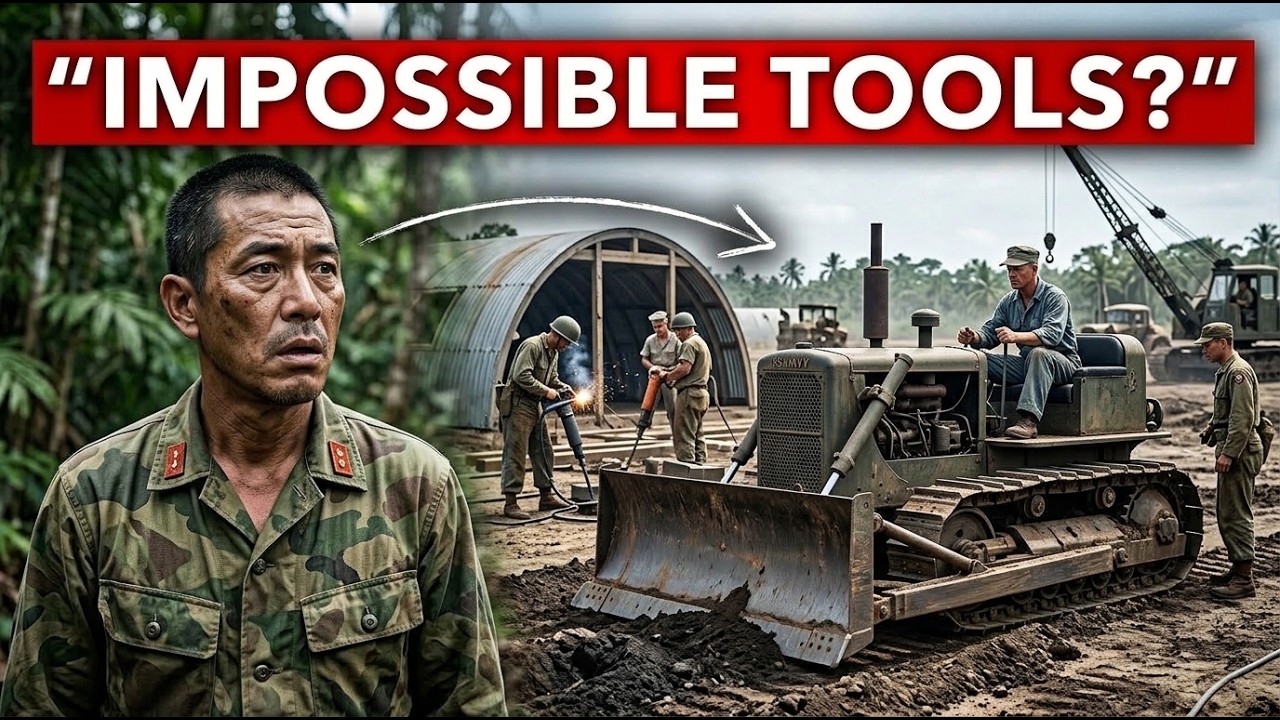
Not men with shovels, but machines. A bulldozer pushed a pile of crushed coral into the first crater. Dump trucks unloaded more behind it. Men with compaction equipment and rollers leveled the surface.
Steel matting was dragged over it. Within a short time, the craters were gone. Shortly afterward, an American fighter took off from the runway his side had just bombed. These men were called Seabees.
Japanese troops who faced them across the Pacific, at Guadalcanal, the Solomons, the Marianas, Iwo Jima, and Okinawa, generally did not know the name, but they noticed the work. Their reports and their commanders’ records expressed the same astonishment over and over. Several remarkable observations stand out. The first strange thing about the Seabees was who they were.
Armies are supposed to be young, made up of men in their late teens and early twenties who can march, carry, and endure. The Seabees reversed that. When the U. S.
Navy formed its Construction Battalions in early 1942, it did not want young recruits. It wanted skilled craftsmen, and skilled craftsmen are almost by definition older men. The Navy recruited heavily from the civilian construction industry. Heavy equipment operators, welders, electricians, carpenters, pipefitters, riggers, and surveyors, men who had built roads, dams, bridges, and skyscrapers across America during the 1930s, joined the first battalions.
Many were in their thirties and forties. Some were over fifty. Age requirements were waived for men whose skills were valuable enough. Many were given ranks and pay reflecting their actual professions rather than starting over as new enlistees.
More than 300,000 men served in Seabee battalions during the war. For the Japanese soldier, this was genuinely strange. When Japanese forces encountered, captured, or examined dead Seabees, they found middle-aged men with calloused hands and the confidence of foremen, not the young draftees they had been trained to expect. What they were looking at was not a new type of soldier.
It was American civilian industry wearing a uniform and shipped to the Pacific with its tools. The second observation was that these older men carried rifles and used them. The Seabee motto was “We build, we fight. ” Their insignia was a bee wearing a sailor hat, holding a tommy gun in one hand and tools in the others.
It sounds like a recruiting slogan, and it was. But it was also a literal description of their situation. Construction in the Pacific War took place on islands where the fighting had not ended. Seabees often landed on the beach with or shortly after the assault troops.
They built on ground where Japanese snipers were still active, where infiltrators crossed the water at night, and where air raids came daily. So they defended their own work. They took perimeter guard duty, stood watch shifts, dug foxholes next to their machines, and on more than one occasion fought off Japanese attacks while construction continued. The third thing was the machine itself.
The bulldozer was the signature piece of Seabee engineering, and it was something Japan barely possessed. The Japanese army built its Pacific airfields and fortifications largely by hand, using enormous numbers of laborers, often forced Korean or local workers, with picks, shovels, baskets, and hand carts, supported by a limited number of trucks and rollers. That approach could build an airfield, and it did. But it took far longer and required far more people.
The Americans came ashore with hundreds of bulldozers, and these machines proved useful for far more than leveling runways. A bulldozer could clear a beach of obstacles so landing craft could get through. It could carve a road up a slope within hours. It could dig or fill an anti-tank ditch.
It could pull a stuck vehicle out of the sand. And in the brutal logic of island warfare, it could seal a Japanese fortification. A bulldozer blade could push soil and rubble over a firing slit or cave entrance, sealing it completely. Some bulldozers were fitted with improvised armor so their operators could do this work under fire.
It was among the most dangerous jobs on any island, and the men doing it sat exposed on the machine seat in a way no tank crewman was. Japanese defenders who had prepared their positions expecting infantry combat and perhaps tanks found themselves facing a construction machine that simply buried the problem. Several Japanese accounts described this with something close to horror. Not because the machines were monstrous, but because they represented a kind of warfare the defenders had never imagined and had no answer for.
The fourth thing was what had happened on the Guadalcanal runway. The Japanese approach to American airfields was denial through bombing. You create craters in the runway, and as long as those craters remain, planes cannot use it. Every bomber mission was measured by how long it kept the enemy grounded.
At Guadalcanal in the fall of 1942, the Seabees, who had arrived to maintain and expand the airfield, turned that calculation into a losing equation for the Japanese. They prepared everything they needed in advance. Piles of crushed coral sat beside the runway. Trucks were loaded and waiting.
Bulldozers and rollers were positioned so they could reach any part of the strip. Rolls and stacks of steel landing mat, interlocking perforated steel plates fitted together like a giant jigsaw puzzle, were ready for repaving. When the raid ended, the crews moved before the dust settled. They filled the crater, compacted it, re-laid the matting, and left the runway.
Accounts from the period describe large bomb craters being filled and the field made serviceable in under an hour, with the airfield regularly returning to operation while the Japanese bomber crews were still on their way home. Nighttime naval bombardment caused greater damage, sometimes far greater, and repair crews worked through the night to have the field ready by morning. This was the essence of the fourth strange thing, and its consequences extended beyond a single island. If you cannot keep the airfield closed, you cannot deny it to the enemy.
If you cannot deny it, it becomes a permanent threat. The Guadalcanal airfield remained in American hands, and the planes launched from it choked off Japanese supply operations to the island until Japanese command finally abandoned it. The soldier on the ridge was watching the reason his army would eventually have to leave. The fifth thing was a piece of equipment that at first glance seemed completely worthless.
A hollow steel box, roughly five by five by seven feet, sealed by welding. That was all there was to it. They were called pontoon barges, and they were among the most versatile tools the Americans brought to the Pacific. The design was developed by a civilian naval engineer before the war.
The boxes could be linked together in rows using iron corner fittings, and depending on how many were used and how they were connected, they could become almost anything that floated. Connected end to end, they formed a pontoon causeway, a floating road from the landing craft across the reef to the beach, letting vehicles reach dry land where the water was too shallow for ships. Connected in a flat rectangle with an outboard propulsion unit, they became a barge that could carry trucks, supplies, or ammunition. Connected in larger formations, they could build a floating pier, a floating crane platform, or even a small floating dry dock.
Seabees carried them everywhere and assembled them to meet the needs of each island. For Japanese defenders who had chosen their beaches precisely because the reefs made landing difficult, this was a deeply confusing development. The reef had been a wall. The Americans were now carrying a bridge across it in sections, like a child’s building toy, and assembling it on the same day.
The sixth thing was what the Seabees did with the islands themselves. Many Pacific islands consist primarily of coral, and crushed coral, when wet and compacted, hardens into astonishingly solid ground. The Seabees quarried it, crushed it, spread it, watered it, often with seawater, and rolled it flat. The result was a surface capable of bearing the weight of heavy aircraft.
They had turned the island into its own runway. This became the standard method across the Central Pacific. Where the Japanese needed to import materials and move them by hand, the Americans found that the ground beneath their feet was construction material, and they had the machines to process it on an industrial scale. The largest example came near the end of the campaign on Tinian in the Marianas.
After the island was captured in the summer of 1944, Seabee battalions built what became, for a time, one of the largest airfield complexes in the world. North Field had multiple runways, each more than a mile and a half long, designed to accommodate the enormous B-29 bombers. The island was reshaped so completely that parts of its road network were planned and named after Manhattan streets. The scale of that operation is worth pausing on, because the phrase “crushed coral” hides a major industrial process.
Quarries had to be opened. Rock crushers, heavy machines shipped across the ocean in pieces, had to be assembled and kept running around the clock. Fleets of trucks moved the crushed material. Water distributors moistened it.
Graders spread it. Rollers compacted it layer by layer until the surface was hard enough to take the weight of a four-engine bomber landing at speed. Every step required a machine, and every machine required fuel, spare parts, and an operator who knew how to keep it running in the heat, dust, and salt air. The Seabees had all of that.
The Japanese garrisons they replaced mostly had shovels. The seventh thing, which connected all the others, was scale. Japanese troops on isolated islands watched the Americans build not just airfields but entire bases with astonishing speed. Fuel tank farms, piers and harbors, warehouses, water distillation plants, power stations, hospitals with hundreds of beds, roads, and housing for tens of thousands of men.
Much of that housing came in the form of prefabricated steel buildings called Quonset huts, half-cylinders of corrugated steel over a framework of steel ribs, shipped as a kit and bolted together on site by a small crew within hours. More than 100,000 of them were produced during the war. The tally the Navy later compiled of what Seabee engineers built during the war reads like a statistical summary of a small country. More than 100 major airfields, hundreds of piers, thousands of ammunition magazines, warehouses covering hundreds of city blocks, fuel storage for nearly 100 million gallons, hospitals for tens of thousands of patients, and housing for more than a million men.
For a Japanese garrison told that the war would be won by the superior spirit of its soldiers, watching an island that had been jungle a few months earlier turn into a lit, paved, bustling base, with runways launching planes against the next island in the chain, was an argument no amount of morale could answer. The point is what the Seabees actually were and why it mattered. Japanese engineers were not incompetent, and Japanese labor achieved remarkable things with very limited resources. The airfield the Americans captured at Guadalcanal was a real airfield built under difficult conditions.
The tunnel networks at Iwo Jima and Okinawa were engineering feats of excavation, carried out largely by hand, and they cost the Americans heavily to overcome. Much of the Japanese construction effort in the Pacific relied on forced labor, Korean and local workers pressed into service under brutal conditions, a part of the real history of how that construction happened that should not be overlooked. The difference between the two sides was not effort. It was machines and the men who knew how to use them.
The United States had spent the 1930s building dams, highways, and bridges on a massive scale, much of it through public works programs during the Depression. That process created an enormous workforce of skilled heavy equipment operators, welders, riggers, and engineers, along with an industry that produced the machines they operated. When war came, the Navy enlisted that workforce, put it in uniform, gave it machines, and sent it across the Pacific. In other words, the Seabees were the American construction industry at war.
And the Pacific War, at its core, was a war about airfields. Every island that mattered mattered because of what could fly from it. The side that could build airfields faster, repair them faster, and extend them farther would control the air. And the side that controlled the air would win.
That is why the soldier on the ridge above Guadalcanal was watching something more important than he realized. He thought he was watching men fill a hole. In fact, he was watching the reason the island would be lost, and then the next one, and then the next.