On the corner of Baltimore Street and Gettysburg stands a quiet brick house with a blue door. Most visitors pass it without realizing they are looking at a place connected to one of the most revealing civilian stories of the Civil War. Gettysburg is often remembered through generals, battle maps, and famous speeches. Cannon smoke across Pennsylvania fields, soldiers charging through gunfire.
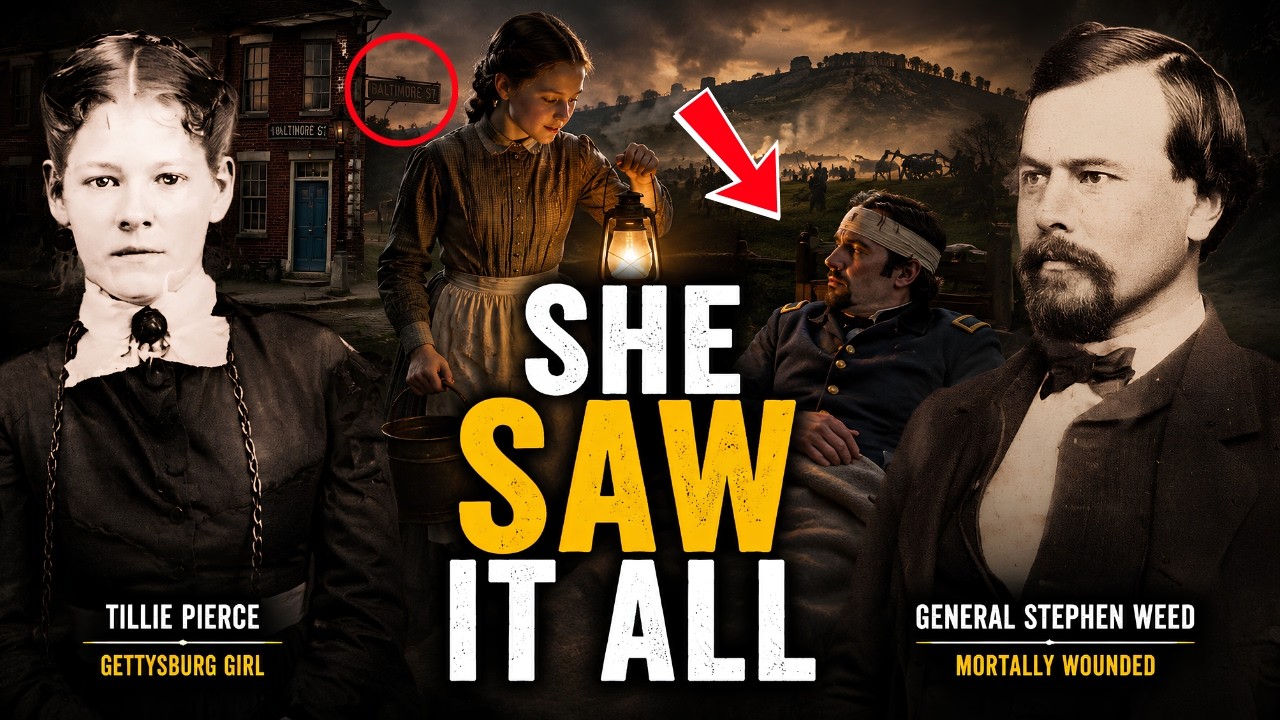
But history often leaves out another battlefield entirely: the civilians. Among them was a 15-year-old girl named Tilly Pierce. She carried no rifle and commanded no troops. Yet what she witnessed during the Battle of Gettysburg became one of the most haunting and historically valuable civilian accounts of the Civil War.
By the summer of 1863, Gettysburg remained a modest Pennsylvania town. The Pierce family lived there in a brick house built decades earlier. Tilly’s father, James Pierce, worked as a butcher and held a respected place in the community. For two years, the Civil War had devastated other regions.
Then suddenly, it was coming north. Confederate forces moved into Pennsylvania. Soldiers appeared along roads and hillsides. Still, many residents struggled to believe Gettysburg itself would become the center of something enormous.
Then came July 1st, 1863. Tilly awoke to distant cannon fire. By afternoon, that distant sound had become impossible to ignore. Union and Confederate armies collided west of town as General Robert E.
Lee’s invasion met fierce resistance. Streets filled with frightened civilians and retreating soldiers. Wounded men stumbled past homes exhausted and bleeding. Gettysburg had become a battlefield.
Tilly’s family faced a desperate choice. Believing town would soon become unsafe, they arranged for her to leave with neighbors and travel south toward the farm of Jacob Weikert near Little Round Top. The decision made sense. A farm outside town sounded safer than streets filling with soldiers.
Tilly later remembered the urgency of departure. “We were in great danger,” she wrote, “so they hurried, almost running. ” As she left town, she passed scenes that shattered ordinary life: limping men, improvised bandages, stretchers carrying the wounded. The Weikert farm stood near the Round Tops along the Taneytown Road, a route that soon became vital to Union operations.
At first, it appeared peaceful. Then, by July 2nd, the landscape transformed. Heavy artillery rolled across fields. Ammunition wagons crowded roads.
Endless columns of Union soldiers marched toward fierce fighting. Tilly watched regiment after regiment pass. Some looked like fathers. Others barely older than boys.
Many hid fear behind conversation or humor. Others marched in silence. Then the wounded began arriving. The farm ceased to be a refuge.
It became a hospital. Like many buildings surrounding Gettysburg, the Weikert house and grounds overflowed with casualties. Men covered porches and floors. Others lay outside because there was nowhere else to place them.
The sounds were relentless: groaning, praying, calling out, and sometimes screaming. Tilly had never encountered suffering on this scale. But instead of retreating, she stepped toward it. She grabbed buckets and carried water again and again.
Dust, blood loss, and summer heat made water relief beyond words. Men thanked her before being carried toward surgeons. Others stared silently, already sensing what awaited them. Then she saw surgery.
Civil War medicine operated under brutal conditions. Gettysburg produced more wounded than medical systems could manage. Surgeons worked rapidly with limited supplies and little rest. Tilly watched as shattered limbs forced terrible decisions.
Amputations became common. Blood stained clothing and floors. The smell of gunpowder mixed with sweat and injury. Outside, amputated limbs accumulated in piles later described with horror.
And Tilly stayed. While armies fought for position, another struggle unfolded among civilians suddenly forced into caregiving. Tilly carried water. She comforted soldiers.
She listened, and sometimes remained beside men who feared dying alone. One wounded officer especially affected her. General Stephen Weed had been mortally wounded near Little Round Top and brought toward medical care. Tilly later recalled sitting beside dying soldiers, holding light and offering comfort during their final hours.
Elsewhere, men called for mothers, for wives, for home. At least one asked her to sing. And so, amid blood, smoke, and suffering, a teenage girl sang hymns to wounded strangers. For three days, July 1st through July 3rd, Gettysburg endured one of the bloodiest battles in American history.
More than 50,000 casualties. Artillery shook the ground. Fighting surged around Little Round Top. Then came Pickett’s Charge.
Thousands advanced across open ground under devastating fire, and afterward even more wounded flooded hospitals already overwhelmed. When guns finally fell silent on July 4th, relief did not immediately follow. Instead came a terrible stillness. Gettysburg became one vast hospital.
Homes, churches, and barns filled with wounded men. The Pierce family home, like many others, became tied to recovery and death. The landscape carried visible scars: broken fences, damaged orchards, shattered trees. Beneath the July heat lay another crisis: the dead.
More than 7,000 soldiers had been killed. Burial crews worked continuously. Many graves were hurried and temporary. Identification often failed, leaving families searching for certainty that never came.
Tilly later remembered how Gettysburg changed after darkness. Lanterns glowed where wounded men struggled through the night. Voices drifted through crowded rooms. Fevered whispers filled the air.
Many cried out in their sleep, calling for home. The battle had ended, but in Gettysburg, its suffering lingered. The town itself grew quieter. People spoke softly.
Children laughed less. Not because Gettysburg had died, but because innocence had been interrupted. Months later, in November 1863, President Abraham Lincoln arrived to dedicate the Soldiers’ National Cemetery. His address would become immortal.
But for residents like Tilly, remembrance required no speech to explain it. They had already walked through hospitals, seen shattered families, heard final prayers. Lincoln gave language to sacrifice. Gettysburg’s civilians had already lived beside it.
Years passed. Tilly married and became Tillie Pierce Alleman. Many survivors tried to forget. She chose another path.
In 1889, 26 years after the battle, she published her memoir, “At Gettysburg, What a Girl Saw and Heard of the Battle. ”
Tilly did not write as a general or politician. She wrote as someone who had stood among the wounded. Her pages preserved details official records often missed: fear, kindness, chaos, and the emotional cost carried by civilians trapped inside catastrophe.
She did not glorify suffering. She described it. Some historians regard Gettysburg as the turning point of the Civil War. Strategically, they may be right.
But Tilly Pierce reminds us of another turning point often overlooked: the moment war stops being distant, the moment it enters homes, fields, and ordinary lives. Tilly lived until 1914, long after Gettysburg became a place of monuments and remembrance. But the girl who carried water never disappeared from her story. Today, her house still stands.
Visitors enter searching for history. And history is certainly there—not simply in legends or ghost stories, but in something more enduring. A reminder that behind every battlefield statistic stood frightened young men and overwhelmed civilians doing what they could inside circumstances they never chose. Tilly Pierce did not become unforgettable through rank or power.
She became unforgettable because she witnessed honestly. At 15 years old, she saw war without illusion. And decades later, she made sure we could see it, too.