It was just before six in the evening on January 5, 1757, when a man who did not belong at the Palace of Versailles managed to approach King Louis XV of France and drive a small knife into his side. The wound was superficial. The king’s thick winter coat and vest had absorbed most of the blow, and the 47-year-old monarch remained standing, reportedly saying calmly, “I have been wounded. ”
The attacker was seized by guards, but the king ordered that he not be killed and that he be questioned instead.
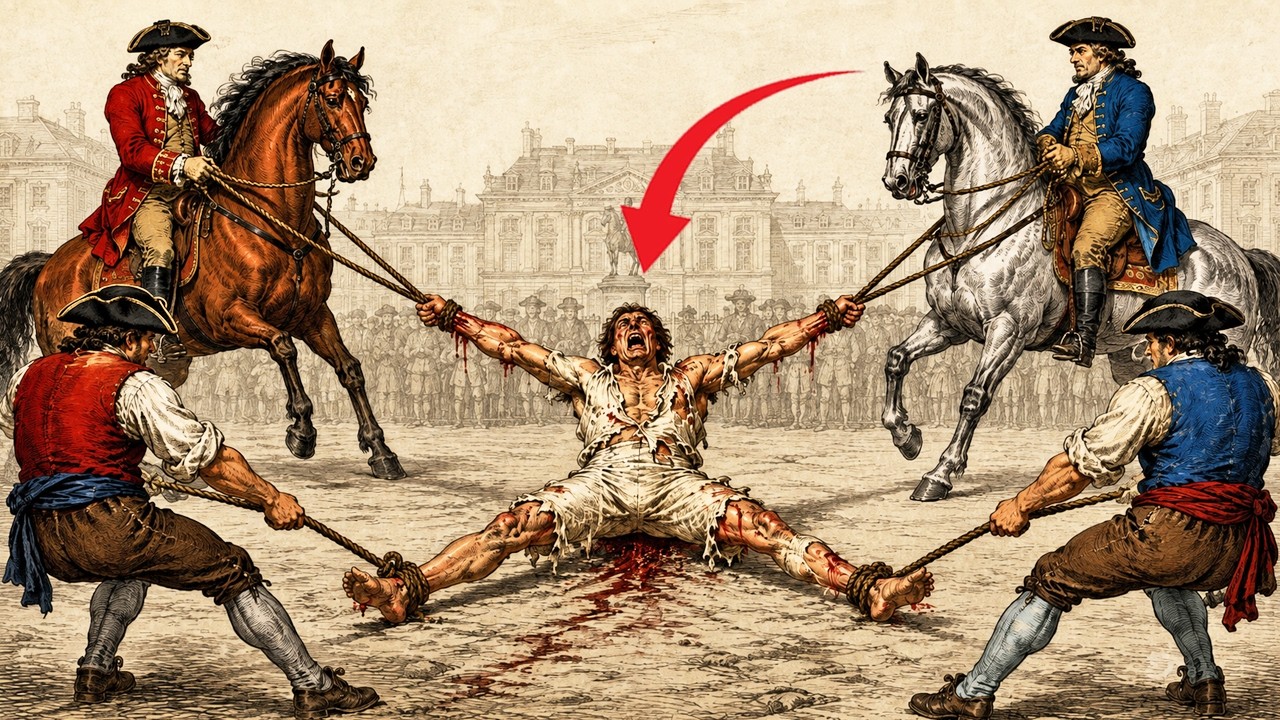
That single order set in motion one of the most brutal and elaborate legal executions in French history. The man was Robert-François Damiens, a 42-year-old former domestic servant from a poor farming family near Arras in northern France. Described by contemporaries as erratic, quarrelsome, and prone to being dismissed from posts, he had worked in households, for the Jesuits, and for lawyers in Paris. Taken to the Conciergerie prison in Paris, Damiens was held in chains and interrogated for weeks.
Judges from the Parlement of Paris, the city’s highest court, subjected him to judicial torture, including having his feet placed in heated irons, while pressing him to name accomplices. They wanted to know whether the Jesuits, the Jansenists, or someone within the Parlement itself had put him up to the attack. Under torture, Damiens named no one and insisted he had acted alone. Historians have debated for centuries whether he was telling the truth or was too disordered to fabricate a convincing conspiracy.
Despite intense pressure, he refused to implicate any other person. On March 26, 1757, the Parlement of Paris issued its sentence. The court chose the same punishment imposed on François Ravaillac, the assassin of King Henry IV in 1610, for the crime of regicide: public penance, the tearing of flesh with hot pincers, the burning of the right hand with sulfur, the pouring of molten lead, boiling oil, resin, wax, and sulfur into the wounds, and ultimately the tearing apart of the body by four horses. The sentence also required that his body be burned and his ashes scattered to the wind.
On the morning of March 28, Damiens was taken from prison wearing only a shirt and holding a burning two-pound torch. A royal guard officer named Bouton, who accompanied him and kept detailed notes throughout the day, later recorded that Damiens was resigned and calm, complaining mainly of the cold. He was first taken to Notre-Dame Cathedral, where he was forced to kneel at the main entrance and publicly acknowledge that he had committed the crime and ask forgiveness from God, the king, and the law. The procession then moved slowly through packed streets to the Place de Grève, the public square in central Paris where executions were held.
Contemporary accounts describe tens of thousands of spectators, with windows and rooftops along the route filled with onlookers, some of whom had paid considerable sums for a place with a good view. An English nobleman present in Paris later wrote in a widely reprinted letter that he had never in his life witnessed a scene that left a deeper impression of horror. At the square, Damiens was tied to a wooden platform. Iron pincers were heated in fires until glowing, and the executioner, Charles-Henri Sanson, applied them to four parts of the body: the chest, arms, thighs, and legs.
The pincers did not simply burn the flesh; they gripped and tore pieces of it away. According to witness accounts, Damiens cried out to God and to Jesus, begging for mercy, but did not curse the king or the executioner. Several accounts note that some spectators began to leave even during this first stage. The right hand that had held the knife was then brought forward, sulfur was placed around it, and it was set on fire.
Witnesses reported that Damiens repeatedly cried out, “My God, have mercy on me. Jesus, help me. ” The burning sulfur produced thick smoke and a powerful stench, and some spectators reportedly vomited where they stood. Throughout the ordeal, Damiens remained conscious and watched his hand burn.
Following the burning of the hand, assistants poured molten lead, boiling oil, and a mixture of resin, wax, and sulfur into the open wounds left by the pincers. At some point during this stage, Damiens fainted, and the executioners revived him. Several contemporary reports emphasize that he was brought back to consciousness because the sentence was not yet complete and the ritual required him to remain present for it. Four horses were then harnessed to his wrists and ankles, as specified by the sentence.
The horses pulled, but the body did not tear apart. The joints of a living body are held together not only by skin but by tendons, ligaments, and cartilage, a fact the judges had evidently not considered. The executioner ordered two additional horses to be added, bringing the total to six, but the body still held. According to the contemporary account of Bouton and the English nobleman’s letter, the executioners then took knives and cut through the tendons and muscles at the shoulders and hips, allowing the horses to pull the limbs from the body one by one.
The Amsterdam Gazette later summarized the protracted ordeal in a single dry sentence: “Finally, he was dismembered. ”
The torso and limbs were then burned on a pyre, and the ashes were gathered and scattered into the wind over the square and the Seine. This final step was itself a part of the sentence, designed to ensure that no remains or grave could become a focal point for sympathy. Damiens’ family was also punished under the old law of parricide.
His father, wife, and daughter were exiled from France under penalty of death, and his brothers and sisters were ordered to change their surname. The state sought to erase the name Damiens from its records entirely. The execution had the opposite effect of what the state intended. The English nobleman wrote that the punishment seemed designed to harden rather than soften the hearts of those who witnessed it.
News spread quickly across Europe, and the story was reprinted in the Dutch Republic, the German states, Vienna, St. Petersburg, and London, where it was used for generations as evidence of the brutality of French absolutism. No French court ever ordered execution by dismemberment again. The execution of Damiens was the last of its kind in French history.
The philosopher Michel Foucault later used Damiens’ execution as the opening scene of his influential 1975 work “Discipline and Punish. ” Foucault argued that public torture in the eighteenth century was, in its own terrifying way, more transparent than the modern prison because the state’s power was visibly, concretely exercised in public. Whatever one thinks of that argument, Damiens’ fate became the hinge around which a major theory of modern punishment turns. Louis XV, whose wound was minor and who survived the attack, reigned for another seventeen years and died in 1774.
His grandson inherited the throne as Louis XVI. Thirty-six years after Damiens was executed, on January 21, 1793, Louis XVI was guillotined before a large crowd in Paris, at a square not far from the Place de Grève. The executioner who placed the former king beneath the blade was the son of the man who had applied the pincers to Damiens’ body.