Balmoral Castle has stood in the Scottish Highlands for more than 170 years as the British royal family’s private retreat, but the granite walls that have sheltered nineteen monarchs have also concealed secrets that threatened to reshape the institution itself. From a queen’s hidden love affair to a princess’s devastating breakdown, the castle has operated as far more than a holiday home—it has been a machine for testing loyalty, enforcing silence, and concealing whatever the crown needed hidden. The estate’s history began in 1451, when a remote patch of land in the valley of the River Dee first appeared in Scottish records under the name Bouchmoral. For centuries, the property passed through various hands—the Drummonds, the Gordons, and the Farquharsons—as little more than a modest tower house known only to locals and the deer that grazed its hills.
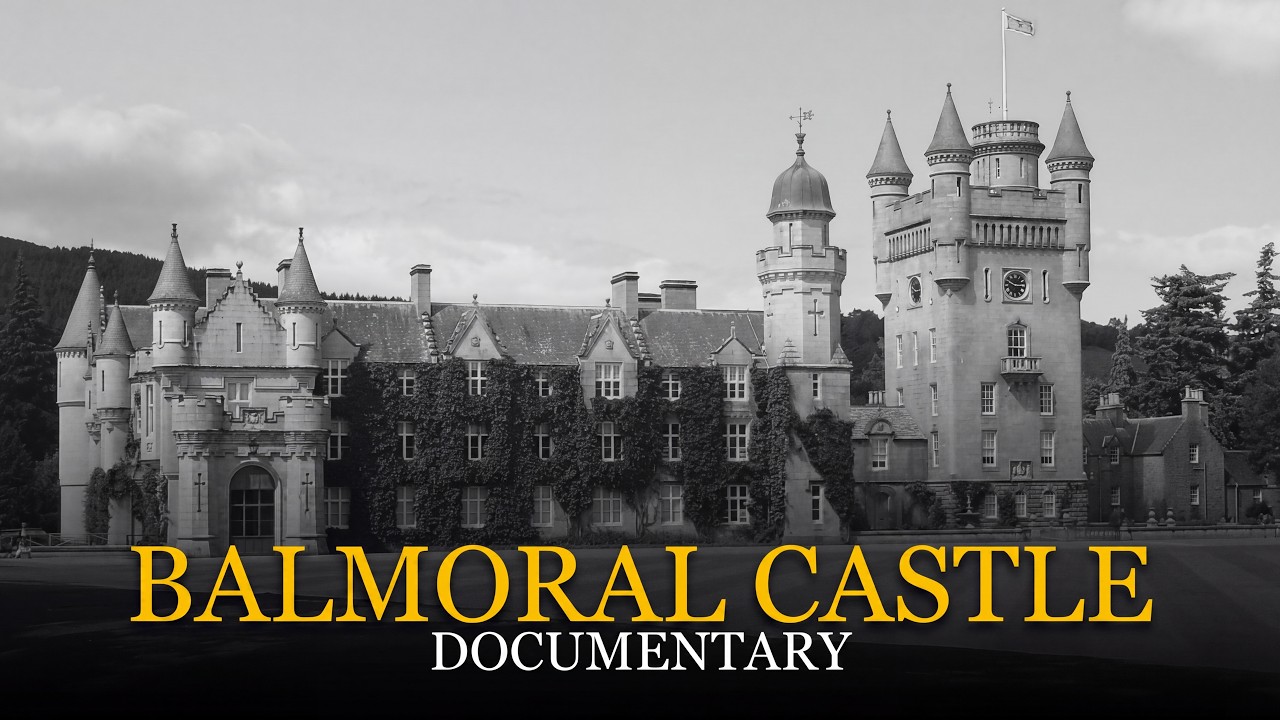
It remained in comfortable obscurity until Queen Victoria and Prince Albert discovered it in 1848 and fell instantly in love with the isolation that made it so inaccessible. For Victoria, Balmoral offered distance from the machinery of obligation that governed her every waking hour—500 miles from Parliament, from the press, from public scrutiny. For Albert, the attraction ran deeper. A man who craved control, he saw in the wilderness not just a retreat but raw material.
Within four years, he purchased the estate for £32,000 and began dismantling the old castle to rebuild it entirely in his own image. Albert was the true architect of the new Balmoral. He sketched floor plans, specified ceiling heights, and insisted the granite be quarried from the estate itself so the castle would literally be made from its own land. The foundation stone was laid on September 28, 1853, with a sealed bottle containing coins and a parchment placed beneath it.
When the walls rose over the next three years, they climbed 80 feet into the Highland sky, thick enough to hold back winters that could last from October to April. The estate sprawled across 53,000 acres, larger than the city of Edinburgh, with more than 150 buildings arranged with military precision. Inside, Albert’s control reached into every corner. He designed the tartan carpets, specified wallpaper patterns until visitors complained of “tartan blindness,” positioned furniture, and selected the antlers that hung above doorways.
One guest observed that the decor felt less like Scotland and more like a German prince’s fantasy of what Scotland should look like—which is precisely what it was. The servants’ quarters occupied a separate block, connected to the main house but invisible from the principal rooms, allowing staff to move through the building without ever being seen. This was deliberate design. Fires appeared in grates without witnesses.
Meals arrived without the clatter of kitchens reaching the dining room. The castle operated like clockwork, with Albert having wound every spring. The old castle was demolished in 1856, its every stone removed and the site grassed over as though it had never existed—a man literally erasing the past to impose his future. Victoria called the new castle her “dear paradise.
” Albert called it his greatest achievement. For five years they lived inside his creation. Then, in December 1861, Albert died at age 42, leaving the machine he had built in the hands of a grief-stricken woman who would spend the next four decades transforming it into something he never imagined—a shrine. Victoria’s mourning reshaped Balmoral’s landscape as surely as any glacier.
She ordered cairns built on hillsides marking every place she and Albert had walked. She commissioned statues. She preserved his rooms exactly as he left them, with his clothes laid out each evening and hot water brought to his dressing room every morning. But it was not the monuments that created scandal—it was a man.
John Brown was a Highland servant who had led Victoria’s pony during estate walks. Tall, broad-shouldered, and direct in speech, he was utterly without the obsequious manner that characterized most royal servants. He called the queen “woman. ” He told her when she was being foolish.
In a court built on deference, he was the only person who treated Victoria as a human being rather than an institution. After Albert’s death, Brown’s role expanded with astonishing speed. He became the queen’s personal attendant, accompanied her everywhere, stood outside her door, and occupied rooms adjacent to hers. The rumors were ferocious.
A Swiss newspaper published an allegation that Victoria had secretly married Brown and was carrying his child—a story almost certainly false but one that spread across Europe. The nickname “Mrs. Brown” appeared in drawing rooms, gentlemen’s clubs, and satirical pamphlets. Lord Derby cataloged behaviors that alarmed the court: Victoria riding alone with Brown for hours, Brown present in her private rooms at times no servant should have been, messages of the highest rank sent through him rather than her secretary.
Whether a sexual relationship existed remains unknown. What is conclusive is that Victoria loved Brown with an intensity she did not trouble to hide. She gave him gifts, wrote about him with warmth she reserved for no one else after Albert, and kept his photograph beside her bed. A deathbed confession reportedly attributed to the Reverend Norman MacLeod, one of Victoria’s closest confidants, claimed he had officiated at a secret marriage between the queen and Brown.
Under Scottish irregular marriage law, such a ceremony would have been legally valid. The confession was reported secondhand and has never been verified, but the possibility speaks to what Balmoral made possible—a hiding place where the most scandalous relationship in Victorian Britain could be concealed. When Victoria died in January 1901, the secret she carried was so dangerous that two people working behind a locked door, following instructions written in the queen’s own hand, ensured the truth would be buried with her. Victoria had prepared two sets of funeral directions.
The first, twelve pages of ceremonial detail, was shared with her household and government. The second was given only to her physician, Sir James Reid, and her dresser. Their instructions were to arrange the coffin before anyone else entered the room and to conceal certain objects so thoroughly that no member of the royal family would ever know they were there. Events unfolded as follows.
On Victoria’s left hand, Reid placed a ring—not Albert’s, but the wedding ring of John Brown’s mother. In her left hand went a photograph of Brown and a lock of his hair, covered with flowers per her explicit instructions. Anyone looking into the coffin saw a queen surrounded by blossoms. They did not see what lay beneath.
Victoria had engineered her own final concealment. Edward VII had despised Brown for decades. Within weeks of Victoria’s death, he launched a systematic campaign to erase Brown from royal history. Statues were smashed or hidden in storage.
The rooms Brown occupied were converted. His name was stripped from household records. A full-length bronze statue inscribed “Friend more than servant” was too large to destroy without attracting attention, so Edward banished it to a remote corner of the estate, hidden behind hedges facing a wall, where it stands to this day. The most devastating act of erasure came not from Edward but from his sister.
Princess Beatrice, appointed literary executor of her mother’s journals, spent thirty years transcribing the vast diaries into fresh volumes—then burned the originals. Historians estimate she destroyed roughly two-thirds of Victoria’s words. The passages that survived were those Beatrice deemed appropriate. The passages that burned were those she did not.
What remains today sits in the Royal Archives at Windsor, written in Beatrice’s handwriting, comprising roughly one-third of the original text, with scholars noting the gaps and silences where Victoria’s pen clearly moved but Beatrice’s did not follow. The castle would not have to wait long for its next secret. Diana Spencer arrived at Balmoral as a bride in the summer of 1981 and left three months later with razor marks on her wrists. She had passed the test—that was the bitter irony.
In the autumn of 1980, Diana had been invited to Balmoral as a prospective match for the Prince of Wales. She was nineteen, came from an aristocratic family that understood the rules, wore the right clothes, walked the hills without complaint, and was exactly what the machine was designed to identify—a woman who appeared willing to conform. The engagement was announced in February 1981, the wedding followed in July, watched by 750 million people worldwide. The honeymoon began aboard the Royal Yacht Britannia, where the rows began almost immediately after Diana discovered gold cufflinks engraved with two intertwined C’s she believed were a gift from Camilla Parker Bowles.
From Britannia, they went to Balmoral for three months. An entire autumn. And it was here that Diana began to break. The schedule consumed her: breakfast at 9:00, lunch at 1:00, tea at 5:00, dinner at 8:15, each meal requiring a different outfit, enforced by a century of precedent.
Fifty full-time staff maintained the invisible infrastructure. The weather closed in—horizontal rain, mist sitting in the valley for days, light fading by 4:00 in the afternoon. Diana, struggling with the early stages of what would later be identified as bulimia, found herself trapped. She found the “blooding” tradition—smearing a hunter’s first deer kill blood across the face—revolting.
The family found her reaction baffling. The annual cull of the estate’s 2,000 to 2,500 red deer was not sport to them but stewardship. Diana began to lose weight and harm herself. She threw herself down a staircase.
She cut her wrists. These were not suicide attempts. They were, as she would later explain, cries for help from a woman who felt utterly invisible inside a castle designed to make individuals disappear. Her own words, spoken years later, remain the most devastating indictment of Balmoral ever uttered by a member of the royal family: “That house sucks one dry.
”
Set this against what Charles said about the same place. He told friends he felt empty and incomplete without Balmoral, that the estate restored him, that the mountains and silence and ritual were the only things that made him feel whole. The same walls, the same schedule, the same 53,000 acres—experienced as salvation by one person and suffocation by another. Diana conformed and passed every visible test the castle could administer.
It broke her anyway. By the end of October, she returned to London early. Sixteen years later, the castle’s indifference would nearly destroy the institution it was built to protect. On the morning of August 31, 1997, the Queen ordered every newspaper removed from Balmoral and every television switched off.
The call had come at 4:30 a. m. Diana had been involved in a car accident in Paris. By the time the full picture emerged, Diana, Princess of Wales, was dead at 36.
Charles woke the Queen and the Queen Mother. He did not wake his sons. William was fifteen, Harry twelve, asleep in their beds, and their father decided to let them sleep through the night and tell them in the morning. It was an act of mercy—and the first in a series of decisions governed not by what had happened in Paris but by where the family happened to be.
They were at Balmoral. And Balmoral had only one response to crisis: close the doors. The Queen’s instinct was immediate and unwavering. This was a private family matter.
The boys had lost their mother. They needed peace, silence, and the comfort of routine. The newspapers were removed, the televisions switched off, the castle sealed itself shut. For five days, the royal family existed inside a bubble of Highland granite, cut off from the outside world by design and by choice.
Outside those walls, Britain was burning. Flowers began arriving at Kensington Palace within hours, stretching for hundreds of yards by Wednesday. The nation was furious—not at the paparazzi who had chased Diana’s car, not at the driver who had been drinking, but at the silence from Scotland. Five days of silence.
One empty flagpole. Millions of mourners. And a single headline: “Where is our Queen? ”
The flagpole was the symbol that crystallized the rage.
Above Buckingham Palace, the royal standard flies when the sovereign is in residence. When the sovereign is absent, no flag flies at all. The Queen was at Balmoral, so the flagpole stood bare. To the millions gathered below, that bare pole said, “We do not care.
She does not matter. ” The pressure built like water behind a dam. Inside Balmoral, the family carried on—William and Harry went to church that Sunday, walked with their grandmother, rode ponies. The routine held.
The walls held. The machine held. For the first time in its history, the machinery of Balmoral worked exactly as intended and produced a catastrophe. By every credible account, the Queen and her household were genuinely unaware of the scale of public anger—a consequence of architecture.
Balmoral had been engineered to remove its occupants from the outside world. No newspapers, no television, no internet. The family’s only source of information was their own staff, trained above all else to shield the sovereign from disturbance. Victoria’s castle, built to protect the monarchy from scrutiny, was now protecting it from the information it desperately needed to survive.
Four days after Diana’s death, someone persuaded the Queen to venture outside the castle gates to view the flowers laid at the entrance. The photographs showed a queen in a headscarf, Philip beside her, William and Harry small and pale bending to read the cards. It was awkward, stilted, too little—but it was a beginning. The family had stepped outside the walls, and the walls could not pull them back.
The return to London came on Friday, September 5. That evening, the Queen made a live television broadcast—only her second such address outside her annual Christmas message in a reign spanning nearly five decades. She spoke of Diana as an exceptional human being, as a Queen and as a grandmother. And above Buckingham Palace, for the first time in history, the Union Jack flew at half-mast.
The royal standard never flies at half-mast because the sovereign never dies—the crown passes instantly. But the decision to bend that rule was the monarchy’s admission that the old system had failed. The monarchy survived the crisis, but something fundamental had shifted. The castle had been built to hide, and for 140 years, hiding had worked.
But satellite television, 24-hour news, and a public that no longer accepted royal grief as a private matter meant silence was no longer dignity—silence was guilt. The new terms were clear: grieve privately, but be seen to grieve. Retreat to your castle, but come back. After 1997, the people who failed the Balmoral test began telling the world exactly what it felt like.
Diana’s former butler Paul Burrell described how the estate was used to inspect potential brides—examined “like specimens,” brought to the castle, observed over a weekend, assessed against criteria never stated and never challenged. Did she shoot? Could she walk twelve miles in the rain without complaining? Did she defer to the queen?
The test had no passing score because conformity, by its nature, is never quite enough. The system was designed not to welcome but to filter. Margaret Thatcher’s experience became legendary. The prime minister, the most powerful woman in Britain, arrived for the customary autumn weekend in the early 1980s without country shoes or appropriate outdoor clothing.
This was noticed. She sat on furniture with apparent discomfort, unfamiliar with a house where sitting in the wrong chair was a social catastrophe. She later described her annual visits to Balmoral as “purgatory. ” Cherie Blair reportedly refused to curtsy to the queen during visits.
In a household where deference was the oxygen supply, even a momentary withdrawal was noted and remembered. Meghan Markle’s entry into the royal family in 2018 brought the Balmoral test into the twenty-first century. An American actress raised in Los Angeles, she arrived with a set of cultural assumptions the castle was not designed to accommodate. The hunting culture unsettled her.
The formality exhausted her. The unspoken rules were invisible to her and therefore impossible to follow. What emerged from these accounts taken together was a pattern so consistent that coincidence could not explain it—an institutional mechanism for enforcing conformity and excluding those who would not conform. In 2024, for the first time in 168 years, strangers walked through Balmoral’s private rooms, and the walls did not stop them.
Charles III made the decision to open the doors. Groups of twelve, £110 per person, guided through the rooms sealed to outsiders since Albert’s day. Every tour sold out within hours. The financial architecture was pragmatic—Balmoral costs approximately £3 million per year to maintain, and 50 full-time staff, a herd of 2,000 to 2,500 red deer, and 150 buildings all require constant management.
Tourism changed the equation. Every visitor who walked through the door was both a customer and a witness. Every room a visitor sees is a room that can no longer hide anything. The traces of what the castle concealed remain.
John Brown’s statue still stands where Edward banished it—bronze, life-sized, hidden behind hedges facing a wall, inscribed “friend more than servant. ” The cairns Victoria ordered built on the hillsides still stand after 160 winters. The transcriptions of Victoria’s journals sit in the Royal Archives, roughly one-third of her mother’s words, with scholars charting the silences. The ballroom still hosts the Ghillies’ Ball each autumn, a tradition dating to Victoria’s time that has never been interrupted.
The red deer still graze the hills, and in Ballochbuie Forest, ancient Caledonian pines—some dating back 300 years or more—still grow, saved by Victoria when she bought the forest to prevent them from being felled. They outlasted her, and they will outlast everyone reading this. Queen Elizabeth II died at Balmoral Castle on September 8, 2022, at age 96, after a reign of 70 years. She was the first monarch to die at Balmoral—the last monarch to die in Scotland had been James V in 1542, nearly five centuries earlier.
Elizabeth worried about the logistics of dying so far from the capital. Her daughter, Princess Anne, later revealed her response: “Just do what you want to do. It is fine. ” And so she did.
She died in the place that had been her refuge for seven decades, with the Cairngorms outside her window and the River Dee running cold and clear below. The coffin journey took her 175 miles south to Edinburgh, along roads lined with people who had come to say goodbye. Farmers formed a guard of honor with their tractors as the hearse passed—the countryside itself paying tribute to the woman who had loved it. In that slow procession, something became visible that the castle had spent 170 years concealing.
Balmoral was not one thing. It had never been one thing. It was not simply a refuge or a prison or a machine or a shrine. It was all of these simultaneously, depending entirely on the person standing inside it.
Charles felt empty without it. Diana felt emptied by it. Victoria built her grief into its hills. Elizabeth chose it as the place to leave the world.
The granite does not care whether you loved it or whether it broke you. The castle simply endures as granite does—unchanged by the centuries, untroubled by the people who passed through. The bottle Albert sealed beneath the foundation stone is still there, unopened, keeping its message as it keeps everything.
In silence and in stone.