Natalie Wood had three Academy Award nominations before she turned 30 and was married twice to the same man. Between those two marriages to Robert Wagner, a discovery she made at home shattered something in her that therapy, success, and years of rebuilding never fully repaired. Born Natalia Nikolaevna Zakharenko in San Francisco in 1938 to Russian immigrant parents, Wood was pushed into performing almost before she could walk steadily. Her mother, Maria, had heard a fortune teller’s prophecy before leaving Russia that she would give birth to a famous daughter, and she spent the rest of her life ensuring it came true.
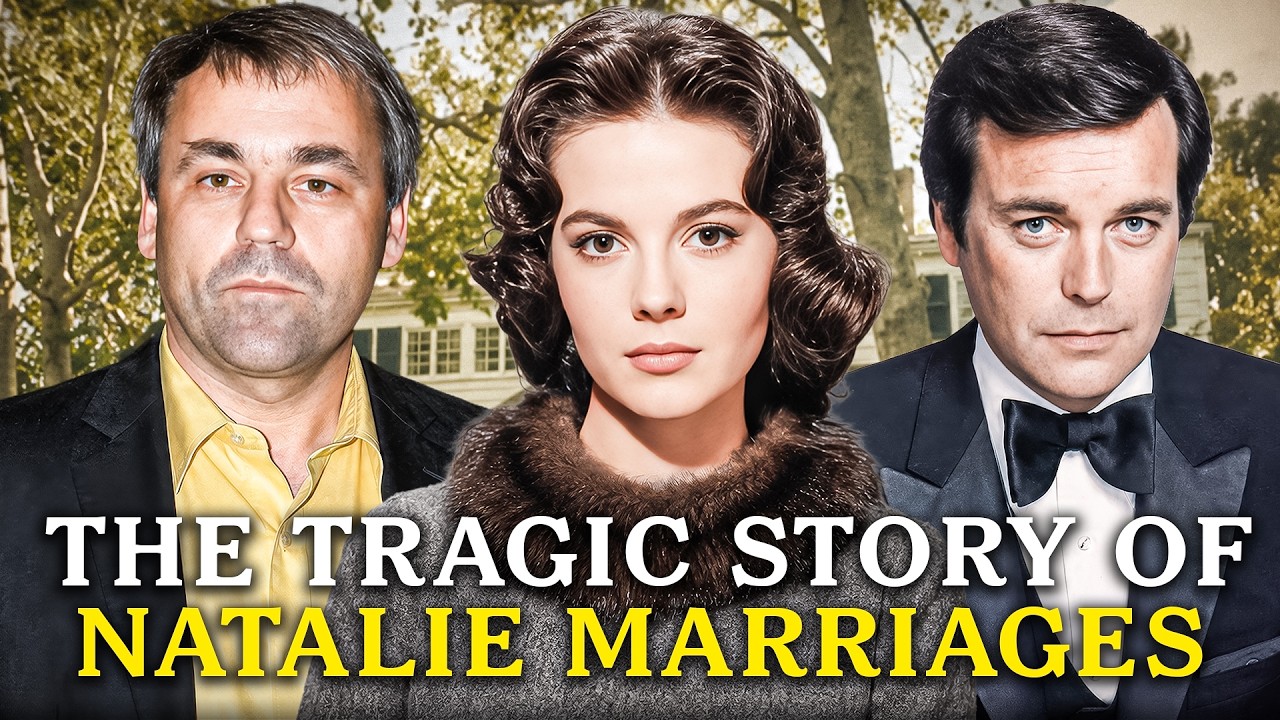
By eight, Wood had delivered a startlingly natural performance in Miracle on 34th Street. Maria managed every aspect of her daughter’s career, choosing roles, accompanying her on set, and keeping the household financially dependent on Natalie’s income, making it effectively impossible for her to step away. Maria also passed along a specific terror: a prophecy that her beautiful daughter would die in dark water. Wood spoke about the fear throughout her career, always with self-conscious humor that did not conceal genuine dread.
The fear had a concrete origin beyond the prophecy. At age 10, while filming The Green Promise in 1949, a bridge rigged to collapse on cue threw her into rushing water below. She was pulled out unhurt, but the experience deepened a fracture with moving water that never fully healed. As a teenager, Wood made the transition from child star to serious dramatic performer.
At 15, she appeared in Rebel Without a Cause alongside James Dean and received an Academy Award nomination before she was 17. At 18, she went on a date with Robert Wagner, then 26, and the world she had built her identity around shifted. Wood had carried a crush on Wagner since she was 10, having told her mother she intended to marry him. The chemistry between them was immediate.
They married on December 28, 1957, in Scottsdale, Arizona, when she was 19. They honeymooned on a rented yacht, a detail carrying its own irony given what followed. The early years looked like the fairy tale fan magazines described. But the central imbalance was professional.
Wood’s career accelerated into a different orbit entirely, while Wagner’s plateaued. He later acknowledged the gap created real tension that accumulated in the household whether it was named or not. The deepest fault line, however, was not professional. In 1961, not long after Wood completed Splendor in the Grass, the first marriage ended suddenly.
The public version, allowed to circulate unchallenged, was that the marriage had broken down because of her involvement with co-star Warren Beatty. But that was not the truth. The true account, documented by biographer Suzanne Finstad and supported by reporting including from Wood’s sister Lana, was that Natalie had come home to find her husband in an intimate encounter with another person. The person was a man.
The shock was not simply the shock of infidelity but the discovery that a central aspect of the man she had married was something she had never known. Finstad described the discovery as something that nearly cost Natalie her life. Wood allowed the Warren Beatty affair narrative to stand unchallenged, protecting Wagner’s image at the cost of her own reputation. Wagner has denied the account in its most specific details.
Wood is no longer alive to speak to it. She went into intensive psychoanalysis, multiple times weekly for years, and described her therapy bills with dark humor as roughly equivalent to the annual defense budget of a small country. She threw herself into work: West Side Story, Gypsy, Love with the Proper Stranger. The period between her divorce from Wagner in 1962 and her second marriage in 1969 was the most turbulent stretch of her adult life.
She did have a relationship with Beatty, the irony being that the affair the public assumed destroyed the marriage only began after it was over. It lasted on and off through the early 1960s, intense and combustible. By the mid-1960s, she was dating, socializing, and in intensive psychotherapy, five sessions per week at certain points. In 1966, Beatty appeared at her home unexpectedly to offer her the role of Bonnie Parker in the film that would become Bonnie and Clyde.
Wood turned it down, later saying she did not believe she could do it justice. The role went to Faye Dunaway and made her a star. That night ended badly. Wood took an overdose of barbiturates.
She told her sister Lana afterward that she had not wanted to be alive at that moment. She recovered, returned to therapy, and moved forward. By 1969, she was rebuilding. Through a mutual friend, she met British film producer Richard Gregson.
The connection came through Robert Redford, who was both a close friend of Natalie’s and a professional client of Gregson’s. They dated seriously for two years, considerably longer than her other courtships. Having learned from the first marriage about the cost of choosing a partner without fully knowing him, she was not in a hurry. They married in May 1969 in a small, private affair.
Redford served as best man. Their daughter, Natasha, was born on September 29, 1970. Motherhood activated something specific in Wood, a focus and sense of purpose that settled her in ways years of psychoanalysis had not quite managed. Gregson later acknowledged that Natalie’s total absorption in Natasha was part of what went wrong.
He began an affair with her personal secretary. Wood found out and told him to leave, having police patrol the house for a week afterward to ensure he did not return. The divorce was finalized in 1972. When Wood and Wagner found each other again in 1972, they were both in their 30s.
Wagner had married actress Marion Marshall in 1963, fathering a daughter, and that marriage also ended in divorce. The reconnection happened at a party in Palm Springs. Natalie later told friends she encountered a man who had genuinely changed. The first time, she said, she had married a boy; this time, she was meeting a man.
They remarried in July 1972 on a boat, with very little fanfare. Courtney Brooke Wagner was born on March 9, 1974, their only biological child together. The household they built through the 1970s was, by the accounts of everyone who spent time in it, genuinely warm. Wood threw herself into homemaking with the same total energy she brought to performance.
She read fairy tales at bedtime. She was present. She was, by most accounts, genuinely happy. Her career stirred again in the mid-1970s.
She appeared in a television version of Cat on a Hot Tin Roof and began work on Brainstorm, a science fiction film directed by Douglas Trumbull, co-starring Christopher Walken. The production brought Walken into the close orbit of the family. Wagner had complicated feelings about the intensity of Walken’s professional presence. Those tensions were present on the Thanksgiving weekend of 1981 when the three of them, along with the yacht Splendour’s captain Dennis Davern, took the boat to Catalina Island.
Wood died on November 29, 1981, in the waters off Catalina. She was 43. She was found floating in the water near the island in the early morning wearing a red down jacket over her nightgown. The jacket, waterlogged, would have made staying above water extremely difficult.
The official cause of death was drowning. The manner was initially recorded as accidental, later changed to undetermined following the reopening of the investigation in 2011. The sequence of events as told by Wagner and as told by Davern differ in significant ways, particularly regarding the timeline of when Natalie was discovered missing and when calls for help were made. In 2018, the Los Angeles County Sheriff’s Department named Wagner a person of interest, a designation that indicates he is believed to have information material to understanding what happened.
Wagner has maintained he does not know what happened to his wife and that he did not harm her. No charges have ever been filed. The case remains open. There is a dimension of Wood’s story that the narrative of marriages sometimes crowds out: the woman she was building through deliberate effort.
The psychoanalysis she began after her first divorce became one of the central projects of her adult life. She read voraciously about psychology and came to understand her own patterns had deep roots. She loved the ocean from a distance but remained terrified of being in it, of the darkness at night, of submersion. The fear stayed, and she lived alongside it with self-awareness.
Professionally, she had made genuinely interesting and non-obvious choices. She played a Puerto Rican girl in West Side Story, a woman who becomes pregnant outside marriage in Love with the Proper Stranger, and took on Brainstorm, a genre she had never worked in, exploring ideas about consciousness and memory. She was 43 and still choosing work that pushed her into unfamiliar territory. The figure who walked onto the Splendour that Thanksgiving had spent decades being shaped by forces outside her control: a mother who never stopped managing her, an industry that never stopped watching, relationships that had cost her in ways she spent years processing.
She had survived all of it and built something real: the film career, the marriage she wanted, the daughters she loved. What emerges from the full arc of Natalie Wood’s marriages is a woman who was always reaching for a specific thing the life she lived made extremely difficult to obtain. She wanted to be known, not seen. She had been seen since she was four.
Known means someone has looked past the performance, found the actual person, and chosen to stay. She had done everything she could. And she was still, in the end, found in the dark water. The investigation continues.
The answers have not come. What has come in the years since, in the documentary her daughter Natasha made and in the accounts of the people who knew her, is a portrait of a woman who was considerably more than a mystery. She was warm and funny and entirely present for the people she loved. She celebrated everything.
She read poetry. She was afraid of dark water.