Just before dawn on June 4, 1971, a fog-shrouded hill in the far north of South Vietnam was about to become the site of one of the most remarkable defensive stands of the war. At the top stood a 27-year-old Army sergeant first class who had grown up picking peaches in California and who had originally been rejected for military service altogether. Below, moving up the slopes in the darkness, was an entire battalion of North Vietnamese Army troops and Viet Cong fighters. His name was John Kavanaugh, and the hill was known as Hickory Hill.
Born John Robert Lemons on August 2, 1943, in Royston, England, he was taken to California by his British mother after his parents’ marriage fell apart. Settling in the tiny farming community of Baelco in the San Joaquin Valley, he took the surname of his stepfather, Ugo Kavanaugh, and went to work picking peaches and melons. The work taught him early that labor does not stop just because you are tired. He became a U.
S. citizen and tried to enlist in the Army. The Army turned him down, classifying him 4F because of a severe allergy to bee stings. He argued his way in, and in 1969 he finally joined.
Instead of sending him into combat, the military made him a veterinarian and agricultural advisor, helping Vietnamese villagers with their livestock and crops. He made it clear he wanted to fight. He trained, qualified, and eventually served with a unit whose very existence the U. S.
government officially denied: MACV-SOG, the secret special operations command conducting cross-border missions in Laos and Cambodia. By 1971, Kavanaugh was an experienced sergeant first class who volunteered for another mission. That mission was Hickory Hill, also known as Hill 950, located in Quang Tri Province, the northernmost province of South Vietnam, right along the Demilitarized Zone. The site overlooked the Khe Sanh area, where U.
S. forces had endured one of the war’s most brutal sieges three years earlier. The hill served two critical functions. It was a radio relay station for covert special operations teams inside Laos, and it housed a highly classified Army Security Agency signals intelligence system called Explorer, which monitored enemy communications and tracked movements along the Ho Chi Minh Trail.
It was not just high ground; it was a vital node in the U. S. intelligence network, and North Vietnam wanted it destroyed. When Kavanaugh arrived to take charge of security in early June 1971, he found a site built for observation, not combat.
The bunkers and structures were there, but the fortifications were not strong enough to withstand a ground assault. He began rebuilding and strengthening the perimeter, racing against a clock he could not see. He was still working when the enemy came. On June 3, North Vietnamese heavy artillery shelled Hickory Hill, an artillery reconnaissance to map defenses and probe positions.
It told Kavanaugh what was coming. The question was not whether the attack would come, but when. The answer came in the early hours of June 4, 1971. Small arms, automatic weapons, rocket-propelled grenades, and mortar fire erupted from multiple directions.
The opening barrage was fast and accurate. Dozens of men were wounded in the first minutes. Then the American commander in charge of the entire site was hit and evacuated from the fight. Command of the defense fell to one man: John Kavanaugh.
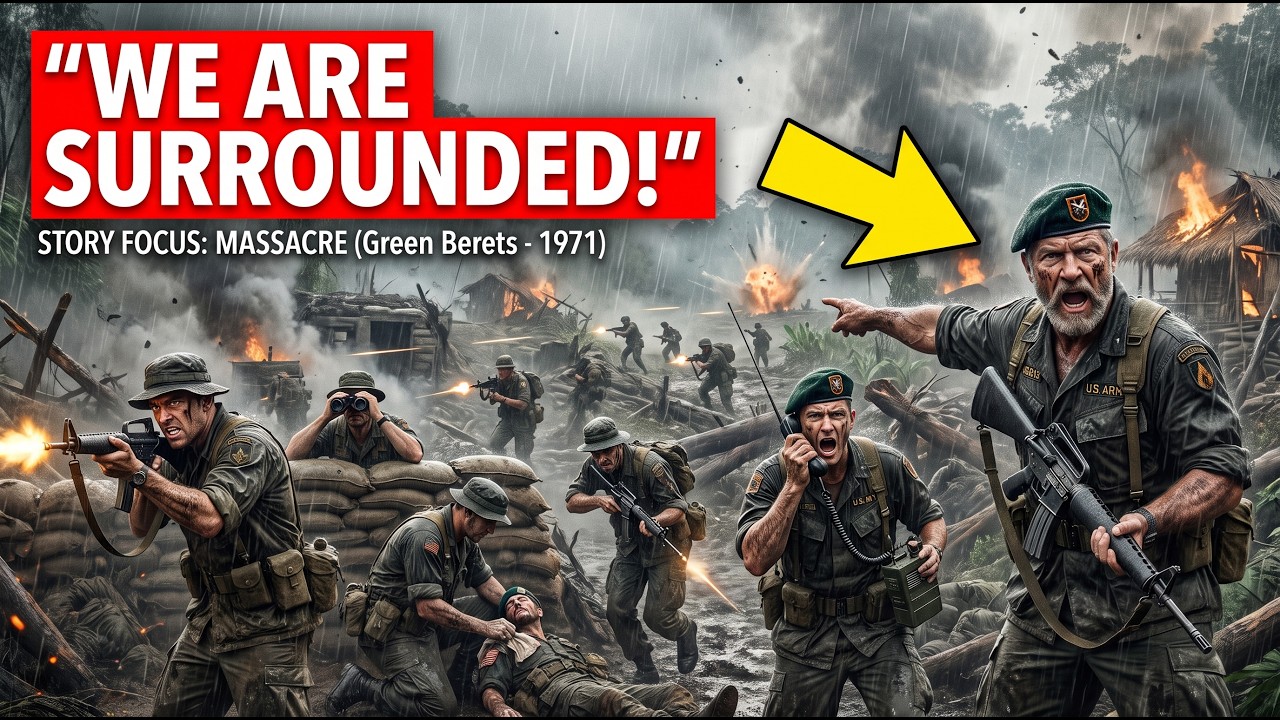
He moved from position to position around the perimeter, heading where the fire was heaviest and the line was thinnest. He redistributed ammunition, shifted men, adjusted firing lines, and returned fire himself with whatever was at hand. He shouted orders and encouragement. The enemy attacked repeatedly throughout the long day of June 4.
The Montagnard fighters, indigenous highland tribesmen loyal to the Americans, held the line with him, repelling assault after assault. But by afternoon, the numbers were taking a brutal toll. The decision was made to evacuate. Three U.
S. helicopters arrived. Kavanaugh put himself in the middle of the action, directing the aircraft, coordinating loading, and standing in direct fire to manage everything. The wounded went first, then the others.
The helicopters filled, took off, and returned. Most of the platoon got out alive. Kavanaugh was ordered to board one of the helicopters. He refused, saying he would leave when the Montagnards left.
He stayed. The last helicopter waited for him, but the enemy was still advancing and one man chose to remain on a hill everyone knew was about to fall. The pilots could not wait forever; the helicopters were taking fire on every approach. They carried the last load they could and lifted off.
One of the last men to leave was Sergeant Ralph Morgan. Before boarding, he asked the remaining Americans to come with him. They refused. Kavanaugh’s reasoning was simple, stated later in clear words: first to hit the ground, last to leave it.
By evening on June 4, only two Americans remained on Hickory Hill: Kavanaugh and Sergeant James Jones, along with about 20 Montagnard fighters. Everyone else had been evacuated, killed, or scattered into the jungle. The enemy was still there, regrouping and waiting for darkness. Kavanaugh prepared for what he knew was coming.
During the night, ground fog rolled in. It was the thick, low cloud cover the mountains around Khe Sanh produced regularly. No helicopter could fly. No warplanes could strafe the ridges.
The radio still worked, so air support theoretically existed, but practically it was useless. Whatever happened on Hickory Hill that night, those men would face it entirely alone. In that fog, the North Vietnamese launched their decisive assault. They came in two waves, professionals, not a mob.
The first wave laid down heavy fire with small arms, automatic weapons, and rocket-propelled grenades to pin the defenders down. The second wave advanced behind them, throwing grenades continuously. It was a trained attack by a unit that had done this before and knew the ground. The fog made it worse.
The defenders could hear them coming but could not see them until they were right on top of them. The perimeter began to shrink. Montagnard fighters were falling. The camp collapsed around a handful of men still holding.
Kavanaugh fought fiercely, moving through the position, exchanging fire, throwing enemy grenades back, placing his body at the most dangerous points of the attack. Then he made the decision that defined him. He ordered his remaining men to scatter, to move into the jungle in small groups, to get out while there was still a chance. He would cover them.
He stood between his men and the attack while they escaped, understanding that every second he held was a second they gained to get away. When his last men finally had their chance to escape, Kavanaugh did something almost impossible to process. He charged forward into the advancing enemy, not away from the attack but into its heart, to give his men any final seconds they needed. He was hit again and again.
By the end, his body carried more than 100 shrapnel and bullet wounds. He fell to the ground. The North Vietnamese swept over Hickory Hill. They moved among the wreckage, checking bodies, looking for Americans.
They reached a bunker inside which lay John Kavanaugh, wounded and burned but alive, playing dead while enemy soldiers stood over him and looked in. When the area was clear, he crawled out of the flames and dragged himself to another position. He kept moving. A man with more than 100 wounds, a defeated camp, no air support, no food, no clean water, severe burns, and most of his comrades gone.
He got himself up and went into the jungle, and he kept going for 11 days. The terrain was rough, the jungle suffocating, and North Vietnamese units were sweeping the area for survivors. He moved at night when he could and hid during the day. Infection was eating at his wounds.
He was losing weight at a rate no man in his condition could sustain for long. On the twelfth day, near the border, North Vietnamese soldiers found him. He was taken prisoner. What followed was 661 days as a prisoner of war.
He was taken to a farm in the north and interrogated for more than a year. He did not break. On December 27, 1972, he was transferred to Hoa Lo prison, which American prisoners sarcastically called the Hanoi Hilton. There he was placed in solitary confinement, where he remained until the prisoner exchange that followed the Paris Peace Accords.
On March 27, 1973, his name was called. U. S. aircraft were landing at Gia Lam airport.
Kavanaugh later described seeing that C-141 land as the greatest sight in the world. He weighed 92 pounds. On the tarmac, steps from freedom, his legs gave out. An Air Force crew chief caught him and kept him standing.
He was repatriated. Doctors documented every one of his more than 100 wounds. The men evacuated from Hickory Hill that night, many of whom had been certain Kavanaugh was dead in the final attack, learned the truth: he had survived. Not everyone did.
Sergeant James Jones, the other American who stayed behind that night, never came home. He was listed as missing in action, and despite searches, no definitive evidence of his fate was ever found. He remains unaccounted for to this day. After recovering, Kavanaugh returned to duty.
He went to Fort Bragg and began training the next generation of Special Forces soldiers. He rarely talked about what happened. In a farewell ceremony before he left Vietnam in 1971, before his capture, he had been recommended for the Medal of Honor. Then he was captured, the war wound down, and the recommendation sat somewhere in the bureaucracy.
Kavanaugh, by his own account, forgot about it entirely. Three and a half years later, while serving with the 101st Airborne Division, he was told he would be sent to Washington. On December 12, 1974, President Gerald Ford placed the Medal of Honor around the neck of Sergeant First Class John Robert Kavanaugh at the White House. The citation was read aloud, detailing the two days on Hickory Hill, the fighting on the perimeter on June 4, the refusal to evacuate, the final charge on June 5, and the covering fire that gave his men a chance to escape into the jungle.
When people asked him what he had done to deserve it, he had one answer, which he repeated for the rest of his life. “I couldn’t run from them. I had to fight them. After that, I was just doing my job.
”
Sergeant Ralph Morgan put it plainly: “That fact tells you more than can be known about John. Everyone got on the helicopters. He stayed. He protected the exit.
” Larry Page, a Special Forces radio operator who was evacuated, said he owed his life to him. Most of the men who left that hill on June 4 believed Kavanaugh had been killed in the attack. The final charge, the hundreds of wounds, and the burning bunker did not point to a man still alive. They carried that weight with them.
Years later, some of them learned he had not died at all. John Kavanaugh retired from the Army on May 31, 1990, after 21 years of service, ending his career as a sergeant major, the highest rank an enlisted soldier can achieve. He returned to farming peaches on his 294-acre ranch in Columbia, California. He worked on veterans’ issues in the years that followed and spoke about service when it truly mattered.
He never became a public figure the way some Medal of Honor recipients do. He did not write a book or seek the spotlight. In 2014, Kavanaugh was diagnosed with a bone marrow disorder. He was 70 years old.
He had survived more than 100 wounds, 11 days in the jungle, and 661 days in captivity. He returned home, built a life, and grew peaches for more than two decades. On July 29, 2014, John Kavanaugh died at Stanford Medical Center. He was buried with full military honors.
His headstone summarizes his life in a few lines: Medal of Honor, U. S. Army, Vietnam. The North Vietnamese and Viet Cong attacked Hickory Hill for purely strategic reasons.
They wanted to destroy the intelligence equipment, eliminate the communication relay station, and erase the site entirely. They brought enough numbers to take it, and they did. What they did not anticipate was the price they would pay. The hill fell.
But the men lived. Kavanaugh made that trade himself in the moment, because the situation demanded it, and because he was the kind of man who faced situations the way they deserved to be faced. It was not one dramatic choice in a single heroic moment. It was a series of decisions made over two days, each under completely different circumstances, each ending in the same result.
Did he move toward the threatened position or stay in his bunker? He moved. Did he withdraw with his men or stay to direct the helicopters? He stayed.
Did he board the last helicopter or wait for the Montagnards? He waited. Did he cover his men’s retreat or find a safe position for himself? He covered them.
Every time, he chose the harder option. Not because he was reckless. The men who served with him described him as calm, deliberate, and fully aware of the risks.
He had a rule, and he applied it the same way every time: first to the field, last to leave it.