In October 1947, an Ojibwe guide named Wendigo Binesi Strongheart led three surveyors from Duluth into the Boundary Waters of northern Minnesota. He brought them out twelve days later. Only two of them came back with him. Strongheart, known locally as Windy, was 61 years old and had spent most of his life on the unnamed lakes and portages of that country.
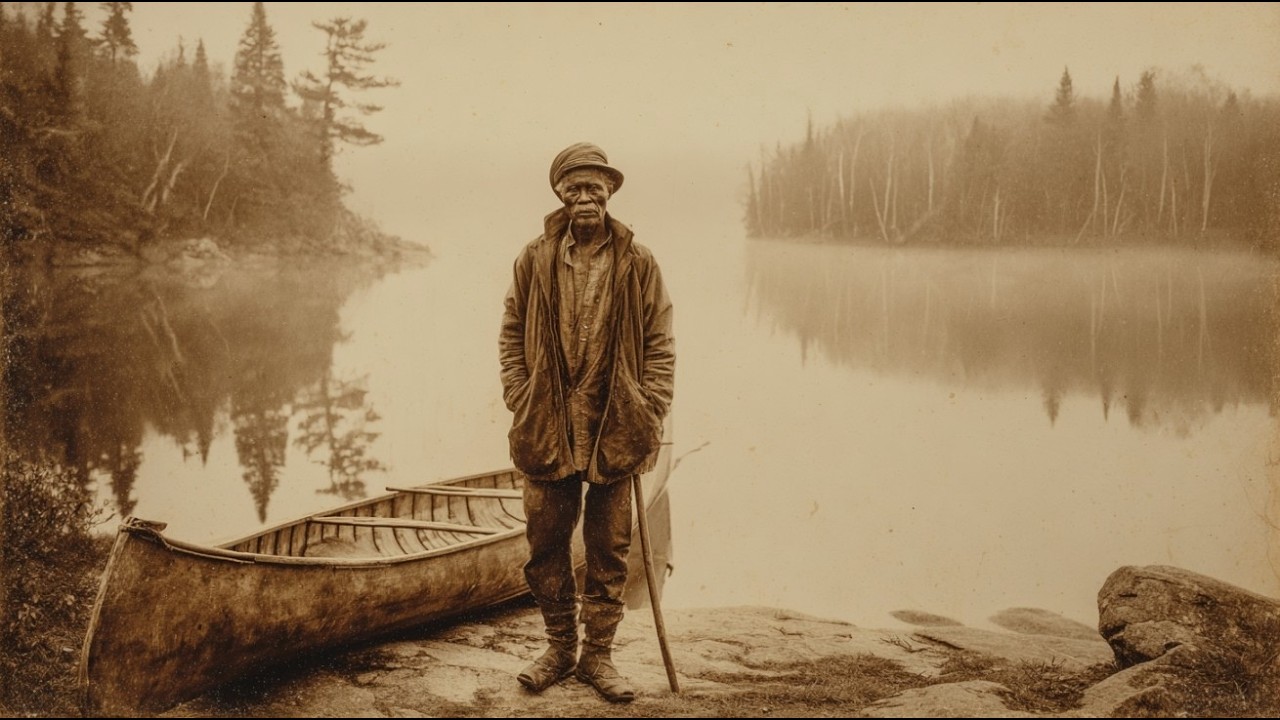
He was hired by the three men—Rupert Garlic, Ozias Wendell, and Thaddeus Penhallow—to guide them for eight days while they surveyed timber country east of Lac La Croix and north of the Kawishiwi River. He took the job reluctantly, needing the money, despite his disapproval of the work. The party put their canoes in at Fall Lake on the morning of October 3. Windy told a Forest Service ranger later that even at the landing, looking north, he had the sense he was looking at a door that should not be opened.
He went anyway. For the first three days, the trip was ordinary. They paddled, portaged, and camped on islands. Penhallow took his readings.
Rupert wrote in his book. The fishing was good. The nights were cold, and the moon was nearly full. On the fourth night, they camped on a small island in a lake that had no name on the surveyors’ map.
Windy knew it by an Ojibwe name. That night, he heard a sound from the mainland to the north. He described it to the ranger as the sound a man makes calling out from a long way off, but the words were not words, and the voice was not quite a voice. He said nothing to the others.
In the morning, he asked Rupert if they could change their route, saying the country to the north was bad country. Rupert cleared his throat and said they were on a schedule. Penhallow looked at Windy for a long moment, then looked north, but said nothing. They went north.
On the fifth day, crossing a long portage through a bog meadow, Windy stopped. He smelled something sweet, not decay, but something like fruit left too long in a warm room. It came from a thicket about twenty yards off the trail. He did not look directly at it.
He picked up the canoe and walked on. When he asked the others if they had smelled anything, Ozias laughed it off. Rupert said he had smelled nothing. Penhallow said nothing at all, but his face was the color of old wax and his hands were shaking.
That night they camped on the southern shore of a lake the surveyors called Lake 186. The fire smoke rose about three feet, then bent at an angle no wind could explain, drifting north. Windy watched it for a long time without commenting. Around midnight, Ozias woke up screaming.
He said that someone had been standing at the foot of his bed—a tall someone, taller than a man. He kept saying the word “someone,” not “something. ” Rupert told him he had been dreaming. In the morning, Ozias was different.
He was quiet. He kept stopping to stare at his own hands, turning them over as if checking they still belonged to him. When Windy asked if he was all right, Ozias smiled at him. Windy told the ranger it was a smile that did not fit on his face, a smile that knew something Ozias did not know.
Penhallow took Windy aside at the next portage. He asked quietly what Windy knew about this country. Windy told him a little: that there were things in these woods that had been there before any people, that his people had learned which lakes you camped on and which you did not, and that Lake 186 was one of those lakes. Penhallow admitted he had felt something watching from the trees on the portage.
He said he had been a surveyor for 31 years and had never felt anything like it. He said he would talk to Rupert about turning back. He never got the chance. That afternoon, paddling single file across a long narrow lake, Rupert shouted from the third canoe.
He was standing up, pointing at the shore. There was a man on the shore, tall, standing very still at the edge of the trees. Windy looked. He saw it.
He understood at the same time that what he was seeing was not a man. The shape was right, but the size was wrong, the proportions of the legs were wrong, and it was standing in a place where, twenty seconds before, there had been nothing at all. Then Ozias started to laugh. It was a high, thin laugh with nothing funny behind it.
He kept laughing. The thing on the shore took one step forward. Windy described the step to the ranger as something that had learned about walking from watching, but had never done it itself. The three men paddled hard for the far shore.
Ozias laughed for what Windy thought must have been ten minutes, then slumped forward with his face against his knees. When they reached shore, Windy found Ozias alive but deeply cold to the touch. His eyes were open and looked at Windy without knowing him. They camped there that night out of necessity.
Windy built a large fire with green wood to make the smoke heavy. He did the things his grandfather had taught him to do, though he had not done them in many years. Penhallow asked what they had seen. Windy told him a word in Ojibwe.
He would not write that word for the ranger later, saying it should not be written, should not be spoken at night, and should especially not be spoken near water. Rupert sat apart, tending to Ozias, who lay staring at the dark sky. Now and then Ozias would smile that smile that was not his smile. Now and then he would whisper something.
Rupert would lean close to listen, then lean back with his face gone gray, and not tell the others what he had heard. Around three in the morning, Windy heard the not-quite footsteps walking along the water’s edge again. They stopped just at the edge of the firelight, behind a stand of birch. He felt it looking at him.
He did not look back. He fed the fire and sang, very quiet, a song his grandfather had taught him, a song he had not sung in forty years. In the morning, Windy went down to the water’s edge and saw marks in the sand. Not footprints—long dragging marks, as if something had walked there that did not know quite how to walk.
He covered them with his boot before the others saw. Ozias was awake that morning. He sat up, spoke, asked for water. He did not remember the laughing, the thing on the shore, or waking up screaming.
To Rupert, this was a relief. To Windy, it was the worst sign yet. Ozias was watching them, the way a thing watches when it is learning how to imitate a man. Windy told Penhallow they needed to go east, out the long way toward Saganaga, to get out of the country of the lake they should not have crossed.
Rupert refused, insisting they were a day from the last survey point and would not be the man who came back without the data. Ozias watched him say it. Ozias smiled. Windy told Penhallow privately that he was going east in the morning and that Penhallow could come with him or not.
He said he would not spend another night in that camp with what was in it. Penhallow, thinking of the daughter who had just married in August and to whom he had promised to return, said he would go east. In the morning, Penhallow was gone. His pack was still where he had left it, but his boots and his coat were missing.
Windy found tracks leading from the bedroll into the trees: Penhallow’s boot prints, and next to them, walking alongside, the long dragging marks. Not behind. Alongside. As if Penhallow had walked away with something at his elbow, the way you would walk with a friend.
Windy followed the tracks about thirty yards into the trees, then stopped. Both sets of tracks stopped mid-stride, in the middle of the moss, as if Penhallow and the thing beside him had walked off the surface of the earth. Windy woke Rupert and told him what he had found. Rupert, who had spent a week pretending nothing was happening, could not pretend any longer.
Windy told him they were leaving, now, east. He told the ranger later that he made a decision in that moment whose details he would never tell another living soul. He said only that he and Rupert left that camp at first light with one canoe, and that they left things behind they should not have left behind, but could not have brought with them. They paddled east for three days, nearly without stopping.
Rupert had become useless, weeping in his sleep and talking to people who were not there. Windy paddled through cold rain and at night by moonlight. He was certain something was following them in the woods along the shore. On the second night, passing through a narrow channel, he heard Penhallow’s voice from the trees, calling his name.
He did not look. He kept paddling. The voice followed for a quarter of a mile, stopped, then came again from the other side of the channel. How it had crossed the water, Windy did not know.
He did not want to know. On the fourth day, they came out at Saganaga, where there was a logging camp with a telephone wire. The men there put Rupert in a bunk and called the rangers in Ely and the mounted police on the Canadian side. A search party went out the next morning.
They did not find Penhallow. They found Ozias on the eleventh day, sitting cross-legged by the long-dead fire on the unnamed shore where Windy had left him. He was alive. He had not eaten, built a fire, or moved from that spot in eleven days.
There had been freezing rain and a night of snow. He was not dressed for any of it. When the lead ranger, Halvor Lindstrom, walked up and asked his name, Ozias looked up and smiled. Lindstrom told the doctor later that the smile was not a young man’s smile, and that he had walked away after a minute and been ill behind a tree, unable to explain why.
Ozias lived another two years in a state hospital in Duluth. He never spoke. The doctors wrote that he was catatonic from exposure and shock, but the orderlies on the night shift said that at three in the morning, he would sometimes be standing by the window, his face very close to the glass, watching the dark water of Lake Superior far below, and smiling. Penhallow was never found.
A three-week search dragged the lake and sent dogs along the shore. His coat was eventually found twenty miles east of the camp, hung on the branch of a low pine with the buttons done up neat. Nothing else. Just the coat.
His daughter, the one married in August, never accepted that her father was dead. She believed for the rest of her life that he was alive in those woods. She told a neighbor she sometimes heard him calling her name at night from the woods behind her house in Duluth, though her house was twenty miles from the nearest stretch of wild country. She moved to St.
Paul eventually, saying the trees in Duluth were too close. Rupert went home to his wife and work, but was not the same man. He drank, lost his job, and spent his last years in a small apartment over a hardware store in West Duluth, keeping every light on day and night. He told his wife he could not sleep if there was any darkness in the rooms.
She left him in 1951. He died in 1954 with every lamp burning. The coroner ruled it heart failure. The note he left, which the coroner did not include in the report but his sister kept until her own death, said only: “I should not have gone north.
I should not have crossed the water. I should not have left my friend. ”
Windy Strongheart lived another nineteen years. He guided a few more parties in country he knew was safe, but never again took anyone north of the Kawishiwi.
When the timber concern that had hired the surveyors tried to send another party three years later, Windy refused to guide them, and so did every Ojibwe guide in the county. The trip was canceled. The country was never cut. In 1966, the year before he died, Windy was interviewed by a student from the University of Minnesota writing a thesis on Ojibwe oral tradition.
At the end of the interview, the student asked whether Windy believed some of the old stories were true. Windy said there were three kinds of things in the world: things that were true and could be spoken of; things that were true and should not be spoken of; and things that were true and could not be spoken of, because the words for them had been taken away from his people on purpose long ago. The student asked him which kind of thing was in the woods north of the Kawishiwi. Windy did not answer.
He stood up, thanked the young man, and went outside to sit on his porch. He looked north for a long while. In 1972, a fishing party out of Ely camped on the southern shore of a lake whose name appears on no map. Among them was a young man from Duluth who had grown up hearing stories from his great aunt about her father, who had gone missing in the Boundary Waters in 1947.
His name was Garlic. He was Rupert Garlic’s grandson. Late on the second night, the younger Garlic walked a short way into the trees behind the camp. His friends heard a small sound, not a shout, which they later described as a sound of recognition.
They went to look for him. They did not find him. A four-day search followed. What they found at the spot where he had walked into the trees was a man’s coat: dark green wool with brass buttons done up neat, the kind a surveyor might have worn in the 1940s, the kind that should not have survived twenty-five winters in those woods.
It matched the description in the old report of Thaddeus Penhallow’s missing coat, down to the small repair in brown thread on the left cuff. The rangers logged the coat into evidence. It disappeared from the evidence locker in Ely sometime in 1974. The clerk on duty that month, an older man close to retirement, said only that he had thrown it into the lake.
He would not say which lake. He would not say why. He retired the next month, moved to Florida, and died in his sleep in 1978. At the end of his statement on October 14, 1947, Windy Strongheart told the ranger that the country up there should be left alone.
He said the thing in the woods was not evil as a white man understood evil. He said it was hungry, and old, and had been hungry for so long that it had forgotten everything except how to be hungry. He said it fed not the way a wolf feeds or a man feeds, but the way a fire feeds, by touch, by nearness, by the slow taking of warmth from the things around it until they had no warmth of their own left to give. He said you could not kill it.
You could only stay away from it. Then he asked if he could go home, because his wife was expecting him and it was a long drive back to Vermilion. The ranger never saw him again. He kept the paper in his Bible for fifty years, on the page with the 88th Psalm, which is the dark one without comfort at the end.
When he died in 1991, his grandson found it there. That grandson passed the story on, and it was told in the retelling that people still paddle those waters every summer, and most of them have a fine time. But some parties go in, and some come out, and one of the people who comes out is not entirely the person who went in. The old rangers will tell you there are certain lakes in the Boundary Waters where they prefer not to camp.
They will not give you the names.