In a New York courtroom, Lillian Gish sat while her private love letters were read aloud in explicit detail. The man who had corresponded with her, contracted her, and claimed ownership of her was suing to keep her. Newspapers printed each line every morning for astonished breakfast tables across the country. Lillian Gish had committed no crime.
She had simply discovered, at thirty-one, what happens when emotion, money, and a signature are braided together and the knot is pulled tight in public. She walked out of that building with her reputation nearly intact and an education no acting coach could have provided. Within weeks, the papers would announce her engagement to someone else entirely. She was America’s wife, mistress, idol, and enemy all at once, and by the time of the trial, she had spent a decade navigating Hollywood’s endless scandal chase.
At ninety-three, in a completely different world, she was still dealing with the fallout. Sex was the center of Lillian Gish’s life, the woman who gave birth to cinema. This is her story. Welcome to Hollywood Secrets.
Lillian Diana Gish was born in Springfield, Ohio, on October 14, 1893, into a family already coming apart. Her father, James Lee Gish, was a candy salesman of German Lutheran stock, and his alcoholism and repeated business failures quickly made him the kind of man read about in local papers and then forgotten. Her mother, Mary Robinson McConnell, was Episcopalian, carried a vague theatrical ambition from her youth, and was about to be forced into acting as a profession. Lillian had a younger sister, Dorothy, born twenty months later, who would become her partner in everything for the next seventy-five years.
By the time Lillian was old enough to remember much, her father was already beginning the slow disappearance that would end in an asylum in Oklahoma. The family moved to Baltimore, then New York, then East St. Louis, Illinois, where they stayed for a time with an aunt and uncle. Mary opened a small shop called “The Magnificent Candy Kitchen” next to a theater, and the girls sold popcorn and candy to patrons attending melodramas.
The theater was loud, warm, and emotional; the candy shop was quiet. Mary made a decision that women of her era did not make easily. She walked onto the stage and brought her two small daughters with her. Lillian was five when she first appeared on stage in a touring melodrama in Rising Sun, Ohio, in 1902.
By six, the stage manager was pushing her across the boards with his hand on her lower back, giving her the only acting direction she would ever receive. She repeated that direction for the rest of her life. “The only acting lessons we ever had,” she liked to say, “were: ‘Speak loudly or they’ll get another girl. ‘” The girls toured the eastern states in trains smelling of coal smoke and wet wool.
They boarded in houses run by widows. They taught each other spelling and arithmetic and read whatever books their mother could find, which was not many. Lillian later said she learned to read by hearing “Black Beauty” so often she memorized it, then could follow the text as the words echoed in her mind. They rarely used their real names on bills.
Acting in rural America in the 1890s was a barely respectable profession for a man; for a woman with two daughters, it bordered on vagrancy. She explained later: “We didn’t use our real names because we didn’t want to bring shame on the family. ” There was no childhood in the way middle-class Americans would recognize. There was, instead, work.
In 1910, when Lillian was seventeen, the family received word that James Gish was seriously ill in Oklahoma. He had been committed to the state hospital for the insane in Norman. Lillian traveled to Shawnee and saw him briefly before his death. She did not speak much about it in later life.
The meeting surfaced only indirectly decades later in the dedication of her 1969 memoir, “The Movies, Mr. Griffith, and Me. ” She wrote: “To my mother who gave me love, to my sister who taught me love, to my father who instilled in me insecurity, and to D. W.
Griffith who taught me that work is more fun than play. ” It is one of the most striking self-portraits in the language—the absent father, the stoic woman, the man with the camera. That man entered her life in 1912. The Gish sisters knew a child actress named Gladys Smith from New York touring companies.
When Lillian and Dorothy met her again, Gladys had changed her name to Mary Pickford and was working at the Biograph Studios under a man named David Wark Griffith. Pickford suggested the sisters visit Biograph and see the films. They walked in one afternoon, two girls in matching dresses, so alike that Griffith could not tell them apart. He reportedly tied a blue ribbon on Lillian’s wrist and a red one on Dorothy’s, then had them run around the building and fired a starter’s pistol at the ceiling to see their reactions on camera.
Lillian was nineteen but told everyone at the studio she was sixteen. The blue ribbon stayed on her wrist all afternoon. By the end of the day, Griffith had cast her with Dorothy in a short film called “An Unseen Enemy. ” It was the beginning of one of the longest and strangest collaborations in American art history.
From that day in 1912 until about 1921, Lillian Gish appeared in roughly forty films with him, perhaps as many as sixty, depending on how shorts and productions he supervised are counted. But the film numbers are not the point. The point is that the art of cinema was being invented in those rooms while she stood in them, and she was the face the camera learned to photograph. She understood, very quickly, what the camera was.
She said of Griffith in an interview with Terkel: “He created the way of telling a story on the screen. ” She also understood that what works on stage does not work in front of the lens. She prowled the theater curtains compulsively. She rehearsed her smallest movements in front of mirrors to discover what registered and what did not.
Acting in films was mostly about the face and the interior. She would later tell Albert Bigelow Paine for his 1932 biography “Life in Lillian Gish”: “You have to learn to think inside yourself. ” That phrase deserves reflection. Most actresses of her generation still believed screen acting meant self-expression.
Gish, before she was twenty-five, understood that the camera sees what is inside, and the only thing she truly wanted to photograph was thought. Griffith began moving toward features, toward epics. In 1915 he released “The Birth of a Nation,” a three-hour melodrama about the American Civil War adapted from Thomas Dixon’s novel “The Clansman,” with Lillian Gish as the Northern heroine Elsie Stoneman. It was the highest-grossing film of the silent era.
Library of Congress materials prepared for the National Film Preservation Board described it as “a work containing perhaps the most vicious racist images ever put on film. ” Black men were depicted as predators, lynching was reframed as salvation, and the Ku Klux Klan was presented as heroes of a redemptive American myth. This is not retroactive resentment. “The Birth of a Nation” was controversial in 1915 as it is today.
The NAACP, founded six years earlier, organized protests against it in numerous cities. Riots broke out at screenings. President Woodrow Wilson reportedly left the White House to see it, a rare event for a head of state in that era. Lillian Gish, at twenty-one, suddenly became the female face of a film that helped revive the modern Klan and cement its symbols in American popular culture for the next half century.
It is impossible to write honestly about her career without pausing to reflect on that. She had grown up in desperate poverty working for a theater company, working since age five for a mother who had nothing else. She was given the lead in what was, by every technical measure, the most ambitious film ever made. She could not have known what that film would do to the country.
There is no evidence she knew. There is also no evidence she consistently confronted what the film did afterward. She defended Griffith her whole life. Defense and harm are twinned; one does not cancel the other.
After “The Birth of a Nation” came a series of films that together did more to shape the rules of screen acting than any other work of that period. “Intolerance” came in 1916, a four-part epic that was a financial disaster and so structurally ambitious it cast a shadow over Griffith’s career. In “Hearts of the World,” shot in Britain at the request of the British government in 1918, she moved to a French village so close to the front lines she could hear the cannons. She later described, decades afterward, what she saw of that war as the reason she opposed America’s entry into the next one.
That decision would cost her dearly. In “Broken Blossoms” in 1919, she got the role she always said she loved most. She played Lucy Burrows, the child living in a damp London slum who is beaten to death by her boxer father in a closet she tries desperately to shut against him. The scene where she tries to paint a smile on her face with her fingers, lifting the corners of her mouth in response to her father’s advice to look happier, remains one of the most devastating moments ever performed by an actress on screen.
When Ladies Home Journal asked her in 1925 about her favorite film, she did not hesitate. She said: “When anyone asks me which film I prefer, I answer: ‘Broken Blossoms. ‘” Then came “Way Down East” in 1920, and with it the image that fixed her in popular memory. Anna Moore is a country girl seduced by a deceitful wealthy man through a fake wedding, left with a dying infant, then thrown out by her angry employer into a Vermont snowstorm.
The climactic scene required her to be unconscious on an ice floe drifting down the White River toward a waterfall while Richard Barthelmess leaps from floe to floe to rescue her. Griffith shot the scene in bitter below-zero weather in White River Junction, Vermont, in early 1920. Small fires had to be kept burning under the cameras to keep the oil in the mechanisms from freezing. Gish’s decision to put her hand and hair in the water was her own, believing it would improve the shot.
It did. But it cost her something she never got back. The crew reshot the scene again and again. Her hair froze into something like a solid cap.
The water temperature was below zero Fahrenheit. She permanently lost sensation in her right hand. The nerve damage never fully healed. She spoke of it in interviews as if describing a minor annoyance, as if someone else were describing a sprain.
She said in her autobiography about Griffith: “All that winter, whenever Mr. Griffith saw an ice floe, he was not satisfied until he put me on it. ” In another interview she put it more simply. This kind of work was not unusual at the time.
She said: “We who worked with Mr. Griffith were completely devoted to the film we were making. No sacrifice was too great to make the film as good as it could be. ” Screenwriter Frances Marion, who knew her well, coined a phrase about her in those years that is still repeated today.
She said Lillian Gish was as fragile as a rod of steel. In that same year of the ice floes, 1920, she undertook something few women in Hollywood had been allowed to do before. She directed a feature film called “Remodeling Her Husband,” written by Dorothy Elizabeth Carter, shot by a crew Lillian assembled herself. The film is now lost, but its existence is documented and its significance is indisputable.
In the year America gave women the vote, a twenty-six-year-old actress directed a feature film in the fledgling film industry, supervising story and design, and finished it on schedule, which was unusual. The following year, “Orphans of the Storm” paired Lillian and Dorothy for the last time in a Griffith production. Two sisters separated by the Paris revolution. After that, Lillian’s collaboration with Griffith ended.
The reasons were partly artistic—she wanted more control. They were partly financial—he could no longer pay what she could earn elsewhere. And they were possibly personal. Rumors of a romantic relationship between them circulated in the industry for years.
The nature of that relationship was never definitively documented. Lillian, to the end of her life, referred to him as “Mr. Griffith. ” It was never resolved, neither in her public statements nor in the archives serious biographers have examined.
After splitting from Griffith, Lillian worked with producer Charles H. Duell, who signed her to a contract for “The White Sister” in 1923 and “Romola” in 1924. “Romola” was shot in Florence over nearly a year. She lived in Italy with her mother and Dorothy.
The films were prestigious, expensive, slow, and beautiful late-silent-era productions. These films were also cover for something else happening underneath. Duell was unofficially engaged to her, or so he claimed. Her account denied it.
According to his records, he controlled her contract, her image, and much of her money. He sued her in 1924 to enforce that contract. The case dragged on for months into 1925, and as it progressed, private letters between Gish and Duell were entered into evidence. The case became one of the first major public scandals of the studio era, and the American public showed its first hint of an insatiable appetite for the sex lives of the women and men who made the movies.
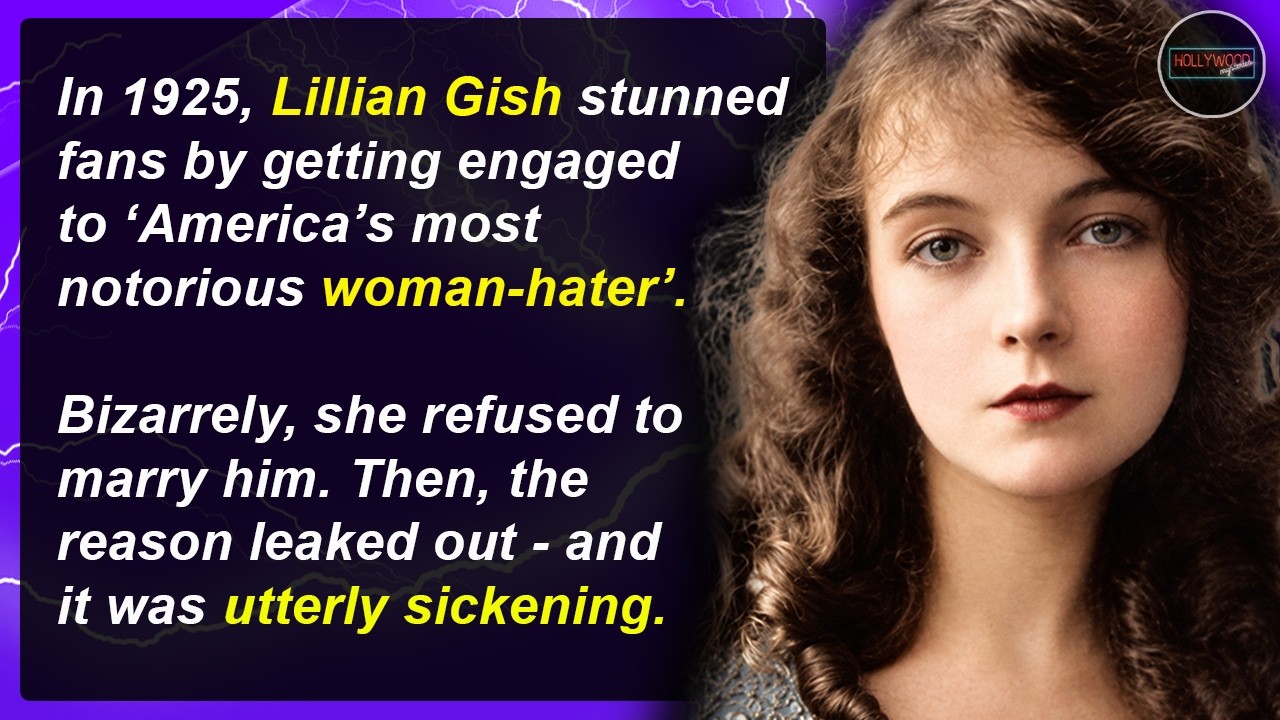
The suit was dismissed in April 1925. Journalists took notice. Within weeks of the dismissal, New York pages filled with a new story. Lillian Gish was said to be engaged to George Jean Nathan, America’s most famous theater critic.
He was a dandy who reserved the seat next to him at opening nights for his hat, cane, and opera coat. He had written about her in Vanity Fair in a way that read like a teenager’s love letter disguised as an aesthetic essay. He wrote: “A Gish girl’s smile is a little bit of happiness trembling on a deathbed. A Gish girl’s tears are the tears that old Johann Strauss wrote into the Alpine roses of his waltzes.
” Her acting, he said, took place behind a veil of silver chiffon. The first time mutual friends introduced them on a train, she did not initially realize who he was. She had imagined him older and harsher. She did not return his phone calls.
But he persisted. Eventually she stopped pretending to be her maid when he rang. The relationship lasted nearly a decade. Variety reported in April 1925 that they were engaged.
Similar reports appeared again in 1927. He proposed repeatedly. She refused repeatedly. He wrote to her in what appears to be the despair of a man unaccustomed to losing.
“Dear,” he wrote in one of the letters preserved in his papers, “I hope I will always tell you what I have told you every day for the past year—that you are the only girl who could ever have a place in my life. You are the only one I could ever love truly and deeply, and I hope you feel the same way. ” She did not. The reasons she gave, when she gave any, were vague.
She stated in interviews that her parents’ marriage was a long disaster and she had no desire to repeat the experience. There was also, probably, the question of Nathan’s background. He was Jewish, though not observant, and he hid it. When she eventually found out, the relationship soured quickly.
There has been debate ever since among those who knew them and those who came after about whether her reluctance came from the anti-Semitism prevalent in her Protestant American milieu, or specifically from his concealment of it from her. She never clarified it in her writings or interviews. He finally married in 1955 at age seventy-three to an actress named Julie Haydon. He died three years later.
Meanwhile, her career was entering its most brilliant phase. In 1925, she signed a contract with MGM, the new conglomerate forming around Louis B. Mayer and Irving Thalberg, at a salary and with terms that gave her creative authority almost unprecedented for a woman in the studio system. She made “La Bohème” in 1926 opposite John Gilbert, abstaining from food and drink for three days before Mimi’s death scene so she could film it as if actually dying.
That same year, she made “The Scarlet Letter” with Swedish director Victor Sjöström and screenwriter Frances Marion, adapting Hawthorne’s novel at a time when major studios were fearful of religious controversy. In 1928, she made “The Wind,” the story of a young Virginia woman married off to a farmer on the Texas plains, gradually driven mad by the dust, the wind, and the men around her. “The Wind” was not a commercial success. It was released at a time when the industry was moving toward talkies, and the studio insisted on adding a happy ending to a film that did not deserve one.
The film is now widely regarded as one of the greatest American silent films ever made, a fitting artistic farewell to a form the industry was then discarding. Gish said in a 1980 interview: “Silent films are the universal language. ” In an essay she wrote for the Encyclopaedia Britannica in 1929, as the form was dying, she put it more grandly. She wrote that the motion picture was a kind of aesthetic Esperanto.
Then came sound. It did not break her, but it changed her course. Her first talkie, “One Romantic Night,” was released in 1930, the same year she returned to New York stages in “Uncle Vanya” directed by Jed Harris, opposite Osgood Perkins. Theater critics praised her lavishly.
Brooks Atkinson of the New York Times called her, in a phrase that would follow her for the next sixty years, an American institution. She spent the following decades moving between film and theater, often preferring the stage, building a second great career of plays. There is a period from the 1930s and 1940s that official honors usually skip over. She had been a young woman in France during World War I, working for Griffith on “Hearts of the World,” and what she had seen of trenches and ruined villages and hospital trains had marked her deeply.
She believed, as many Americans of her generation did, that the United States had been tricked into that war by corrupt interventionists and arms merchants, and that it should not be tricked again. When the next war broke out in Europe in 1939, she joined a lecture tour for a group called the “Keep America Out of War Committee,” then for the larger and more famous “America First Committee,” a name that may be familiar today. She gave speeches at America First rallies throughout 1940 and 1941. She appeared on national radio.
Apart from Charles Lindbergh, the aviator who became the movement’s media face, she was the only famous figure in its leadership. She spoke about what she had seen in France in 1918, and she was sincere. She told a colleague that spring: “If I could save one American life, even if it meant destroying my career, I would consider my career completely wasted. ” She did not know then how seriously she would be tested on that proposition.
America First, as it appears today, was a coalition of people who agreed on one thing and disagreed on almost everything else. Some were principled pacifists who had buried husbands or sons in 1918. Some were progressives and old socialists who distrusted any war run by Wall Street. By 1941, some were openly fascist sympathizers and unambiguous anti-Semites.
Lindbergh’s Des Moines speech in September 1941, naming Jews among those pushing the country toward war, killed the movement. At that point, Gish—who was not a fascist and was not anti-Semitic in any form, who had spent months on platforms with anti-Semitic men—began to understand the kind of people she was keeping company with. She resigned from the committee months before Pearl Harbor. Hollywood, almost entirely interventionist, had already begun informally blacklisting her.
Job offers stopped. She wrote an article justifying her position called “I Made War Propaganda” for Scribner’s Commentator. Mary Pickford, the friend who had brought her to Griffith thirty years earlier, defended her in the press. “This lady is just like the rest of us,” Pickford said simply.
“She was just against war. ” The incident was not discussed except in academic journals for decades, in studies of what historians came to call “brown fear. ” At the time, it cost Gish work, and in some industry circles her name retained a faint negative tone through the rest of the 1940s. But she kept working.
In 1946, she returned to a major film, “Duel in the Sun,” a lurid Western directed by King Vidor for David O. Selznick, playing the dying wife of an aging Texas rancher played by Lionel Barrymore. She was nominated for an Academy Award for Best Supporting Actress. She did not win, but the nomination was a comeback.
Hollywood, which had cooled on her, decided to take her back. Nine years later, she made the work she is best remembered for. English actor Charles Laughton was directing his first and only film, adapted from Davis Grubb’s novel “The Night of the Hunter,” with a script by James Agee. Robert Mitchum was cast as a murderous traveling preacher with the words “LOVE” and “HATE” tattooed on his knuckles.
Laughton needed a counterweight to him, an older woman of fixed principles defending a house full of orphaned children against him. He had originally wanted an actress in the mold of Mary Pickford. He got arguably better when he cast Gish. She was sixty-one, and Laughton had studied her old silent work in preparation for directing.
He believed, correctly, that silent film technique was the only language available for the kind of symbolic fairy tale he was trying to make. The film was released in 1955 to commercial indifference and mixed reviews. It has since become one of the most influential American films of the twentieth century. Gish’s scene as Rachel Cooper, sitting in a rocking chair on her farmhouse porch with a shotgun across her lap, singing a hymn in response to Mitchum’s preacher singing to her from the darkness of the yard, is one of the immortal moments of postwar cinema.
She is, in that scene, the embodiment of every protective woman in American folklore. She is also, specifically, the woman who had been working in front of cameras for forty-three years. She kept working steadily through the 1950s, 1960s, and 1970s in television, feature films, and theater. She also lectured, having begun in 1932 when she toured colleges talking about Griffith and the silent era.
By the 1980s, when the American Film Institute counted, she had given more than four hundred lectures. She lobbied legislators and testified in Washington in favor of film preservation. She helped persuade the Museum of Modern Art to take Griffith’s production materials when all the studios refused them. She urged Mary Pickford repeatedly to stop hiding her films in the Pickford vaults and start sending them to archives.
Some of the most important films of the silent era were saved because of Lillian Gish’s relentless efforts to preserve them. Dorothy died in 1968. The sisters had lived together intermittently for decades in a long-term, unmarried family relationship that formed the backbone of their adult lives, and her loss hit Lillian harder than the deaths of either Griffith or Nathan. She did not speak much about it publicly.
She kept lecturing, in fact increased her lecturing after Dorothy was gone. Then came the honors. In 1971, the Academy gave her an honorary Oscar. In 1972, she was inducted into the American Theater Hall of Fame.
In 1982, she received a Kennedy Center Honor. In March 1984, at a formal ceremony at the Beverly Hilton, she was given the American Film Institute’s Life Achievement Award. Robert Mitchum and Eva Marie Saint gave speeches, and Colleen Moore, who had acted with her in a silent film in 1924, was also present. “She was the real femme fatale of Hollywood,” Moore told a Washington Post reporter that night, in a tone of admiration mixed with something like mockery.
The audience laughed. It was a reference to the men, including Nathan and others, who had crashed against her over the years. Gish rose to accept the award. She was ninety years old.
After seventy years of doing interviews, she did not give a victory speech or a summary. She gave one of the shortest speeches in the history of the ceremony. She said: “Achievement? I don’t know.
” Then, with timing learned from a melodrama director in 1912, she said: “But thank you for my life. ” She also spoke the phrase that summarized her view of her cinematic art better than any longer statement. She said: “The motion picture is in its infancy. We are still crawling on the ground.
”
Then she made one more film. In 1987, director Lindsay Anderson cast her, at ninety-three, in a drama about two elderly sisters living in a cottage on an island off the coast of Maine, waiting for the whales that may or may not return. Bette Davis, seventy-eight and exhausted from a series of strokes, was in no mood to be upstaged. She demanded top billing over Gish.
The press sensed the story and hovered around the set hoping for any juicy detail about what would become the most famous female feud in history. Gish would not take the bait. She told a reporter on location: “Oh my God, I can’t deal with this kind of thing. I don’t care what they do with my name.
If they left it off, that would be much better. I love the work, not the fame. ” The shoot was bitter. Davis would not look at her between scenes.
Davis complained that Gish did not understand her cues, accused her of deafness, deliberately lowered her voice so Gish could not hear her, and then was furious when she learned Gish was not as deaf as she claimed. The crew split into two camps. Anderson favored Gish and said so loudly in later interviews. He said: “Lillian’s first instinct is to try to fulfill the director’s demands.
Her professional attitude is from her days with D. W. Griffith. Bette tries to ignore the director.
” One day, Anderson came to the set and said, as if addressing everyone: “Miss Gish, you’ve just given me a beautiful close-up. ” Davis, sitting nearby, exhaled smoke and said, in the voice she had used to devastate people for sixty years: “Gish should know a lot about close-ups. She was there when they were invented. ” The remark was relayed to Gish, who chose to take it as a compliment rather than an insult.
She spoke about Davis with a kind of cold, twisted sympathy that was itself a form of revenge. She said: “That face, have you ever seen such a tragic face? The poor thing, how she suffers! I don’t think it’s right to judge a person like that.
We must endure and forgive. ” Davis, who had spent her career in Hollywood trenches, was not accustomed to being defeated by compassion. She had no answer. “The Whales of August” was the last film Lillian Gish ever made.
A photograph was taken of her marking seventy-five years in cinema, her final year. The film was released in October 1987. She spent the next five and a half years living quietly in her apartment on Sutton Place in Manhattan with the books she had longed to read since childhood. Her interviews grew rare.
She maintained her correspondence with Helen Hayes, her oldest theater friend, who lived nearby. She continued to fight in letters and occasional public statements for the preservation of films she believed were being left to decay. She died in her sleep on February 27, 1993, at the age of ninety-nine. The Los Angeles Times ran the news the next morning.
She never married and had no children. She was buried beside Dorothy in the Church of St. Bartholomew’s Episcopal in Manhattan. Helen Hayes, named in her will, died eighteen years later.
By her direction, most of her estate became the Dorothy and Lillian Gish Prize, an annual award of more than a quarter of a million dollars given to one artist in any field who, according to the will’s language, has made an outstanding contribution to the beauty of the world and to mankind’s enjoyment and understanding of life. The prize is still awarded every year. Other parts of the estate were directed to the restoration of D. W.
Griffith’s films. She was, at the end, the last of her generation—the last of Griffith’s generation, the last of Biograph’s generation, the only actress who could be filmed in 1912 and again in 1987 and still be recognizably the same person. But there was warm blood under the cool exterior. In one of her last interviews, she said of the innocent persona that had stuck to her since 1919: “I had nothing to do with her.
” Frances Marion’s old phrase about the steel rod, repeated in the obituaries, finally made the front pages. As did Brooks Atkinson’s phrase, sixty years after he first used it: American institution. For the first time, those words were not casual but definitive. Her afterlife was not quiet.
In 2019, twenty-six years after her death, Bowling Green State University in Ohio formed a task force to reconsider the naming of the Dorothy and Lillian Gish Film Theater. The task force cited Lillian’s role in “The Birth of a Nation” and the racial harm associated with that film. The board of trustees voted, with deep regret and grave reluctance, to remove the Gish name from the theater. The decision drew a counter-petition from prominent directors and film critics, including Martin Scorsese, who argued that erasing Gish’s name was a misreading of her entire body of work.
The controversy has never been fully resolved and is unlikely to be resolved in our lifetime. What she gave to American cinema was the discovery that the screen could photograph thought. What she gave to American life was a practical demonstration of what eight decades of relentless work, most of it without support, some of it on ice, could produce in a single body. She was the country’s first great close-up.
She is now also one of its hardest cases—a woman whose face was intimately tied to the invention of the art form, and whose career was intimately tied to the most controversial film that art form ever produced. The motion picture, as she said in 1984, is still in its infancy. It is still crawling on the ground.
Lillian Gish is the one who taught it, more than anyone else, to look up.