On the morning of May 2, 1947, Dorothea Binz walked to the gallows at Hamelin prison in British-occupied Germany. Witnesses described her as composed, almost unnervingly so. Her final recorded words were not a confession, nor an apology to the thousands of women she had terrorized. She expressed a hope that those watching would not think all of the guards had been evil.
It was a request history did not grant. Binz is remembered today by the name prisoners gave her while she was still in power: the Beautiful Devil of Ravensbrück.
Ravensbrück was not a small operation. It was the largest concentration camp built specifically for women anywhere in the Nazi system. Tens of thousands of women passed through its gates over the course of the war. At the guard level, it was run almost entirely by women.
That detail matters. This was not one man’s atrocity carried out by faceless subordinates. It was an institution staffed and shaped by people who had once been ordinary teenage girls looking for a job.
Binz was born in 1920 in a small forester settlement in northern Germany. She left school at 15. She tried working as a maid and hated it.
At 19, she walked into a local SS office looking for something else. Within days, she was sent to Ravensbrück to train as a camp guard. The camp was brand new at the time, built specifically to hold women.
Nothing about her background explained what came next. Historians who studied her file found no prior record of violence. She was not flagged as different from any other young woman who arrived that year looking for steady work.
New guards went through weeks of induction. Drills, uniform inspection, lectures on camp regulations. The same bureaucratic machinery any institution uses to turn a civilian into staff.
Binz rose fast anyway. By August 1943, she had been promoted to deputy chief wardress, the second highest position a woman could hold in the camp’s guard hierarchy. Survivors later said the official chief wardress was completely overshadowed by her own deputy.
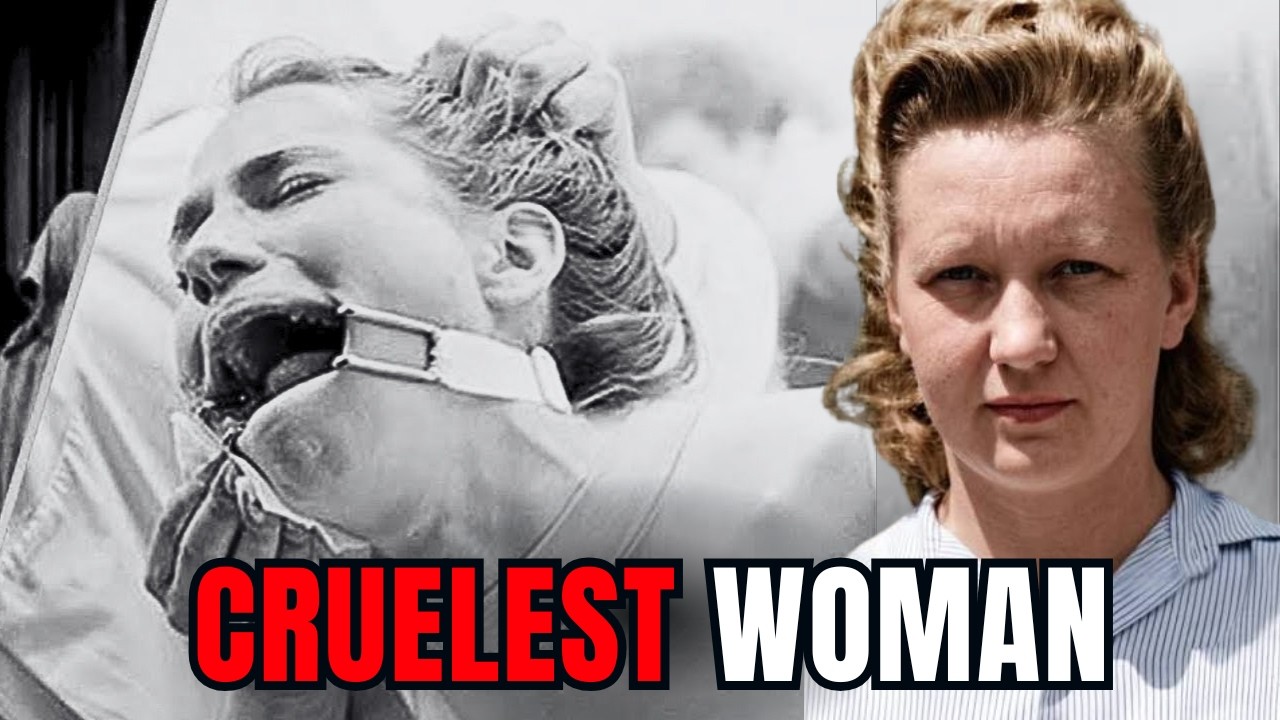
Binz was, in their words, the true star of the camp. Not because she was liked. Because she was feared more than anyone else wearing a uniform there.
She walked the grounds with a whip in one hand and the leash of her German Shepherd in the other. She used both without warning. She targeted the weakest prisoners, the ones already too exhausted or too sick to defend themselves.
She beat them, kicked them, slapped them. In some documented cases, she shot them. Seemingly for the pleasure of it rather than for any camp infraction.
Survivors testified that when Binz appeared on the roll call square, silence fell across the entire yard instantly. Thousands of women standing in rows would go quiet the moment she walked into view. That is not the silence of respect. That is the silence of people trying not to become the next name she remembers.
Binz personally supervised the camp’s punishment bunker. It was the cell block where women were tortured, and in a number of documented cases, killed. Being sent there was one of the most feared moments a prisoner could experience.
As part of the camp’s command staff between 1943 and 1945, she also directed the training of new guards. At times she oversaw more than 100 women at once. That training role may be the most consequential thing on her record.
The cruelty did not end with her. It multiplied through her. One of the guards she is documented to have trained, Ruth Closius, went on to become one of the most brutal wardresses in the entire camp system. Survivors described her in terms almost identical to the ones used for Binz herself.
By April 1945, with Soviet forces closing in, Ravensbrück was evacuated. Binz was marched out along with what remained of the prisoner population. She slipped away during the chaos, trying to disappear into post-war Germany.
It did not work. On May 3, 1945, barely a day after Germany’s formal surrender, British forces captured her in Hamburg. She was sent to a detention facility that had until recently been a subcamp of Buchenwald.

Roughly a year and a half later, Binz stood trial. The proceeding was held at the Curio House in Hamburg, running from December 1946 into February 1947. It became known to history as the first Ravensbrück trial.
It was one of the earliest courtrooms anywhere in the world built specifically to hold women accountable for their own direct role in running a system of mass atrocity. Sixteen former camp staff sat in that courtroom. Binz sat among them wearing the number five.
The testimony against her was overwhelming. Survivor after survivor described the same pattern. The whip. The dog. The sudden violence with no warning and no apparent trigger.
Through much of the proceeding, according to multiple accounts, Binz did not show remorse. She smiled through much of the trial. The same unsettling expression guards would later describe on the scaffold.
Her defense team did not try to argue she was innocent. She had already admitted to the beatings herself on the record. Instead, they argued for mercy on three grounds.
That she was young when most of the conduct described had taken place. That she had been honest about what she had done. And most strikingly, that no one could prove a specific prisoner had died directly as a result of her personal mistreatment.
The defense was in effect arguing that terrorizing thousands of already starving, already dying women for years, running a torture block, and training the next wave of guards somehow did not count as directly causing anyone’s death.
The court did not accept that argument. Binz was found guilty and sentenced to hang.
She was not executed alone. The court handed down five death sentences from that same proceeding. Binz. The camp’s head nurse, Elisabeth Marschall. A wardress named Greta Bösel. And two women who had served as prisoner functionaries, or kapos, inside the camp.

One of the kapos never made it to the gallows. She took her own life in her cell the night before the executions were set to begin. The remaining four were taken to Hamelin prison, the same British execution site used for war criminals across occupied Germany.
The hangings were carried out by Albert Pierrepoint, Britain’s chief executioner. By 1947, Pierrepoint had already hanged dozens of convicted Nazi officials. Colleagues described him as almost mechanically efficient at the job.
On the morning of May 2, 1947, Dorothea Binz walked to the gallows. Elisabeth Marschall was executed that same morning alongside her.
Greta Bösel and the remaining kapo were not hanged that same morning. Their executions followed roughly a day later. Four women who had been sentenced together in the same courtroom for crimes committed inside the same camp died within about 24 hours of one another, split across two mornings on the same gallows.
History does not give a clean answer for why the British split these executions across two days. It might have been nothing more than the practical mechanics of processing four condemned prisoners through one set of gallows. Or someone may have deliberately chosen to separate Binz from the others convicted alongside her.
What is known for certain is how it ended. Binz was composed right up until the end. Her last words were not a denial of what she had done. They were something closer to a request. A woman who had personally supervised a torture block, asking in her final seconds not to be remembered as a monster.
History did not grant that request. Binz is remembered by the name the prisoners gave her while she was still terrorizing them. The Beautiful Devil of Ravensbrück.
She was one name among 16 defendants in that first trial. That trial was only one of seven separate proceedings the British would eventually hold to work through the camp’s chain of command. Most of the men and women who ran Ravensbrück day to day were never household names.
Binz is remembered specifically because survivors made sure she would be. Her name appears over and over in memoirs written by women who made it out. Not because a historian assigned her that role. Because enough people who lived through what she did refused to let her disappear into the same anonymous uniform as everyone else.