The destruction of three Roman legions in the Teutoburg Forest in AD 9 is often taught as a simple story of imperial arrogance meeting savage revenge. Tight lines of legionaries were supposedly overwhelmed by a screaming tide of barbarians pouring out from between the trees. That version survived for centuries, but it is wrong. The truth is colder and more precise.
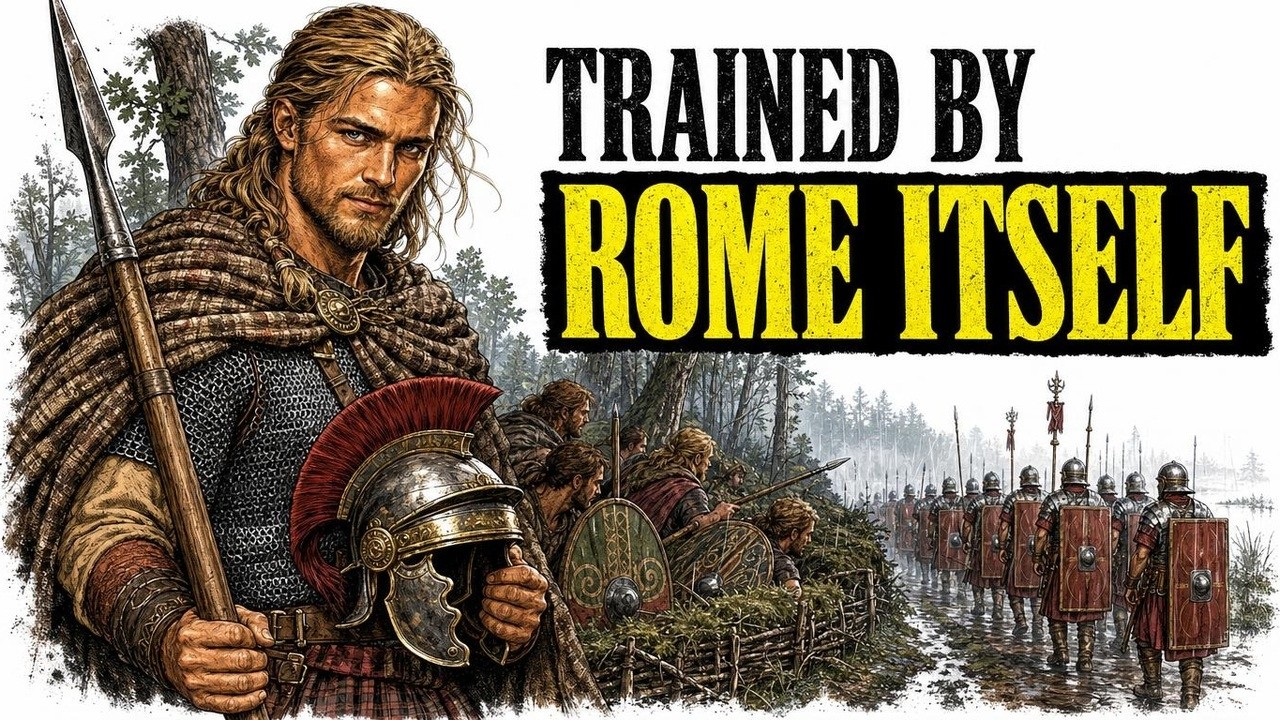
The legions were not simply swamped by numbers. The very system that made them unbeatable was studied, cataloged, and turned against them. This was not a battle. It was an execution arranged by a man who knew the Roman machine from the inside.
The physical evidence began to emerge in 1987, when a British army officer named Tony Clunn swept a farmer’s field near the village of Kalkriese in Lower Saxony with a metal detector. He found silver denarii, all struck before AD 9, along with lead sling bullets and pieces of scale armor. Professional archaeologists soon joined him. The most significant discovery was a turf wall running for hundreds of meters along the foot of the Kalkriese hill.
It was built secretly before the Romans arrived. It was not built to defend. It was built to steer the marching column into a narrow corridor between the hill and an impassable bog. The wall proves intent and a mind that had measured exactly how the Roman army moved.
The man who built that trap was Arminius, a chieftain of the Cherusci. He had been raised inside the Roman world as a high-status hostage. He learned Latin, gained Roman citizenship, was elevated to the equestrian rank, and served as a Roman officer. He knew the legions’ discipline, supply chains, and predictability.
Arminius returned home and became a trusted adviser to the Roman governor Publius Quinctilius Varus. Varus was an experienced administrator, not a general. He had governed Syria successfully, but he treated Germany like a settled province, holding courts and imposing Roman law and taxes on free tribes. Before the march, a German chieftain named Segestes warned Varus of the entire plot during a feast.
He named Arminius as the leader and offered to be arrested alongside him as proof of good faith. Varus dismissed the warning as a squalid family quarrel, a jealous father punishing a son-in-law who had stolen his daughter. Arminius then reported a small tribal revolt that required the legions to leave the main roads and cut across country. Varus gave the order.
The 17th, 18th, and 19th legions marched out with their auxiliaries, cavalry, and a large column of wagons, families, and camp followers. The attack began as harassment. Javelins came from the treeline, then the attackers melted away. A storm broke, turning the ground to mud and tearing branches from the oaks.
The legionaries’ curved shields soaked up rain and became heavy. Their hobnailed boots were clogged with mud. The column could not form its fighting lines. By the fourth day, the Romans were funneled into the corridor between the hidden wall and the bog.
Varus, wounded and facing capture, fell on his own sword. His officers followed him. The Germans dug up his body, cut off his head, and sent it from chieftain to chieftain before it was eventually forwarded to Rome. The three eagle standards were torn from their poles and carried off into sacred groves.
The Roman reaction was profound. Emperor Augustus let his hair and beard grow for months in mourning. He beat his head against the doorposts of the palace and cried out, “Quinctilius Varus, give me back my legions. ” He feared the Germans might march on Italy and dismissed his German bodyguards.
The numbers 17, 18, and 19 were never used again by the Roman army. Six years later, in AD 16, Germanicus marched 80,000 men back into the forest to bury the dead. The historian Tacitus described a field white with bone, with skulls nailed to tree trunks and altars where officers had been executed. The veterans gathered remains with their own hands, unsure whether they were burying strangers or brothers.
Germanicus eventually met Arminius on open ground at Idistaviso in AD 16 and shattered his coalition. He recovered two of the three lost eagles. But Emperor Tiberius looked at the cost and decided the war was finished. He recalled Germanicus and fixed the frontier permanently on the Rhine.
There would be no Roman province in Germany. Arminius won the war that mattered, but he did not enjoy the victory. His coalition dissolved without a common enemy. He turned against rival chieftains and was killed in AD 21 by his own kin, who feared he was reaching for a crown.
He was 37 years old. Tacitus called him, without hesitation, the liberator of Germany. The consequences of that decision on the Rhine lasted far longer than the Roman Empire itself. The frontier became a fault line between the Latin world and the Germanic world, shaping languages, borders, and nations for 1,500 years.
A vast copper statue of Arminius still stands on a hilltop near Detmold, its blade lifted toward the west, toward the ghost of Rome. CONTENT CUT OFF – final paragraph retained: